Do thank-you emails actually help after residency interviews, or are they just one more anxious ritual applicants force on themselves?
Here's the straight answer: they usually do not move your rank in any major way. They are mostly etiquette. Polished etiquette, sometimes useful etiquette, but still etiquette. A thank-you email won't rescue a flat interview, fix awkward answers, or make a program forget that you seemed uninterested. That's fantasy. What it can do is reinforce that you're professional, attentive, and genuinely interested. Small stuff. Sometimes that matters.
That's the real distinction. Signal versus substance. The interview is substance. The thank-you email is signal. If the substance was weak, the signal won't save you. If the substance was strong, the signal can support it.
The evidence on this in residency specifically is thin. There isn't some magical randomized trial proving that sending a thank-you note boosts Match outcomes. What we have instead is a mix of program statements, faculty opinions, survey-style data, and what's been seen in hiring and admissions more broadly. And that evidence points in one direction: most programs don't rank applicants based on thank-you emails, but many people still notice when a message is especially thoughtful, especially sloppy, or wildly overdone.
That last part matters more than people admit. I've seen applicants agonize over whether failing to send a thank-you email ruined their chances. Usually, no. I've also seen people send generic, copy-paste notes with the wrong program name. That's worse than silence. Way worse.
So this article isn't going to pretend there's one universal rule. There isn't. Some programs welcome follow-up. Some ignore it. Some actively discourage post-interview communication because they're trying to keep things fair and clean. Your job isn't to chase a fake rule. Your job is to decide whether follow-up is useful, neutral, or unnecessary in your situation.
What the Data and Program Behavior Suggest
Here's the practical read on the available evidence: thank-you emails rarely function as a major rank-order factor. Most residency programs are ranking based on your interview performance, your application, your letters, your perceived fit, and whether they'd actually want to work with you at 2 a.m. on a rough call night. That's the truth. Not your post-interview prose.
Many programs explicitly say they do not expect thank-you notes. Some interview days even include a version of: "No post-interview communication is necessary." Believe them. Applicants have a bad habit of hearing that and thinking, "Sure, but maybe I should send one anyway just in case." That kind of overthinking is how people create stress for no benefit.
The limitations of the data are obvious. Residency programs are wildly different. Academic internal medicine is not community anesthesia. A small specialty with close-knit faculty is not a giant program interviewing hundreds of applicants. Most of the evidence is indirect. We're looking at surveys, observed norms, and broad professional behavior, not airtight causal research.
Still, patterns are pretty consistent.
- Most interviewers say thank-you emails have no meaningful impact on rank.
- A smaller group says they create a minor positive impression.
- A very small group may use them as a soft tie-breaker or memory jog.
- A few programs dislike them altogether.
That's not enough to justify panic. It's enough to justify common sense.
One thing applicants routinely misread is silence. You send a thank-you email, and nobody replies. Then your brain does what applicant brains do: "Did I say something wrong? Did they hate me? Am I out?" No. Calm down. Many faculty and coordinators don't respond because they're busy, because they want communication handled consistently, or because their program has rules around post-interview contact. No response is usually just no response.
And yes, thank-you emails can still matter indirectly. Not in some dramatic movie-plot way. More in a subtle human way. If you had a meaningful conversation with an interviewer about underserved care, ICU teaching style, or your research on quality improvement, a short note that references that discussion can help place you back in their memory. That's not manipulation. That's ordinary professional follow-through.
I've seen this happen with applicants who had a genuinely memorable conversation with one faculty member. The email didn't change the whole rank list. But it reinforced, "Oh right, this was the applicant who asked thoughtful questions and seemed like a great fit." That's the ceiling. Helpful reminder. Not miracle cure.
So here's the decision rule I give people: send one if it's polished, brief, and sincere. Skip it if you're sending it only because you think it's required.
That rule works because the upside is modest and the downside is mostly self-inflicted. A strong thank-you email is low-risk. A sloppy one is dumb. A desperate one is worse. A generic one that reads like you blasted it to 14 programs before midnight? Everybody can tell.
Thank-You Email vs No Follow-Up: How to Decide
This decision gets easier when you stop treating it like a moral test and start treating it like a communication choice.
Send a thank-you email when there's an actual reason to send one. Good reasons include:
- You had a particularly strong interaction with a faculty interviewer.
- A resident or faculty member gave you helpful insight you genuinely appreciated.
- You discussed a specific topic that deepened your interest in the program.
- The program's culture seems open to normal professional follow-up.
- You can write a clean, short, personalized message without drama.
That's enough. You do not need a grand emotional reason. You just need a real one.
A few examples. You interviewed at a pediatrics program and had a thoughtful discussion about advocacy tracks and continuity clinic. Good setup for a brief note. Or you spoke with a program director who answered a concern you had about mentorship after parental leave. Also reasonable. Or a chief resident gave you an unusually candid explanation of call structure that helped you understand the program better. Fine. Thank them.
When is no follow-up reasonable? Honestly, pretty often.
Skip it when:
- The program explicitly discourages post-interview communication.
- Your interviews were generic panel sessions with little personal interaction.
- You're so rushed that the email will probably be vague or error-prone.
- You're only doing it because Reddit told you everyone else is doing it.
- You know you're about to send the same bland paragraph to six people.
No follow-up is not rude in most residency settings. It's neutral. That's the part applicants struggle with. They want every step to be optimized, weaponized, converted into some edge. But not every action creates an edge. Sometimes silence is perfectly acceptable.
Timing matters, but not enough to lose sleep over it. Within 24 hours is ideal because the interview is still fresh and your note feels connected to the conversation. If it takes 48 hours, fine. If it's been four days and now you're sending a guilty essay about why you're late, don't do that. Send a short, normal message or let it go.
Recipient choice also gets overcomplicated. You do not need to hunt down every email address from every faculty member you met for 12 minutes in breakout rooms. That's performative. Better options:
- Send one note to the interviewer with whom you had the most meaningful exchange.
- If you only have coordinator contact information, it's acceptable to ask that your thanks be passed along, though this is less personal.
- If a program director interviewed you directly and the interaction was substantive, that's a reasonable recipient.
- Resident interviewers are fair game if they were part of the process and you have their contact info through approved channels.
What you should not do: mass-email every person attached to the program. It looks forced. It creates clutter. And yes, people can tell when the same template was copied all day long.
Also, separate thank-you emails from other post-interview communication. These are not interchangeable.
- Thank-you email: brief courtesy note after the interview.
- Update letter: new publication, award, grade, or meaningful application change.
- Letter of intent: usually one program only, stating they're your top choice if that is true.
- General interest communication: more cautious, less binding than a letter of intent.
Don't mash these together. A thank-you email should not turn into a mini personal statement, a ranking promise, and a life story in three paragraphs. That's messy. If you truly need to communicate an update or your top-choice status, do that deliberately and according to ERAS, NRMP, and program preferences.
Here's the clean rule of thumb: the best follow-up is specific, professional, and low-risk. The worst is generic, needy, or sent against the program's wishes.
How to Write a Thank-You Email That Helps, Not Hurts
Keep it simple. This is not a creative writing contest.
A good thank-you email usually has four parts:
- A greeting.
- One specific thank-you point.
- One line connecting the conversation to your interest.
- A professional close.
That's it.
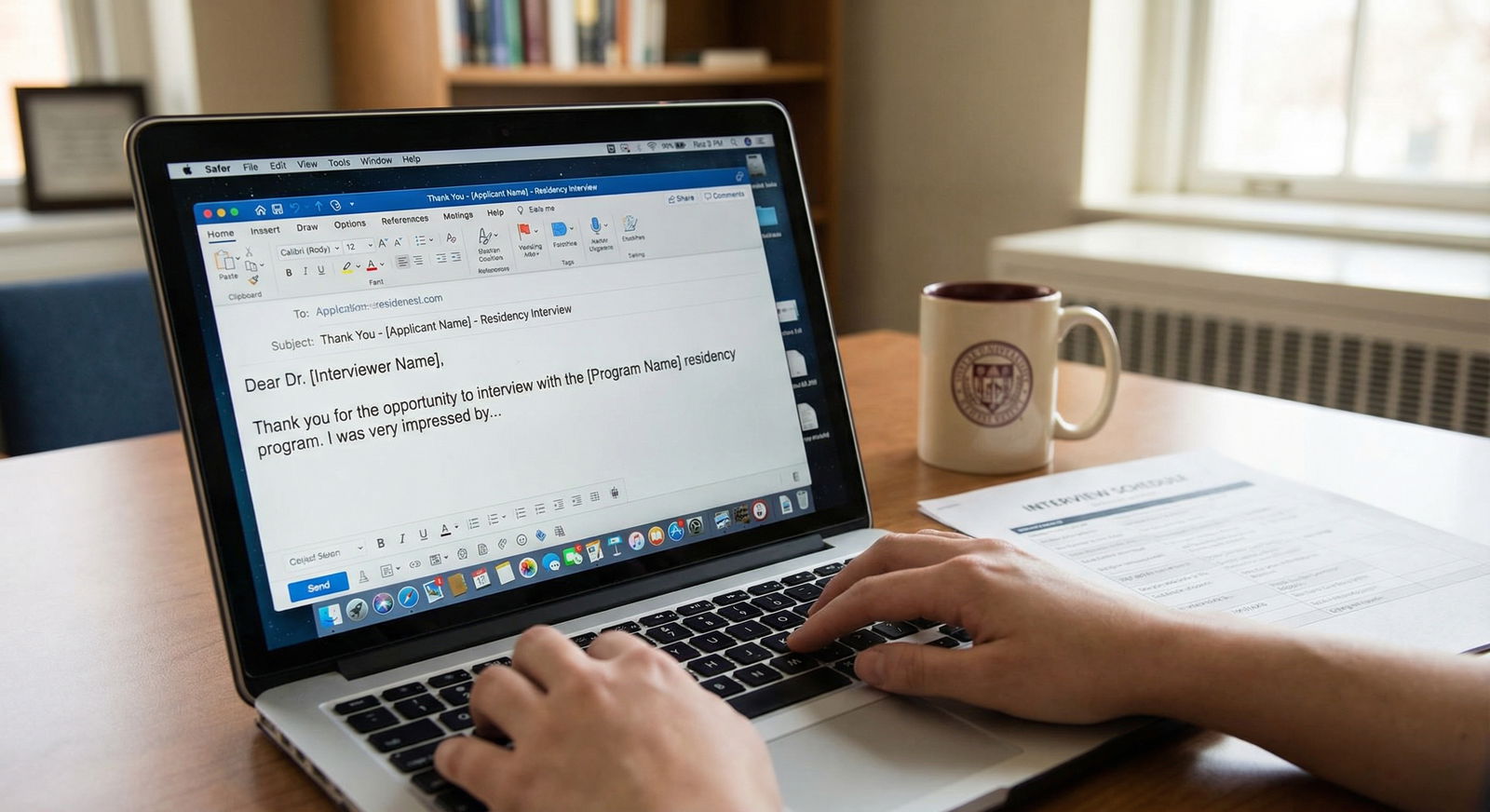
Here's a usable template:
Subject: Thank you for the interview
Dear Dr. Smith, Thank you for taking the time to speak with me during my interview day. I especially appreciated our conversation about the program's mentorship structure and the way residents are supported in developing academic interests.
Our discussion reinforced my interest in your program, particularly the strong teaching culture and emphasis on resident growth. Thank you again for your time and insight.
Sincerely, Your Name
Short. Specific. Professional. Done.
Personalization matters more than polishy wording. Mention one real thing you discussed. A patient population. A curriculum feature. A research conversation. A comment about resident culture. Not five things. One is enough. If your note could be sent unchanged to any program in the country, it's too generic.
Common mistakes? I've seen all of them.
- Excessive flattery: "Your program is the most amazing institution I have ever encountered." Relax.
- Overexplaining your candidacy: they already have your application.
- Sending notes to every faculty member without purpose: unnecessary.
- Multiple follow-ups because no one replied: absolutely not.
- Typos, wrong names, wrong specialty, wrong program: brutal and avoidable.
Special situations are straightforward.
Multiple interviewers: You don't need to email everyone. Pick the person with whom you had the strongest interaction, or send none.
Resident interviewers: A brief note can be appropriate if they spent meaningful time with you and you have a proper contact route. Keep it just as professional.
Program coordinators: A short thank-you is reasonable if they were especially helpful or if you're using them as the proper administrative contact. Coordinators do a ton of invisible work. A sincere note is never wrong.
You forgot to send it right away: If it's still recent, send a brief note without a dramatic apology. If too much time has passed and there's nothing useful to say, let it go.
The main thing to remember: restraint wins. Clever wording doesn't. Effortless professionalism beats performative enthusiasm every time.
Practical Recommendations for Residency Applicants
Here's the strategy I actually recommend.
First, put your energy where it counts: interview preparation, clear answers, thoughtful questions, professionalism on the day, and understanding program fit. That's what moves rank decisions. Not post-interview etiquette theater.
Second, use thank-you emails selectively. For most applicants, the default move is simple:
- Send one concise email when it feels culturally appropriate.
- Personalize it with one real detail.
- Keep it short.
- Don't panic if you choose not to send one.
That's the whole system.
A simple tracking method helps. After each interview, jot down:
- Interviewer names
- One memorable discussion point
- Whether the program discouraged follow-up
- Whether you plan to send a thank-you
- Any later updates worth communicating separately
This saves you from the post-interview blur where every conversation starts to blend together.
And here's the reassurance people need to hear: not sending a thank-you email is usually not a fatal mistake. Sending one is not a guaranteed advantage. The interview matters far more. Your professionalism matters far more. Your judgment matters far more.
If the email is easy to do well, send it. If it's turning into a stress spiral, skip it and move on.
Summary
Thank-you emails after residency interviews are usually optional. They are not decisive. They rarely change rank outcomes in a measurable way, and most programs care much more about how you interviewed, how you come across professionally, and whether you seem like a good fit.
So use a simple rule: send one when it's genuine, brief, specific, and consistent with program preferences. Skip it when it's forced, generic, or likely to create more risk than value.
That's the bottom line. Strong interview performance wins. Professionalism helps. Careful post-interview communication can support your application. But the thank-you email itself? Usually just a nice touch. Nothing more.