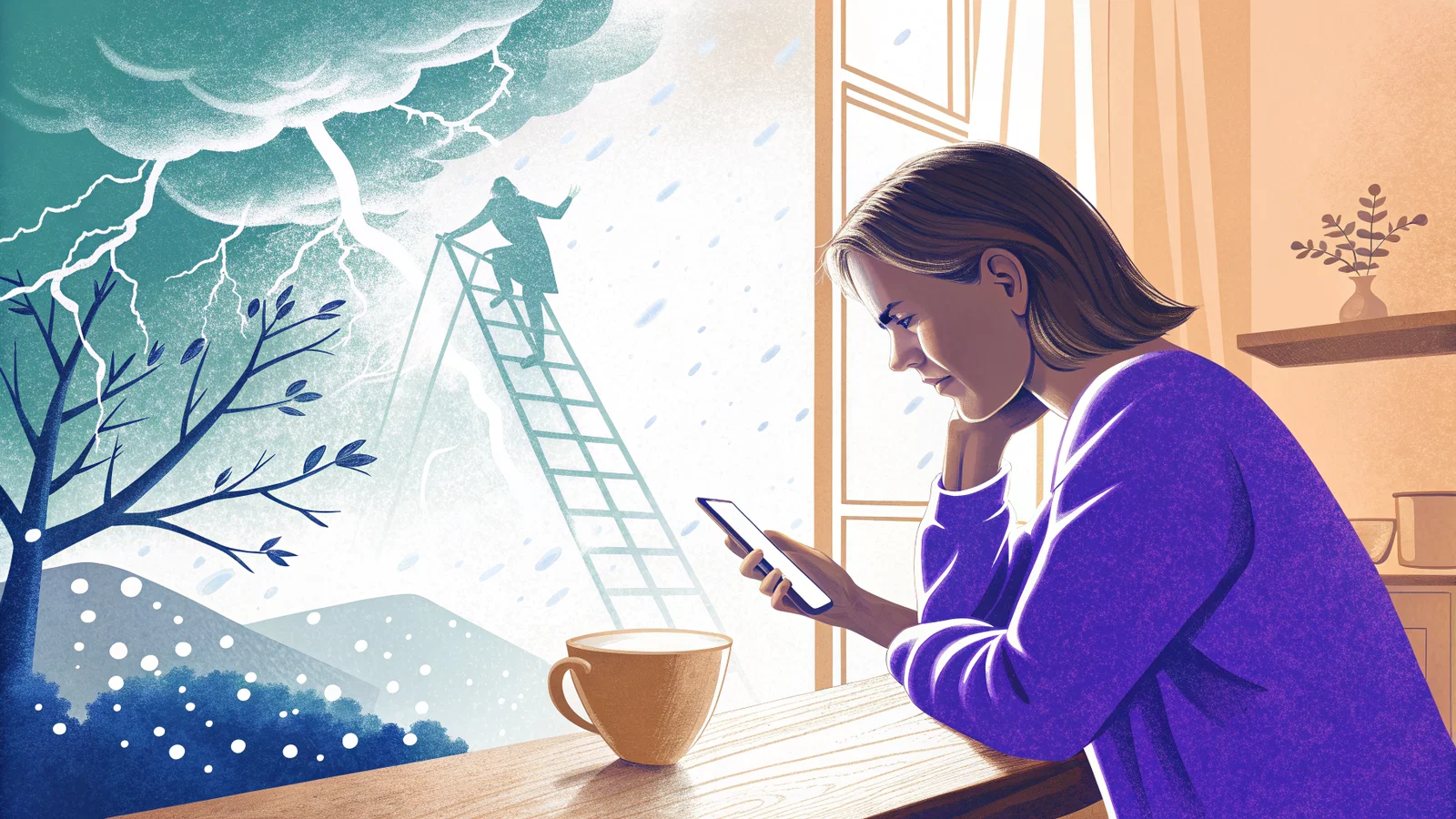
Your Match Email Isn't a Poison Pill, Stop Treating It Like One
Every March, the same folklore crawls out of the group chats. Don't open the email on your phone. It'll glitch. Programs can see you read it on mobile and they'll think you don't care. One applicant told me last year, dead serious, that her cousin's roommate opened the email on an iPhone and "ended up in SOAP," as if the operating system had personally intervened. I've watched fourth-years refuse to check results until they were home in front of a laptop, white-knuckling a steering wheel for forty minutes, treating a notification like a bomb that only detonates on small screens.
Let's settle it. What determines where you match: the rank order list you certified weeks earlier, the official algorithm that processed it, the deadlines you met, and the official communications that follow. What does not determine where you match: the screen size of the device you read the news on.
The fear isn't really about technology. It's about control. You've spent months with none, no say in interview offers, no say in how programs ranked you, and the human brain hates that vacuum. So it invents rituals, because rituals feel like control. That's psychology. It's not physiology, and it's definitely not algorithm. Here's what the data actually shows.
Myth #1: "Opening the Match Email on Your Phone Can Hurt You (Technically or Algorithmically)."
Start with the fact that kills this myth outright: by the time that email exists, your result has been locked in for weeks. Rank order lists certify in early March. The algorithm, an applicant-proposing variant built on Nobel-winning matching theory, runs, settles every applicant and program into place, and finishes. Then everyone waits. Match Week arrives, and the email goes out as a notification of a decision that already happened. The email is the postcard, not the verdict. Reading a postcard on your phone does not rewrite the postcard.
"But what about read receipts? Tracking pixels?" Fine, let's grant it. Plenty of mail systems log when and where a message gets opened. Say the server records that you opened yours on a phone at 12:00:04 p.m. Eastern. Where would that datum go? There is no field in the matching algorithm for "device used to read email." There is no pipe from a mail server's open log back into a process that completed weeks earlier. Your rank list and the programs' rank lists are the inputs. That's the whole ingredient list. Everything else is seasoning your anxiety, not your outcome.
Same goes for the timing superstitions, opening it "too fast," or at an unlucky second, or in the wrong building. The result lives in the official system whether you read the email or never touch it. You could throw your phone in a lake and your match would sit there unchanged, waiting for you on any other device with a login.
Is there published research proving phones don't alter match results? No, and that's the point. There's nothing to study, because there's no plausible mechanism. When a claim has no mechanism and no evidence, the burden of proof sits on the superstition. It never pays up.
Myth #2: "Phone Opening Causes Something Medical (Stress, Heart Risk, Eye Damage)."
Now the more sympathetic version of the myth, the one that says opening that email on a phone is physically dangerous. Your heart's pounding, your hands are shaking. Isn't that doing damage?
No. And I won't insult you by pretending the physiology isn't real, because it is. It's just not injury. Anticipatory anxiety ramps your sympathetic nervous system: adrenaline, a cortisol bump, racing pulse, tunnel vision, sweaty palms. That's your body doing exactly what it evolved to do before a high-stakes reveal. Arousal is not disease. The spike peaks and, absent other risk factors, it resolves. Minutes to hours, back to baseline.
The eye claim is flimsier still. Digital eye strain is real, but it's a fatigue-and-dry-eye phenomenon from hours of sustained screen use, and it's reversible. Reading a two-paragraph email on a phone for ninety seconds is not a retinal event. Nobody's match result ever came with a side of macular degeneration.
The heart claim deserves the most care because it's the scariest. Stress cardiomyopathy, takotsubo, is a real diagnosis, triggered rarely by extreme emotional shock. It's also extraordinarily uncommon, concentrated in specific populations, and it follows catastrophic shocks, not "checked email on phone." If you have a known cardiac history or a serious panic disorder, that's a conversation with your clinician, and the answer will be about support and setting, not screen size.
The pattern the evidence actually supports: the worst of the stress is anticipatory, the night before, the morning of, and it resolves either way. The device is never the variable. The coping is.
Reality Check: What Actually Matters on Match Day (and in the Hour You Open It)
If you want to spend your preparation energy somewhere useful, spend it here:
- Access, not superstition. Confirm your login to the official system before Match Week. Make sure the email address on file works, your phone is charged, and you've got a backup device and decent signal. The email isn't even the only door, results post in the official system too.
- Follow official instructions, not group-chat summaries. If your message includes next steps, and on Monday of Match Week, for some applicants facing SOAP, it will, follow the source, exactly. Device choice is not a substitute for procedure.
- Decide your communication plan in advance. Who gets the first call? Are you sharing publicly? Are you muting the class group chat that's been a panic amplifier since Tuesday? Choose now, while you're calm.
- Plan for both outcomes. Match Week has a Monday (whether you matched) and a Friday (where). Have a script and a support person for the version you don't want, not just the one you do.
- Buffer the hour. Nothing scheduled for sixty minutes after. Whatever the news, you'll want the space.

Myth Buster Playbook: How to Open the Email Safely Without Feeding Anxiety
Yes, you can open it on your phone. Safety is about readiness, not technology voodoo. Do this instead of doing rituals:
- Pre-commit the scene. Pick where, when, and with whom before Match Week starts. Improvising under adrenaline is how small panics become big ones.
- Run ninety seconds of paced breathing. Longer exhale than inhale, in for four, out for six. It's the cheapest, fastest brake pedal your nervous system has.
- Ground before you tap. 5-4-3-2-1: five things you see, four you feel, three you hear, two you smell, one you taste. Thirty seconds. It yanks your brain out of the catastrophizing loop.
- Starve the doom scroll. No forums, no megathreads, no "my cousin's roommate" anecdotes in the hour before. That's pouring gasoline on anticipatory anxiety and calling it research.
- Pre-write two scripts. One for good news, one for hard news. Knowing what you'll say either way means you won't have to invent it mid-adrenaline.
- If you have a real panic history, plan for it. Tell someone. Have them with you. Loop in your clinician if that's appropriate. That's actual risk management, unlike switching laptops.

Key Takeaways
- Device choice is irrelevant to your result. Phone vs. laptop has no known pathway into the matching algorithm, because the algorithm finished its work weeks before the email existed. The myth is unsupported by how match systems actually function.
- The real risk is unmanaged anxiety, not the phone. A transient stress spike is normal and resolves; what matters is whether you have a stabilization routine for the moment you check.
One last thought, for the version of you reading this after the fact. If the news wasn't what you hoped, it wasn't the phone. The email is a thermometer, it didn't give you the fever. Your rank list, the programs' lists, and the algorithm are where outcomes live, and none of them knew or cared what was in your hand at noon. And if the news was good? You don't owe the universe a superstition tax either. You matched because of the work, not because you opened the message "correctly." Rituals are just anxiety wearing a costume. Data beats vibes, every Match Day, every time.