
The biggest mistake new residents make on Match Day is acting like it’s purely a celebration. It is a celebration. It’s also the first 12 hours of your new job. You either use that day well, or you spend the next month scrambling.
Here’s your hour‑by‑hour, from the moment the email hits to the moment your head hits the pillow.
0–15 Minutes After the Match Email: Immediate Response Mode
At this point you should confirm, capture, and calm down. Not start emailing PDs. Not shopping for apartments.
Open the email fully. Read every line. Twice.
Do not skim. Look for:- Program name
- Hospital system
- City / state
- Track (categorical vs prelim vs advanced)
- Program number (for later paperwork)
Screenshot everything.
- Screenshot the email on your phone
- Forward the email to:
- Your non‑school email
- A trusted person (partner, parent, friend)
I’ve seen people lose access to their school email two weeks later. Do not rely on it.
Stop and breathe. Literally.
Set a 2‑minute timer. Put the phone down. Just sit. Your brain is about to get spammed by group texts and social media. Give yourself a moment before the noise hits.Send three texts. Only three.
- One to your closest person (“Matched at [Program, City]!”)
- One to your main group chat
- One to anyone waiting on logistics with you (partner if they’re not in the room, roommate if this affects moving)
After that, mute notifications for 30 minutes. You’ll get to the flood later.
15–60 Minutes Post‑Email: Verify and Announce Smartly
At this point you should lock in the facts and control the narrative.
15–30 minutes: Verify and orient
Confirm where this actually is on a map.
Yes, you know it’s “in Chicago.” But:- Which neighborhood?
- Commute patterns?
- One main hospital or several sites?
Check the program website quickly.
You’re looking for:- Start date (often late June vs early July)
- Orientation dates
- Required pre‑employment steps (drug screen, background check)
Note any immediate deadlines.
Many programs include:- “Watch for an email from GME within 24–48 hours”
- Links to housestaff manuals, policies, or login portals
Write these in one place (Notes app, Google Doc, whatever you actually use).
30–60 minutes: Public announcements
Now you can blast it out—strategically.
Decide your public line.
Something clean you can copy‑paste:- “Thrilled to share I matched into Internal Medicine at [Program Name] in [City]!”
Post to:
- One main social platform (Instagram, X, Facebook—pick your primary)
- Your med school’s Match form or spreadsheet (if they use one)
- Any student orgs or mentors who asked to be updated
Send 3–5 targeted emails to mentors.
Short and respectful:Subject: Match Update – [Your Name]
Dear Dr. [Name],
I wanted to share that I matched into [Specialty] at [Program, City].
Thank you again for your support throughout this process – your guidance made a real difference.
Best,
[Your Name]
Do this today while they still remember you clearly and are in “Match brain.”
Late Morning: 60–180 Minutes – Logistics Skeleton
Now the high fades and the reality hits. At this point you should build the skeleton of your transition plan, not fill in every detail.
Build one central planning hub
Pick ONE tool. Not five.
- A single Google Doc titled “Residency – [Program, City]”
- Or a Notion page
- Or a physical notebook if you’re old‑school and disciplined
Create these headings:
- Program contact & emails
- Licensing / credentialing
- Housing & moving
- Finances & contracts
- Family / partner logistics
- To‑do timeline (Month by month)
You’ll fill these in steadily. Today you just need the structure.
Quick program research (30–45 minutes max)
This is not deep stalking. It’s targeted.
- Program website:
- Current residents page
- Call schedule overview
- Clinic locations
- Social media:
- Program’s official account
- Resident‑run Instagram or TikTok
Your goal: basic expectations and culture. Is this a program with heavy ICU time? Lots of clinic sites? Multiple hospitals spread across a city? You’re not judging; you’re calibrating.
Early practical moves
Now, concrete tasks that save weeks later.
Update your email signature.
- “M.D. / Incoming [Specialty] Resident, [Program Name], PGY‑1 (2025–2026)”
Makes every email from now on a subtle announcement and avoids future re‑intros.
- “M.D. / Incoming [Specialty] Resident, [Program Name], PGY‑1 (2025–2026)”
Make a contact folder.
In your email:- Folder: “Residency – [Program]”
- Sub‑folders: “GME/HR,” “Program leadership,” “Housing,” “Licensing”
Start a simple password system.
Use a password manager or at least:- One dedicated note with all residency logins (encrypted app if possible)
You will have 10+ logins by July. You won’t remember them.
- One dedicated note with all residency logins (encrypted app if possible)
Midday: Matching Your Phase of Life to the Move
At this point you should inventory your situation honestly. Different checklists for different people.
| Situation | Top Same-Day Priority |
|---|---|
| Single, renting | Housing + move timing |
| Partner, no kids | Partner job + location choice |
| Partner + kids | School districts + childcare |
| Homeowner | Sell vs rent decision |
| Visa holder (IMG) | Immigration and start date |
If you’re staying in the same city
Your timeline is different.
- Confirm commute:
- New hospital vs your current one?
- Parking vs public transit?
- Think lease timing:
- Does your current place work for night float, early mornings, and post‑call sleep?
If it’s a noisy, five‑roommate situation, you already know the answer.
- Does your current place work for night float, early mornings, and post‑call sleep?
If you’re moving cities or states
Today, you do not sign leases. You gather constraints.
Create a quick list:
- Likely start date range
- City areas near main hospital
- Must‑haves:
- 20–30 minute commute max
- In‑unit laundry vs shared (night float + laundromat at 2 a.m. is a special kind of hell)
- Relative safety for late‑night walking
Text or call anyone you know in that city:
“Matched at [Hospital] – any quick thoughts on best neighborhoods for residents to live in / avoid?”
You don’t need deep analysis. Just red flags and top suggestions.
Early Afternoon: Administrative Reality Check
Now the boring but critical stuff. At this point you should capture everything the program and GME will ask you for later.
15–30 minutes: Document checklist
Make a list of documents you’ll need to pull together in the coming weeks:
- Passport or government ID
- Social Security card or equivalent
- Medical school diploma (when available)
- Final transcript
- USMLE/COMLEX score reports
- Immunization records
- TB test results
- COVID and flu vaccine documentation
- ACLS/BLS certification cards (or plan to obtain them)
You’re not uploading today. You’re just making sure nothing will blindside you.
Money and contract snapshot
Do not ignore this part. Future you will be grateful.
- Look up:
- PGY‑1 salary on the program/GME site
- Any published moonlighting policies (for later years)
- Parking fees (often overlooked, but can be $100+ per month)
- Start a simple budget line:
- Monthly take‑home estimate (post‑tax)
- Current recurring expenses (loans, subscriptions, car, phone, etc.)
You’re not fully budgeting today. You’re checking, “Is this move financially survivable as I am, or do I need to cut some stuff before July?”
Mid/Late Afternoon: Social and Emotional Cleanup
By now you’ve gotten 200 messages and 15 “we should catch up!” texts. At this point you should close loops and protect your bandwidth.
30–45 minutes: Gratitude sprint
Batch all your thank‑yous.
- Reply to mentors’ congrats:
- “Thank you so much – your letter/advice during interview season was huge for me. I really appreciate your support.”
- Drop short notes to:
- Research PI
- Clerkship directors who championed you
- Any admin who helped schedule away rotations or letters
This is networking without being gross. Also just basic respect.
Decide what you’re doing tonight
Match Day evenings go off the rails when you don’t decide in advance.
You’ve got three reasonable options:
- Big class celebration/bar crawl – If your group is tight, this can be great.
- Smaller dinner/house hang – Better if you’re introverted or emotionally fried.
- Quiet night with your person/yourself – Underrated, especially if the match was stressful.
Pick one before 4 p.m. and commit. Otherwise you’ll bounce between events and never fully enjoy any of them.
Late Afternoon: Future‑You Setup
This is where you buy back time in April and May. At this point you should schedule, not solve.
Calendar blocking (30 minutes)
Open your digital calendar and drop placeholders:
- “Residency onboarding email watch” – 1 week from today
- “Licensing paperwork check‑in” – 4 weeks from today
- “Start housing search” – 6–8 weeks from today (earlier if high‑demand city)
- “Order white coats / scrubs if needed” – 6 weeks before start date
These are reminders to move the ball, not full work sessions.
Task triage
Look at your planning doc and mark tasks as:
- Today – must be done before bed (you’ll choose 3)
- This week – okay to handle over the next 7 days
- Later – anything beyond that
Examples of today tasks:
- Emailing key mentors
- Basic program website review
- Setting up your planning hub
Everything else can wait. Yes, really.
Early Evening: Celebration with Boundaries
Now you’re transitioning from logistics to actually enjoying the day. At this point you should celebrate like a human who also needs to be functional tomorrow.
Before you go out
Take 15 minutes alone.
- Read the Match email one more time. Let it sink in.
- Look up a picture of the main hospital. That’s your new workplace.
- Say out loud (sounds cheesy, works anyway): “I’m going to be a [specialty] resident at [program].”
Then do three practical pre‑celebration tasks:
- Lay out tomorrow clothes (even if it’s Saturday): something comfortable in case you feel wrecked.
- Set a water bottle and some ibuprofen near your bed if you plan to drink.
- Charge your phone and laptop – you’ll likely get actual residency emails overnight or by morning.
During the celebration
A few hard‑earned opinions:
- Do not bring your rank list drama into tonight. It’s done.
- Don’t humble‑brag or compare program prestige. Everyone remembers who did that.
- Avoid heavy residency‑bashing (“I’m gonna hate intern year”). You’ll be working with residents soon—word travels.
Enjoy the weird, fragile feeling of a huge door closing and another one just cracked open.
Night: 60–90 Minutes Before Bed – Reset and Prep
This is where most people crash into bed and leave a mess for Future You. Don’t.
At this point you should do a controlled shutdown.
Step 1: 10–15 minutes – Digital cleanup
Move all Match‑related emails into your “Residency – [Program]” folder.
Add any new details you heard today (from residents, group chats) into your planning doc:
- “Interns rotate at [community site] 2 months/year”
- “ICU months are Q4 call”
Just bullet points. No analysis.
Star or flag:
- Any official program communication
- Anything mentioning deadlines or forms
Step 2: 10–15 minutes – Brain dump
Take a blank page (physical or digital) and write without editing:
- “Things I’m excited about” – list 5
- “Things I’m scared of” – list 5
- “Things I can’t control” – list 5
Then pick one scared‑thing you can actually do something about in the next month. That becomes a future action (e.g., “Nervous about procedures → ask current residents which resources they liked, plan a skills bootcamp in June”).
Step 3: 5–10 minutes – Micro‑plan for tomorrow
Tomorrow is phase two. Tonight you only need:
- 1–2 tasks for the morning:
- “Text [Person] who lives in [City] re: neighborhoods”
- “Skim GME page for onboarding checklist”
- 1 nice thing for yourself:
- Brunch with friends
- Gym
- A completely irresponsible amount of sleep
Write these down where you’ll see them when you wake up.
Final 10 Minutes Before Bed: Mental Reframe
At this point you should close the loop on the identity shift.
- You’re no longer “med student applying to residency.”
- You’re “incoming resident at [program].”
Two quick exercises:
Fast‑forward visualization (3–4 minutes)
Picture:- Walking into orientation with your badge
- Your name on the call schedule
- Writing your first actual resident note
Keep it mundane, not cinematic. The ordinary details make it real.
One‑sentence commitment
Write one sentence somewhere visible:- “I will show up prepared and coachable on Day 1.”
- “I will protect sleep like a prescription, not a luxury.”
- “I will ask for help before I’m drowning.”
That’s your north star for the next few months.
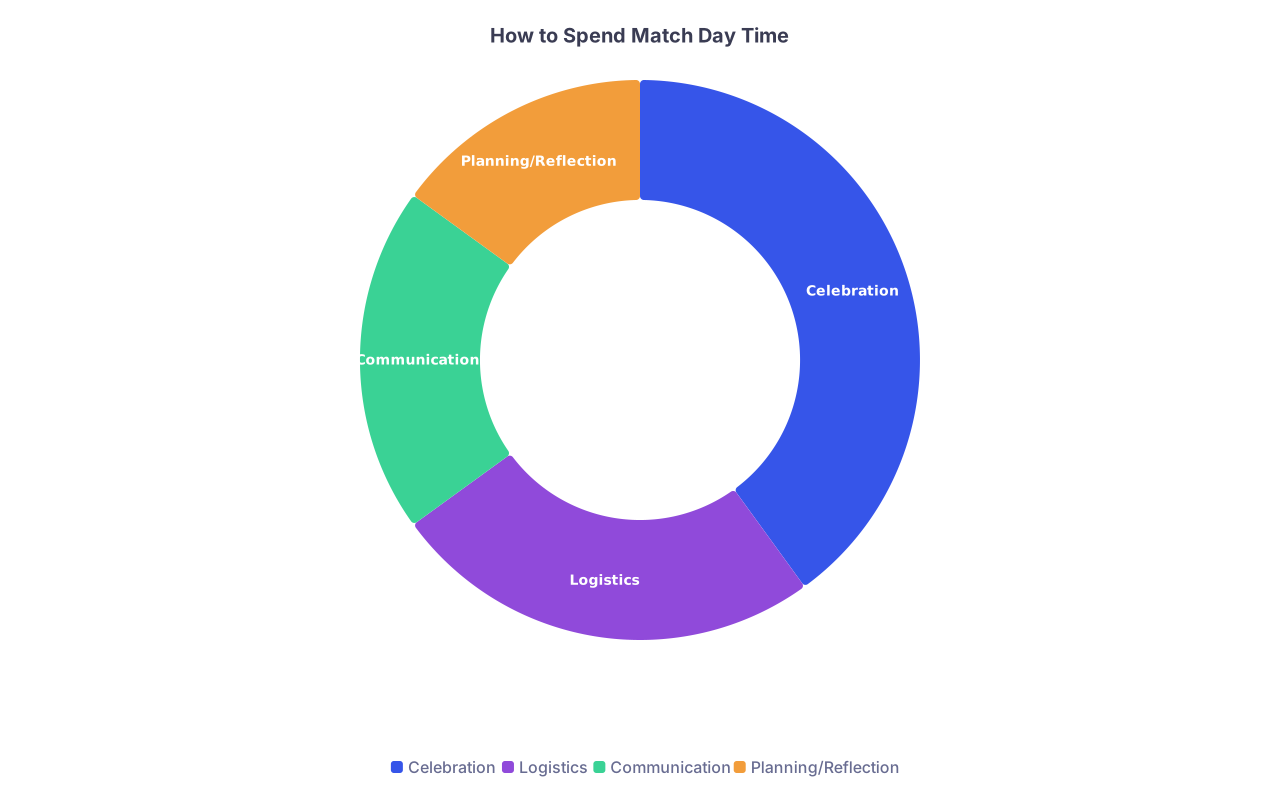
| Category | Value |
|---|---|
| Celebration | 40 |
| Logistics | 25 |
| Communication | 20 |
| Planning/Reflection | 15 |
A Brief, Honest Same‑Day Checklist
If you remember nothing else, this is what you handle between Match email and bedtime:

Immediately (0–1 hour)
- Read Match email completely, screenshot, and forward
- Text inner circle and send one clean public announcement
- Email 3–5 key mentors with your outcome
Late morning (1–3 hours)
- Create one central planning doc
- Skim program and GME websites for start date and major requirements
- Start a document checklist (ID, vaccines, scores, diploma, etc.)
Midday (3–5 hours)
- Clarify move vs no‑move realities
- Gather quick neighborhood intel if relocating
- Roughly check salary and obvious financial pressure points
Late afternoon (5–7 hours)
- Batch thank‑you messages and close social loops
- Drop future reminders into your calendar (onboarding, housing, licensing)
- Triage to‑dos into today / this week / later
Evening to bedtime (7+ hours)
- Celebrate in a way Tomorrow You can recover from
- Before bed: organize emails, brain dump, choose 1–2 tasks for tomorrow
- Write one clear sentence about the kind of resident you intend to be
That’s it. Match Day will blur. But if you hit these beats, you wake up not just “matched,” but actually prepared to become the physician you’ve been working toward for years.