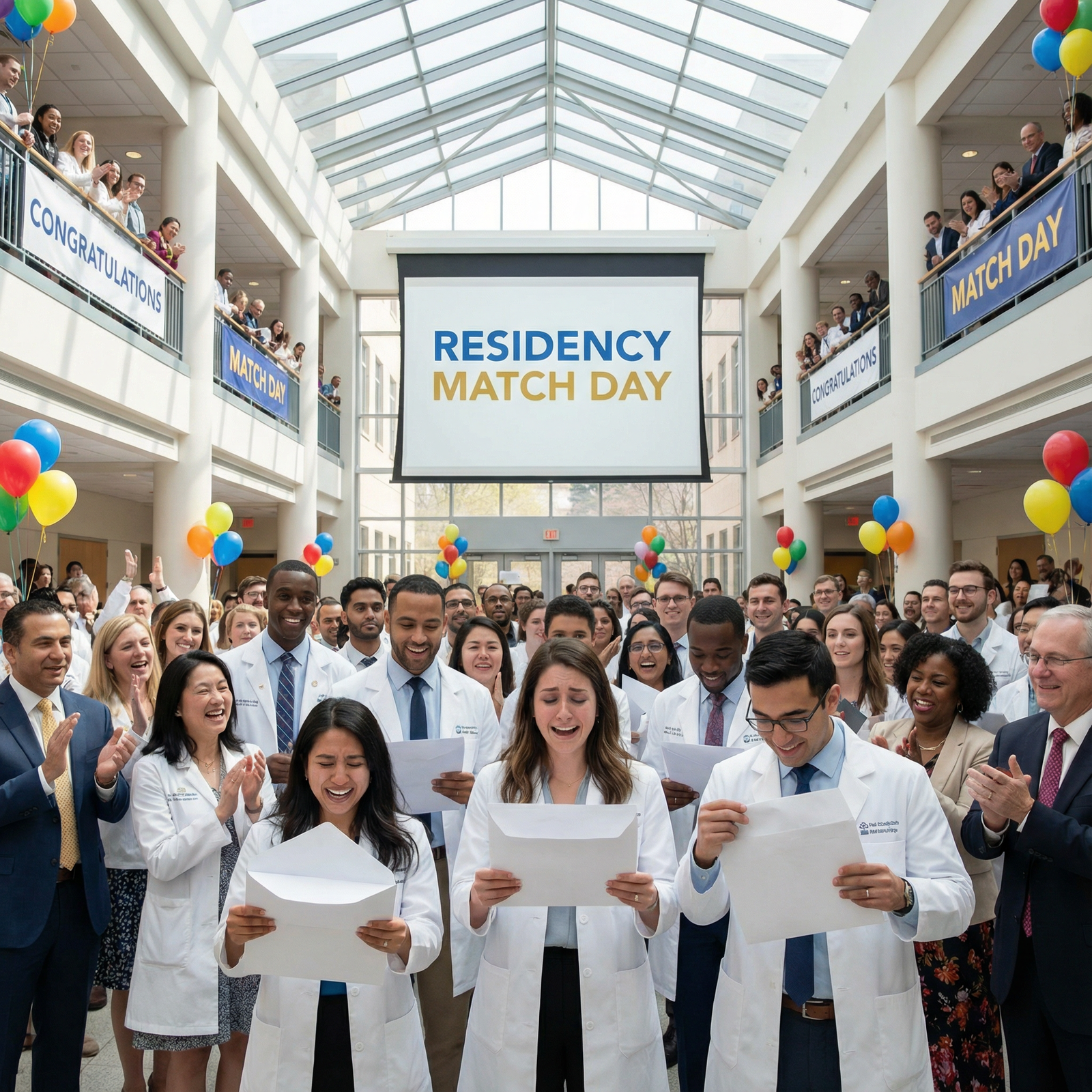
It’s 12:03 PM on Match Day. Your phone just buzzed with friends’ screenshots, people celebrating, some crying. You scroll to your email again, staring at the “Congratulations, you have matched!” line, then your eyes drop to the program name.
Not them.
Not the place you swore you “just clicked with.” Not the program where the PD said, “We really like you here.” Not the city you spent three away rotations chasing.
Somewhere behind all that, in a different building, that PD just pulled up their NRMP report. Your name is not on their matched list.
Here’s what actually happens on their side. And how they really react. Not the polished version you hear on podcasts. The real one.
What PDs See the Minute the Match Results Drop
Let me start with the mechanics, because you cannot understand their reaction without understanding what’s on their screen.
At noon Eastern, PDs get their match output from NRMP. Practically, they see three things:
- Their final matched list of residents
- Whether they filled or not
- Later, some data on how far down their rank list they had to go
What they do not get:
- A list of “who ranked us but didn’t match here”
- How high you ranked them
- Any explanation for “why this great applicant we liked didn’t land here”
To them, you are either:
- On the matched list
- Or you disappeared into the ether
They can infer you matched elsewhere if you were a competitive candidate. They might guess you ranked another program higher. But there is no official report that says:
“Applicant #432150 ranked you #2 and matched at University X.”
That’s the first secret: your heartbreak feels personal; to them, the outcome is mostly system noise unless they specifically go looking for you.
The First Five Minutes: Relief, Not Regret
The number one emotion when PDs open the Match list is not sadness for those who didn’t match with them.
It’s fear-of-unfilled relief.
They’re scanning: “Did we fill all positions?”
If they filled:
- Shoulders drop
- Someone exhales loudly
- A coordinator says, “Thank God”
- People start skimming the names, not analyzing who’s missing
If they did not fill:
- Panic mode
- SOAP strategy immediately
- No one is sitting around thinking, “Oh no, what about Sarah from Hopkins who rotated with us?”
They’re too busy putting out fires.
I’ve sat in those rooms. The conversation is:
- “We filled? Good.”
- “Who did we get?”
- “Wait, that away rotator didn’t match here?” (brief pause)
- “Okay, anyway, look at this combo we got on nights…”
That moment you’re reading your result as a referendum on your worth? They are not dissecting it that hard.
When They Notice You Didn’t Match There
PDs do notice sometimes. But the pattern is different than you think.
They usually notice in these ways:
- Your name is missing from the match list, and they expected it to be there
- A chief resident flips through and says, “Huh, where’d that one end up?”
- Someone checks later out of curiosity
Here’s how that plays out:
Case 1: You Were a Top-Ranked Favorite
If you were clearly a top-5, “we’d be thrilled to get them” candidate, and you’re not on their final list, the PD has one of three immediate thoughts:
- “They ranked someone else higher and matched there”
- “We didn’t rank them as high as I remember”
- “The algorithm zigged when we thought it would zag”
And underneath that?
Mild disappointment. Maybe a one-liner.
I’ve heard exact lines like:
- “Ah, I really liked them.”
- “Well, good for them, they probably went to [prestige program].”
- “Figures, they had their eyes on the coasts.”
Notice what’s missing: anger. Resentment. Feeling “betrayed.”
Contrary to the mythology, PDs are not sitting around offended that you dared to rank someone else above them. They know how this game is played. They’re doing the same thing with applicants.
Case 2: You Were Solid, But Not a Top Priority
If you’re in the big middle of their list and you don’t match there, you’re often not even noticed as “missing” until much later, if at all.
The internal monologue is basically:
- “We got a nice group.”
- “We filled all our categorical slots.”
- “Okay, time to email GME, draft the welcome announcement, get photos, etc.”
Your absence is not a statement about you. It’s just the limitation of 10–40 slots and 400+ applicants.
Case 3: You Rotated There, They Told You “We Really Like You”
This is where people get burned emotionally.
Here’s what happens behind the curtain:
During your away/sub-I, the attendings and residents genuinely like you. You fit in. You show up, stay late, write notes, help the team. They tell the PD and the PD says, “Good, I’ll keep an eye out.” On interview day you’re great again.
In January, they build the rank list. And this is where you lose perspective because you only see your own narrative.
The actual conversation in the ranking meeting sounds like:
- “We like them.”
- “Yeah, good worker, social fit.”
- “Okay, but compared to this MD/PhD with strong research?”
- “Versus this home student we’re obligated to rank high?”
- “Versus this couple who wants to stay together here?”
By the time the dust settles, you slide from “we like them” to Rank #14. They have 8 spots. They match their top 8. You never had a mathematical chance.
Match Day reaction?
- “Ah, too bad, they must have gone somewhere good.”
- “They would have done fine here.”
And then the meeting moves on. That’s the harsh reality.
They Don’t Assume You “Failed” If You Matched Somewhere Else
The insecure story in your head goes like this:
“I didn’t match there, they probably think I wasn’t good enough.”
Their story is simpler:
“They probably ranked X higher.”
or
“The algorithm took them to a place they liked more.”
PDs are very aware of how limited their slots are. They know they “lose” great applicants every year. That’s built into their mental model.
I’ve literally heard:
- “We lost them to [top program]. Good for them.”
- “I’m sure they’ll do well wherever they landed.”
- “Yeah, I figured they’d end up in [region they’re from].”
They’re not labeling you as “rejected.” You’re just “someone we liked who matched elsewhere.”
If you landed at a lateral or stronger program, many PDs are low-key proud: “We identified a strong candidate; they’re thriving in a competitive market.” It reflects more on their judgment than your loyalty.
How Much They Actually Remember You After Match Day
Harsh truth: memory is correlated with one main thing—time and emotional investment.
You’re memorable to a PD if:
- You rotated with them for a month
- You were a standout in conference or on service
- You had a particularly unique story
- They personally advocated for you at rank meetings
And even then, by July, the bandwidth is already filled with the new intern class, accreditation issues, faculty drama, and call schedules.
If you did not match there, you file mentally into one of three bins:
- “We really liked them; I wonder where they went.” (a small group)
- “Name rings a bell.”
- “No idea who that is anymore.”
That’s not cruelty. It’s volume. A mid-size IM program interviews 250–400 people. EM, surgery, peds… similar ranges. There simply isn’t enough cognitive space to keep detailed narratives on all the near-misses.
How They React When You Reach Out After Not Matching There
Here’s another angle students get wrong.
You matched at another program. You’re still thinking about them. Maybe you want a fellowship there later. Maybe you have some professional crush on the place. So you email the PD or a faculty member:
“Thank you again for the opportunity to interview. I ultimately matched at [X], and I’m excited to train there, but I really appreciated getting to know your program.”
How do they react?
Honestly? Positively. And quickly. Because you’re no longer a transactional risk; you’re simply a polite colleague-in-the-making.
The replies I’ve seen PDs send look like:
- “Congratulations on your match! You’ll get great training there.”
- “Keep in touch and let us know if you’re ever interested in electives or fellowship.”
- “Very happy for you. Please say hi if you’re ever in town.”
There’s no bitterness. The algorithm made the decision; the social fiction is that “you chose them; they chose you; we’re all happy.”
If you’re wondering whether emailing them makes you look desperate? It doesn’t, if you keep it short, professional, and genuinely appreciative.
The One Situation Where PDs Actually Feel Burned
There is a situation where PDs get irritated. It’s not you simply not matching there.
It’s when your behavior suggested something else entirely, and you actively misled them.
Examples I’ve seen:
- You told them, “You’re my clear #1” in writing or in a phone call
- You had your home PD or big-name letter writer call them saying, “They’re ranking you #1”
- You hard-committed in that way to multiple programs
Then you match somewhere else.
What happens?
In the post-Match debrief between PDs, that name gets mentioned. Not always officially, but informally.
Comments sound like:
- “They told us we were their top choice. Clearly not true.”
- “I’m not trusting their med school’s leadership as much next time.”
- “We’re not playing phone-call games with that advisor again.”
Notice: the damage is not “we hate this student forever.” It’s reputational hit for your school or specific mentor, and a mental note that you’re willing to over-promise.
Will it ruin your career? No. But if you someday try to apply for fellowship there, you may walk into a room where one person remembers, “Ah, that’s the one who swore we were #1.”
So: be strategic, but do not be dishonest. They actually talk to each other.
How PDs Use the “Ones That Got Away” in Future Years
Programs do track this at a high level. Not by keeping a poster of your face on the wall, but by pattern.
They’ll say things like:
- “We tend to lose our top 3–5 candidates to coastal programs.”
- “If they have dual-career issues, we usually lose them to programs where their partner landed.”
- “Our research-heavy applicants consistently choose the university 2 hours away.”
And they adjust.
Maybe they:
- Bump up a certain category of applicant because they historically do come
- Slightly drop others they have learned never actually rank them high
- Change how they pitch the program to students similar to you
Your individual non-match feeds into that larger gestalt. You’re data, not drama.
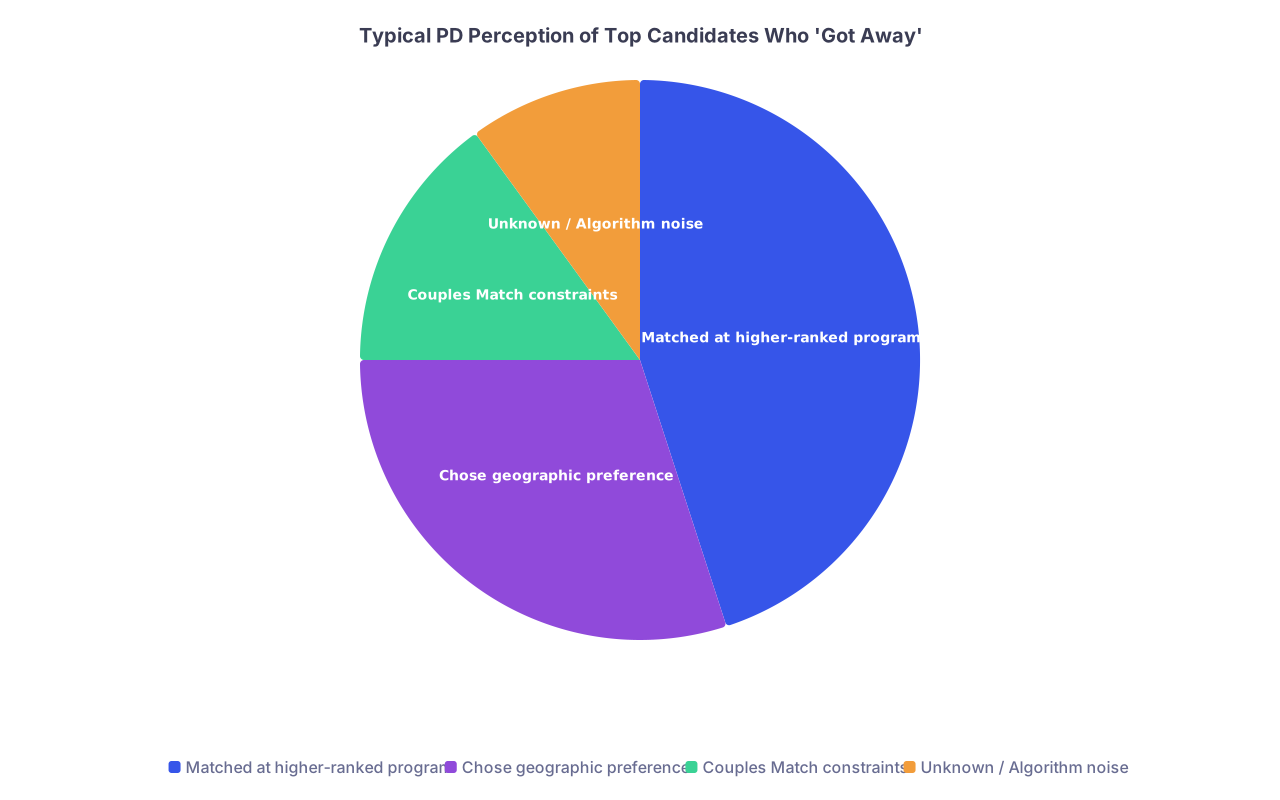
| Category | Value |
|---|---|
| Matched at higher-ranked program | 45 |
| Chose geographic preference | 30 |
| Couples Match constraints | 15 |
| Unknown / Algorithm noise | 10 |
They are not personalizing every “loss.” They’re building probability models in their head: “This type of student tends not to come here.”
What They Privately Say About You If You Matched “Down”
This one stings, but I’ll give it to you straight.
Sometimes you’re clearly overqualified for where you matched on paper. Strong scores, impressive research, glowing letters, and you land at a smaller community or lower-tier academic program.
Behind closed doors, at rank-list review meetings the following year, PDs and core faculty do sometimes say:
- “What happened to them? Surprised they went there.”
- “Did they have a red flag we didn’t know about?”
- “Maybe they really wanted that city or family there.”
They’ll speculate for about 45 seconds. Then someone shrugs. Conversation returns to “How do we build this year’s list?”
Nobody is calling your new PD to gossip. Nobody is blacklisting you. At most, you become a cautionary legend at your own school: “Remember so-and-so? They were strong, but their application list was weirdly short / geographically limited / heavy on reaches.”
Again: you’re not a villain. You’re a data point.
How They React If You Didn’t Match Anywhere
Different situation.
If you went unmatched and you were on their radar, their reaction is very different emotionally—but still not about blaming you.
Here’s what happens:
They get the SOAP list. Sometimes they see your name there. Sometimes your Dean or advisor emails or calls: “We had a student go unmatched; you interviewed them—any chance you’d consider them in SOAP?”
Now their reaction depends on three things:
- Their true impression of your performance
- Whether they have open spots
- Their bandwidth and risk tolerance
A PD might say privately:
- “I’m shocked they didn’t match.”
- “I can see it… their interviews were a little off.”
- “Yeah, they were okay but not at our usual level.”
Most of the time, if they genuinely liked you and now understand you’re in trouble, they feel bad for you, not triumphant that “you didn’t pick us and now look.”
They also have to protect their program. SOAP decisions are high-stress and often politically charged with GME and department chairs monitoring.
They’ll call your Dean back and say one of three things:
- “We’d love to talk to them in SOAP.”
- “We unfortunately don’t have open positions.”
- “We don’t have the right fit for them this year, but we wish them well.”
Harsh truth: if they passed on you during SOAP, it was not revenge for not ranking them #1. It’s because they did not believe you were the right call for those scarce, high-risk spots.

| Step | Description |
|---|---|
| Step 1 | See applicant on SOAP list |
| Step 2 | No action |
| Step 3 | Consider for SOAP interview |
| Step 4 | Express support but cannot help |
| Step 5 | Did we strongly like them? |
| Step 6 | Do we have open spots? |
The Fellowship Angle: “We Lost You Now, But We May Get You Later”
Here’s the part applicants almost never appreciate:
Many PDs see residency match as Phase 1. Fellowship is Phase 2. Faculty recruitment is Phase 3.
If you were impressive but didn’t land there for residency, a non-trivial number of them are thinking:
“Would love to see them for fellowship later.”
They won’t email you this. They won’t say it out loud. But they remember the very top tier.
In cardiology, GI, heme/onc, EM fellowships, surgical subspecialties—I've seen PDs light up years later when a name reappears:
“Oh, I interviewed them for residency once. Strong candidate. Good to see they’re applying here now.”
They don’t care that you didn’t come for residency. The opposite: they’re happy you still want to be in their orbit.
Your “rejection” story is very short in their minds. Your “future colleague” story is potentially much longer.
What You Should Take From All This
Strip away the noise and here’s the reality:
You not matching at a place you loved is an emotional earthquake for you. For them, it’s a small tremor in a year with hundreds of applicants, institutional constraints, and a rigid algorithm.
Their reaction when you don’t match there is:
- Relief they filled
- Mild disappointment if they particularly liked you
- A quick story they tell themselves about why you landed elsewhere
- Then… back to work
You’re not on some mental enemy list. You’re not a traitor. You’re one out of many strong applicants in a system that only allows a handful of matches per program.
They remember the best and the worst. Everybody else blends into general impressions and long-term patterns.
So if you’re sitting with that Match email, wondering what they’re thinking about you?
The uncomfortable but freeing answer is: not very much. And that’s a good thing.
Because it means you’re free to build your career without imagining some shadow council of PDs holding a grudge about where you trained.
They’ll judge you by what you do from now on. Your work, your reputation, your professionalism. Not by the path the algorithm chose on one Thursday in March.
Key points:
- PDs don’t see who ranked them or “chose” them; they just see who matched and whether they filled. Your non-match is usually a minor blip, not a personal slight.
- They feel mild disappointment for strong candidates who “got away,” irritation only when someone blatantly misleads them, and sometimes sympathy if you go unmatched—but almost never resentment.
- Over the long run, they care far more about who you become as a resident, fellow, and colleague than about whether you matched their program on that single Match Day.