
38% of residents who thought they were “definitely” going into academics end up in community practice within five years.
That single number tells you something: the academic vs community choice you make at Match is not permanent. But it will strongly shape your salary trajectory, fellowship options, and leverage for the first 5–10 years.
Let me walk through what the data actually show, not the folklore you hear on interview days.
1. Salary: Academic vs Community, With Real Numbers
The myth: “Academic = poor, community = rich.”
Reality: The median pay gap is large, but not infinite. And it varies a lot by specialty and geography.
Most of the best data come from:
- AAMC Faculty Salary Reports
- MGMA and other large compensation surveys
- Specialty-specific surveys (Medscape, ACC, ACR, etc.)
Big-picture numbers
For broad comparison, reasonable ballpark figures for early-career attending physicians (first 3–5 years after residency or fellowship) in non-surgical specialties:
| Specialty | Academic Early-Career Avg | Community Early-Career Avg |
|---|---|---|
| Internal Med | $220,000–$260,000 | $275,000–$325,000 |
| Hospitalist | $240,000–$280,000 | $300,000–$350,000 |
| Pediatrics | $170,000–$200,000 | $220,000–$260,000 |
| Neurology | $230,000–$270,000 | $280,000–$340,000 |
| General Surgery | $300,000–$350,000 | $400,000–$475,000 |
These are compressed ranges, but they illustrate the pattern: a 20–40% premium for community in most fields.
In surgical subspecialties and procedure-heavy fields (ortho, GI, cardiology, IR, rad onc), spreads of $150,000–$300,000 per year between academic and community are very typical. Sometimes more.
How fast does the gap show up?
You start seeing divergence almost immediately after fellowship:
- Academic: smaller signing bonuses, lower base, modest RVU or bonus structure.
- Community: larger signing bonuses, relocation packages, higher RVU multipliers, productivity-heavy.
Look at it year by year as a resident making decisions.
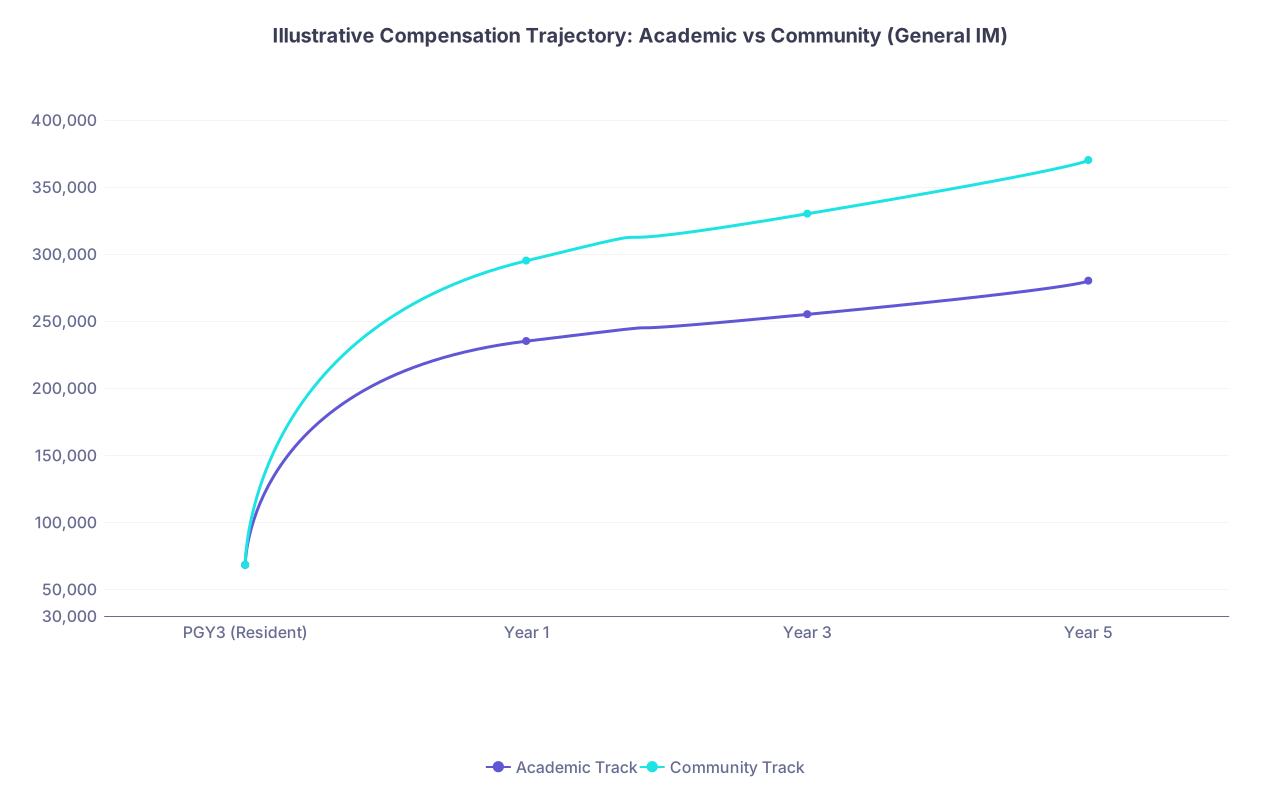
| Category | Academic Track | Community Track |
|---|---|---|
| PGY3 (Resident) | 68000 | 68000 |
| Year 1 | 235000 | 295000 |
| Year 3 | 255000 | 330000 |
| Year 5 | 280000 | 370000 |
By year 5, the cumulative difference in this conservative example is in the $300k–$400k range post-tax. That is a house, a large chunk of loans, or a major delay in financial independence.
Cost of living and regional spread
The trap is comparing a Boston academic offer to a midwestern community job and acting surprised.
Academic jobs cluster in:
- Major metros
- High cost-of-living areas
- Quaternary centers with prestige premiums
Community jobs are:
- More geographically distributed
- Often in lower cost-of-living regions
- More likely to offer loan repayment and aggressive signing bonuses
I have seen offers where an academic assistant professor in the northeast makes $240k while a community general internist 90 minutes away makes $340k plus $50k loan repayment. After taxes and rent, the real gap is wider than $100k.
If you do not normalize for cost-of-living and benefits, you are not actually comparing academic vs community. You are just comparing zip codes.
2. Fellowship Match Outcomes: Where You Train Matters
Residents care—often obsessively—about fellowship placement. The question you really care about is not “academic vs community” in the abstract. It is:
“Does matching at an academic program vs a community program change my odds of landing a competitive fellowship?”
The short answer: yes, especially for competitive subspecialties. But the effect size is not infinite, and there are big exceptions.
Where academic programs have a clear edge
Look at fellowship fill rates by residency type in fields like:
- Cardiology
- Gastroenterology
- Hematology/Oncology
- Pulmonary/Critical Care
Large academic IM residencies often publish lists of fellowships matched over 5–10 years. Good programs consistently show that 60–80% of their residents go into fellowship, many at top-tier places.
In contrast, strong community programs may have:
- Smaller absolute numbers of residents going into fellowship
- Fewer matches at ultra-competitive destinations
- More concentration in regional or in-house fellowships
A typical pattern I have seen across multiple programs:
| Residency Type | Any Fellowship Rate | Match at Top 20 Program | High-Competition Fields* |
|---|---|---|---|
| Top Academic Program | 75–85% | 30–40% | 25–35% of all residents |
| Mid-tier Academic | 55–70% | 10–20% | 15–25% |
| Strong Community | 35–55% | 5–10% | 10–15% |
*Cardiology, GI, Hem/Onc, Pulm/CC, matched in those fields specifically, not total residents.
These are aggregated patterns, not a specific dataset from one paper. But the direction is consistent across many internal medicine programs.
The mechanisms are fairly obvious:
- More research output and mentorship in academic centers
- Established relationships with fellowship PDs
- More in-house fellowships that preferentially take their own residents
- Better name recognition on applications
If your goal is a highly competitive fellowship, the data are blunt: training at a large academic institution improves your odds.
Fields where community programs are not a disadvantage
The story changes in:
- Less competitive fellowships (geriatrics, allergy/immunology in some regions, sleep, palliative, many hospitalist-focused fellowships)
- Specialties where the residency itself is already heavily academic (e.g., radiation oncology, neurosurgery—most programs are academic by definition)
- EM fellowships, where program reputation and personal networking can matter as much as brand-name institution
Plenty of residents from community IM, FM, EM programs match solid fellowships every year. The curve is just steeper: you need to be in the top slice of your program rather than “above average” to be competitive nationally.
Does an academic residency lock you into academic practice?
No.
- Only around 20–30% of physicians stay mainly in academic medicine long-term.
- Many who start academically move to community practice in 5–10 years for salary or lifestyle.
- Movement in the opposite direction (community to full academic faculty) is much rarer but not impossible if you have research productivity or niche expertise.
So an academic residency is less about “I will be an academic lifer” and more about:
- Higher chance at competitive fellowship
- More research and leadership opportunities early
- Stronger institutional name on your CV
What you do after that is far more flexible than students assume.
3. Match Strategy: How Academic vs Community Programs Differ
You are preparing for Match, not picking your retirement job. Different program types affect what your application needs to look like.
Applicant profiles that fit academic-heavy programs
Academic programs like data too. Their own data, usually.
What they preferentially interview:
- Higher Step 2 CK scores (or shelf performance in pass/fail systems)
- Demonstrated research experience, preferably with abstracts or publications
- Strong clerkship grades from home or peer institutions
- Clear interest in subspecialization, QI, or academia in the personal statement
They are selecting for residents who:
- Can support fellowship match numbers
- Contribute to research and teaching metrics
- Boost their institutional reputation
If you match there, expect:
- More structured teaching
- Higher expectations for scholarly output
- Tighter evaluation systems (yes, more emails about milestones and portfolios)
Applicant profiles that fit community programs
Good community and hybrid programs are not “easier,” but they optimize for different traits:
- Clinical reliability
- Efficiency
- Breadth of exposure across community settings
- Fewer research requirements, more service load
Their data priorities:
- Can you staff a busy ED or inpatient service without falling apart?
- Will you stay in the region and join their network?
- Are you going to be a solid, unspectacular but safe attending? (This is not an insult. It is exactly what many systems want.)
I have seen residents who are clinically outstanding but uninterested in academic writing thrive in these programs and move directly into high-paying community jobs with less friction than their academic peers.
4. Long-Term Outcomes: Income, Autonomy, and Burnout
Everyone talks about “getting their dream fellowship.” Fewer people run the numbers on where that path actually leads 10–15 years out.
Lifetime income gap
Run a simple back-of-the-envelope scenario:
- Academic physician earns $280k, grows to $350k by mid-career.
- Community physician starts at $350k, grows to $450k by mid-career.
Assume:
- 3% annual raises
- 30-year career
- Ignore investment differences for a moment.
The cumulative difference easily passes $2 million in pre-tax earnings. After taxes and compounding if the higher earner invests early, the gap is bigger.
Is that always the trade? No.
- Some academic subspecialists (e.g., transplant surgery, interventional fields) can earn community-level or higher pay.
- Some “community” jobs are actually hospital-employed with academic-like pay.
- Leadership roles (CMO, service line director, large group partner) can change the math dramatically.
But if you match into and remain in traditional academic hospitalist or general subspecialty roles, the expected financial gap vs community is real and non-trivial.
Autonomy and schedule
Data from multiple burnout and satisfaction surveys (Medscape, AMA, specialty societies) consistently show:
- Academic physicians report higher satisfaction with teaching and intellectual environment.
- Community physicians report higher satisfaction with income and schedule flexibility.
- Burnout rates are obnoxiously high in both, but the drivers differ.
Common patterns I hear:
Academic:
- “I am pulled in 4 directions: clinical, teaching, research, committees.”
- “Protected time disappears as soon as the department is short.”
Community:
- “I see too many patients, but I control my practice style more.”
- “If I want to cut a session or go 0.8 FTE, it is mostly a business decision, not a dean’s office decision.”
You cannot get these tradeoffs from salary tables. You get them from asking PGY-3s and junior attendings off the record, preferably at 6 p.m. when they are tired and honest.
5. How to Use This Data When Building Your Rank List
You are not choosing “team academic” or “team community” forever. You are choosing:
- How much you care about fellowship options vs immediate financial upside.
- How much you want structured mentorship and research vs pure clinical volume.
- How much geographic flexibility you have.
Here is how I would structure the decision, analytically.
Step 1: Quantify your fellowship ambition
Be honest. If you say “maybe cards, maybe hospitalist, we will see,” the data say: most people in that position end up hospitalist or primary care.
If you are truly aiming for:
- Cardiology, GI, Hem/Onc, Pulm/CC, IR, Derm, Ortho subspecialties, etc.
then an academic or hybrid residency with:
- High fellowship placement rates
- In-house fellowship in your field
- Documented research output for residents
is statistically a better gambit. You are buying probability.
If your top preference list is:
- Hospitalist, outpatient IM/FM, generalist EM, anesthesia private practice, etc.
then community or hybrid programs give you:
- More clinically focused training
- Earlier real-world workflow
- Better short- and medium-term pay once you finish
Step 2: Compare concrete metrics, not vibes
When you compare programs, ask for or look up:
- 5-year fellowship match lists (names + programs)
- Percentage of graduates entering fellowship vs going straight to practice
- Median resident debt (this tells you what financial pressure your peers feel)
- Moonlighting availability and typical resident moonlighting income
- Starting salaries for recent grads who stayed local, academic vs community
You want a table like this for your top 5–10 programs:
| Metric | Program A (Academic) | Program B (Hybrid) | Program C (Community) |
|---|---|---|---|
| Fellowship rate (IM) | 80% | 55% | 40% |
| Cards/GI/HemeOnc per year | 6–8 | 3–4 | 1–2 |
| Avg moonlighting per PGY3 | $15,000 | $25,000 | $30,000 |
| Local hospitalist starting | $230,000 | $260,000 | $290,000 |
If a program will not share these numbers, that is data too.
Step 3: Map your likely exit path
Use a simple mental model: “If I matched here and followed the median path, where would I likely be 7–10 years from now?”
Example:
Academic IM residency with strong cardiology division
- Median path: subspecialty fellowship → assistant professor, heavy teaching and research expectations → slower income growth but strong academic identity.
Community IM residency, no in-house cards/GI but solid regional reputation
- Median path: hospitalist or outpatient IM locally → potential leadership roles in group or hospital system → higher income, less research output.
Ask yourself which median path you can live with, not which best-case story copies someone’s CV from Twitter.
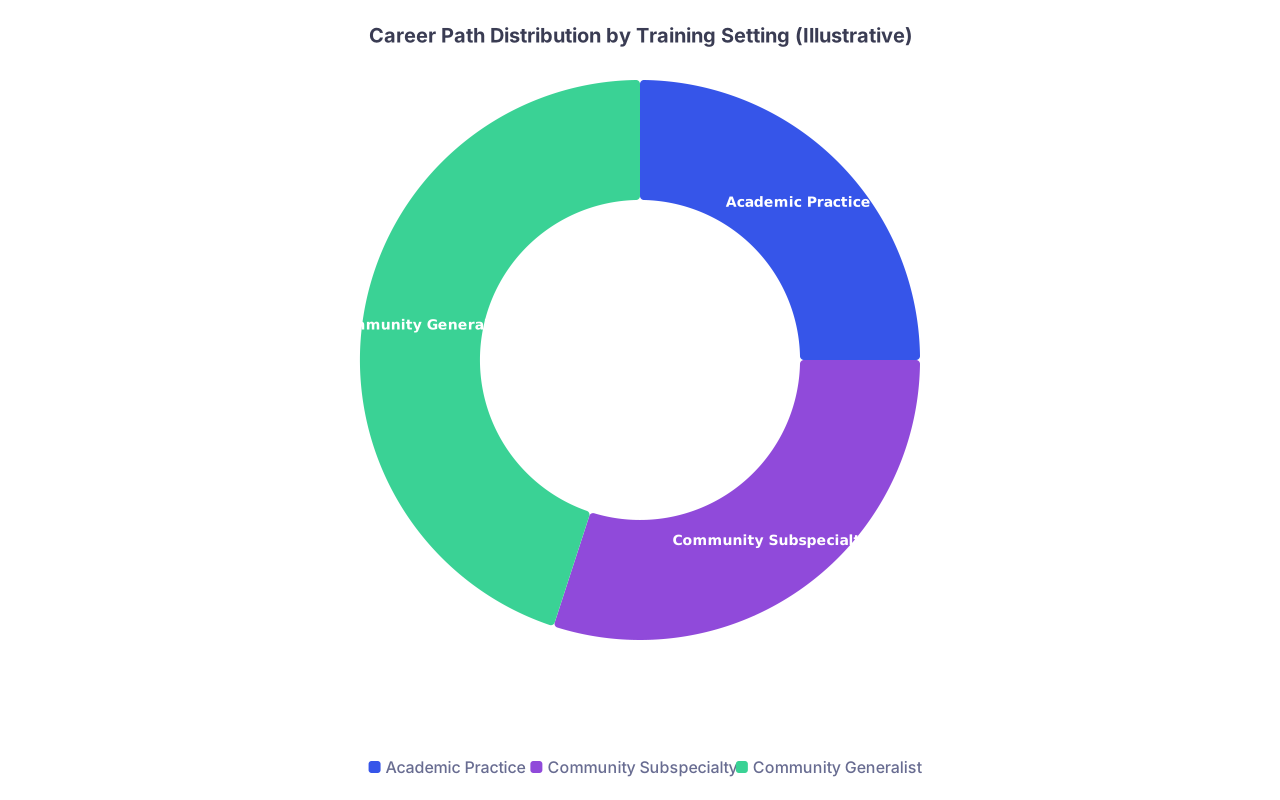
| Category | Value |
|---|---|
| Academic Practice | 25 |
| Community Subspecialty | 30 |
| Community Generalist | 45 |
Across many specialties, long-term outcomes tend to converge toward community generalist or subspecialist practice, regardless of initial academic enthusiasm. The doughnut chart above represents a common pattern I have seen: a minority staying fully academic, a sizeable chunk doing community subspecialty, and the largest portion in community generalist roles.
Where you train shifts the proportions, but not to extremes.
6. The One Thing Students Usually Miscalculate
They underweight money in the first 5–10 years and overweight prestige in the first 5–10 minutes of an interview day.
If you have $250k–$400k in loans at 6–7% interest, the difference between a $280k and a $360k starting salary is not a rounding error. It is a 5–10-year acceleration in debt payoff and financial stability.
On the flip side, if you are dead serious about an ultra-competitive fellowship, skipping an academic program that reliably sends people into that field just to chase future salary is shortsighted. You might never reach that high-paying subspecialty if you train somewhere that rarely matches into it.
The data-driven approach:
- Decide if you are truly all-in on a competitive fellowship.
- If yes, prioritize academic/hybrid programs with documented success in that field. Accept that you are probably trading income for probability.
- If no or unsure, do not overpay the “prestige tax.” Give strong community and hybrid programs serious consideration; they can deliver excellent training and better financial upside.
Key Takeaways
- Academic training programs generally offer better odds for competitive fellowships but come with a 20–40% pay penalty vs community practice early in your career.
- Community and hybrid programs often provide stronger immediate earning potential and real-world clinical volume, while still offering fellowship pathways for top residents.
- For Match decisions, compare hard numbers—fellowship rates, moonlighting, local starting salaries—rather than prestige alone, and choose the path whose median outcome you can live with, not just the best-case scenario.