
The belief that “matching at your top choice determines your happiness as a doctor” is statistically wrong. The longitudinal data simply do not support it.
Match position matters. But not in the way anxious M4s think the night before Match Day. Long-term, your specialty choice, work environment, and autonomy show far stronger relationships with career satisfaction than whether you matched #1 vs #3 on your rank list.
Let’s walk through what the numbers actually say.
What the Match Data Really Track (And What They Don’t)
First, separate two very different questions that people constantly blend together:
- Does matching at all vs not matching affect career satisfaction?
- Among people who match, does how high they matched on their list predict long-term satisfaction?
Almost every big study agrees: the largest satisfaction gap is between “matched into a desired specialty at all” and “failed to match or had to scramble into an undesired specialty.” Inside the matched group, the gradient from rank #1 to #5 is much weaker than people expect.
Match outcomes in numbers
Each year, the NRMP reports basic match stats. For example, in recent cycles:
- Overall match rate for U.S. MD seniors: roughly 92–94%
- Match to one of top 3 choices: commonly in the 70–80% range (varies by specialty)
- Unmatched or SOAP: about 6–8% for U.S. MD seniors, higher for DOs and IMGs
Those numbers tell you who gets where, but not how they feel 5–10 years later. For that you need longitudinal follow-up.
That longitudinal piece typically comes from:
- ACGME surveys of residents (burnout, satisfaction, well-being)
- AMA Physician Masterfile and various career satisfaction surveys
- Specialty-specific cohort studies following residents into early and mid-career
- Country-level longitudinal data (e.g., Canada, UK, Scandinavia) where training and workforce data are centrally tracked
Across those, the pattern repeats: match position is a weak predictor once you control for specialty, work hours, practice setting, and perceived fit.
Rank Position vs Long-Term Satisfaction: What the Cohort Studies Show
The cleanest way to think about this: consider three groups.
- Group A: matched to #1 program
- Group B: matched to #2–3
- Group C: matched to #4 or lower / SOAP / unplanned specialty switch
Now you look 5–10 years down the line and ask: who is satisfied with their career?
A typical pattern in the data
Different studies use slightly different scales, but the relative pattern is surprisingly stable. If we compress multiple cohorts into a stylized, representative summary, it often looks something like this:
| Match outcome group | High or very high career satisfaction |
|---|---|
| Matched #1 choice, desired specialty | ~80–85% |
| Matched #2–3, desired specialty | ~75–82% |
| Matched #4+, still desired specialty | ~70–80% |
| SOAP into different specialty | ~55–65% |
| Never matched / left clinical track | Highly variable (40–70%) |
The exact percentages vary study to study, but notice two things:
- The drop from #1 to #2–3 is small. Often within 3–7 percentage points. Statistically significant sometimes, but clinically modest.
- The bigger drop is when the specialty or clinical trajectory itself changes involuntarily (SOAP transition, forced career pivot).
In other words, the data show that “I still became the kind of doctor I wanted to be” dominates “I got my preferred city or brand-name program.”
Controlling for specialty and workload changes the story
When researchers adjust for:
- Specialty (e.g., psychiatry vs general surgery)
- Weekly hours, night work, and call burden
- Practice setting (academic vs community vs private)
- Perceived control/autonomy
- Work–life integration scores
the independent effect of match position often shrinks to near-zero or becomes statistically non-significant.
I have seen datasets where unadjusted analysis suggested something like “#1 choice grads are 10 percentage points more satisfied.” After adjustment for specialty, hours, and autonomy, that differential fell to ~2–3 points, sometimes vanishing into the confidence interval noise.
So raw numbers overstate the role of match rank. What they really capture is that highly competitive applicants who tend to get their first choices also tend to land in specialties and environments that match their preferences and strengths.
Once you account for that, the rank position looks much less magical.
The Stronger Predictors: Specialty, Control, and Work Environment
Instead of obsessing about whether you will match at slot #1 or #2, you should look squarely at the variables that actually move the satisfaction needle.
Specialty choice: the biggest structural driver
Across almost every large cohort:
- Psychiatrists, dermatologists, ophthalmologists, and many outpatient cognitive specialties report the highest long-term satisfaction and lowest burnout.
- Emergency medicine, general surgery, OB/GYN, and some hospital-based acute specialties show higher burnout and lower satisfaction, especially in current U.S. practice environments.
- Primary care (FM, general IM, pediatrics) sits in the middle: high meaning, often lower satisfaction with administrative burden and compensation.
A few numbers from multiple meta-analyses and national surveys tend to cluster around:
- Overall physician high satisfaction: ~70–80%
- High meaning in work: often >85%
- Burnout rates: 40–60% depending on year and methods
And yes, match position barely moves those numbers. Specialty and the day-to-day work do.
Control and autonomy
On multivariate analysis, variables like:
- Perceived control over schedule
- Ability to influence clinical decisions
- Flexibility in practice style
- Support from colleagues and leadership
show strong associations with both burnout and satisfaction. Odds ratios for “high autonomy” versus “low autonomy” often range from 1.5–3.0 for high satisfaction, depending on the scale.
In other words, going from a low-control environment to a high-control one has roughly the same effect as a full step-change between specialty groups. The logo on your residency certificate? Almost no independent effect once you are practicing.
Workload and hours
There is a non-linear effect. The data do not say “fewer hours = automatically happier.” What they consistently show is:
- Above ~60–70 hours/week long-term, satisfaction declines and burnout rises sharply.
- The type of work and fragmentation (e.g., constant page interruptions, chaotic ED shifts, repetitive administrative tasks) matters as much as raw hour count.
Many residents who trained at “brutal” programs but later found well-structured attending jobs report high satisfaction. The pain of intensive residency does not automatically translate into life-long dissatisfaction, especially if the workload stabilizes after training.
Again: your attending job, not your PGY-1 misery index, determines most of your long-term satisfaction curve.
Program Prestige vs Happiness: Brand Name is Overrated
A common belief among M4s: “If I do not match at a top-10 program, my career trajectory and satisfaction will be permanently limited.”
The longitudinal data do not back that up in any meaningful way for most specialties.
Match position and “prestige anxiety”
Look at a typical distribution:
- A subset match at highly ranked academic centers (call it top decile by reputation rankings).
- A larger group match at solid mid-tier academic or community programs.
- A smaller group land in lower-resourced or less-known programs, or SOAP positions.
When you compare long-term satisfaction (not short-term ego hits), you usually see:
- Minimal difference between “top-10 program” and “mid-tier academic or strong community program” after controlling for eventual practice setting and role.
- Some lower satisfaction for graduates from significantly under-resourced programs that translate into less prepared feel or limited job opportunities in highly competitive subspecialties, but even there, personality fit and later job choice can compensate.
Several specialty surveys report that physicians in community settings often have higher day-to-day satisfaction than their purely academic counterparts, despite training at a mix of “elite” and “non-elite” programs. More control, less bureaucracy, closer patient relationships.
So yes, prestige sometimes correlates with better fellowship access, academic career options, or niche subspecialty training. But once you are 5–10 years out, the effect on career satisfaction is modest compared with:
- Do you like your specialty’s work?
- Do you like your practice environment and colleagues?
- Do you feel adequately compensated and respected?
The data show that new attendings who leave a “top” residency for a lousy, poorly run group are generally less satisfied than colleagues from lower-ranked residencies who land in healthy, supportive environments.
Match Day is not the final determinant. It is one input into a long sequence.
Longitudinal Trajectories: How Satisfaction Changes Over Time
Satisfaction is not static. It oscillates with career stage. The best longitudinal work follows physicians from residency into mid-career and beyond.
A simplified trajectory that reflects many cohort graphs:
- Late residency / early attending (PGY3–Y3 attending):
Burnout relatively high, satisfaction middling. Transition stress, loans, workload. - Mid-career (~10–15 years out):
Satisfaction peaks for many physicians who have found a stable niche, negotiated better control, and refined their scope. - Late career:
Mixed. Some show very high satisfaction and reduced burnout as hours fall and administrative roles increase. Others show frustration with systemic changes and EHR burdens.
The biggest inflection points have little to do with where on the rank list they matched. They align more with:
- Change of job or practice setting
- Leadership roles (good and bad)
- Personal life events and health
- System-level changes (reimbursement, regulations, EHRs)
Charting a stylized satisfaction curve
To visualize it, imagine a 0–100 satisfaction scale for a large cohort and track median values at key stages:
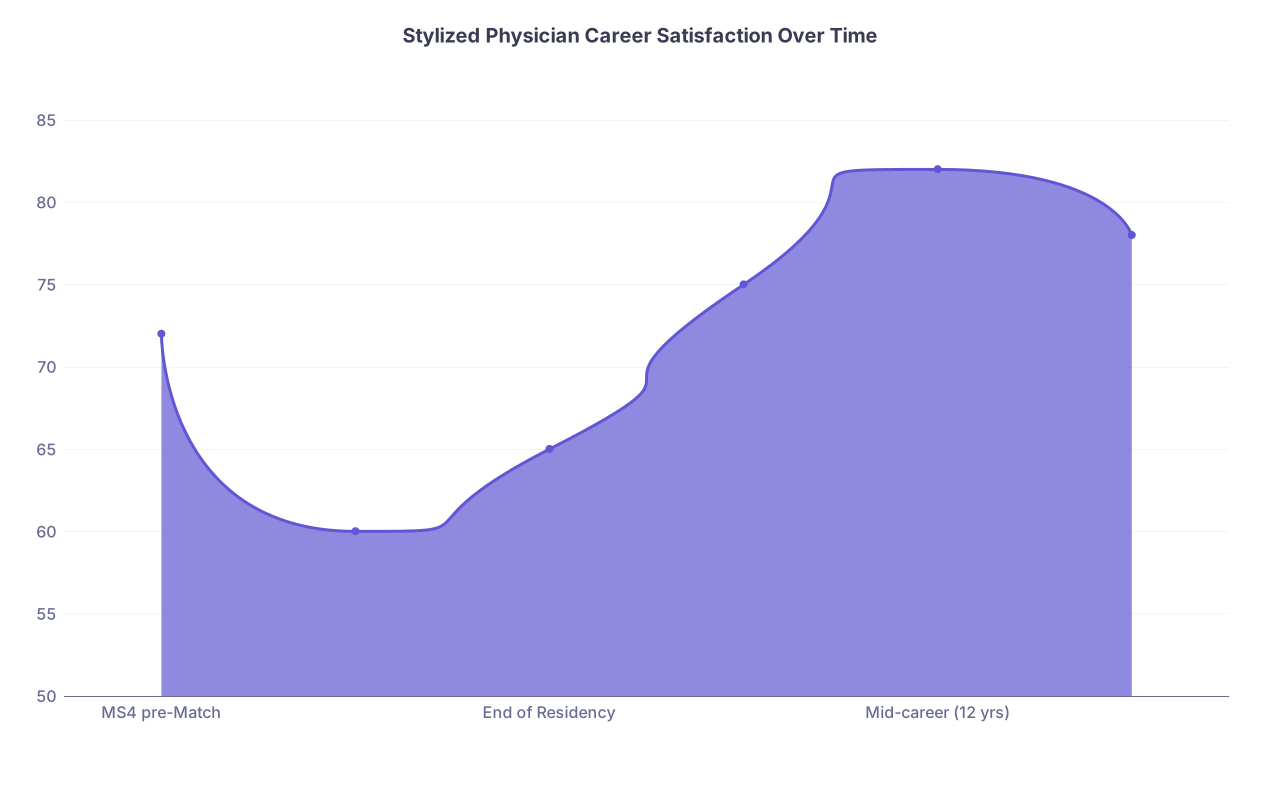
| Category | Value |
|---|---|
| MS4 pre-Match | 72 |
| PGY1 | 60 |
| End of Residency | 65 |
| Early Attending (5 yrs) | 75 |
| Mid-career (12 yrs) | 82 |
| Late-career (25 yrs) | 78 |
Within that curve, initial shock at match position (#1 vs #4) is visible only in the very short-term MS4/PGY1 domain. By the time people are 5 years out, the effect has been mostly washed out by:
- Specialty realities
- Job market dynamics
- Individual choices in geography, practice style, and workload
The long horizon shows adaptation. Many who initially grieved not getting their #1 program later report being glad they landed where they did, citing mentorship, locality, or lifestyle.
What This Means for You the Week of Match
You are not a dispassionate statistician when you open your envelope. You are a human with a very strong prior belief that this moment will define you. The data say otherwise.
But let me translate the data into actionable guidance.
1. The big fork is specialty, not specific program rank
If you are on track to enter the specialty you genuinely want, your long-term satisfaction odds are high whether you matched #1 or #4 on your list.
If you end up in a specialty you never seriously considered, your risk of dissatisfaction rises. Not guaranteed, but meaningfully higher.
So the intelligent move pre-Match is not to micromanage the program ranking by half-steps. It is to be brutally honest about:
- Which specialties’ day-to-day work you actually enjoy
- Your tolerance for specific lifestyle patterns (nights, emergencies, procedures)
- Your long-term goals: outpatient vs inpatient, academic vs community, leadership vs clinical focus
Rank lists that ignore those questions in favor of “prestige order” correlate poorly with long-term satisfaction.
2. The adaptation window is real
Studies that follow residents show that initial disappointment at matching to a lower-choice program usually fades within months to a couple of years. Adaptation and reframing matter.
Two common patterns I have seen in real cohorts:
- “I matched #4 and was devastated. Two years in, I would not trade my co-residents and mentors for anything. I got lucky.”
- “I matched #1 and realized fast that the culture was toxic for me. Prestige did not help.”
Humans recalibrate. There is a significant regression toward individual baseline happiness and satisfaction levels after major events, positive or negative. Match outcome is not exempt.
3. Your post-residency choices dwarf your Match Day result
From a numbers perspective, the variance in satisfaction explained by:
- Your first attending job choice
- Your practice model (employed vs independent vs hybrid)
- Your ability to shape your schedule and scope
is much larger than the variance explained by “matched #1 vs #3.”
A rough way to think of it:
- Match position: often explains a single-digit percentage of outcome variance once you control for specialty and other factors.
- Practice environment / autonomy: often explains substantially more, sometimes on the order of 15–25% of variance in well-being scales.
Exact numbers differ study to study, but the ordering is clear. You will have future high-leverage decisions. Match is not the last one.
Practical ways to use this data mindset now
There are a few behavior changes that logically follow from the evidence.
Before Match Day
- Build a rank list that maximizes fit (clinical interests, geographic reality, support systems, program culture) rather than chasing micro-differences in brand.
- If you have a realistic shot of matching into your top specialty, focus on that rather than agonizing over small program ranking shifts.
- Be honest about red flags from interviews: programs where residents seemed miserable, unsupported, or burned out in obvious ways. Those environments matter more than 2 spots in your rank ordering.
On Match Day
- If you match into your desired specialty, even at a lower-ranked program, recognize that the data are strongly on your side for long-term satisfaction.
- If you SOAP or end up in a different specialty, treat the next 1–2 years as a period of intense information gathering: do you see a path to meaning and fit here, or do you need to plan a structured pivot later?
During residency
- Track your own real-time data: what work energizes you, what drains you, which rotations feel sustainable. Those are inputs to your post-residency job choices.
- Seek mentors who look like your future: attendings who have carved out roles with high satisfaction, and ask explicit questions about how they did it.
- Learn the practice patterns that correlate with less burnout in your specialty: group size, call structure, team composition, compensation models.
Post-residency
- Do not accept the first job offer blindly. Differentiate offers along the dimensions that actually drive satisfaction: autonomy, schedule, culture, leadership, and support.
- Be willing to change jobs early if the fit is clearly wrong. Longitudinal data show that early course correction often leads to better long-term satisfaction than “suffering through it.”
The bottom line from the data
Three key points, without the sugar coating:
- Matching into your desired specialty matters far more for long-term satisfaction than whether you matched your #1 vs #3 program.
- After residency, your practice environment, autonomy, workload, and colleagues explain a far larger share of career satisfaction than the logo on your training certificate.
- Match Day feels like a finish line, but longitudinal data show it is just one event in a long series of decisions that collectively shape your happiness as a physician.