
The 48 hours after you match can quietly wreck your first six months of residency—or set you up to glide through them.
Most people waste those two days basking in relief and texting screenshots. You are not “most people” if you are reading this. You want a concrete 48‑hour post‑Match action plan that locks down three big, unsexy pillars: housing, licensure, and HR onboarding. So let me break this down, specifically, like I would for a fourth‑year sitting in my office with a legal pad and a half‑finished latte.
The Real Goal of Your 48‑Hour Plan
You are not trying to “figure everything out” in 48 hours. That is impossible and unnecessary.
You are trying to:
- Identify every dependency and hard deadline.
- Start the processes that have the longest lead times (licensure, background checks, credentialing).
- Narrow housing from infinite options to 3–5 realistic choices with clear next steps.
- Prevent stupid, avoidable delays that make GME staff remember you for the wrong reasons.
Everything else is details.
Here is the mental model I use:
- Hour 0–4: Information harvest and timeline mapping.
- Hour 4–24: Critical communications and applications (HR, licensure, key housing outreach).
- Hour 24–48: Refinement—decisions, backup plans, and documentation organization.
We will walk through those three pillars—housing, licensure, HR—inside that 48‑hour structure.
Step 1 (Hour 0–4): Extract All the Hidden Instructions
The most common mistake: people do not read the entire offer packet and every attached PDF. They skim the email, post to Instagram, then three days later realize they missed a “respond within 72 hours” condition.
Here is what you do in the first few hours.
1.1 Build your one-page “Residency Operations Sheet”
You want a single document (Google Doc, Notion page, or even paper) with:
- Program name, address, and main GME contact
- Program coordinator email and phone
- GME office general contact
- State (and whether you will need a training license or full license)
- Start date and usual orientation start week
- Conditional items: “Must respond by…”, “License required by…”, “Background check due by…”
Then pull from three sources:
- NRMP/Match letter (start date may be referenced here).
- Welcome email from the program / GME.
- Attached PDFs or web portal links (these hide 90% of the actual requirements).
You are hunting specifically for:
- License requirement type (training license vs full license).
- Application method (state board portal, paper, program-facilitated).
- Background check / drug screen vendor and deadlines.
- Occupational health requirements (TB, titers, vaccines, fit-testing).
- HR onboarding portal and forms.
- Housing resources (hospital-subsidized housing, partner complexes, relocation benefits).
Make yourself a 3‑column table: task, deadline, dependencies.
| Task Category | Typical Hard Deadline | Key Dependency |
|---|---|---|
| Accept offer / confirm position | 24–72 hours | Email/portal response |
| Training / full license application | 2–8 weeks before start | State board processing time |
| Background check / drug screen | 1–4 weeks before start | HR portal activation |
| Occupational health clearance | 2–6 weeks before start | Vaccine records, lab titers |
| Housing lease signed | 4–8 weeks before move | Program city and salary info |
You now have the skeleton of your action plan.
Step 2: Housing – Aggressive Shortlisting in 48 Hours
Housing mistakes hurt more than a mediocre Step 2 score. A miserable commute or a bad building manager will drain you daily.
The point of your 48‑hour housing plan is not to sign a lease. It is to move from “no idea” to a filtered, ranked shortlist with contact made for the top options.
2.1 Define your non‑negotiables in 20 minutes
Sit down and write, in plain language:
- Maximum commute time in rush hour (door‑to‑door).
- Minimum safety standards (you, not your parents).
- Budget ceiling (monthly rent as a percentage of take‑home).
- Parking needs (none, 1 car, 2 cars; on‑site vs street).
- Roommates vs solo.
Do this before you look at a single listing, or you will let pretty kitchens and rooftop decks distract you.
For most interns, this is reasonable:
- Commute: ≤30 minutes on a reliably available route (public or car).
- Rent: 25–35% of post‑tax monthly income.
- Safety: walking from hospital to home at odd hours must feel clearly “fine,” not “iffy.”
2.2 Use program-level intel first, not Zillow
In the first 48 hours, your best information is not online listings; it is current residents and the program coordinator.
Send one concise email to the coordinator:
“Hi [Name],
I am very excited to be joining [Program]. I am starting to plan housing and would appreciate any resident neighborhood or building recommendations, particularly areas that are safe for late-night commuting and within about 30 minutes of the hospital.Do you have:
– a current resident housing list / neighborhood guide, or
– a contact for the interns’ group chat / chief residents?Best,
[Your Name]”
You want either:
- A PDF or email with “most of our residents live in…” and building names.
- An invite to the GroupMe/WhatsApp/Slack where you can ask directly.
Then, message current residents like a normal adult, not a spam bot:
“Hey, I am one of the new PGY‑1s for July. Where do most interns live now, and if you had to do it again, which area would you avoid?”
You will get real answers: “Do not live south of X Avenue,” “This complex looks nice online but has break‑ins,” “Half the class lives in Y; 15‑minute walk.”
That flatly beats any web search.
2.3 Create a 3‑tier housing shortlist
You should end the 48 hours with a simple structure:
- Tier 1 (3–5 options): High-probability, realistic places you would sign with minimal hesitation.
- Tier 2 (3–5 options): Acceptable but not ideal; backups if Tier 1 fails.
- Tier 3: Temporary / stopgap options (Airbnb month-to-month, hospital housing, extended-stay hotel).
Use a quick matrix in your notes:
| Option | Commute (peak) | Est. Rent | Safety (resident input) |
|---|---|---|---|
| Building A | 15 min walk | $1,650 | Very safe |
| Building B | 10 min drive | $1,500 | Safe |
| Neighborhood C (roommates) | 25 min train | $1,200 | Mixed |
| Hospital housing | 5 min walk | $1,400 | Safe but old |
You do not need perfection. You need enough clarity to start viewings and applications within 1–2 weeks when your schedule and finances stabilize.
2.4 Decide your temporary vs permanent housing strategy
This is where people get anxious. Ask yourself:
- Will you need to move for fellowship in 3 years? (Yes, likely.)
- Are you moving across the country with zero local knowledge?
- Do you have a partner / kids who need stable schooling or job access?
My bias:
- Solo intern, long-distance move, no local support: Strongly consider 1–3 months of temporary housing near the hospital, then sign a longer lease after you know the city and your schedule.
- Couple or family, or you already know the city: Reasonable to lock a 12‑month lease with careful research.
Do not lock yourself into a 45‑minute commute because the apartment has a pool. You will not see that pool in July.
Step 3: Licensure – Triggering the Longest Fuses Early
Licensure is where people quietly get burned. I have watched otherwise competent new interns sitting in HR in late June, white-faced, because the state board has not issued their training license and they cannot start.
Your 48‑hour goal: Know exactly what license you need, what it costs, and what steps you must initiate this week.
3.1 Training license vs full license – clarify immediately
States fall into a few broad categories:
- Training license only (common): Resident cannot work under full license; program verifies your status with the board.
- Either training or full license allowed (less common): Residents can choose, with cost and autonomy implications.
- Full license required before start (rare but real in some specialties and states for PGY‑2+).
You are not guessing. You:
- Read the welcome materials—there is often a “Licensure” section.
- Check the state board website specifically for “Resident Physician” or “Postgraduate Training” license.
- Email GME for clarification if language is vague.
A quick email template:
“Hi [Name],
To ensure I start the licensure process correctly, can you confirm whether incoming PGY‑1s at [Hospital] use a training license through the state medical board, or if we are required/recommended to obtain a full medical license prior to starting?Also, does GME submit any documents directly to the board on our behalf (like verification of training), or should I initiate the entire process myself?
Thank you,
[Your Name]”
3.2 Build your licensure checklist that same day
Licensure applications are all the same flavor of annoying. Expect these components:
- Identity: passport, driver’s license, Social Security card.
- Education: medical school diploma or certification of expected graduation.
- USMLE / COMLEX transcripts (sent via FSMB or NBOME).
- Background check / fingerprints (state-specific vendors).
- Notarized documents in some states.
Within 48 hours you should:
- Create an account on the state medical board portal (if required).
- Download any PDF application forms to review required fields.
- List every document you will need to collect, and who must send it (you vs school vs testing body).
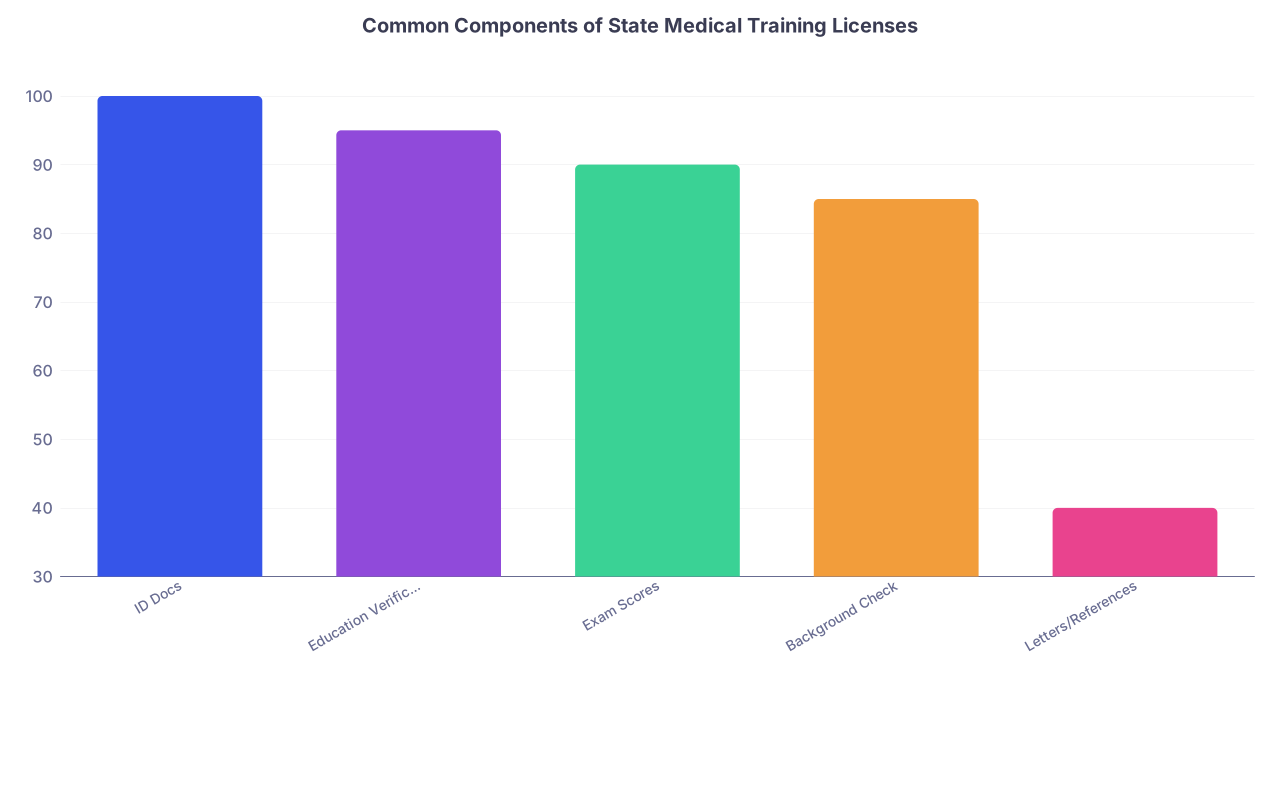
| Category | Value |
|---|---|
| ID Docs | 100 |
| Education Verification | 95 |
| Exam Scores | 90 |
| Background Check | 85 |
| Letters/References | 40 |
(The numbers here conceptually represent percentage of states requiring each item; the point is: almost all require the first four.)
3.3 Time-critical actions to start within 48 hours
There are three things that often bottleneck licensure:
Medical school verification
Some schools take weeks to send “Certification of Medical Education” or similar forms. Find out your school’s process immediately:- Who handles licensure verification? Registrar vs Dean’s Office.
- Do they batch-send forms on certain dates?
- Do you need to submit a request and pay a fee?
Submit that request now, even if your board application is not fully complete.
USMLE / COMLEX transcripts
Log in to FSMB (for USMLE) or NBOME (for COMLEX), add the correct state board as a recipient, pay the fee. This takes 5–10 minutes and removes another delay.Background check / fingerprints
Some boards use electronic fingerprinting; others want a physical card. Some allow out-of-state completion; others do not. Read that section closely and, if possible, schedule your fingerprinting for your next available day.
Line up these three actions in your 48‑hour plan.
3.4 Money and logistics
Licenses are not cheap. Training license fees can run $100–$500 depending on the state, plus exam transcript fees, plus fingerprinting.
Do two things within this 48‑hour window:
- Rough budget: Sum up expected licensure-related fees.
- Identify funding: Savings, parental help, 0% credit card (not ideal, but sometimes reality).
You do not want to be hesitating for a week because you “didn’t realize it would cost that much.” The board does not care.
Step 4: HR and Onboarding – Becoming an Actual Employee
You are not just a trainee. You are about to be an employee with all the bureaucracy that entails. HR delays will block:
- Your ability to start work.
- Your hospital badge.
- Your EMR access.
- Your paycheck.
Your 48‑hour HR goal: Ensure HR knows you exist, you have access to any onboarding portal, and you understand every mandatory pre-employment step.
4.1 Confirm offer acceptance and contact details
Some programs treat the Match as automatic acceptance. Others still require a signed offer letter or portal acknowledgment.
Do not guess. Do this:
- Reply to the Match/welcome email explicitly accepting.
- Sign any attached offer letters electronically and return them.
- Confirm they have your current cell number and a personal email you actually check.
If they use an HR or GME portal (e.g., “MedHub,” “New Innovations,” hospital-specific systems), make sure:
- You received the activation email.
- You can log in.
- You can see a clear list of assigned onboarding tasks.
If you do not have portal access by 48 hours post-Match, send a polite nudge to the coordinator.
4.2 Map the HR onboarding requirements
Common elements:
- I‑9 verification (proof of work authorization).
- Background check / drug screen through a third-party vendor (e.g., HireRight, Certiphi).
- Occupational health: physical exam, TB screening, titers, vaccines, N95 fit testing.
- Direct deposit and tax forms (W‑4, state equivalents).
- Policy acknowledgments (HIPAA, code of conduct, harassment training).
Pull every item you can see into your operations sheet and classify:
- Can do entirely online now.
- Needs scheduling (lab, physical, drug screen).
- Needs documents brought in person (passport, Social Security card, vaccine records).

| Step | Description |
|---|---|
| Step 1 | Match and Welcome Email |
| Step 2 | Accept Offer |
| Step 3 | HR Portal Access |
| Step 4 | Complete Forms Online |
| Step 5 | Schedule Drug Screen |
| Step 6 | Upload Vaccine Records |
| Step 7 | Schedule Employee Health Visit |
| Step 8 | Complete Tax and Direct Deposit |
| Step 9 | Background Check Cleared |
| Step 10 | Health Cleared |
| Step 11 | Badge and System Access |
| Step 12 | Background Check Assigned |
| Step 13 | Occupational Health Assigned |
Your objective in the first 48 hours is not to finish all of it but to:
- Complete every purely online form.
- Trigger any background check processes.
- Request and organize your health records.
4.3 Occupational health – the silent time sink
Many people underestimate how long it can take to dig up vaccine records and get titers.
Do this now:
- Ask your medical school for a copy of your immunization and titer records.
- Retrieve any childhood vaccination records from parents or prior providers.
- Scan or photograph and upload them into a secure folder.
Typical requirements:
- TB screening (PPD or Quantiferon).
- Hepatitis B vaccination and surface antibody titer.
- MMR immunity or documented vaccines.
- Varicella immunity or documented vaccines.
- Tdap within the last 10 years.
- COVID vaccination, depending on system policy.
If you know you are missing a vaccine or previous titer was negative, mentally plan to fix that early, not at the end of June.
4.4 International and visa-specific nuances
If you are on a visa (J‑1, H‑1B), the 48‑hour plan shifts slightly.
You must:
- Confirm which visa category you will be on (usually J‑1 for residents via ECFMG).
- Identify who is handling your DS‑2019 or H‑1B petition (GME vs external counsel).
- Make a list of documents needed: ECFMG certificate, passport, prior I‑94s, prior DS‑2019s, etc.
You do not file the visa yourself, but delays on your side (missing documents, delayed responses) will absolutely slow things down. Use the 48 hours to create a visa document folder and confirm the timeline with the GME/visa coordinator.
Step 5: Turning This into a Concrete 48‑Hour Timeline
Let me give you a sample hour‑by‑hour structure. Not because you must follow it exactly, but so you see how much you can realistically accomplish without burning out.
Hours 0–4: Intake and Mapping
- Read every email and attached PDF from your matched program and GME.
- Build your Residency Operations Sheet with key contacts and all known deadlines.
- Clarify start date and orientation week.
- Make a rough budget (salary, rent range, licensure fees).
Hours 4–12: Communications and Initiations
- Email program coordinator with housing questions; ask for resident contacts.
- Email GME/licensure contact to clarify type of license needed and who submits what.
- Log in to state medical board site; create account; identify required documents.
- Submit medical school verification requests if your school requires a form or fee.
- Order USMLE/COMLEX transcript to the state board if the license requires it.
- Reply formally accepting your offer and confirming your contact info.
- Ensure HR / onboarding portal access; if not present, email coordinator.
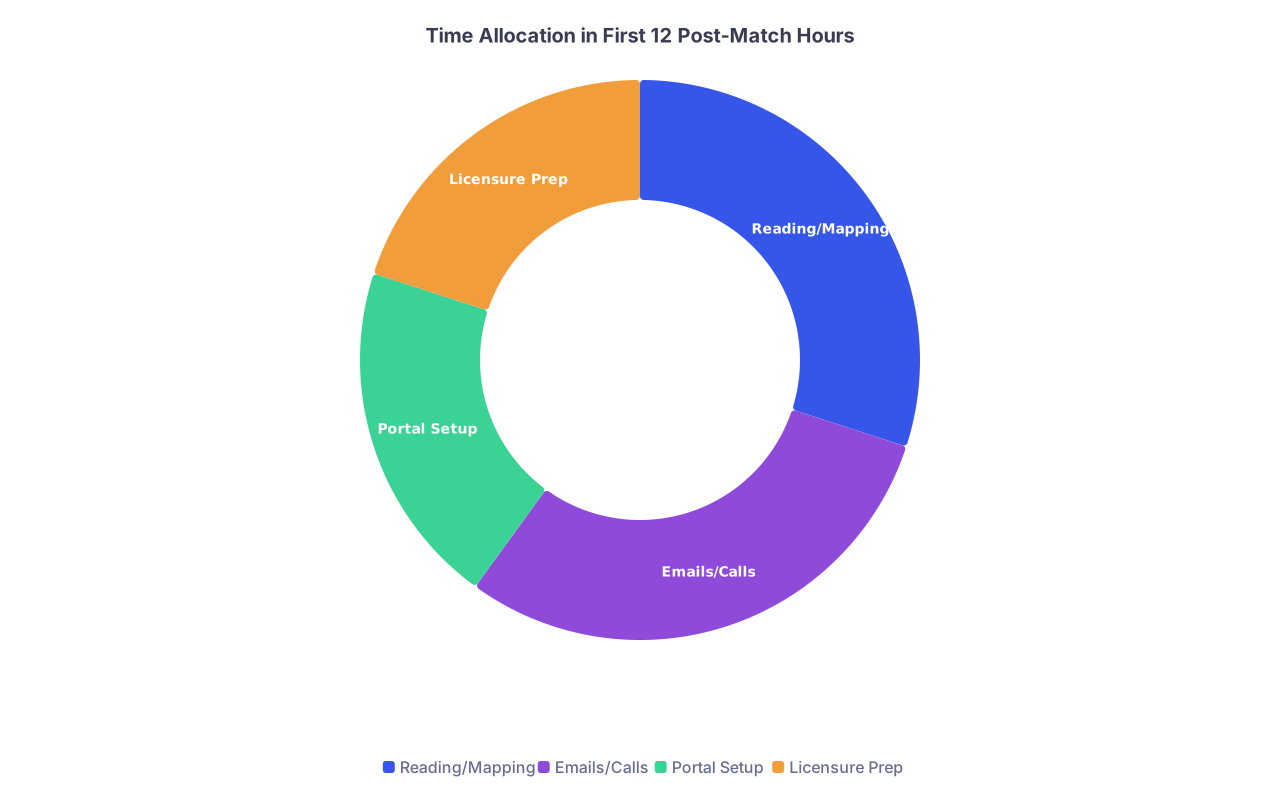
| Category | Value |
|---|---|
| Reading/Mapping | 30 |
| Emails/Calls | 30 |
| Portal Setup | 20 |
| Licensure Prep | 20 |
Hours 12–24: Housing and HR Deep Dive
- Join any resident GroupMe/WhatsApp/Slack; ask concise housing questions.
- Identify 3–5 neighborhoods and 3–5 specific complexes or housing options.
- Build your Tier 1 / Tier 2 / Temporary list.
- Open HR portal tasks; complete any online forms (demographics, tax, direct deposit).
- Start background check forms if assigned.
- Begin organizing vaccination records and other health documents.
Hours 24–36: Decision Points and Scheduling
- Narrow housing to a realistic shortlist and identify which need tours vs can be rented sight unseen.
- If you are planning temporary housing (Airbnb, short-term rental), shortlist specific options and note cancellation policies.
- If you know your availability, tentatively identify windows for occupational health visits and drug screens.
- If visa-dependent, email visa coordinator to confirm timeline and your next steps.
Hours 36–48: Documentation and Backup Plans
Scan and organize every critical document into a secure, cloud-backed folder:
- Passport, driver’s license.
- Social Security card.
- Medical school transcripts / letter of expected graduation.
- USMLE/COMLEX score reports.
- Immunization/titer records.
Create a “Deadlines” section in your operations sheet with:
- License complete-by date (your buffer, not just the board’s).
- HR onboarding completion target.
- Housing decision and lease-signing target.
Outline your backup plan if:
- License is delayed (training license vs start under supervision only; ask GME).
- Housing falls through (temporary housing options).
- Visa processing has issues (for IMGs).
Common Pitfalls You Avoid With This Plan
I will be blunt. I have watched the following disasters happen multiple times:
- Resident did not start license process until May → Board backlogged → Start date delayed, paycheck delayed, program annoyed.
- Intern signed a 14‑month lease 40 minutes away because “the gym is nice” → By September, they are begging anyone to take over the lease.
- New hire ignored emails from the background check vendor → File auto-closed → HR had to re-initiate, pushing start date back.
- Resident assumed “my med school has my vaccine records” → School had partial data; they were chasing titers 3 days before orientation.
Your 48‑hour action plan is how you avoid becoming one of those stories people tell the next class as a cautionary tale.
Quick Specialty-Specific Notes
A few nuances based on where you matched:
- Surgery / OB‑GYN / EM: You will have more nights and early starts; weigh walking distance or extremely reliable transportation more heavily. I have seen trauma interns literally sleep in call rooms on post‑call because their commute was too long.
- Psych / FM / Peds in community settings: Clinics may be off-site from the main hospital; ask specifically where you will spend most days. That should drive housing choice, not just the flagship hospital location.
- Preliminary year / transitional year: Do not over‑optimize a long-term lease for a one-year stop. Short, flexible arrangements often make more sense.
Final Sanity Check: What You Should Have by Hour 48
By the end of 48 hours, you should be able to say yes to all of these:
- I know exactly what type of license I need, what it costs, what forms are required, and I have initiated at least the school verification and transcript requests.
- I have HR or onboarding portal access, I have formally accepted my offer, and I have either started or understand every required step for background check, drug screen, and occupational health.
- I have a structured housing shortlist (Tier 1, Tier 2, temporary options), based not just on Zillow but on actual resident input and my commute and safety criteria.
- I have one central document tracking all major deadlines and contacts.
- My critical personal and educational documents are scanned and organized.
If any of those are a “no,” that is your next immediate task.
Key Takeaways
- The first 48 hours after the Match are not for celebration alone; they are for starting the longest-lead processes: licensure, background checks, and housing reconnaissance.
- Talk to actual residents and your program coordinator early: they will shortcut months of guesswork on housing and clarify licensure and HR nuances for your specific institution and state.
- A simple, disciplined operations sheet—with tasks, deadlines, and contacts—will prevent almost every avoidable disaster that derails new interns before they ever write their first note.