
The week after you match is exactly when bad residency contracts get signed.
Programs count on it. You are exhausted, relieved, and terrified of rocking the boat. That is how residents end up stuck with abusive call schedules, weaponized “professionalism” clauses, and repayment traps they never saw coming.
Let me walk you through what to flag in that first version of your residency contract or training agreement—specifically in that first week post‑Match, while there is still time to ask questions, negotiate small fixes, or at least go in with your eyes open.
1. Timing, Conditions, and “At-Will” Landmines
The first mistake is assuming the contract is just a formality because “the Match is binding.” Not exactly.
The Match binds the program and you to start the training relationship, but your actual rights and obligations are in that contract (or “appointment letter,” “house staff agreement,” or “GME agreement”).
Appointment length and renewal language
Most contracts are for 1 year at a time. That is not the problem. The problem is the renewal clause.
Look for language like:
- “Appointment is for one year and may be renewed at the sole discretion of the Program and/or Institution.”
- “Continuation is contingent upon satisfactory performance and availability of funding.”
Every contract will say something like this, but you care how vague it is and whether there is any process spelled out.
Red flags:
- No mention of evaluation process, remediation, or appeal if they choose not to renew.
- Language that sounds like you are at-will staff: “may be terminated at any time, with or without cause.” That is completely inappropriate for a GME position.
What you want to see somewhere in the contract or attached GME manual:
- Clear references to due process, grievance/appeal procedures.
- “For cause” termination only, except for narrowly defined institutional reasons (loss of funding, loss of accreditation).
- Ties to ACGME or other accrediting body policies.
If the contract is short and punts all this to a “House Staff Manual,” ask for that this week and read it. This is where programs hide the real rules.
Start date, contingencies, and licensing
You will see conditions like:
- Passing USMLE/COMLEX Step 2/Level 2.
- Obtaining a state license or training license.
- Passing background checks and drug screens.
- Work authorization/visa approval for IMGs.
These are legit. The key is what happens if something is delayed.
Questions to ask this week:
- “If my license or ECFMG certificate is delayed but ultimately approved, is my start date delayed, or is my contract voided?”
- “Is there a specific deadline for Step 2 CS/Level 2 PE alternatives or documentation?”
- “If the state board is backed up, who helps coordinate and what happens to my salary/benefits in the interim?”
You are flagging clauses that allow the program to walk away easily while you are left holding housing leases and moving costs.
2. Salary, Stipends, and Hidden Money Traps
You already know to check the PGY salary. That is the easy part. Where people get burned is in:
- Unpredictable raises.
- Unreimbursed mandatory expenses.
- Repayment or “liquidated damages” clauses masquerading as incentives.
Base salary, raises, and extra duty
Look at the exact PGY level:
- Some contracts list a range: “PGY‑1: $60,000–$65,000.” No. You want a specific number.
- Check if raises for PGY‑2, PGY‑3, etc., are spelled out somewhere (often in an attached schedule).
Now look for:
- “Additional compensation” for moonlighting, extra call, or bonuses.
- Language that says the program can assign additional duties “without additional compensation.”
If they require moonlighting-like coverage (e.g., covering extra services, out-of-department call) but explicitly say it is part of your base salary, that deserves a follow-up email:
“Can you clarify which duties are considered standard program responsibilities versus optional compensated moonlighting?”
You are not negotiating money so much as forcing them to put in writing what is “optional” versus mandatory.
| Clause Type | What To Look For |
|---|---|
| Base Salary | Specific PGY amount, not a range |
| Raises/Future Years | Published PGY scale, annual step |
| Required Fees | Board, license, DEA coverage |
| Repayment Obligations | Sign-on, relocation, bonuses |
| Moonlighting Compensation | Clear rate and eligibility |
Required costs: boards, licensing, and exams
Programs love vague lines like:
- “Resident is responsible for expenses related to licensure, examinations, and certifications, unless otherwise provided.”
This can be thousands of dollars.
You want to know, specifically:
- Do they pay for your initial state license or training license?
- Do they pay for DEA registration?
- Do they pay for required certifications: ACLS, BLS, PALS, NRP, ATLS?
- Do they pay for at least one attempt at boards (ABIM, ABS, ABEM, etc.)?
If the contract is silent, check the GME benefits page or manual. If still unclear, email GME:
“Are licensing fees, DEA, and required life-support courses reimbursed, and is that policy guaranteed for my cohort?”
Repayment and claw-back clauses
Here is where things get ugly.
You may see:
- Relocation allowance.
- Signing bonus.
- Housing stipend.
- “Educational loan forgiveness.”
These can be fine, but you must read the repayment language.
Classic traps:
- “Resident agrees to repay relocation allowance if they do not complete 12 months of training.”
- “Signing bonus must be repaid if the resident resigns or is terminated for any reason within X years.”
- “Liquidated damages” clauses if you leave early.
The most problematic phrases:
- “For any reason, including, but not limited to, voluntary resignation, non-renewal, or termination for cause.”
- No pro-rating. You leave at month 11 and still owe the full $10,000.
In your first‑week review, you are not necessarily negotiating these. But you should:
- Calculate exact potential liability if you had to leave early.
- Decide if you need to cap your exposure (e.g., refuse optional sign-ons with harsh claw-backs).
- Ask if repayment is pro-rated and if there are hardship exceptions.
3. Work Hours, Call, and Moonlighting: Where Burnout Gets Baked In
The contract will not list your exact rotation schedule. But it will tell you who owns your time and how they interpret “duty hours.”
Duty hours and call expectations
Look for:
- A reference to ACGME duty-hour compliance.
- Language about average hours, in-house call, home call, and days off.
Red flags:
- Language that says “Resident will work hours necessary to meet educational objectives” with no explicit tie to ACGME or duty-hour policies.
- Statements that “home call does not count toward duty hours” or vague treatment of at-home responsibilities.
- “Resident may be required to work additional hours to meet service needs.”
You want to see, somewhere binding:
- One day in seven off, averaged over 4 weeks.
- Maximum 80 hours/week, averaged over 4 weeks.
- Maximum shift duration (24+4, etc., depending on specialty and level).
This is more than compliance. It is leverage. If the contract and manual bake in language contradicting ACGME limits, you will have a harder time pushing back when you are on your sixth 28‑hour call in 8 days.
Moonlighting: who really owns your nights
Moonlighting clauses are always more restrictive than advertised on interview day.
You will see patterns like:
- “Moonlighting is not permitted for PGY‑1 residents.”
- “Moonlighting requires written approval from Program Director and must not interfere with educational responsibilities.”
- “Moonlighting hours count toward ACGME duty hours.”
All reasonable. The dangerous ones:
- Blanket prohibition for the entire residency without that having been disclosed earlier.
- Vague language that lets them revoke permission at any time “for any reason.”
- A requirement that you moonlight internally as part of your assigned shifts, often with no additional pay.
Pay attention to:
- Whether internal moonlighting is compensated.
- Whether there is a stated hourly rate or RVU formula.
- Whether malpractice coverage for moonlighting is provided or explicitly excluded.
If you see: “Resident is not covered by institutional malpractice insurance when moonlighting,” you need a paper trail before doing any external work.
| Category | Value |
|---|---|
| University | 40 |
| Community | 65 |
| Hybrid | 55 |
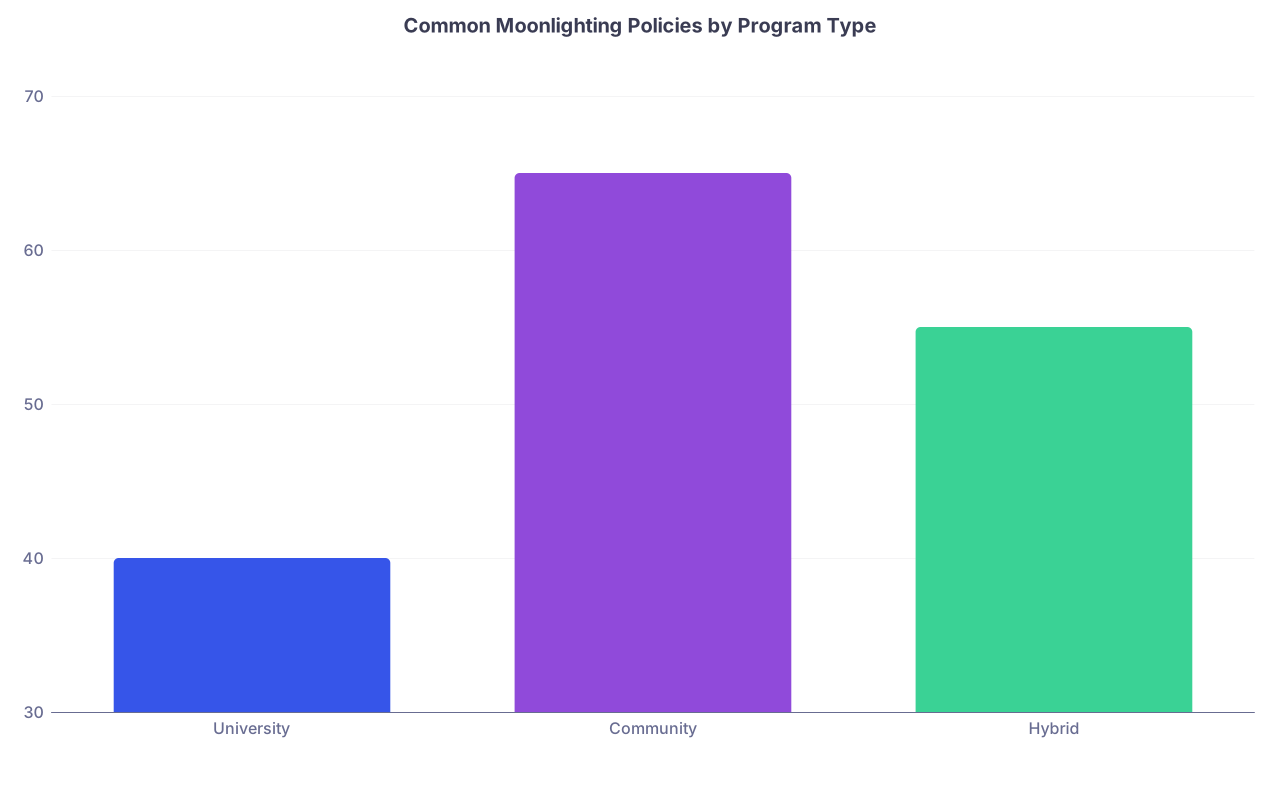
(Think of those numbers as “percent of programs with at least some moonlighting allowed”—roughly what I have seen among IM/EM/Anesthesia programs. Community-heavy institutions are usually more permissive but not always clearer.)
4. Benefits, Leave, and the Pregnancy/Illness Reality Check
This is where idealism dies. Contracts and GME manuals often dramatically under-specify leave, especially for pregnancy, chronic illness, and mental health.
Vacation and sick leave: words vs reality
Look for:
- Number of paid vacation days per year (usually 15–20 weekdays).
- Sick days or “paid time off” bucket.
- Holidays.
Red flags:
- Vacation and sick time combined into one tiny PTO pool (e.g., “20 days of PTO for all purposes”).
- Language stating unused leave is “lost” with no accommodation for illness or maternity.
- Any suggestion that taking sick time is “discouraged” or “must be minimized.”
Check if the contract or manual states:
- Whether vacation can be carried over.
- Whether vacation can be denied unilaterally by the program.
- Whether you can be forced to use vacation days to cover illness.
You are not going to fix national staffing shortages in one email, but you can at least know the rules you are walking into.
Parental leave, FMLA, and board eligibility
This deserves ruthless scrutiny, especially if you or your partner may become pregnant during residency.
You need to know:
- Does the program follow a formal parental leave policy (e.g., ACGME minimums, institutional policy, or state law)?
- How many weeks of paid parental leave?
- Do they force you to use vacation or sick time first?
- What happens to your board eligibility if you exceed a certain number of weeks off?
Board rules vary by specialty, but common patterns:
- Only a certain number of weeks per year “count” toward training.
- Extra time off may require extending residency.
In the contract or manual, look for phrases like:
- “Extended absences may result in extension of training as required by the certifying board.”
- “Resident is responsible for understanding board requirements.”
That last line is code for: “We may not warn you until it is too late.”
You should email:
“Can you provide our specialty board’s specific allowance for time away from training and how your program applies it (especially for parental leave)?”
If the answer is vague, write that vagueness down. It will matter if you have to fight for a fair extension later.
5. Termination, Discipline, and “Professionalism” as a Weapon
Most applicants never read this section carefully. Then PGY‑2 hits, and someone gets blindsided by a “non‑renewal” for social media posts or poor documentation.
“For cause” vs “without cause” language
Scan for:
- Grounds for immediate termination: fraud, patient harm, license loss, failure to obtain visa, etc.
- Non-renewal at the end of contract year.
The worst language looks like:
- “Resident may be terminated at any time for any reason deemed sufficient by the Program or Institution.”
- No mention of due process or appeal.
Better (still not perfect):
- “Termination for cause” with a list: egregious misconduct, gross negligence, violation of institutional policy, etc.
- “May be subject to remediation and due process procedures.”
If “due process” exists only as a buzzword with no concrete steps, demand to see the exact grievance/appeal policy.
Vague professionalism clauses
These have exploded in the last decade. Here is the pattern:
- “Resident must adhere to professional standards and institutional values.”
- “Unprofessional behavior” may include “failure to maintain harmonious relationships” or “negative impact on team dynamics.”
This is how programs sometimes shut down legitimate complaints.
Ask yourself:
- Is there any definition or example list of “unprofessional behavior”?
- Is there mention of graduated steps: feedback, written warnings, remediation plans?
- Are there protections for good faith reporting and whistleblowing?
If the contract allows discipline or non-renewal based on undefined “fit” or “team culture,” assume it can be used arbitrarily. It does not mean you should not sign. But you should be mentally prepared to document everything from day one.
6. Non-Competes, Post-Training Restrictions, and “You Cannot Work Here”
Hospital lawyers have started slipping post‑employment restrictions into resident contracts. A non-compete for a trainee is, frankly, garbage. Still, you have to flag it.
Look for any clause labeled:
- “Non-compete”
- “Restrictive covenant”
- “Post-employment practice restrictions”
- “Non-solicitation / non-interference”
Red flags:
- Distance-based restriction (e.g., “may not practice medicine within 10–50 miles for 1–2 years after leaving”).
- Specialty‑specific restriction in the same metro area.
- Restrictions tied to any separation, not just leaving early or for cause.
In many states, non‑competes for physicians or trainees are unenforceable or heavily restricted. But here is the legal reality: unenforceable clauses still scare people and can delay jobs. They get used as leverage, even if they would lose in court.
At minimum, you should:
- Save a copy of that clause.
- Check your state law (or have a physician-focused attorney review it).
- Ask the GME office directly: “Is this non-compete clause actually enforced for residents?”
If they say “we never enforce it,” respond: “Would the institution consider removing or clarifying that this does not apply to residents?” Often they will say no. But forcing them to admit the inconsistency on email is useful.
7. Malpractice, Liability, and Legal Support
You will practice under the hospital’s malpractice umbrella. But that does not mean you are safe.
Coverage scope and tail coverage
Look for:
- “Claims-made” vs “occurrence” malpractice coverage.
- Whether tail coverage is included after you leave.
Most hospitals use claims-made and carry institutional tail coverage. That is fine if:
- It explicitly says residents are covered for acts within the scope of their duties.
- Coverage survives your graduation or departure for any claims arising from your residency work.
Red flags:
- Silence about tail coverage.
- Language that implies you are personally responsible for some component of coverage or defense.
You want language like:
- “The Institution shall provide professional liability coverage for Resident for acts within the scope of assigned duties, including coverage for claims made after completion of training, to the limits maintained by the Institution.”
If you see something off, ask GME to confirm—by email—that you will not need to purchase your own tail coverage for residency activities.
Legal representation and institutional vs personal risk
Contract language often says:
- “Institution will provide legal defense for claims arising out of resident’s performance of clinical duties for the Institution.”
- “Resident must cooperate fully with defense.”
What is missing:
- Who represents you if your interests diverge from the hospital’s?
- What if you are named individually in a lawsuit and accused of going against policy?
You will not fix that in your contract. But you should understand you may need independent counsel one day. The first week is a good time to mentally separate “malpractice coverage” from “someone entirely on my side.”
8. Ancillary Policies: Where the Contract Hides the Real Rules
A trick: many residency “contracts” are 3–5 pages but incorporate hundreds of pages by reference.
Look for language like:
- “Resident agrees to abide by all policies of the Institution, including but not limited to the House Staff Manual, Medical Staff Bylaws, and Institutional Policies.”
- “These documents are incorporated by reference as though fully set forth herein.”
Translation: those documents carry the same legal weight as the contract.
This week, you should request or download:
- House staff manual.
- GME policies.
- Duty-hour policy.
- Harassment and discrimination policy.
- Grievance and due-process policy.
- Moonlighting policy.
Then you skim them like a hawk for:
- Process: How are concerns raised? To whom?
- Protections: Does the anti-retaliation policy exist and look real?
- Transparency: Are remediation and non-renewal pathways described, or just “at the discretion” of leadership?

| Step | Description |
|---|---|
| Step 1 | Receive Contract |
| Step 2 | Read Contract |
| Step 3 | Request Manuals and Policies |
| Step 4 | Flag Red Clauses |
| Step 5 | Email GME with Questions |
| Step 6 | Optional Legal Review |
| Step 7 | Sign and Return |
You are not trying to memorize every policy. You are marking the terrain. So you are not stunned six months in when someone quotes policy 8.3.1 at you in a meeting.
9. What To Actually Do This Week: A Practical Pass-Through
Let me be specific about how to handle this without losing your mind.
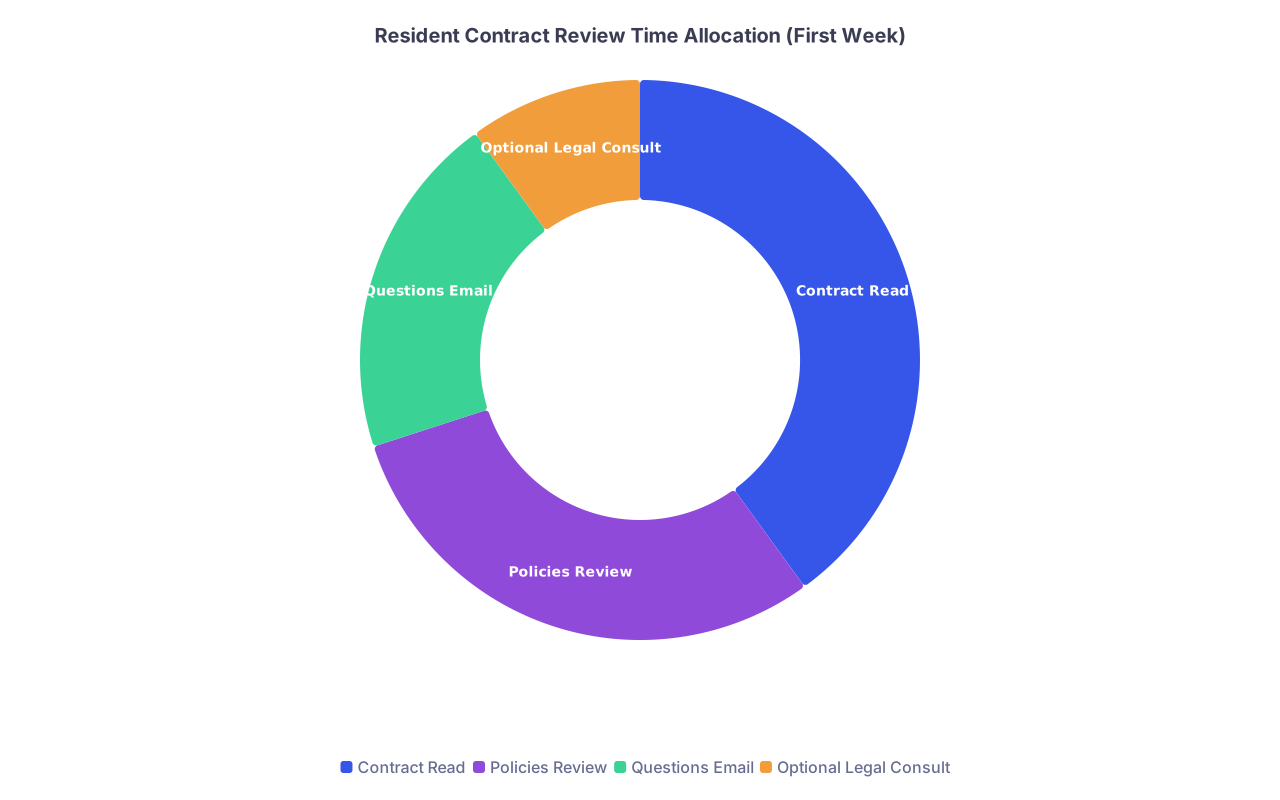
First read: 30–45 minutes
Print the contract or open it on a large screen. Grab a pen.
On this pass, you are looking for:
- Money: salary, stipends, repayment.
- Time: vacation, leave, duty hours, moonlighting.
- Safety: termination, grievance, malpractice, non-competes.
Put a star next to anything that:
- Has a number attached (days, miles, years, dollars).
- Uses vague language (“at the discretion of,” “for any reason”).
Second read: focus questions
Open a blank document and type 10–15 specific questions, for example:
- Can you confirm whether relocation assistance is subject to repayment and whether it is pro-rated?
- Do residents pay for their own state license, DEA, and required life-support certifications?
- Is moonlighting allowed after PGY‑2, and is institutional malpractice coverage provided?
- How many weeks of paid parental leave are guaranteed, and how does that interact with board eligibility?
- Does the institution enforce the non‑compete language against residents?
- What grievance and appeal processes are available in the event of non‑renewal?
- Does time on home call count toward duty hours, and how is that monitored?
Send this as a single, polite email to the GME office or program coordinator, not as 15 scattered messages. You are not negotiating aggressively. You are clarifying in writing.
| Category | Value |
|---|---|
| Contract Read | 40 |
| Policies Review | 30 |
| Questions Email | 20 |
| Optional Legal Consult | 10 |
Optional but smart: a brief legal review
If you see:
- Significant repayment obligations.
- Restrictive non-compete language.
- Anything that feels off for visa holders (J‑1, H‑1B).
Spend a few hundred dollars for a 30–60 minute review with a lawyer who actually does physician contracts. Not your cousin who does real estate. A real physician-contract attorney.
They are not going to renegotiate your salary. They will:
- Translate the ugly clauses.
- Flag state-law issues (non-competes, damages).
- Suggest specific wording changes you can ask for—sometimes programs accept small edits.
Most residents skip this. Many regret that later.
10. For IMGs and Visa-Dependent Residents: Extra Landmines
If you are on a J‑1 or H‑1B, the contract is not just about hours and money. It is about immigration survival.
Specific things to look for:
- Clause tying employment strictly to visa status: “This agreement is contingent upon maintenance of appropriate visa status.”
- Any requirement that you pay for your own immigration attorney or filing fees (often inappropriate, especially for H‑1B).
- Language about what happens if visa processing is delayed.
Questions to send this week:
- “Who handles my visa processing? Institution lawyers, or do I need my own attorney?”
- “Which fees, if any, am I responsible for?”
- “If my visa is delayed by USCIS, will my contract be honored with a delayed start, or can it be rescinded?”

The goal is not to panic. It is to identify whether the institution has its act together or treats visa issues like an afterthought.
11. What You Cannot Change—and What You Can
Harsh reality: you are not negotiating like an attending. Residency contracts are largely take-it-or-leave-it.
Here is the breakdown from what I have seen across multiple programs:
Easily clarified but rarely changed:
- Written descriptions of call expectations.
- Moonlighting eligibility details.
- Board exam/leave reimbursement amounts.
- Clarification that certain vague policies do not apply to residents.
Rarely changed but sometimes softened:
- Repayment terms for relocation or sign-on (pro-rating).
- Wording on non-competes (“does not apply to residency training period”).
- Details of leave usage for parental leave (e.g., not forcing use of vacation first).
Almost never changed at individual level:
- Base salary.
- Vacation day count.
- Overall institutional policies.

So why review it carefully if you cannot change much?
Because power in residency is not just money or time. It is information. Knowing in advance:
- Where they can pull levers against you.
- Where national/ACGME/board rules back you up.
- What written commitments they have already made.
That knowledge is often the difference between being quietly steamrolled and successfully pushing back when things go sideways.
12. Bottom Line: How To Walk Into July With Eyes Open
Let me strip this down to what actually matters the first week after you match:
Get everything they “incorporate by reference.” House staff manual, policies, GME handbook. If the contract says you must follow it, read at least the sections on leave, duty hours, discipline, and grievances.
Flag numbers and vague phrases. Anything with a dollar sign, a date, a distance, or words like “at the discretion of” gets a second look. Most resident horror stories trace back to those lines.
Put your clarifying questions in writing now. One clean email to GME or your coordinator, asking for specific clarifications. Their answers become part of the paper trail you can rely on later.
You are not trying to draft a perfect contract. You are trying to avoid signing a terrible one blindly.