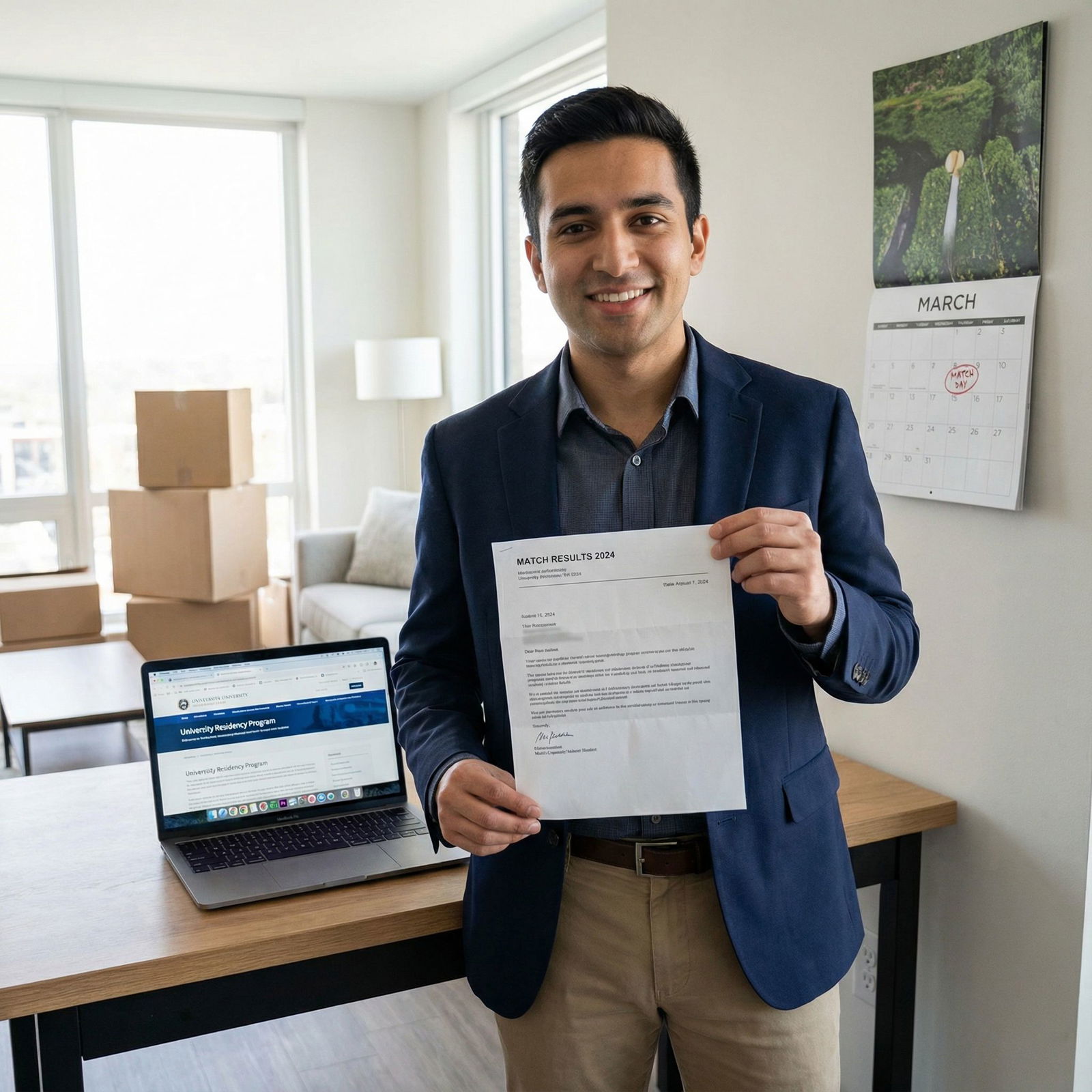
The most common Match Day conversations are lost not because students lack gratitude, but because they use vague, forgettable language.
You are about to ask busy attendings, PDs, and letter writers for advice, advocacy, and future help—often in the span of a few short emails or five‑minute hallway encounters. If your phrasing is sloppy, hesitant, or unclear, you will get generic responses and missed opportunities. If it is precise, confident, and respectful, you can turn Match Day into the beginning of your next step, not the end of this one.
Let me walk you through exact phrases that actually work. The kind I have seen students use in real programs, with real PDs, where everyone is tired and has 40 other things to do.
1. Ground Rules Before You Open Your Mouth
Before we get into scripts, I want you to internalize three things. They shape how you say everything else.
- Do not be vague about what you want.
- Do not make them do guesswork or emotional labor.
- Do not send “emotional dump” emails without a clear ask.
Your mentor or letter writer is usually juggling a full clinic or OR plus committee work. You get one shot at their full attention. So your communication needs:
- A clear purpose
- The essential context in 1–2 sentences
- A concrete ask or next step
If you remember nothing else, remember this spine:
“Here is what happened. Here is what I am hoping to do. Here is how you can help, if you are willing.”
We will plug that into specific situations: matched, partially matched, SOAPed, unmatched, switching specialties.
2. Scripts for Before Match Day: Setting Expectations
Most students only think about scripts after the envelope. That is late. You want your mentors primed.
A. Email to mentors 1–2 weeks before Match Day
Subject line matters. You want them to recognize this as brief and important.
Subject options:
- “Brief Match Day update and thank you”
- “Match status update and next steps”
Email template (pre‑Match, to any mentor or strong letter writer):
Dear Dr. [Last Name],
I wanted to send a brief update before Match Day and to thank you again for your support of my application this year.
I ranked [Specialty] programs with a focus on [regional preference or program type, e.g., “academic internal medicine in the Midwest” or “community EM programs near family in Texas”]. I feel that my interviews went well overall, and I am hopeful about the outcome next week.
Regardless of where I match, I am very grateful for your mentorship and the time you invested in my letters and guidance this cycle. I will email you on Match Day with the final result and my plans moving forward.
Sincerely,
[Full Name]
[Medical School, Graduation Year]
Short. Respectful. Does not ask them to do anything. But it sets the expectation that an update is coming. That way your Match Day email is not out of the blue.
B. Brief in‑person script the week before
Hallway / clinic conversation:
“Dr. [Last Name], I just wanted to say thank you again for all your help with my residency application. Match Day is next [Friday], and I will let you know where I end up. I really appreciate your support.”
That’s it. Do not overcomplicate.
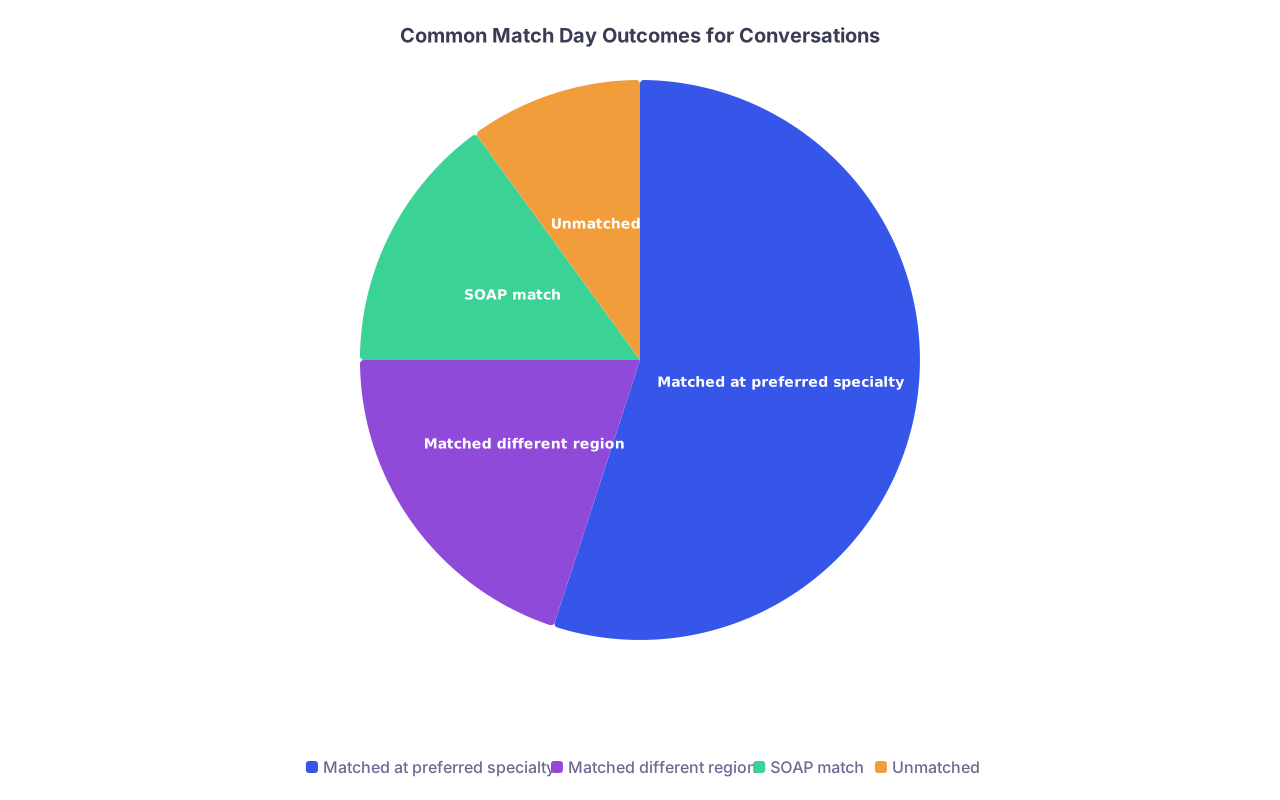
| Category | Value |
|---|---|
| Matched at preferred specialty | 55 |
| Matched different region | 20 |
| SOAP match | 15 |
| Unmatched | 10 |
3. If You Matched: Scripts That Build Long‑Term Goodwill
Most students blow the easiest part: telling people they helped you succeed. They send one mass text and think they’re done. You are leaving relational capital on the table.
A. Match Day email to mentors (you matched, straightforward case)
Use this for cores: research PIs, clerkship directors, advisors, strong letter writers.
Subject options:
- “Match Day update – thank you”
- “I matched in [Specialty] – thank you”
Email template:
Dear Dr. [Last Name],
I wanted to share my Match Day news and to thank you for your support during this process.
I matched into [Specialty] at [Program Name, City]. I am excited about the opportunity to train there, especially given their strengths in [one specific area relevant to mentor: e.g., “clinical reasoning,” “global health,” “medical education,” “cardiology research”].
Your mentorship and support, including your letter on my behalf, played a significant role in this outcome. I have greatly valued your guidance throughout medical school and hope to stay in touch as I begin residency.
With gratitude,
[Full Name]
[Medical School, Graduation Year]
Two key moves here:
- You name one specific program feature. Shows you are thoughtful, not generic.
- You explicitly credit their role without being dramatic.
B. In‑person or Zoom script (mentor you know well)
If you catch them on Match Day or shortly after:
“I wanted to tell you in person—I matched into [Specialty] at [Program]. I am really excited about it. Thank you again for everything you did to help me get here, especially your letter and all the career advice. It made a big difference.”
If they ask, “Was that your top choice?” and it was not, do not lie. Use:
“It was not my number one, but it was in my top three and it fits really well with my interests in [X]. I think it will be a great place to train.”
That tells the truth without sounding disappointed or ungrateful.
C. When you matched but are mildly disappointed
This is common, especially for competitive specialties or geographic preferences. Do not dump that onto a busy letter writer on Match Day. You can acknowledge reality without making it their emotional burden.
Email variation:
Dear Dr. [Last Name],
I wanted to share my Match Day outcome and to thank you again for your support.
I matched into [Specialty] at [Program, City]. While this was not at the very top of my rank list, I am grateful to have matched into my chosen specialty and I see strong opportunities there in [X/Y].
Your mentorship and letter were extremely important to me throughout this process, and I am thankful for your support. I will keep you updated as I get started and would value your continued guidance as I plan my next steps in [specific interest, e.g., “cardiology fellowship” or “academic medicine”].
Sincerely,
[Name]
You never frame it as “second best”; you frame it as “not #1, but still clearly valuable.”
4. If You Partially Matched or SOAPed: Scripts That Preserve Dignity and Options
The ugly truth: a lot of SOAP and partial match emails are either panicked novels or vanish into silence. Both are damaging. Faculty read your reaction as much as your result.
A. You SOAPed into a different specialty than planned
Example: You applied categorical general surgery, did not match, then SOAPed into a prelim surgery or a different field.
You must show three things:
- You are professional about it.
- You have a coherent plan.
- You are not blaming them or the system in your first 48 hours.
Email to mentors/letter writers:
Dear Dr. [Last Name],
I wanted to update you on my Match outcome and to thank you again for your support throughout this application cycle.
I did not match into [original specialty] during the main Match, and I participated in the SOAP. I have accepted a position in [Prelim Medicine at X / Transitional Year at Y / [Other Specialty] at Z].
While this was not my initial plan, I am grateful to have a strong training position for this coming year. I am planning to [either: “reapply to [specialty] next cycle” or “explore long‑term training in this field and reassess after intern year”].
I would appreciate any advice you may have on how to make the most of this position and strengthen my application for [next cycle / future opportunities] when you have time.
Thank you again for your mentorship and for everything you did to support me this year.
Sincerely,
[Name]
You are allowed to be disappointed. You are not allowed to be disorganized in front of PD‑level mentors.
B. You SOAPed but are still aiming to reapply in original specialty
You must make your goal explicit or your mentors will assume you moved on.
Add a clarifying paragraph:
Looking ahead, my goal remains to train in [original specialty]. During this [prelim/TY/other] year, I plan to focus on strong clinical performance, securing updated letters, and, if possible, pursuing additional [research / elective time] related to [original specialty].
If you are willing, I would be very grateful for your continued mentorship as I prepare to reapply.
That last line is deliberate. Clear ask, not a vague “I’ll be in touch.”

5. If You Unmatched: Scripts That Get You Real Help (Without Self‑Sabotage)
This is where wording matters the most. You need both empathy and strategy. Most faculty genuinely want to help, but they need a clean, usable signal from you.
A. First 24–48 hours: short update, no requests yet
Immediately post‑email from NRMP (“You did not match…”), you are often overloaded. Do not fire off rambling explanations. Send one controlled email.
Subject: “Match outcome update”
Template:
Dear Dr. [Last Name],
I wanted to let you know my Match outcome. I did not match in [Specialty] this cycle. I am currently working with our dean’s office on SOAP options and immediate next steps.
I am grateful for your support and the time you invested in my application and letters. I will reach out again once the SOAP process is complete and I have a clearer plan for the coming year.
Thank you again for your mentorship.
Sincerely,
[Name]
That is it. You are not hiding. You are not oversharing. You are buying time to gather data.
B. Post‑SOAP, still unmatched or in a gap year
Now you need something more detailed. One email per key mentor. This is where many students write a four‑page narrative about childhood dreams and unfair systems. Do not. Faculty need:
- What happened
- What you are considering
- Where their specific help fits
Subject: “Request for guidance after unmatched outcome”
Template:
Dear Dr. [Last Name],
I hope you are well. I wanted to follow up now that the SOAP period has finished and I have had some time to process my Match outcome.
I did not match into [Specialty] and was not able to secure a position through SOAP. I have met with our dean’s office and am exploring options for the coming year, including [examples: “a research year in [field], a prelim position if something becomes available off‑cycle, and preparing to reapply in [Specialty] next cycle”].
I would be very grateful for your honest feedback and advice on how to strengthen my application for a reapplication, particularly regarding [e.g., “research expectations in this field,” “how program directors view reapplicants,” or “whether you feel reapplying in [Specialty] is realistic given my application profile”].
If you are open to it, I would appreciate the chance to meet for 20–30 minutes (in person or via Zoom) at a time that works for you. I have attached my ERAS application and CV for reference.
Thank you again for your mentorship and the support you have already provided.
Sincerely,
[Name]
Notice the line: “your honest feedback.” You are giving them explicit permission to be candid. That changes the tone. Good mentors will respect that.
C. How to ask, directly, “Is reapplying realistic?”
A lot of students dance around this and get noncommittal answers. If you want real intel:
In person / Zoom:
“I value your honesty. Based on my current application—Step scores, grades, research, and the fact that I did not match—do you think a reapplication in [Specialty] is realistic, or would you advise me to consider another path?”
Then shut up. Let them speak. Do not argue with their first take; ask clarifying questions:
“If I were your own student or child, what would you recommend I do over the next year?”
That question tends to cut through politeness.
6. Asking for Future Letters After Match Day
You will need letters again: fellowship, reapplication, or non‑clinical paths. Your previous letter writers are your most efficient leverage, but you have to handle the ask correctly.
A. Reapplying to the same specialty after SOAP/unmatched year
You are asking for either:
- An updated letter
- Permission to reuse and refresh their prior letter
Do not assume they remember your original ERAS or letter. They wrote dozens.
Email template:
Dear Dr. [Last Name],
I hope you are doing well. I wanted to update you on my plans and to ask whether you would be willing to support my upcoming application.
As you know, I did not match into [Specialty] last cycle. Over the past year, I have [brief, concrete bullets in sentence form: “completed a prelim year in Internal Medicine at [Hospital],” “conducted research in [field] with [PI],” “presented at [Conference],” “strengthened my clinical evaluations in [setting]”].
I am planning to reapply to [Specialty] in this year’s Match. If you feel you can write a strong letter on my behalf, I would be very grateful for your support again. I am happy to provide an updated CV, personal statement, and a brief summary of my work this year to make this as easy as possible.
Thank you for considering this, and for your ongoing mentorship.
Sincerely,
[Name]
The phrase “If you feel you can write a strong letter” is critical. It gives them an out if their support is lukewarm, which is exactly what you want them to not submit.
B. You matched and are now asking for fellowship letters later
Fast‑forward: You are a PGY‑2/3 applying for fellowship. The same attendings from med school may still be valuable if they know you well.
Subject: “Request for letter of recommendation for [Fellowship]”
Dear Dr. [Last Name],
I hope you are well. I wanted to reach out with an update and a request.
I am currently a [PGY‑2 Internal Medicine resident at X], and I am planning to apply for [Cardiology / Heme‑Onc / etc.] fellowship this cycle. I have strong mentorship at my residency program, and I am also hoping to include a letter from someone who knew me well as a student and supported my early interest in [field].
If you feel you could write a supportive letter about my work with you during medical school—especially regarding [specific project, rotation, or role]—I would be very grateful. I can send my updated CV, personal statement, and a short summary of what I have been doing since graduation.
Thank you again for all your guidance.
Best regards,
[Name]
Notice you explicitly allow them to say no (“If you feel you could…”). You also remind them where they knew you and why their voice still matters.
| Scenario | Primary Communication Goal |
|---|---|
| Matched at desired specialty/program | Express gratitude, reinforce relationship |
| Matched in specialty, not ideal program | Show maturity, highlight positives, keep mentors engaged |
| SOAPed into non‑first‑choice plan | Preserve dignity, outline clear plan |
| Unmatched after SOAP | Request honest feedback, explore realistic paths |
| Planning reapplication | Secure strong updated letters and strategic advice |
7. Live Conversations on Match Day: Scripts You Can Actually Remember
You will not remember a full paragraph when your dean reads the email and your hands are shaking. You need 1–2 sentence “modules” you can mix and match.
A. For mentors when you matched
Use a simple three‑part formula:
- Result
- Emotion
- Thank you
Example:
“I matched into [Specialty] at [Program]. I am really excited—it seems like a great fit. Thank you again for all your help with letters and advice; I really appreciate it.”
If you want to sound slightly more polished:
“I matched at [Program] in [City]. I am very happy with the outcome and grateful for your support throughout this process.”
B. When they ask, “So, where did you match?” and you are disappointed
Do not wince, do not pre‑apologize, do not say “just.”
Wrong: “Oh, I just ended up at [Program], it wasn’t my top…”
Better:
“I matched into [Specialty] at [Program]. It was not my very top rank, but I think it will be a good place to train, especially given their focus on [X].”
If they press further and you are still raw, it is okay to gently set a boundary:
“I am still processing a bit, but overall I am grateful to have matched in [Specialty]. I would love to get your thoughts about making the most of it once the dust settles.”
That signals: I am not here to dissect the rank list right now.
C. When you did not match and they ask, “How did it go?”
You will hate this moment. Everyone does. Short, controlled answer:
“I did not match this cycle. I am working with our deans on SOAP options and next steps.”
If they are someone who can actually help (clerkship director, PD, strong mentor), you can add:
“Once SOAP is over, I would really value your perspective on what would make the most sense for the coming year.”
Then stop talking. Let them guide whether now is the time.
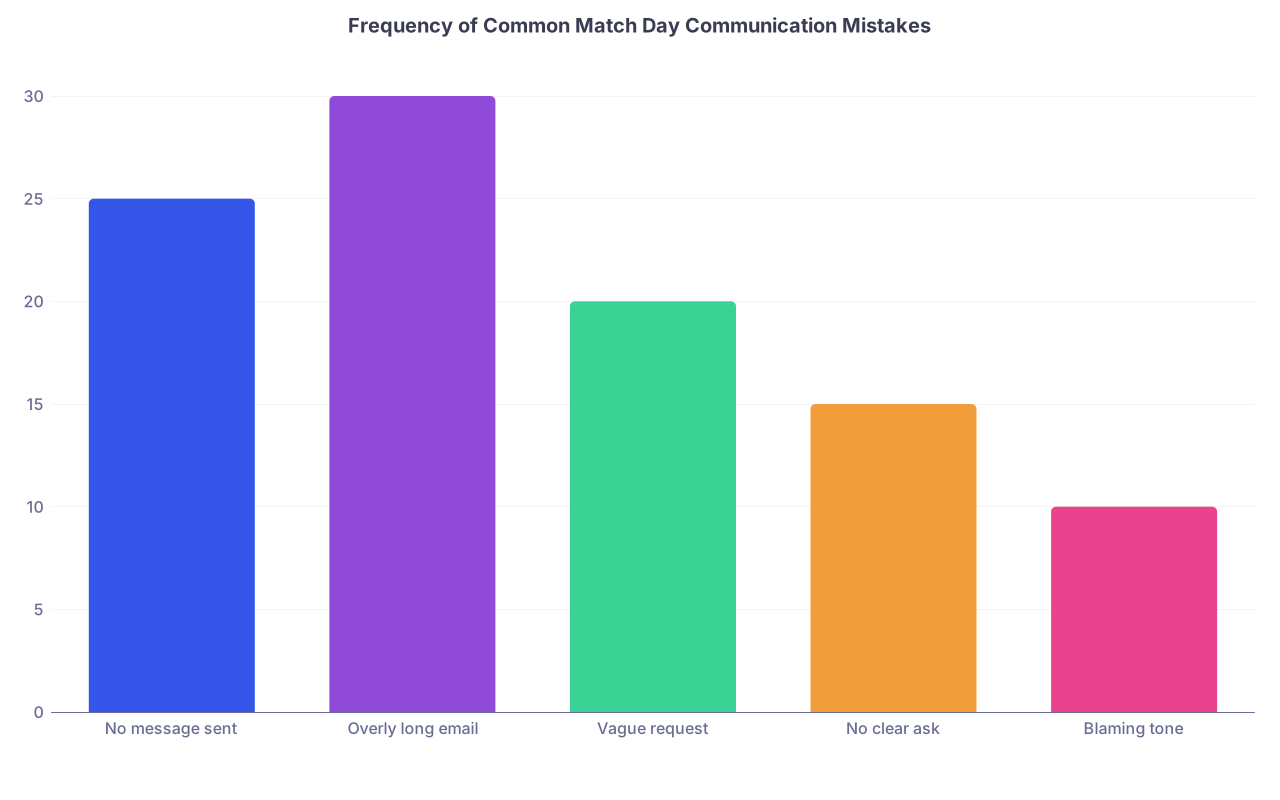
| Category | Value |
|---|---|
| No message sent | 25 |
| Overly long email | 30 |
| Vague request | 20 |
| No clear ask | 15 |
| Blaming tone | 10 |
8. Subtle But Critical Phrasing Choices
Words signal professionalism. A few swaps change the way your email lands.
A. Avoid overly emotional framing in first contact
Bad:
- “I am devastated and do not know what to do.”
- “This was my dream and I have no backup plan.”
Better (for first contact):
- “I am disappointed with the outcome, but I want to approach the next steps thoughtfully.”
- “This was not the result I hoped for, and I am trying to make a realistic plan moving forward.”
Raw emotion is for friends, family, therapist, or very close mentor in a scheduled conversation. Your first contact with broad mentors should be controlled so they can think clearly about how to help.
B. Show agency, not passivity
Bad:
- “I am waiting to see what happens.”
- “I do not know what my options are.”
Better:
- “I am working with our dean’s office to understand my options and potential paths, including [X/Y].”
- “I am exploring [research year / prelim options / reapplication] and would appreciate your perspective on which path is most realistic.”
Faculty help students who help themselves. Your language should scream: “I am disappointed but functional.”
C. Never, ever blame a specific person or program in early emails
Do not write:
- “I think [Program] made a mistake not ranking me higher.”
- “My lack of interviews was due to [specific faculty, dean, or school].”
If there were structural problems, they come up in deeper conversations later, not your opening line. Your first task is to show insight into your application, not everyone else’s faults.

9. Follow‑Up Timing and How Not to Be Forgotten
The other big failure mode: students send one email on Match Day and then disappear. Relationships decay. Opportunities go to the students who stay on the radar—without being annoying.
A. After a positive Match
Timeline:
- Match Day: send the brief update + thanks
- End of MS4 / graduation month: one follow‑up
Graduation follow‑up email:
Dear Dr. [Last Name],
I wanted to share a brief update as graduation approaches. I will be starting [Specialty] residency at [Program] this July. I remain very grateful for your mentorship and for your support of my application.
If you are ever in [city of residency] or at [relevant conference], I would be glad to connect. I hope to keep you updated as I progress through residency and explore opportunities in [subfield or interest].
With appreciation,
[Name]
Short. You remind them who you are and where you are headed. That is how people remember to nominate you for things later.
B. After an unmatched / SOAP outcome
Timeline:
- Day of NRMP “Did not match”: short update
- After SOAP + meeting with dean: full email + request for meeting
- After meeting: one thank‑you
Post‑meeting thank‑you:
Dear Dr. [Last Name],
Thank you again for taking the time to speak with me about my Match outcome and options for the coming year. I appreciated your candid feedback regarding [X specific insight].
I am planning to [summarize agreed plan in one line]. I will keep you updated as these plans take shape and as I prepare for [reapplication / alternative path].
Thank you again for your support.
Sincerely,
[Name]
That last piece—reflecting back what they told you—is how mentors feel heard and invested.
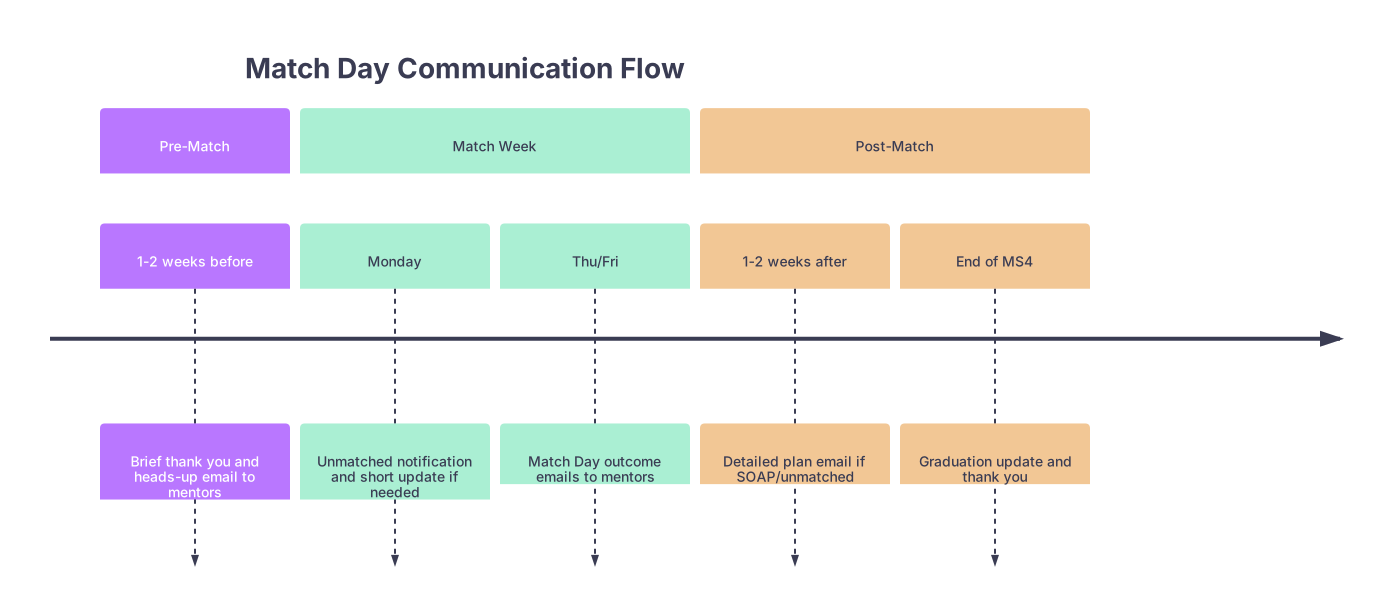
| Period | Event |
|---|---|
| Pre-Match - 1-2 weeks before | Brief thank you and heads-up email to mentors |
| Match Week - Monday | Unmatched notification and short update if needed |
| Match Week - Thu/Fri | Match Day outcome emails to mentors |
| Post-Match - 1-2 weeks after | Detailed plan email if SOAP/unmatched |
| Post-Match - End of MS4 | Graduation update and thank you |
10. Quick Phrases You Can Steal Word‑for‑Word
Let me finish with a small set of plug‑and‑play lines you can drop into almost any situation.
For gratitude:
- “Your mentorship has had a significant impact on my path, and I am very grateful.”
- “Thank you for investing so much time in my development as a student and applicant.”
For disappointment without drama:
- “The outcome was not what I had hoped for, but I want to approach the next steps thoughtfully and realistically.”
- “I am disappointed but trying to focus on what I can control going forward.”
For asking for honest feedback:
- “I would appreciate your honest assessment, even if it is difficult to hear.”
- “If I were your own resident or child, what would you advise in my situation?”
For asking for a letter:
- “If you feel you can write a strong letter on my behalf, I would be very grateful.”
- “I know you are busy, so I am happy to provide any materials that would make this easier.”
For closing emails:
- “Thank you again for your mentorship and support.”
- “I appreciate your time and consideration.”
Use them verbatim if you like. They read as professional, not robotic.
The Takeaway
Three points to keep tight in your mind:
- Your Match Day language should always do three jobs: state the outcome clearly, show composed professionalism, and make a specific ask (or explicitly defer the ask to later).
- “If you feel you can write a strong letter” and “I would appreciate your honest feedback” are not fluff—they are signals that separate mature applicants from everyone else.
- Match Day is a relationship event as much as it is a result event. The students who communicate clearly, briefly, and respectfully with mentors and letter writers build the kind of long‑term support that outlasts one match cycle.