

Match Day does not “bring out your true self.” It amplifies whatever stress habits you already have. If you go into it without a plan, the day will run you over.
You need a protocol. Hour by hour. Decision by decision. Instead of white‑knuckling it through the longest 24 hours of medical school.
I am going to lay out a structured 24‑hour coping protocol you can follow on Match Day (and the week of) whether you:
- Matched your top choice and feel oddly numb
- Matched, but much lower on your list
- Scrambled through SOAP and feel gutted
- Did not match at all
- Or are just completely overwhelmed and dissociated by the whole thing
You do not need more platitudes. You need a script.
1. Before Match Day: Build Your Emergency Plan
If you are reading this before Match Day, good. This is where most people screw up—they improvise on the most emotionally volatile day of their training.
You will be in no condition to “figure it out” when the email hits. So you pre-load decisions now.
1.1 Decide Your Match Day “Containment Rules”
You are not trying to have the “best day ever.” You are trying to prevent:
- Catastrophic decisions made in the first 6 hours
- Relationship damage (saying things you cannot unsay)
- Self-destructive behavior (substance use, self-harm, burning bridges online)
Set these rules in advance. Write them down. Share them with one trusted person.
At minimum:
No major life decisions for 72 hours
- No quitting medicine
- No burning your ERAS account
- No furious emails to program directors
- No “I am withdrawing from the Match” posts
No social media posting for 24 hours
- You can scroll if you must (I would advise against it), but no posting
- Especially not vague, angry, or drunk posts
Limit how many people you tell and how fast
- Pre-pick:
- 1–2 people you will text immediately
- 1–2 people you will talk to by phone
- Everyone else can wait 24–48 hours
- Pre-pick:
Alcohol and substances are capped
- Decide the max (e.g., 1–2 drinks total, or zero for today)
- Tell a friend your plan. Ask them to hold you to it.
No comparison spirals
- You are forbidden from:
- Comparing rank numbers
- Saying or thinking “I only got X, while they got Y”
- You may feel it. You do NOT have to feed it with behavior.
- You are forbidden from:
1.2 Build Your 24-Hour Logistics Skeleton
You will plug your emotions into this later. For now, you design the scaffold.
Write this out:
Where will you physically be at email time?
- Alone? With classmates? With your partner?
- Pick what will feel least destabilizing, not most “Instagrammable.”
What is your plan for the 4 hours after the email?
- A walk? Brunch? A nap? A workout?
- Who is allowed in that window? (Name them.)
Who is your emergency contact team?
- 1 emotional support person (friend/partner/family)
- 1 professional support (mentor, advisor, therapist if feasible)
- 1 practical support (someone who can bring food/drive/check in on you)
Write their names and numbers on a physical card. This is not dramatic. It is smart.
2. Match Day: The First 2 Hours (Acute Shock Window)
Here is where things get real. The email hits. Your stomach drops. Whether it is joy, relief, disappointment, or total devastation—your brain is flooded.
The next 120 minutes are where you do the most damage. Or the most good.
2.1 The 10-Minute Immediate Response Protocol
As soon as you read the result, do not move on autopilot. Follow this script.
Step 1: Physical reset (2–3 minutes)
- Put both feet flat on the floor
- Sit or stand upright, shoulders back (posture matters)
- Do this breathing pattern:
- Inhale through nose for 4 seconds
- Hold for 4 seconds
- Exhale through mouth for 6 seconds
- Repeat 6–8 times
This is not “woo.” It manually turns down your sympathetic surge.
Step 2: Label what happened in one neutral sentence (1 minute)
Out loud, say:
- “I matched at ___ in ___ specialty.”
- Or “I matched, not where I wanted.”
- Or “I did not match.”
Not a story. Just facts. Your brain will rush to write a novel. Do not let it—yet.
Step 3: Contain your first impulse (5 minutes)
For the next 5 minutes you do not:
- Text the entire class or group chat
- Post on social media
- Call that one attending you are afraid of disappointing
You are allowed to:
- Sit quietly
- Cry
- Laugh
- Swear
- Write a few words in a notes app like:
- “I feel numb.”
- “I feel sick.”
- “I am relieved and confused.”
You are doing one thing here: slowing down. You are buying time from your own nervous system.
3. Hours 2–6: Structured Response for Each Scenario
Now we divide. Your protocol depends on what screen you just saw.
3.1 If You Matched Your Top Choice (and Still Feel Overwhelmed)
Oddly, a lot of students in this group feel guilty, anxious, or disconnected. Sometimes more than the people who did not match.
Your 4-hour protocol:
Step away from the comparison fire
- Limit social media to short, intentional check-ins
- Do NOT scroll other people’s match lists for longer than 5–10 minutes
Anchor your reality with a 10-line exercise Pull up a doc or paper and write exactly 10 lines:
- 3 lines: what you are grateful for about this match
- 3 lines: what scares you about this match
- 3 lines: what you are proud of in how you got here
- 1 line: one concrete thing you will do today to celebrate
Plan a modest, controlled celebration
- Small group meal
- Walk + coffee with a friend
- Video call with family
You want enough celebration to mark the milestone, but not so much that you wake up tomorrow hungover and confused.
- Defer all future anxiety to a scheduled time
- Put an event on your calendar: “Future planning: residency logistics” for 3–5 days from now
- This is where you will think about moving, housing, money, etc.
- If those thoughts pop up today, tell yourself: “That is for Wednesday.”
3.2 If You Matched, But Far Below Your Rank List
This is the group that gets the worst advice. You will hear a lot of:
- “At least you matched.”
- “Everything happens for a reason.”
Unhelpful. Here is what to actually do.
First 4 hours: The “Stabilize and Protect” Protocol
Allow private disappointment
- You are allowed to grieve the program and city you wanted
- Find a private space. Set a 15-minute timer.
- Cry. Swear. Rant into a voice memo that you will never send.
Protect your story from other people for one day
- You do NOT owe anyone a polished, positive narrative today
- Use a script:
- “I matched in X specialty. I am still processing it, I will share more later.”
Separate two questions in your mind
- “Am I disappointed by the program/location?”
- “Am I ashamed of my worth as a future physician?”
They are not the same. Do not merge them. The second one is the lie.
Do a 3-column “Reality Check” sheet (20 minutes)
Draw three columns and fill them:- Column 1: “What I am afraid is true”
- Column 2: “What I actually know”
- Column 3: “What I can control in the next 6 months”
Example fears and corrections:
| Fear Thought | What I Actually Know | What I Can Control |
|---|---|---|
| My career is ruined | This program is fully accredited | How hard I work and show up |
| No one good matches here | A resident I respect trained there | My attitude on day one |
| I will never get fellowship | People from less-known programs match every year | Research, mentorship, performance |
- Plan one “engagement act” with your matched program
Today or tomorrow, do ONE of these:
- Re-read the program website and identify 1–2 faculty you are genuinely curious about
- Draft a short email of gratitude to the program coordinator or PD to send in 24–48 hours
You do not have to love it yet. You just have to move one inch toward accepting that this is your team.
3.3 If You Matched Through SOAP or in a Backup Specialty
The emotional weight here is heavy: shame, exhaustion, and a lingering sense of failure even though you did secure a spot.
Your 4-hour “Decompression and Reframe” Protocol:
Name what just happened
- “I went through SOAP and matched.”
- Or “I pivoted to a backup and matched.”
This was not an accident. You did something very hard, under pressure, successfully.
Clean up the cognitive distortions Take 15 minutes and list:
- Every thought that starts with “Real residents in X specialty…”
- Every thought that starts with “People will think…”
For each one, write a counter example:
- A SOAP resident who thrived
- A backup specialty resident who built a great career
You probably personally know at least one. If not, ask an attending. They will rattle off multiple names.
Limit storytelling to a very small circle today
- One trusted friend or partner
- One mentor if you feel up for it
Script:
- “This week was brutal. I am grateful to have matched, but I am still sorting out how I feel. I could use support, not advice today.”
Schedule a “Career Strategy” call—but not today
- Email or text a mentor:
- “I matched in X after going through SOAP. I would value a conversation about how to make the most of this path. Could we talk next week?”
Knowing that talk is coming calms down the “my whole life is off track” panic.
- Email or text a mentor:
3.4 If You Did Not Match
This is the hardest scenario. It is also far more common than people admit.
You will be tempted to draw large, absolute conclusions:
- “I am not meant to be a doctor.”
- “I am behind everyone; I can never recover.”
Both are wrong. But your body will not believe that yet. So we go stepwise.
First 4 hours: The “Acute Triage” Protocol
Get physically safe and not alone
- If you are at home: text someone to come over or stay on FaceTime
- If you are at school: find a quiet office/room and ask a friend to sit with you
Stabilize your body
- Drink water
- Eat something with protein and carbs (not just caffeine or alcohol)
- Take a 5–10 minute walk, even in circles
Use a tight language container For today:
- Only say: “I did not match this cycle.”
- Avoid: “I failed,” “My career is over,” “I am a disaster.”
You can feel those things. You do not need to speak them into existence.
Contact one professional support
- Email or page:
- Your student affairs dean
- Your specialty advisor
- Or a general advisor if you do not have a specialty one
Template:
Subject: Did not match – request for guidance
Dear Dr. ___,
I wanted to let you know that I did not match this cycle. I am feeling overwhelmed and would really value your guidance on next steps.
Could we schedule a brief meeting in the next few days to review my application and discuss options?
Thank you,
[Your Name]- Email or page:
You are not solving your career in 4 hours. You are securing a roadmap conversation.
4. Hours 6–12: Controlled Communication and Boundaries
By now, the initial surge has slightly dropped. This is when family, classmates, and social media really start to press in.
You need a communication protocol. Otherwise, you will say yes to everyone and collapse later.
4.1 Define Your “Inner Circle” vs “Outer Circle”
Inner circle (3–8 people):
- Get the full version of your story over the next 24–48 hours
- You can be unfiltered, upset, confused
Outer circle (everyone else):
- Gets a simple, one-sentence update
- You are polite, but not emotionally available
Suggested language:
Inner circle text:
- “I matched, but not where I hoped. I could really use a call later if you have time.”
- “I did not match. I am safe but pretty shaken. Can we talk tonight or tomorrow?”
Outer circle text/social:
- “Matched into [specialty]. Grateful and processing a lot—more soon.”
- Or if you did not match and do not want to share yet:
- You do not owe anyone a statement today. Silence is allowed.
4.2 Handle Social Media Intentionally (Not Emotionally)
Strong recommendation: do not sit there doom‑scrolling.
If you insist on checking:
- Set a 10–15 minute timer
- Decide in advance:
- “I am only going on to congratulate 3–5 close friends, then I am logging off.”
If you feel your body react—tight chest, heat, nausea—log off. This is real physiological stress, not just “envy.”
4.3 Set a Script for Difficult Conversations
You will get questions you do not want to answer. Pre-write your responses.
If you matched somewhere lower than expected:
- “Yes, it was lower on my list. I had a complex application season. I am focusing on making the most of this opportunity.”
If you matched through SOAP:
- “The week was rough, but I ended up in a spot that gives me a clear path forward. I am still unpacking it.”
If you did not match:
- “I did not match this year. I have support from my school and we are working on next steps. I am not ready to go into details yet, but I appreciate you asking.”
Say it word-for-word if you need to. You are not required to improvise while you are emotionally concussed.
5. Hours 12–24: Reset, Reflect, and Plan Your Next 3 Steps
The back half of Match Day is about two things:
- Preventing a crash that carries into the next week
- Setting up the first small moves of your longer recovery or adjustment
5.1 Mandatory Physical Reset
Tonight, before bed, you do three non-negotiables:
Eat a real meal
- Actual protein, carbs, and fats—not just snacks or alcohol
Take a 10–15 minute “off-phone” walk or shower
- No music, no podcasts, no texts
- Let your nervous system finish a full stress cycle
Enforce a screens-off cutoff time
- At least 30–60 minutes before sleep
- Your brain is fried. Bright screens and more social comparison will not help.
Sleep might be poor tonight. That is fine. You are not aiming for perfect. You are aiming for “not catastrophic.”
5.2 A Structured 20-Minute Reflection (Not Rumination)
Before bed or the next morning, do this on paper, not in your head.
Part 1: What actually happened today (5 minutes)
Write bullet points, not a memoir:
- Where you matched / did not match
- Who you spoke to
- One thing that surprised you
- One thing you handled well
Part 2: Feelings inventory (5 minutes)
Under three headings, list words (not explanations):
- “I feel…” (disappointed, relieved, numb, angry, proud, ashamed, etc.)
- “I am afraid that…”
- “I hope that…”
You are giving your brain a container so it does not spill all over your sleep.
Part 3: The “First 3 Steps” list (10 minutes)
No grand life plan. Just three concrete actions for the next 7 days.
Examples:
- Email advisor / schedule meeting
- Read through program welcome packet
- Draft but do not send emails to PDs or faculty
- Start a budget for moving
- Block out 2 therapy or counseling visits if you have access
Write them. That is enough for tonight.
6. Special Protocols: High-Risk Traps to Avoid
There are a few patterns I have seen wreck residents and students on Match Day and its aftermath. You will be tempted by at least one of these.
6.1 The Drunk Venting Call or Text
You know this one:
- You drink
- You call or text:
- An attending
- A previous research mentor
- An ex
- Or a class group chat
You overshare, sob, rage, or all three. You wake up mortified.
Protocol:
- Put a sticky note on your laptop or desk: “No drunk calls. No program emails tonight.”
- If you plan to drink, hand your phone to a trusted friend after your second drink. Yes, seriously.
6.2 The Angry Email to a Program Director
You will feel the urge to explain, demand feedback, or call out perceived unfairness.
Do not.
If you absolutely must write it, do this:
- Draft the email in a separate document
- Label the file “DO NOT SEND – EMOTIONAL DUMP”
- Let it sit for 72 hours
- Show it to a mentor before sending anything to a PD
99% of the time, you will never send it. And you will be very glad.
6.3 The “I Need to Redo My Entire Life” Spiral
This usually looks like:
- Googling alternative careers at 2 a.m.
- Looking up PA / NP / MBA / coding bootcamps in a panic
- Telling yourself you “wasted 8 years”
These are not rational plans. They are pain-avoidance fantasies.
Temporary rule:
No career-altering decisions or applications for at least 30 days after Match Day if you did not match, and 90 days if you did.
You can explore options in conversation. You do not commit yet.
7. If You Did Not Match: The Next-Week Stabilization Framework
You wanted a 24-hour protocol. You got it. But if you did not match, I am not leaving you there.
Here is the basic skeleton for the first week after not matching:
7.1 Day 1–2: Data Gathering
- Meet with:
- Student affairs / dean
- Specialty advisor or general advisor
Ask for:
- Download of how many interviews you had vs typical norms
- Honest assessment of:
- Scores
- Grades
- LOR quality
- Red flags
Request specific questions:
- “If you were in my shoes, what would you do for the next 12 months?”
- “What 2–3 things most limited my application this cycle?”
7.2 Day 3–5: Option Mapping
You should now be filling out a very simple table like this:
| Path | Timeframe | Main Goal |
|---|---|---|
| Reapply same specialty | 1 year | Strengthen application |
| Switch to less competitive specialty | 1 year | Secure residency position |
| Research year | 1–2 years | Publications, networking |
| Preliminary / transitional year | 1 year | Gain US clinical experience |
| Non-clinical bridge job | Variable | Income and stability |
With each advisor, you are trying to rank these options in terms of fit and feasibility. Not committing yet. Just understanding.
7.3 Day 5–7: Commit to a 30-Day Action Plan
You are not forced to know your 5-year career path. You are responsible for a 30-day plan, for example:
- Revise CV and personal statement
- Identify 5–10 potential research mentors to contact
- Arrange observerships or additional clinical work
- Clarify what exams/steps you need to retake or strengthen
Write it out, week by week. That way, every time your brain screams “you are stuck,” you have proof that you are actually moving.
8. One Visual: How Your Coping Capacity Shifts Over 24 Hours
Here is how most people’s mental load and coping capacity look over the Match Day period:
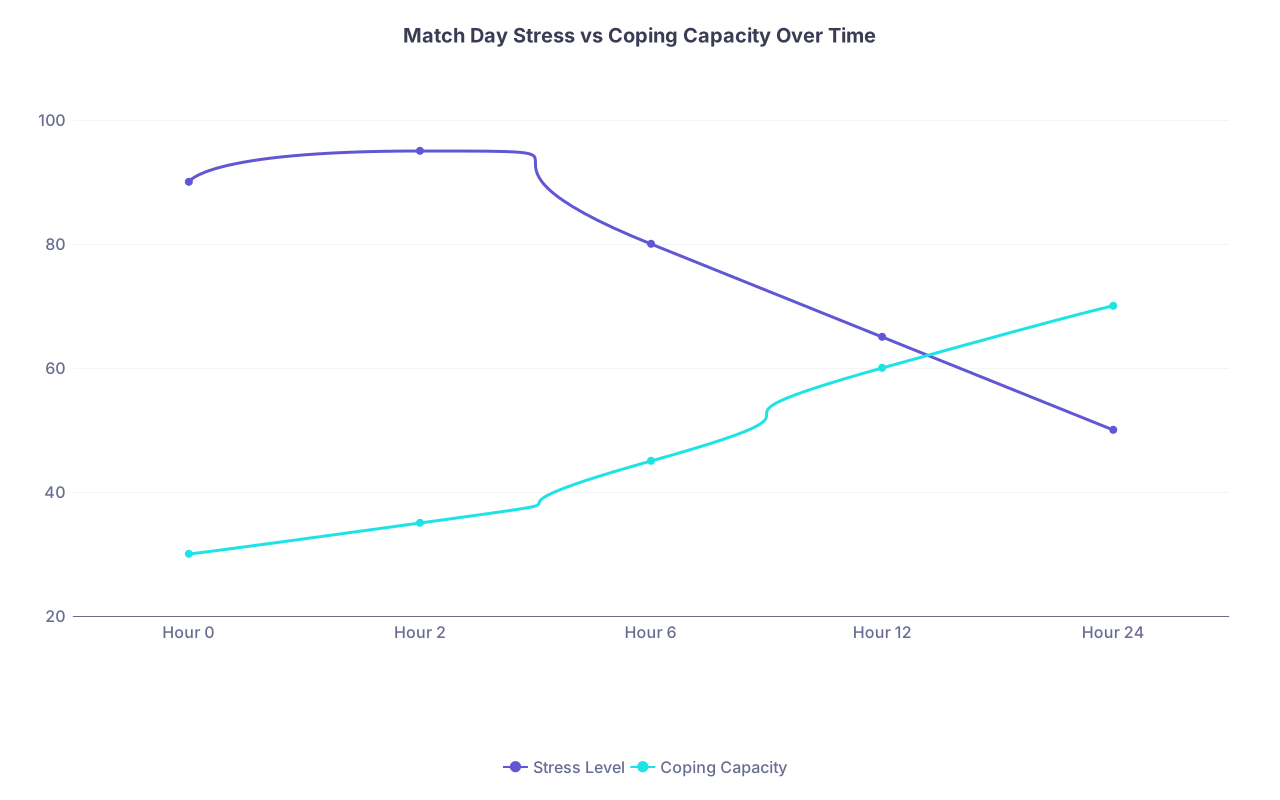
| Category | Stress Level | Coping Capacity |
|---|---|---|
| Hour 0 | 90 | 30 |
| Hour 2 | 95 | 35 |
| Hour 6 | 80 | 45 |
| Hour 12 | 65 | 60 |
| Hour 24 | 50 | 70 |
The protocol I gave you is designed to:
- Keep the stress curve from spiking into “do something irreversible” territory
- Push the coping capacity curve up faster with structure and support
Match Day will still hurt if the outcome was not what you wanted. This is not anesthetic. It is a brace so the joint heals in the right position.
9. How to Use This Protocol in Real Life
Do not just “remember the ideas.” That will fail when your heart is racing and your inbox dings.
Here is exactly how to operationalize this:
- Print or save this as a PDF.
- Highlight:
- The scenario section that fits you (top choice, lower choice, SOAP, no match)
- Write your actual scripts in your notes app:
- Inner circle text
- Outer circle text
- Difficult conversation answers
- Create a tiny Match Day folder:
- “Scripts.txt” with your sentences
- “Emergency contacts” with your 3 people
- “First 3 steps” doc for your next week
Then, when the email hits, you are not starting from zero. You are following a protocol you built when your brain was still mostly online.
Match Day does not define your worth. It does shape your next few years. How you respond in these first 24 hours shapes far more.
Here is your next move:
Open your calendar right now and block a 30-minute slot titled “Match Day Plan.” During that slot, rewrite the key scripts and rules from this protocol in your own words and save them where you will see them the morning of Match Day.


