
Last March, while you sat in your apartment pounding the refresh button on your inbox, a program director I know was in a windowless conference room, holding a Styrofoam coffee cup he’d already refilled three times. The clock hit 11:59 a.m. Eastern. He turned to his coordinator and said, “Okay. Let’s see who we got—and who we lost.”
If you think Match Day is just your moment of truth, you’re missing half the story. On the other side of the screen, PDs are watching a completely different set of numbers, names, and quiet disasters unfold in real time.
Let me walk you through what they’re actually looking at while you panic-refresh your email.
The Room You Never See on Match Day
The fantasy is that there’s some dramatic “reveal” for programs too. There isn’t. No confetti, no champagne. Just people in bad ergonomic chairs staring at spreadsheets.
Most mid-to-large residency programs do some version of this:
They meet in a conference room—PD, associate PDs, maybe a couple of key faculty, and the program coordinator who actually keeps the whole ship from sinking. Smaller programs might do it from their offices individually, but the tools are the same.
Here’s the first insider truth: by Match Week Monday, your fate is already mathematically determined. By Friday, they’re not deciding anything about you. They’re watching the results of decisions they already made weeks ago.
The PD has two main things open:
- The NRMP results portal for programs
- Their internal rank spreadsheets / database
Your name, if you matched there, is not appearing like fireworks with your smiling photo. It’s a line in a table that just moved from “possible” to “confirmed.”
They’re watching three things in the first five minutes:
- Did we fill?
- If not, how badly did we get hit?
- Who did we actually get from the top of our list versus the bottom?
And that third one changes the mood of the room instantly.
What They See on the NRMP Screen While You Hit Refresh
Let’s be specific, because vague doesn’t help you.
On Match Day, program directors see a report that basically says: here are the applicants who matched to your program, in rank order. They already know their own rank list; what they don’t know is how the algorithm paired that with all the lists from other programs.
So on that screen, they’re looking at:
- The full list of matched residents, with NRMP IDs
- Each person’s position on their rank list
- Whether the program filled all its spots
- Sometimes consolidated institutional reports (for leaders of multiple programs)
No one’s clicking into your ERAS personal statement at this point. They’re not re-reading your letters. They’re not reviewing your AOA status. That ship sailed when they certified the rank list.
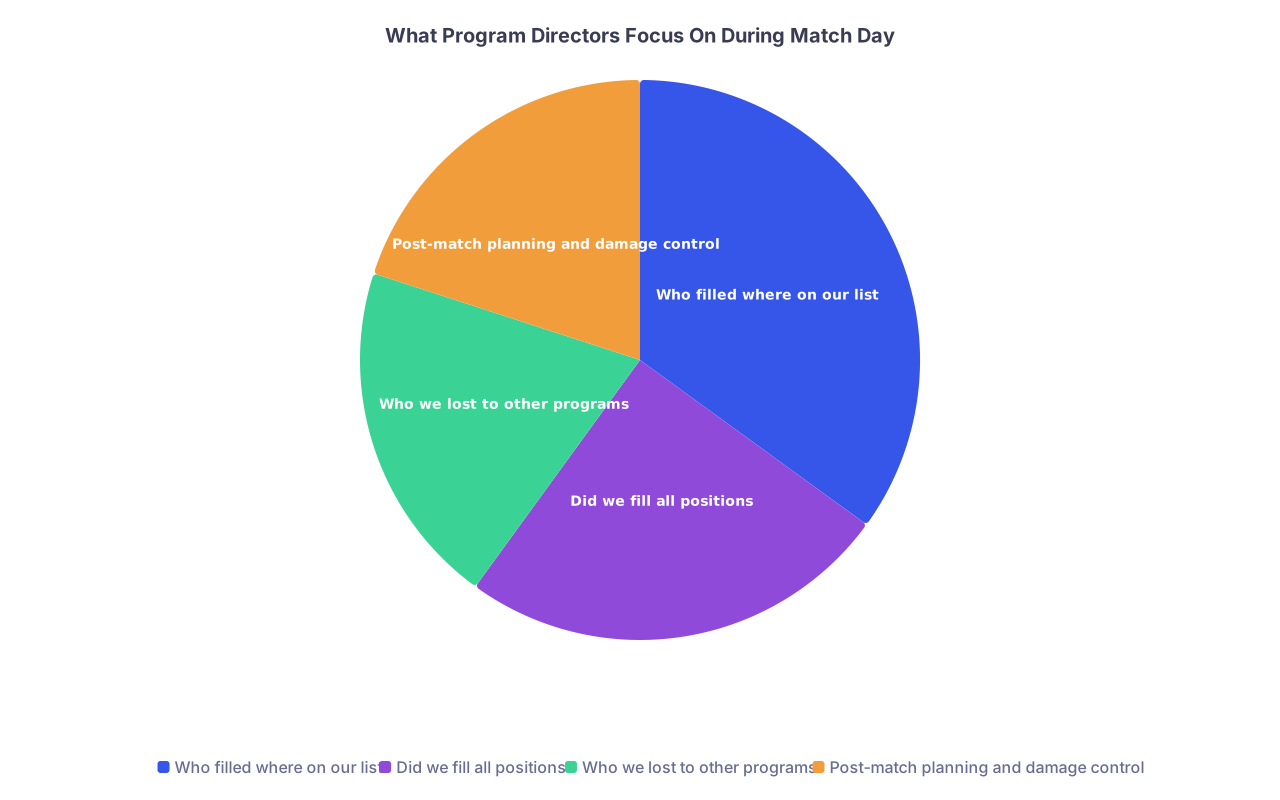
| Category | Value |
|---|---|
| Who filled where on our list | 35 |
| Did we fill all positions | 25 |
| Who we lost to other programs | 20 |
| Post-match planning and damage control | 20 |
Instead, they’re asking brutal questions like:
- “We ranked her #5—why did she go to [competing program] instead?”
- “We filled, but we’re heavy on IMGs this year—how’s that going to play politically?”
- “We slipped further down the list than last year. Are we losing our edge?”
They also get comparison data across years. Trust me—nobody forgets if they filled all spots for the last ten years and then suddenly didn’t.
That’s what they’re watching while you’re refreshing: their own status, reputation, and trend line.
The One Metric PDs Obsess Over (That You Never See)
You’re fixated on “Did I match?” PDs are focused on something else: match position.
Not just who they got, but where you were on their rank list when the algorithm stopped.
I’ve watched PDs go down their results saying things like:
- “Nice, we got our top three.”
- “Hmm, our first US MD didn’t show up until #7. Not great.”
- “Wait—how did we match down to the 40s on this track?”
Here’s the unspoken hierarchy in their heads:
- Top 5–10 on the list: “We’re competitive. They chose us.”
- Middle third: “Solid. Reasonable outcome.”
- Bottom third: “We slipped. Market sees us as a backup.”
That’s the emotional reaction driving what happens in that room.
And this is where your rank list strategy suddenly matters to them. If you ranked their mid-tier program number 1 over a “brand name” place, they notice that pattern in aggregate over time. Maybe not your individual decision, but the way applicants vote with their rank lists.
They’re not just asking “Did we fill?” They’re asking, “Did we match where we should be matching?”
The Quiet Autopsy: Who They Lost You To
This is the part nobody tells you about: PDs absolutely talk about where they “lost” certain applicants.
Every year, there are a handful of names they really care about. That one away rotator who was a rock star. The research fellow they invested in for two years. The sub-I who everyone swore would “definitely rank us #1.”
On Match Day, they scroll down and see:
- That person’s name isn’t on their match list.
- Or worse: their name shows up on someone else’s institutional report.
And then they start doing forensics.
If they know you well, they may already have a sense of where you were leaning. But if they were blindsided, I guarantee you’ll hear some version of this behind closed doors:
“Where did she go?”
“[Program X].”
“Seriously? Over us?”
“Yeah. They must’ve ranked us low.”
“What did they offer that we didn’t?”
They’re not blaming you. They’re benchmarking themselves.
A lot of PDs keep informal lists of:
- High-priority applicants they hoped to land
- Where those people ended up
- Any patterns: bleeding applicants to one specific competitor, losing research-heavy candidates, etc.
Those patterns affect future recruitment. Whether they double down on research, change interview style, push more resident involvement, or fix some toxicity rumor that’s scaring people off.
Your rank list decisions become their feedback loop—even if you never say a word.
What Happens If a Program Does NOT Fill
While you’re thinking, “Did I match?” some PDs are facing a worse question: “Did we just partially or fully bomb this Match?”
If a program doesn’t fill, here’s what Match Day looks like for them:
11:59 a.m. – Portal refresh. Their hearts sink. Number of unfilled positions shows up.
12:00–12:05 p.m. – Very quick, very tense conversation:
- “How many spots?”
- “Which tracks?” (categorical vs prelim vs advanced)
- “How bad does this look for the department?”
Now comes SOAP reality. Yes, they already started contingency planning on Monday if they saw “unfilled” then, but Match Day confirms how fully they recovered (or didn’t).
They’ll be staring at:
- How many positions went into SOAP
- Who they got out of SOAP vs where they hoped to match originally
- How this compares to last year’s disaster/success
They’re also doing damage control with:
- Department chairs: “We’re addressing it.”
- GME leadership: “Here’s why this happened and how we fix it.”
- Existing residents: “Yes, we filled the class, no, you’re not going to be doing double the work.”
You’re refreshing your inbox to see one life-changing line. They’re refreshing to see whether they have a career-threatening PR problem on their hands.
The Internal Spreadsheet You Never Knew Existed
ERAS and NRMP are just the visible layer. Underneath that, almost every serious program runs their own internal system—Excel, Access, some janky custom database, or a centralized institutional system.
I’ve seen these spreadsheets. They’re ugly, color-coded nightmares. And they’re everything.
Your row usually includes:
- Name and NRMP ID
- School type (US MD, DO, IMG)
- Step scores / COMLEX
- Interview score (numeric or tiered)
- Categorical flags: “red flag”, “star”, “great fit”, “concerns”
- Research quantity/quality
- Home vs away rotator status
- Diversity considerations, language skills, special niches
On Match Day, they line up:
- The NRMP “final” matched list
next to - Their rank list / evaluation grid
And they basically check:
- Did we get the people who impressed us most on interview day?
- Did we unintentionally bias toward certain profiles?
- Did our “fit” categories actually predict who we matched?
| Column | What It Really Tracks |
|---|---|
| Interview Score | Faculty gut feeling quantified |
| Tier / Priority Flag | Who they really wanted |
| School Type | Prestige and perceived safety |
| Red Flag Notes | Any risk to team or PR |
| Diversity / Skills | Language, background, niche |
On your side, it feels like the algorithm is God. On their side, the algorithm is just the final step in a long chain of subjective human choices, recorded in a grid no applicant ever sees.
The Emotional Side You Don’t See
You’re not the only one sweating.
I’ve watched seasoned PDs—people who run multimillion-dollar programs, who speak at national conferences—look genuinely anxious in the ten minutes before Match results drop.
Here’s why:
- A bad match year can hurt their reputation nationally.
- Failing to fill can be ammo for internal enemies (yes, they exist).
- Matching poorly can validate every whisper about the program going “downhill.”
When the list looks good—strong candidates high on their rank list, maybe they landed a couple of “reach” applicants—they relax. The jokes start. They start Googling you, checking your photo, pulling up your ERAS again just to put a face to the name.
When the list looks rough—heavier on lower-ranked candidates, fewer US grads than expected, several beloved interviewees gone—the whole tone shifts. You feel joy or heartbreak as an individual. They feel victory or failure as a program.

And yes, residents are sometimes pulled in too. I’ve seen chiefs brought into the room to react:
- “You’ll like this one—she was the sub-I who ran circles around everyone.”
- “Heads up, this guy’s got visa issues, we’ll need your help prepping coverage if it delays.”
- “We matched three from [School X] again; you’re basically their satellite program now.”
You’re wondering if they even remember you. They do. Maybe not every single name, but the standouts? The problematic ones? The incredible team players? Those are very much discussed.
What This Means for How You Should Approach Match Day
Let me be blunt: by Match Day, you have zero control. But understanding what’s happening on their side helps you make better choices in the months before.
The things PDs are actually watching on Match Day should change how you think about:
Where you interview and rotate.
Away rotations and strong impressions are remembered at the moment they build that internal spreadsheet. That’s how you become one of the names they’re actively looking for on Match Day.How you signal interest.
They care—deeply—about whether they seem to be your “backup” or your true #1. Your communication, consistency, and genuine engagement before rank lists are certified shape that feeling.How realistic your rank list is.
If you only rank “dream” programs and then a long tail of places you barely know, your pattern becomes noise. The applicants who strategically build lists that align with how programs see themselves tend to produce the cleanest matches—for both sides.

| Step | Description |
|---|---|
| Step 1 | Your Application |
| Step 2 | Interview Performance |
| Step 3 | Program Internal Ranking |
| Step 4 | Your Rank List |
| Step 5 | NRMP Algorithm |
| Step 6 | Program Match Results |
| Step 7 | Program Director Reaction |
Match Day is the output. The real work was months earlier in how you performed, how they rated you, and how your rank list intersected with theirs.
What PDs Are Already Planning While You’re Celebrating (or Hurting)
While you text your family or drown in disappointment, PDs are already moving to the next phase.
For a solid match year, they’re:
- Starting to think about how to integrate you into the call schedule
- Planning orientation, bootcamps, mentorship pairings
- Strategizing how to market this year’s match to future applicants (“Look who we attracted”)
For a weak or mixed year, they’re:
- Doing a postmortem: “Did we interview the wrong people?” “Are our filters off?”
- Calling mentors: “We lost three of our top candidates—what are you hearing about us out there?”
- Recalibrating how hard they’ll push for resources, spots, or curriculum changes
And here’s a little secret: some PDs are quietly tracking specific residents from Day 1 to see if their Match Day fears were justified.
The applicant they worried might be lazy—does that show up?
The person they thought was a bit fragile emotionally—does intern year break them?
The “reach” candidate they were thrilled to land—do they become the star they hoped?
Match Day is not the end of anything from their perspective. It’s the beginning of seeing whether their read on you was right.
What You Should Actually Do on Match Day
You can’t change their screen. You can only control your side of it.
On your end, Match Day should be about three things:
Contain the chaos.
You don’t need to be alone, but don’t set yourself up for a performance in front of 200 people either. Your nervous system does not need that.Prepare for both outcomes mentally before Friday.
If you matched: how you’ll respond, who you’ll call, how you’ll show gratitude to mentors.
If you didn’t: who you’ll contact, what concrete next steps to take, how you’ll resist the urge to disappear.Don't romanticize their reaction.
If you match at your top choice, they’re not throwing a party specifically for you. You’re one part of a complex system that either reinforced their confidence or raised new questions. That’s all.
But here’s the good part. For the PD who really believed in you, who went to bat in the ranking meeting, who pushed you higher than some faculty wanted—seeing your name on that Match list does feel personal. I’ve seen PDs smile quietly at one name and say, “Good. We got them.”
You won’t see that moment. Doesn’t mean it isn’t happening.