
It’s 9:02 a.m. on Match Day. Out in the auditorium, your classmates are screaming, crying, FaceTiming their parents. Inside a small conference room at a hospital across town, a program director has just refreshed the NRMP screen.
And sees it.
“Unfilled: 2 categorical IM positions.”
The room goes quiet. Someone swears under their breath. The coordinator pulls out a yellow legal pad they hoped not to use. The “we filled” celebration email draft stays unsent.
You want to know what happens in that room next. Because if you understand how programs react when they unexpectedly don’t fill, you understand leverage, strategy, and why SOAP feels like total chaos from your side.
Let me walk you through what actually goes on, step by step, from the program side. The stuff nobody puts in the NRMP manuals.
The Moment the Gap Appears: Internal Panic, External Calm
The NRMP fills notification hits early. Programs see the result before the public announcements, before students open envelopes, before Twitter lights up.
Inside that conference room, there are three basic categories of reaction:
- Programs that fully expected to fill and did.
- Programs that knew they were at risk and partially prepared.
- Programs that were arrogant or naive and are now staring at unexpected gaps.
Category 3 is where the real drama lives.
The PD refreshes, sees “Unfilled: 1 prelim, 3 categorical,” and the mood changes immediately. That fake confidence from interview season evaporates. Now the game isn’t “Who did we get?” but “How do we fix this without looking weak?”
The coordinator pulls up last year’s SOAP lists. The APD starts listing their strongest rotators who went unmatched. The chair asks the only question that matters: “How fast can we fill these?”
Here’s the part you don’t see: there is almost always a short moment of blame.
“We ranked too aggressively.” “We overreached for that couple.” “We should’ve sent more love letters.”
Then they shut it down and move straight into damage control mode. Because the clock has already started.
What Programs Knew Before Match Day (That You Didn’t)
Programs do not walk into Match Week blind. They’ve run internal projections based on:
- How many applicants ranked them high.
- Their changes in reputation (new PD, lost fellowship, ACGME citation).
- Interview season feedback from residents and faculty.
Some PDs even keep an internal “risk of not filling” scale. I’ve literally seen “High risk we don’t fill prelims” written on a whiteboard in December.
So by Match Day:
- They know which tracks are vulnerable (prelim surgery, prelim IM, transitional year, smaller community programs, new programs).
- They know which specialties are safe (big-name academic IM, derm, ortho, most big EM—though EM has its own mess right now).
- They’ve had a quiet conversation with GME: “If we don’t fill, are we allowed to over-hire, convert prelims, move funding?”
Some programs even build a SOAP contingency plan. Not all, but the better-run ones do. It looks something like this (though they’d never show you):
| Track | Fill Risk | Plan If Unfilled |
|---|---|---|
| Categorical IM | Low | Use SOAP if needed |
| Prelim IM | High | Convert 1 to categorical |
| TY | High | May leave 1 unfilled |
| Categorical Neuro | Moderate | Aggressive SOAP ranking |
So when gaps appear, good programs switch from “surprised” to “execute the plan” in about 10 minutes. Bad programs pretend they didn’t see it coming and scramble.
You can guess which environment you’d rather SOAP into.
The Closed-Door Huddle: Who’s in the Room and What They Argue About
By late morning of Match Week Monday, this is who’s typically in that closed room:
- Program Director (PD) – final say, owns the mess
- Associate/Assistant PD – usually the one with names and real intel
- Program Coordinator – runs NRMP interface and paperwork, quietly keeps everyone sane
- A chief resident – often the only one who tells the truth about resident capacity
- Sometimes the Department Chair or GME rep – especially for bigger gaps
First order of business: get past the ego.
Nobody wants to admit their program didn’t fill. In some departments, that’s practically a mark of shame. I’ve watched PDs try to spin a 3-spot gap as “strategic flexibility” to their chair. It doesn’t fly.
The real conversation behind closed doors goes like this:
“Do we absolutely have to fill all of these now?” “How many patients are on our census? How much call is already brutal?” “If we fill with weaker residents, what does that do to our board pass rate and reputation?”
The chief resident is usually the one who cuts through the nonsense: “If we don’t fill at least two of those, we’re dead on the wards by September.”
Then they look at funding. Some hospitals will let them convert a prelim to a categorical, or shift GME dollars between programs. Others are rigid: you fill what you matched for or you lose the funded slot.
This is where you see real differences between institutions. At a strong academic center, the chair will often say, “Fill them. We’ll support remediation if needed. Patient care comes first.” At weaker or financially strained hospitals, someone might say the quiet part out loud: “Maybe we don’t want to fill those; less payroll.”
That’s the ugly side. Yes, it happens.
How Programs Actually Use SOAP (Not the Polished Version You Hear)
From your side, SOAP looks like a black box: you apply, you wait, you hope.
From the program side, SOAP is a grind.
First: they get the list of unfilled positions they’re allowed to SOAP for. The PD sees their own program’s tracks, and an absurd list of applicants who expressed interest.
Then several urgent decisions happen:
Filtering by hard cutoffs.
Even in SOAP chaos, most programs hold to basic filters. Failed Step 1? Some won’t touch it. No Step 2 CK score? Many will pass unless they’re desperate. Too many attempts? You fall to the bottom.Prioritizing “known quantities.”
Programs aggressively look for:- Home students who didn’t match
- Students who rotated with them and were decent
- People they interviewed but ranked low
- People vouched for by someone they trust (“This kid had a bad day on Step but is excellent clinically.”)
Reassessing risk tolerance.
Before Match, programs can be picky. In SOAP, the conversation shifts:
“Will this person show up, pass boards eventually, and not be a major professionalism disaster?”
A lower score plus strong LORs can suddenly become acceptable.Ranking within SOAP.
This is the part nobody tells you: they run a mini–rank list again during SOAP. Often in a much more compressed, more emotional way. The PD will say things like:- “I’d rather run a position vacant than take someone with that many failures.”
- “This DO grad with a 220 and strong letters? I can work with that.”
And yes, they absolutely make some of those decisions in minutes.
What They’re Really Afraid Of When Filling Gaps
Programs don’t just fear being unfilled. They fear filling with people who will:
- Fail Step 3 repeatedly and threaten accreditation stats.
- Have major professionalism issues that trigger GME investigations.
- Become so chronically unreliable that co-residents threaten to quit.
So, behind closed doors, they’re less worried about your exact score or school name and more about two questions:
“Is this person safe to put on our wards by October?” “Will this person damage our culture or training environment?”
That’s why certain red flags get disproportionate weight in SOAP:
- Multiple exam failures: PDs have been burned by this.
- Big unexplained gaps: they read “chronic problem.”
- Weak or generic letters: in SOAP, they want someone to vouch strongly, not “performed at expected level.”
On the flip side, this is when strong, specific advocacy pays off.
I’ve watched a PD say, “I know this name. Their Sub-I attending from our institution called me and said they were one of the best students on the team.” That applicant jumped 20 spots up the SOAP mini-rank list on that sentence alone.
Converting, Restructuring, and Quiet Backroom Deals
Here’s another thing students don’t see: programs are not always stuck with exactly what’s on ERAS.
During SOAP and shortly after, programs might:
- Convert one prelim spot to a categorical spot to attract a stronger applicant.
- Offer a one-year position with a “likely” transition to categorical if performance is good (they never guarantee it in writing).
- Recruit an off-cycle resident outside the Match later in the year, especially IM and FM.
But the back-channel moves are where it gets interesting.
I’ve seen:
- PDs emailing colleagues directly: “We’ve got an extra slot we may fill off-cycle. Anyone you trust who didn’t match?”
- Departments quietly offering funded research or observer roles with a wink: “Perform well for a year, and we’ll strongly consider you for next cycle.”
None of that shows in official NRMP statistics. On paper, the gap is either filled or not. In reality, there can be a lot of maneuvering in the background for months.
How Desperation Changes Standards (And Where It Doesn’t)
Let’s be blunt: a program that unexpectedly did not fill is more flexible than it was two weeks before. But there are limits.
Where standards drop:
- They’ll accept lower Step scores than their usual average, as long as they’re passing.
- They’ll consider international grads they would’ve filtered out earlier, especially those with U.S. clinical experience.
- They’ll take a closer look at nontraditional applicants, older grads, career switchers.
Where standards stay firm:
- Repeated professionalism issues in the MSPE? Hard no.
- Multiple unexplained leaves or dismissals. Too risky.
- Clearly dishonest or inconsistent application content. Nobody wants a problem child under GME scrutiny.
Behind closed doors, you’ll hear lines like:
“I don’t care that his Step is 215. His letters say he works like a senior already.” or “I’d rather go short than deal with that kind of MSPE narrative.”
This is the difference between a human-driven process and a purely numerical algorithm. SOAP isn’t the time PDs choose “perfect.” It’s the time they choose “solid and safe.”
Why Some Programs Choose to Leave Spots Unfilled
Yes, that happens. On purpose.
The NRMP data you see each year showing unfilled positions? A chunk of those are programs that decided, after looking at the SOAP pool and their own risk tolerance, to say no.
The logic in that room goes something like this:
- “Our current residents are strong; we’d rather give them a slightly heavier workload than introduce a known high-risk trainee.”
- “Our ACGME board pass rate is on the edge; we can’t afford another likely failure.”
- “We might be able to recruit someone off-cycle, word-of-mouth, who’s safer.”
From a student perspective, this feels unfair: “Why would they rather burn out their residents than give me a chance?” From the program side, it’s not emotional at all. It’s math and risk management.
I’ve seen PDs agonize over it. But when forced to choose between short-term service strain and long-term accreditation jeopardy, some will take the short-term pain.
What This Means for You If You’re in SOAP or Worried About Gaps
You’re reading this for a reason. Either you’re afraid you’ll end up in SOAP, or you already did and you’re trying to decode why programs acted the way they did.
Here’s the unvarnished truth of how to position yourself in a world where programs sometimes don’t fill and sometimes refuse to fill:
You want to be the easiest “yes” in the room.
That means:
Make it insanely easy to say, “Safe, reliable, teachable.”
No vague narratives, no unexplained gaps, no weird half-truths.Stack credible human advocates.
Not just generic “pleasure to work with.” You want at least one attending who would, if asked, say: “Take them. They’ll make your life easier, not harder.”Show that you’re clinically functional on day one.
SOAP is not when PDs want to train someone from zero. They want someone who can write a note, follow up labs, communicate with nurses, and not fall apart on a call night.
And if you’re already in SOAP, understand what’s happening on the other side:
- They’re stressed.
- They’re trying to protect their resident cohort.
- They’re willing to bend but not break on risk.
So your emails, short statements, and any contact that gets to them? It should answer, implicitly: “I’ll show up, work hard, learn fast, not embarrass you, and I’ll stay.”
You’d be shocked how much that matters compared with the raw score they filtered you with back in October.
Visual: Where Gaps Actually Happen
Just to give you a sense of the reality of unfilled spots, here’s a simplified picture of where programs tend to get burned:
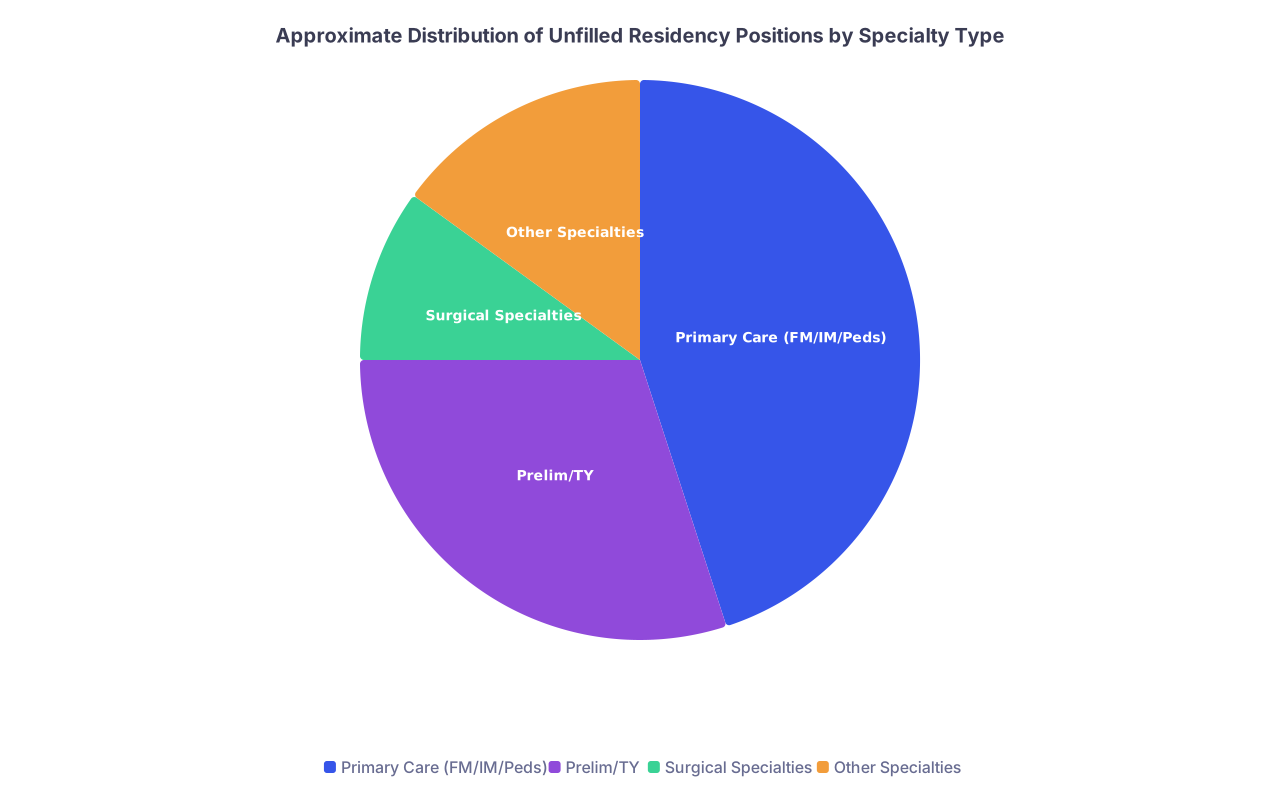
| Category | Value |
|---|---|
| Primary Care (FM/IM/Peds) | 45 |
| Prelim/TY | 30 |
| Surgical Specialties | 10 |
| Other Specialties | 15 |
This is not exact NRMP data, but it reflects the consistent pattern PDs talk about in those rooms: prelims, transitional years, and smaller primary care programs are where the real gaps cluster.
How the Timeline Actually Feels Inside the Program
From your side, Match Week has clear milestones. From the program side, it feels like this:
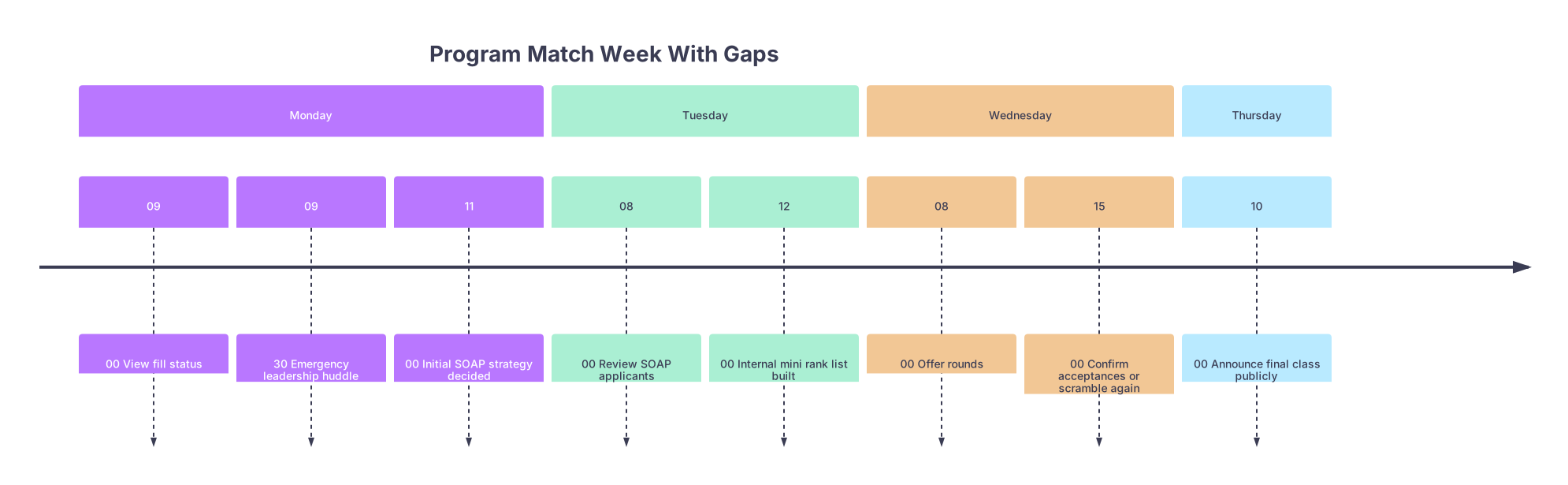
| Period | Event |
|---|---|
| Monday - 09 | 00 View fill status |
| Monday - 09 | 30 Emergency leadership huddle |
| Monday - 11 | 00 Initial SOAP strategy decided |
| Tuesday - 08 | 00 Review SOAP applicants |
| Tuesday - 12 | 00 Internal mini rank list built |
| Wednesday - 08 | 00 Offer rounds |
| Wednesday - 15 | 00 Confirm acceptances or scramble again |
| Thursday - 10 | 00 Announce final class publicly |
That compressed window is why decisions can feel abrupt and impersonal from your side. They are. Because the clock is brutal.
Quick Comparison: Normal Match vs. SOAP Behavior
Just to crystallize how different the mindset is when programs are filling in SOAP:
| Aspect | Regular Match Season | SOAP / Post-Match |
|---|---|---|
| Time per applicant | Days to weeks | Minutes to hours |
| Risk tolerance | Lower | Slightly higher but bounded |
| Focus | Ideal fit and long-term reputation | Service coverage and safety |
| Weight of advocacy | Helpful but not critical | Can be decisive |
| Willingness to bend | Rare | Common for scores, rare for behavior |
Knowing which game they’re playing helps you present yourself strategically.
Frequently Asked Questions
1. If a program didn’t fill and I ranked them, did they rank me at all?
Usually, yes—if you got an interview. If you didn’t match there, it means you either fell below where their list intersected with others, or they ranked you so low you effectively never had a shot. When they end up with gaps, they don’t get to “re-activate” you from the main Match; they move into SOAP with whoever’s in that pool at that moment.
2. Do programs ever go back and try to grab unmatched people they interviewed but who didn’t SOAP there?
Informally, yes. I’ve seen PDs email an unmatched applicant they liked before SOAP saying, “We’ll likely have positions in SOAP; apply to us.” But once SOAP starts, they’re constrained by NRMP rules. Any movement outside that (off-cycle hires) usually happens months later, quietly, and often through connections and direct emails.
3. Is it better to SOAP into a program that just missed filling a couple of spots or one that had a huge number of unfilled positions?
If I had to choose, I’d pick the program that missed filling a couple of spots but historically fills, especially if it’s not a brand-new program. A program with many unfilled spots, year after year, often has deeper issues: workload, reputation, leadership instability, poor support. You’re not just filling a gap—you’re walking into a structural problem.
4. Will programs treat SOAP residents differently than those who matched initially?
Officially, no. Unofficially, it depends entirely on the culture. In well-run programs, once you’re on the roster, you’re a resident, period. In toxic programs, there might be subtle comments about who “matched” vs “SOAPed.” I’ve seen both. But performance erases that faster than you think; if you show up competent and reliable, six months later no one cares how you got there.
5. If I do not SOAP into a PGY-1 spot, can I still benefit from these post-Match gaps later?
Yes, but it’s relationship-driven. PDs with unfilled or newly funded spots later in the year often recruit by emailing colleagues, reviewing prior unmatched applicants, or considering people doing research/observer roles in their system. If you’re unmatched after SOAP, aligning yourself with a department (research, prelim, observership with real work) and earning genuine champions can put you in that small, off-cycle “we’ve got a spot, who do you trust?” conversation.
If you remember nothing else, remember this:
Programs that don’t fill are not just “desperate”; they’re scared—of service gaps, of bad hires, of accreditation risk. Your job, if you’re in that world, is to look like the calm, solid solution to that fear.
Make it easy for the people in that closed conference room to say yes. And they will.