
The public Match Day celebration is theater. The real Match Day happens behind a closed conference room door, hours earlier, with bleary-eyed program directors, chiefs, and coordinators refreshing dashboards and quietly triaging the future of their department.
Let me walk you into that room.
What Really Happens Before the Email Drops
Every student thinks Match Day is about them. Their envelope, their email, their Instagram photo. In department war rooms, Match Day is about one thing: did we protect the service and the reputation of the program for the next 3–4 years?
Most departments have been “preparing” for Match Day since before you even submitted ERAS. The war room moment is just the final audit.
The week before: quiet paranoia
In the week leading up to Match Day, program leadership is doing three things they will not talk about on the Q&A panel:
- Running mental “what if” scenarios on the rank list
- Confirming internal plans for SOAP in case of disaster
- Pre-writing emails and talking points for every outcome scenario
I’ve watched more than one program director at a “relaxed” faculty meeting open a laptop, share a totally unrelated slide, then quietly alt-tab to rank list spreadsheets as soon as people stop watching. They’re checking:
- Did we go too “reach-heavy” at the top?
- Are we exposed to couples matching volatility?
- Did we put enough “service-stable” workhorses high enough?
They’re not thinking “Who deserves this the most?” at this stage. They’re thinking, “If we get this combo of interns, will my senior residents burn out and quit?”
The internal risk list
Every serious program keeps an informal risk list. It does not live in ERAS. It lives in Excel, or on a piece of paper that only the PD, APD, and maybe one trusted coordinator ever see.
This list breaks applicants into archetypes, whether they say it out loud or not:
- “Anchor” residents – mature, stable, will carry a team, won’t melt down
- “High ceiling / high risk” – genius or disaster, nothing in between
- “Service savers” – maybe not brilliant, but always show up, always do the work
- “Question marks” – glowing letters, strange vibes, odd gaps, soft concerns
- “Do not bring into this building” – looks fine on paper, major red flags from backchannel calls
By Match Week, they’ve already debated these people to death. Now they’re simply hoping the distribution of who actually comes out of the algorithm doesn’t overload them on any one category.
No one will admit this. But this is exactly the lens they use to read their Match results.
Match Week: The Calm Before They Pretend It Was Always Fine
Program directors know on Monday who did not match. They also know that any non-trivial SOAP involvement on their side can become political very fast.
Monday–Wednesday: SOAP as a mirror
Departments that end up with multiple SOAP spots open are in emergency mode. They have to pretend they’re “grateful for the opportunity to recruit great talent through SOAP,” but internally, everyone understands what actually happened: the market judged their program and found it wanting.
So during SOAP, while you’re somewhere panicking about backup plans, here’s what’s happening upstairs:
- Chair asking PD: “How many open positions do we have? Why?”
- PD trying to explain: “The applicant pool was weaker / we took a risk / our call schedule scared people away.”
- APD sitting with the coordinator, reviewing SOAP applications at insane speed, trying to avoid bringing in obvious disasters just to fill bodies
SOAP week becomes an accidental stress test of a department’s culture. If they’re cohesive, they triage together and protect their residents. If they’re dysfunctional, it turns into blame and quiet panic while the residents hear rumors in the hall.
By Wednesday afternoon, any SOAP fires are either contained or the building’s still smoldering. Either way, by Thursday night, the department has to get its Match Day story straight.
The War Room: Early Morning on Match Day
Match Day morning is when the curtain lifts for faculty, long before it lifts for you.
Most programs get official Match results early Friday morning, often around 9–10 am local time (varies slightly). Many PDs are sitting at their computers earlier than that, coffee in hand, logged into NRMP, pretending they aren’t constantly refreshing.
When that email lands, everything stops.
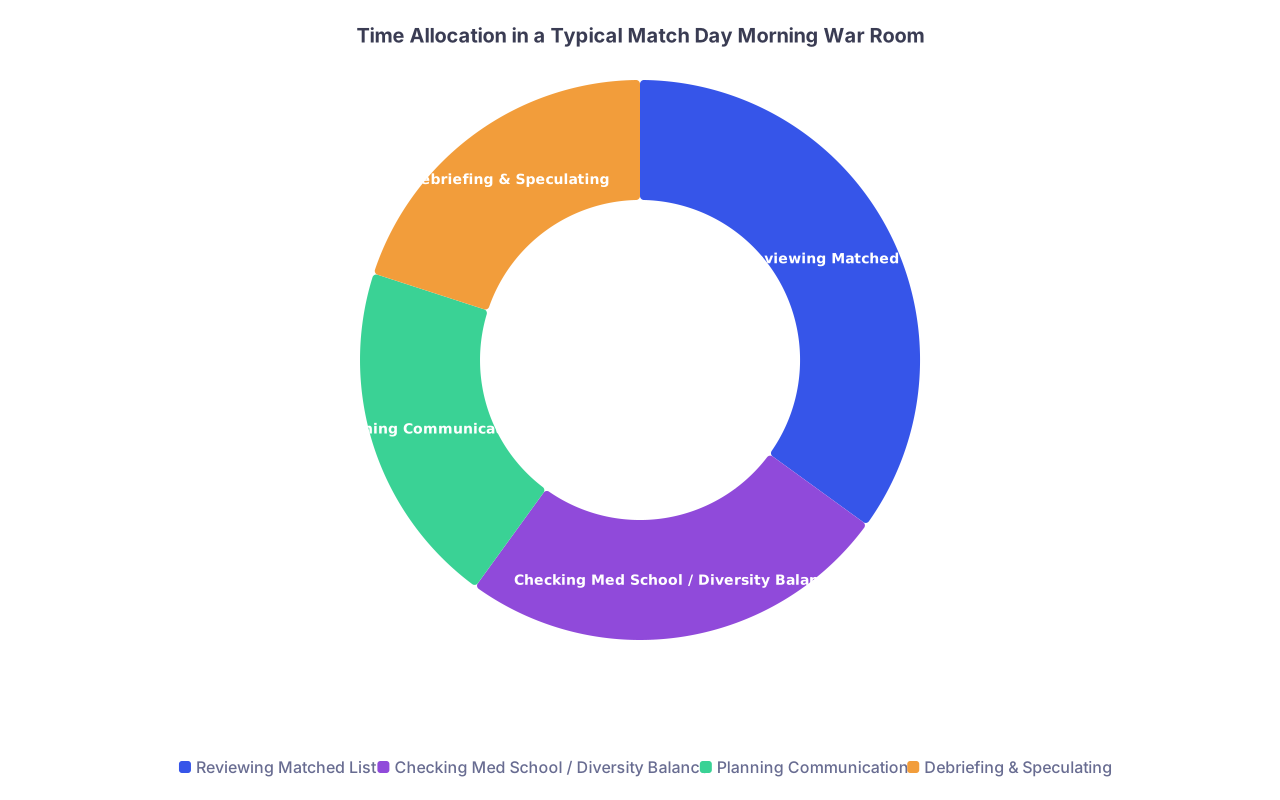
| Category | Value |
|---|---|
| Reviewing Matched List | 35 |
| Checking Med School / Diversity Balance | 25 |
| Planning Communication | 20 |
| Debriefing & Speculating | 20 |
Step 1: Raw reaction — “Did we fill?”
The first filter is brutally simple:
- Did we fill all categorical spots?
- Did we fill all prelim/TY spots?
- How many advanced positions were taken?
There is a binary emotional split here:
- Filled completely: relief first, then curiosity
- Left spots unfilled: tight chest, immediate SOAP/NRMP postmortem thoughts, reputational damage worries
I’ve seen PDs literally sigh out loud when they see “All positions filled.” Then, and only then, do they start looking at names.
Step 2: Name scan — “Who did we actually get?”
They pull up the actual list of matched residents. Usually, there’s a custom spreadsheet or a ranking database open side by side. They’re not just reading names. They’re mapping them against where they were on the rank list:
- “Okay, our #3, #4, #7, #10, #11, #13… that’s a strong group.”
- “We dipped into the 20s more than I hoped.”
- “Huh. All three of those couples-matching people landed here. That’s going to be interesting.”
This is where prior debates come back with a vengeance. Someone who was controversial in the ranking meeting suddenly became real. And that’s when the side comments start:
- “We’re going to have to keep an eye on him on nights.”
- “She’s going to be a star if she doesn’t burn out.”
- “Good, we needed someone like this on wards.”
Do they remember your personal statement at this point? Almost never. They remember your interview, one big letter, and one or two adjectives they’d attached to your name.
Step 3: Composition check — “What did we just build?”
Next, they zoom out. No longer about individuals, but the class as a unit.
They scan for:
- Balance of workhorses vs. superstars
- Home vs. away vs. completely external med schools
- Diversity — gender, race/ethnicity, geographic background, training background
- Known personality types (“too many quiet ones?” “too many alpha types?”)
If you hear a PD later say, “We are thrilled with the balance of our incoming class,” that sentence was born in this composition check.
I’ve heard real dialogue like:
- “We got three from our own med school. That will smooth the transition on the wards.”
- “We needed more residents who are comfortable with high-acuity — we got at least two from big county systems.”
- “We are heavy on MD/PhDs and very light on community med school grads… that might be a problem for pure service coverage.”
They are not just excited. They are already gaming out call schedules and potential weak spots.
The Unspoken Calculus: Who They Worry About, Who They Bet On
You should understand this clearly: by noon on Match Day, every PD already has a mental “concern list” and a “this one will be chief” list from your class.
They won’t say it publicly. But they have it.

The internal narrative they write about you
Even before they meet you in July, they’ve usually slotted each incoming intern into a story:
- “Underrated grinder who will surprise everyone.”
- “Rock star applicant, could go academic, we should mentor early.”
- “Still not sure about the professionalism concerns, but we took the risk.”
- “Good enough clinically, might struggle with the culture fit.”
Here’s the part no brochure tells you: those narratives are sticky.
If the PD already “remembers” you as the mature, composed couples-match applicant who handled a tough question gracefully, you start residency on a different slope than the person remembered mainly for a slightly odd reference check. That doesn’t mean you’re doomed or destined, but it’s naïve to pretend it doesn’t color initial expectations.
Internal backchannel: phone calls and gossip
Within hours of seeing the list, PDs start texting and emailing:
- Other PDs: “Hey, who did you get from X med school?”
- Clerkship directors: “You know this student — any heads-up for us?”
- Faculty who interviewed you: “You’ll be happy, your top two matched here.”
Faculty who interviewed you will quietly feel a sense of ownership. If someone advocated hard for you, Match Day is their scorecard too. That can be protective. Or exposing.
I’ve literally seen an attending beam because “my candidate” matched, only to have the PD say later, “Great, but just remember you’re now partly responsible if they implode.” Said with a smile, but not entirely a joke.
How Departments Prep the Script for You (and For Themselves)
Once they’ve processed who they got, the next move is messaging. To you, to medical students, to their own residents, and to the chair.
They need a coherent story.
The email you get from the PD
You know that “We are thrilled you’ve matched with us!” email? It did not emerge from nowhere.
Many PDs have templated versions:
- One for “we crushed it” years
- One for “solid, stable” years
- One for “this was rough, but we’ll never say that out loud” years
If it’s a strong year, the email will call out things like:
- How competitive the program is
- How your class stood out among “thousands of applications”
- How excited they are about the “talent and diversity” of the class
If it was a weaker year, they double down on words like “community,” “supportive environment,” and “investment in your growth.” The subtext: “whatever your stats, we’re going to make this work.”
I’ve seen PDs wordsmith a single sentence for 10 minutes because they know it’ll be screenshotted and sent around group chats.
Talking to current residents: “This is who’s coming to help you”
Simultaneously, they have to sell this class to the current residents. Because residents are not stupid. They know which programs took big steps down in competitiveness. They also know when they’re headed for a year of carrying weaker interns.
So in noon conference, in hallways, or at resident meetings, PDs share a curated version:
- “We filled with an incredibly strong group this year.”
- “We’re especially excited about their diverse experiences and strong letters.”
- “We think they’ll fit our culture really well.”
If the Match was below their historical level, they’ll emphasize personality fit and “good people.” When a class is objectively more competitive, they quietly expect senior residents to push them harder academically.
Under the Hood: Strategic Debrief and Quiet Regret
After the excitement fades, the war room becomes a postmortem space.

| Step | Description |
|---|---|
| Step 1 | NRMP Results Released |
| Step 2 | Check Fill Status |
| Step 3 | Review Matched List |
| Step 4 | SOAP Debrief and Damage Control |
| Step 5 | Assess Class Composition |
| Step 6 | Draft Communications |
| Step 7 | Inform Residents and Chair |
| Step 8 | Internal Debrief and Next Year Strategy |
The “what went wrong / what went right” meeting
Within a week — sometimes the same afternoon if they’re efficient — the PD, APDs, and often the coordinator sit down to dissect the Match:
- Did our rank list strategy work?
- Did couples matches hurt or help us?
- Did our interview strategy favor the right people?
- Did any “pet projects” (borderline candidates championed by one person) fail or succeed?
This is when the quiet regret surfaces:
- “We probably ranked X too low; I bet they went to that other program.”
- “We overestimated how much applicants care about our research reputation versus lifestyle.”
- “We got burned for putting too many risky ‘projects’ in the top 15.”
Some programs actually pull data. Others just go by gut. You can guess which ones tend to consistently recruit well.
How that affects future applicants (including you if you’re early in the pipeline)
Next year’s selection process is shaped heavily by this debrief.
Maybe they got:
- Too many brilliant but fragile interns → next year, they overcorrect to “resilience” and “grit.”
- Too many average but reliable people → next year, they aim higher on board scores and research.
- Not enough diversity → next year, they explicitly prioritize certain schools or backgrounds.
That’s why the advice from a PGY-3 about “what this program likes” can already be outdated. The target shifts year to year, depending on how burned or delighted leadership felt reading that Match list.
How You Fit Into This Machine — And How to Use That Knowledge
You can’t change what they said about you in this year’s war room. But understanding the machinery changes how you interpret Match Day and what comes after.
If you matched: what their war room probably said about you
If you matched at a reasonably competitive program, here’s the unvarnished odds:
- Someone in that room explicitly advocated for you at some point.
- They already remember 1–2 key things: a specific case you discussed, a memorable letter, an unusual background.
- You’ve been slotted, mentally, into their “incoming class narrative” as either ballast, spark, or question mark.
Your job starting July 1 is to quickly show them their best narrative about you was correct — or, if they underestimated you, that they were wrong in your favor. The first 2–3 months matter more than people like to admit, because they either confirm or overwrite the war room expectations.
If you did not match: how programs actually view that
From the department side, an unmatched student is not automatically “defective.” PDs know:
- The algorithm is brutal in hyper-competitive specialties.
- Some excellent candidates end up squeezed out for reasons totally unrelated to ability.
- SOAP situations blur all the usual signals.
Most PDs, off the record, will say there are unmatched applicants every year they would happily have taken as preliminary or categorical if they had space.
So if you’re reapplying, understand something important: the fact you once sat on someone’s risk list or just outside their rank bracket does not mark you forever. After a year of strong work (research, prelim year, or another productive path), you will be seen through a different lens.
It’s not sentimental; it’s pragmatic. Departments want residents who can help them. Show you can do that, and last year’s war room note becomes background noise.
FAQ: Inside the War Room on Match Day
1. Do programs actually remember how high or low they ranked each incoming resident?
Yes, at least for the first few weeks. Leadership absolutely knows who was in their top 5–10 and who came from deeper on the list. They may not remember your exact number, but they remember categories: “top-tier,” “mid-range,” “backup.” Over time, your performance erases that, but on Match Day morning, it’s very salient.
2. If I was a controversial candidate in ranking meetings, will that haunt me as a resident?
It can color initial expectations, but it is not permanent. If one faculty member really pushed for you and another was skeptical, both will be quietly watching your early performance. If you show up prepared, reliable, and coachable, the skepticism fades quickly. If you validate their concerns, it hardens. The first six months matter more than applicants realize.
3. How much do programs care about “class balance” versus just grabbing the best individuals?
Strong programs care a lot about balance. They’ve seen what happens when a class is full of only superstars with no workhorses, or all introverts with no leaders. In the war room, they absolutely talk about how your class will function as a unit. They are building a team, not a leaderboard.
4. Do departments ever regret not ranking an applicant high enough once they see where that person matched?
All the time. I’ve heard, “Wow, they went to MGH? Maybe we misread that file.” That feeds directly into the next year’s strategy and often makes PDs more cautious about over-penalizing minor red flags. But it does not help you retroactively. Once the list is certified, regret is just data for next year.
5. Are programs brutally honest in their internal debriefs after Match Day, or is it all spin?
Inside the closed room, they’re much more candid than you’d expect. PDs will openly say, “We had a soft year,” or “We nailed it this time.” They’ll call out specific misjudgments. The spin is for external audiences: students, residents, the dean, social media. Internally, most serious departments treat Match outcomes like a performance review of their own selection process.
Key takeaways. First, Match Day for departments is a strategic audit, not a party; they’re judging their own choices as much as yours. Second, by the time you open your email, you’ve already been slotted into a narrative in that war room — your early months in residency either confirm or rewrite it.