
You’re sitting there on Match Day. ERAS is closed, NRMP is done, the email has popped up: “Congratulations, you have matched.” You know where you’re going. You’ve texted your family, posted the obligatory blurred screenshot to your group chat, maybe even drafted an Instagram story.
And now you’re staring at a blinking cursor trying to email the people who actually got you here—your research PI, your clerkship director, that attending who wrote you a stellar letter. You think, “How hard can this be? I’ll just shoot off a quick message.”
This is exactly where people quietly torch relationships they spent years building.
Not with one huge unforgivable insult. With a sloppy subject line. With a mass BCC that includes two mentors from rival departments. With an email that sounds more like a social media caption than a professional update. I’ve watched students do this. I’ve watched faculty react—rolling eyes, “Wow, guess I know where I rank,” or “Did you see how they announced that?” They remember.
Let me walk you through the landmines so you’re not the story people tell next year.
1. Treating Mentors Like a Group Chat
The first and most common disaster: the mass email.
You’ve seen it. Subject line: “Matched!!!” and twenty faculty BCC’d. One generic paragraph pasted into every thread. Maybe even obvious mail-merge artifacts (“Dear [Mentor Name]”).
Do not do this.
Here’s why it backfires:
- It screams “transactional.” You used them for a letter; now you’re checking the “update mentors” box.
- People who invested very different amounts of time in you get the same bland message.
- Faculty talk. When two attendings realize they got the identical email down to the comma, they do not feel special. Or appreciated. Or likely to help you again.
Personalization is not optional here. It’s the whole point.
I’ve watched a program director pull up a student’s “update email” on his phone and say, “She sent me the same paragraph she sent everyone else. Took me 30 seconds to write her letter, apparently.” Was he being harsh? Sure. Did that color how he thought of her going forward? Yes.
The safer approach:
- Write separate emails to your key mentors. Especially:
- Letter writers
- Research PIs
- Advisors who met with you 1:1
- Anyone who made calls for you
- Use at least one line that proves this email is for them, not for “my mentor list.”
- If you truly must send a group email (like to a student interest group faculty list), make that a separate, obviously-broadcast note—not the same text you send to your PI.
If you feel tempted to BCC everyone, that’s your sign: stop and sort your mentors by level of involvement.
| Mentor Type | Involvement Level | Email Style |
|---|---|---|
| Research PI | High | Fully personalized |
| Strong letter writer | High | Fully personalized |
| Career advisor | Medium | Semi-personalized |
| Clerkship contact | Medium | Semi-personalized |
| Listserv faculty | Low | Group announcement |
If someone wrote you a letter or advocated for you, they deserve more than your “Dear all” template. Anything less is a quiet insult.
2. Sending the Email at the Wrong Time (Yes, You Can Blow This)
Timing mistakes are sneakier, but I see them constantly:
- Emailing “I matched at X!” before the official result release time in their time zone.
- Emailing about your match after you’ve splashed it all over social media.
- Waiting a week, then casually mentioning it when you need something.
Faculty do not need to be the first to know. But they should not be the last.
Here’s the order that avoids drama:
- Family / partner / close friends
- Your core mentors (the ones who wrote letters or advocated)
- Everyone else / social media
Not reversed. Not “I’ll get to them when I have time.” If someone picked up the phone to call a program director for you, they should not find out where you matched from your Instagram story.
Another timing pitfall: forgetting about time zones and schedules. Some mentors are on inpatient services, in clinic, or at conferences.
Safer practices:
- Send your emails the same day you learn where you matched (or at worst, within 24 hours).
- If results drop at a weird hour, draft the emails ahead and send once it’s reasonable where they are.
- Do not write “I just found out!” if you’ve known for two days. They’ll see through it.
I watched one student email a mentor five days after Match Day. The faculty’s first line in the reply: “Glad to finally hear from you.” Not hostile. But not thrilled either.
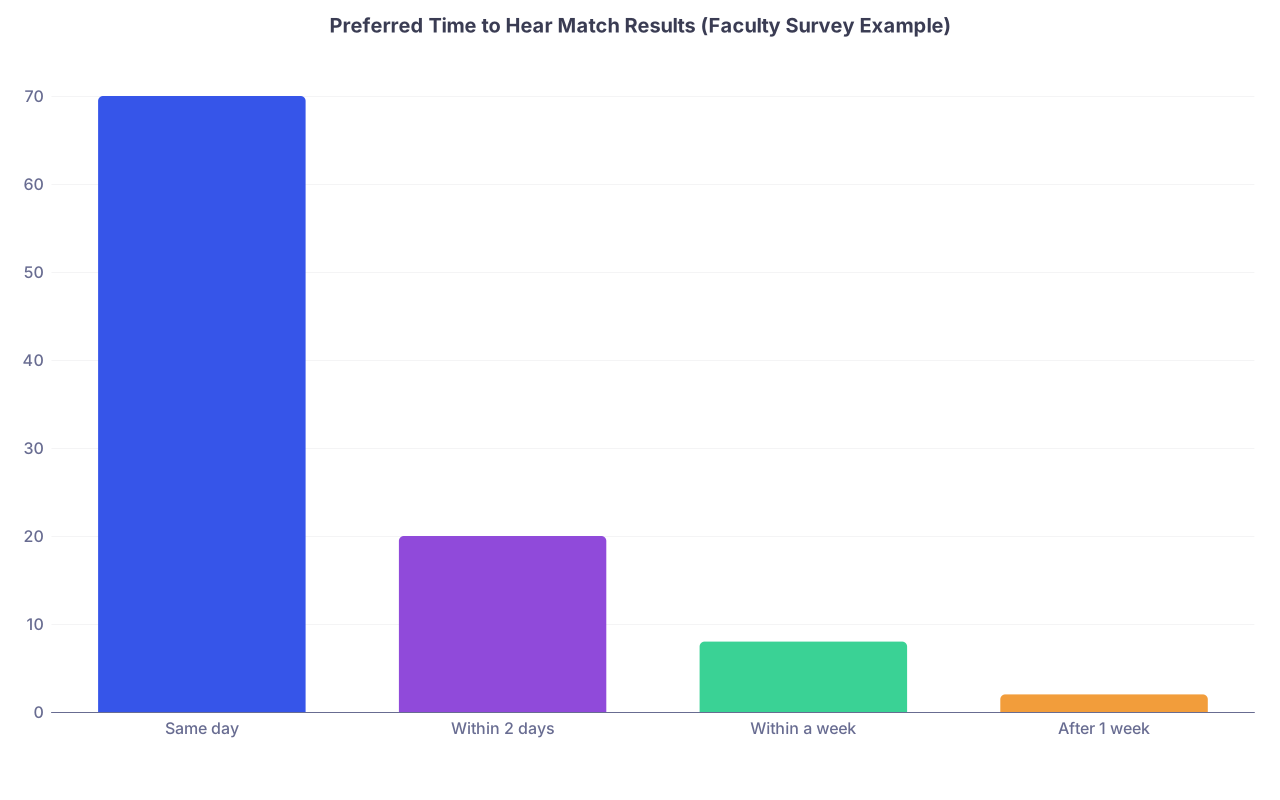
| Category | Value |
|---|---|
| Same day | 70 |
| Within 2 days | 20 |
| Within a week | 8 |
| After 1 week | 2 |
The pattern is obvious: if you care about the relationship, you don’t make them wait.
3. Making the Email About Your Flex, Not Their Help
There’s a specific kind of email that makes mentors quietly close the tab:
“OMG I matched at [Big Name Program]!!! This is literally my dream and I’m still shaking!!!”
No acknowledgment of the time they spent with you. No recognition of their letter. The subtext: “Look how good I am. Thought you should know.”
That tone is a mistake.
The purpose of this email is not self-promotion. It’s to:
- Share the result
- Express genuine gratitude
- Close the loop on their investment in you
- Signal you remember who helped you
If your email could be copied directly into an Instagram caption, it’s wrong.
Here’s the formula people mess up:
Bad structure:
- 90% bragging about the program
- 5% about your future goals
- 5% “Thanks again!”
Better structure:
- 10–20%: the outcome (where you matched)
- 40–60%: appreciation for their specific help
- 20–30%: brief look ahead / staying in touch
Short version: less “I did it!” and more “We did it; thanks for your part in it.”
I’ve sat in offices where an attending reads an email out loud to another faculty member: “Listen to this—four lines about how incredible this program is, and one line of ‘thank you for your help.’”
They do not forget who made them feel like a footnote.
4. Forgetting the Mentor’s Specialty and Politics
This one’s touchy, but real.
If you matched into a specialty different from what a core mentor wanted for you—or at a program they have a complicated relationship with—your language has to be careful.
Common errors:
- Gushing about choosing a field they argued against (“I know you warned me about lifestyle, but I matched into neurosurgery at X and I’m so pumped to grind!”).
- Over-selling one program in a way that indirectly insults their institution (“Of course X is the best place in the country for Y, so I’m thrilled to be going there instead of anywhere else.”).
- Treating the specialty you didn’t choose as a joke (“Guess psych didn’t get me after all lol.” — sent to your psychiatry mentor. Yes, I’ve seen it.)
Faculty care about their field. They care about their institution. They’re not going to openly fight you over your choices at this stage—but you can easily sound dismissive or ungrateful.
Safer approach:
- If you picked a different specialty than they hoped, acknowledge their guidance respectfully and focus on your fit with what you did choose, not what you rejected.
- Never phrase your match in a way that trashes your home program or their department.
- Avoid “best in the world” language when they’re on faculty at a direct competitor.
I watched a student matched at a big-name private institution email their state school mentor: “I’m happy I’ll be getting real academic training now.” That line was brutal. Completely unnecessary. The mentor showed me the email with a raised eyebrow. That student burned a bridge for no reason.
You don’t need to lie. Just don’t insult where you came from.
5. Over-Sharing the Rank List and Backstory
Another subtle way to step on a landmine: explaining too much.
Mistakes I see:
- Writing, “I ended up at Program B even though Program A was actually my #1” to a mentor at Program B.
- Telling a faculty member, “I ranked your program third because I thought I might not be competitive for X and Y… but I’m thrilled with how it turned out!” So they know they were your backup.
- Dissecting how close you were to choosing a different specialty or city in excruciating detail. They do not need the drama.
They care where you landed and whether you’re happy. Not your entire internal debate.
If you matched somewhere they didn’t expect, keep the explanation concise. One line is enough: “After a lot of thought, I realized X was the best fit for my interests in Y and Z.”
What you should not do is send them a mini-personal statement about why their advice was only partially followed, or why their program ended up lower than they thought. That is a perfect recipe for quiet resentment.
This is email, not confession.
6. Sloppy, Casual, or Cringey Tone
You’d be shocked how many “Match emails” read like texts:
- No capitalization
- Emojis everywhere
- “lol” and “lmk”
- Or the opposite: stiff, robotic, obviously AI-generated prose
Your goal is warm and professional. Not “corporate memo,” not “TikTok caption.”
Red flags that your tone is off:
- You’re using the exact same language you used in your group chat.
- You’ve added five exclamation points.
- You’ve used “literally” three times in two sentences.
- Reading it out loud makes you wince.
Here’s a quick gut check: would you be comfortable if this email got forwarded to the entire residency selection committee at your new program? Because sometimes, that’s exactly what happens.

On the flip side, don’t overcorrect by writing like a legal document. If it sounds like ChatGPT wrote it, mentors will feel the distance.
Your own voice, but the “presenting on rounds” version, not the “2 AM meme scroll” version.
7. Ignoring the People Who Quietly Helped You
One mistake that stings: students obsess over their “big name” letter writers and completely forget:
- The clerkship coordinator who squeezed you into that away rotation
- The junior attending who gave you honest advice on your personal statement
- The chief resident who practiced interviews with you
- The advisor who told you not to apply to 70 programs and saved you $2,000
When you only email the people with titles, it’s obvious. And it tells everyone else exactly how you value people.
I know a coordinator who keeps a mental list of “students who only email when they need something.” She’s also the one future students ask for help with scheduling, letters, and forms. You want to be on her good list, not her eye-roll list.
Ask yourself:
- Who answered my emails when I was panicking in October?
- Who reviewed my rank list?
- Who looked at my personal statement or CV?
- Who helped me navigate a bad rotation evaluation or a weak NBME?
Then send each of them a short, sincere note—even if it’s just three or four sentences. You don’t need a full essay. You just need to prove you noticed their effort.
8. Over-Attaching, Under-Respecting Their Time
Another way to mess this up: turning your match email into a to-do list for them.
Bad pattern:
“Dear Dr. X,
I matched at Y! I’ve attached my CV, headshot, updated personal statement, and a copy of my rank list for your reference. Also, could you review my updated research plan and CV format when you have a chance?”
No. This is not the moment to pile on asks.
On Match Day and the days after, mentors are:
- Reading dozens of emails
- Congratulating graduates
- Interviewing next year’s applicants
- Doing their actual job
Your email should be quick to read and easy to respond to.
Avoid:
- Unnecessary attachments (they do not need your CV right now)
- Complex questions (“What should my five-year plan be?”)
- Scheduling requests in the same email (“Can we meet next week to talk about XYZ?”)
If you need something—like advice on prelim vs. transition year, or research in your new city—either:
- Ask in a single, simple line at the end of the email, with a clear option to decline, or
- Send a separate email a week or two later, once the “congrats” moment has passed
Do not bury your “thank you” under a mountain of work for them.
9. Being Vague or Confusing About Where You Matched
You’d think this would be the easy part: state where you matched. But students manage to muddy it all the time:
- Only naming the city (“I’m moving to Chicago next year!” — Chicago has multiple IM and EM programs; they have no idea where you’re actually going.)
- Forgetting the specialty when you scrambled or switched (“Excited to announce I matched at X Medical Center!” Okay… in what?)
- Not clarifying advanced vs. prelim positions
Your mentor should not have to Google you to figure out your match.
Be specific but clean:
- Name the specialty
- Name the institution and program (and track if relevant)
- Clarify prelim vs. categorical vs. advanced when it’s not obvious
This matters more in some fields than others. In competitive specialties, people gossip about where people land. You don’t want rumors filled in with incorrect information because your email was vague.
10. Burning the Future: Forgetting You’ll Need Them Again
This last mistake is bigger than the email itself: acting like Match Day is the end of the relationship.
Here’s reality:
- You might need a fellowship letter in 3–4 years.
- You might need a job recommendation.
- You might apply for a research year or chief year.
- You might land at their institution for fellowship later.
Mentors remember who disappeared after they “got what they needed.”
Your Match email is a chance to set the tone that this isn’t goodbye. One clean line does the job:
“I’d love to keep you updated as I go through residency—your mentorship has meant a lot.”
or
“I hope to stay in touch and would be grateful for your continued advice as I move into this next stage.”
You’re not promising weekly updates. You’re just signaling that this relationship matters beyond the transactional.
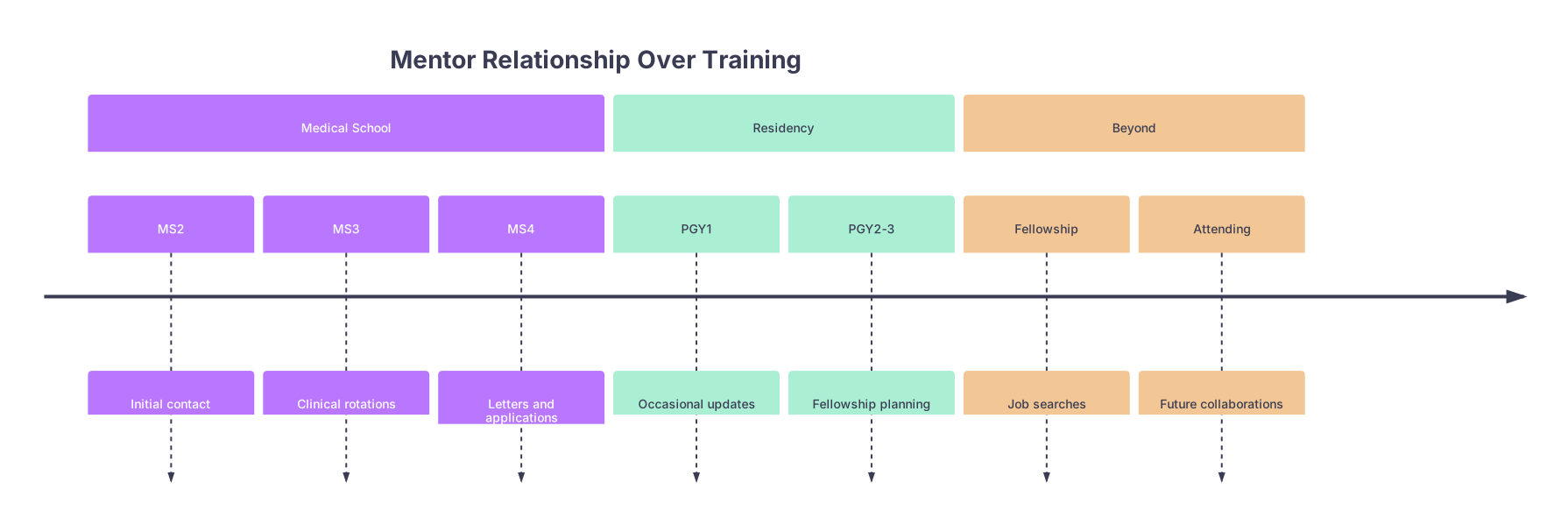
| Period | Event |
|---|---|
| Medical School - MS2 | Initial contact |
| Medical School - MS3 | Clinical rotations |
| Medical School - MS4 | Letters and applications |
| Residency - PGY1 | Occasional updates |
| Residency - PGY2-3 | Fellowship planning |
| Beyond - Fellowship | Job searches |
| Beyond - Attending | Future collaborations |
Students who treat mentors like one-use vending machines for letters usually discover, the hard way, that those machines remember who kicked them.
A Quick Look at Safe vs. Problem Emails
| Aspect | Risky Version | Better Version |
|---|---|---|
| Recipients | Mass BCC to all mentors | Individual emails to key mentors |
| Tone | Over-excited, emoji-heavy | Warm, professional |
| Content focus | Bragging about program name | Gratitude + clear update |
| Timing | Days late, after social media posts | Same day or within 24 hours |
| Clarity | City-only, no specialty mentioned | Program + specialty clearly stated |
And yes, mentors absolutely notice which side you fall on.
Two Email Disasters to Avoid at All Costs
Let me end with the two moves that trigger the most silent damage:
The generic blast email to everyone who helped you.
It feels efficient. It reads as indifferent. Especially to the people who did the most. If your PI has to share the same generic paragraph as the faculty who met you once, you’ve just ranked them all as interchangeable.The self-congratulatory message that forgets gratitude.
When the subject line, body, and closing all center your achievement and barely nod at their effort, you’ve told them exactly how you see the relationship. They’ll still reply “Congrats!” But mentally? You’ve slipped several notches.
Final Takeaways
To keep this simple:
- Treat your match email as relationship maintenance, not a victory announcement.
- Send personal, timely, specific messages that highlight your gratitude more than your bragging rights.
- Remember: you’ll need these people again. Don’t let a careless two-paragraph email undo four years of mentorship.