
You’re in your 30s or 40s (maybe older). It’s Match Week. Your classmates are mostly 24–27, their biggest outside responsibility is maybe a dog, and their parents are planning Match Day watch parties over brunch.
You? You might have a spouse who moved once already for medical school. Maybe kids in school. Aging parents. A mortgage. And you’re trying to figure out how to talk about Match results with people who either do not get it, or are way too invested.
You’re not just dealing with “Where did you match?”
You’re dealing with:
- “Are we moving… again?”
- “So you’ll be how old when you finish training?”
- “Was this worth it?”
- “Why didn’t you match in dermatology like that other student?”
This is a different game for older applicants. The conversations hit harder, and the stakes feel higher.
Let’s walk through what to actually say, to whom, and when—across three scenarios:
- You match somewhere you’re okay with or happy about
- You match somewhere that’s a hard pill to swallow
- You don’t match, or you SOAP
And we’ll break it down by audience: peers, partner, kids, parents/extended family, and your non-medical friends.
Step 1: Before Match Day – Set Expectations Like an Adult, Not a Student

| Step | Description |
|---|---|
| Step 1 | Today |
| Step 2 | Clarify your rank list realities |
| Step 3 | Decide what you will share |
| Step 4 | Have brief talk with partner and key family |
| Step 5 | Set boundaries for Match Week questions |
If you’re older, you do not have the luxury of “we’ll just see what happens” with your people. The fallout hits everyone.
Do this before the email on Monday and the result on Friday.
1. Get brutally honest with yourself first
You cannot communicate clearly with others if you’re still lying to yourself about your odds.
Ask yourself:
- What are the likely outcomes based on your application? (Not your fantasy ones—your realistic ones.)
- What are the three tiers of outcomes:
- “Thrilled”
- “Acceptable / workable”
- “Crisis / major adjustment needed”
Write that down. Literally. On paper or in Notes. It will keep you from spiraling or oversharing later.
2. Decide what you’re willing to share ahead of time
Older applicants get burned by this a lot. You overshare with friends and family because you’re used to being open with them, and then you have to deal with their disappointment on top of your own.
Here’s a simple rule:
- With non-medical family: share process, not probabilities
- With peers: share general goals, not specific rank details, unless you really trust them
- With kids: share what it means for them, not how competitive radiology is this year
A simple phrase you can prep now:
“Match is complicated and pretty unpredictable. I’ve applied broadly, and we’ll know the result on [date]. I’ll let you know once I’ve had time to process it first.”
That last part—“time to process it first”—is your shield. Use it.
3. Set an expectation with your partner
If you have a partner, they’re not “family member #3.” They’re co-leading this.
You need one specific conversation pre-Match:
- What information do we want to share with:
- My parents
- Your parents
- Our friends
- Our kids (if you have them)
- Who gets told first on Match Day?
- Are we doing this live (FaceTime) or delayed (after we’ve processed)?
You’d be surprised how much trouble comes from misalignment here. I’ve seen partners blurt “We didn’t match” on a family group text because they panicked. Avoid that.
Step 2: If You Matched – You’re Happy or At Least Okay
Let’s say you matched. Maybe it wasn’t #1, but it’s a solid outcome. You’re going to be a resident. You want to share, but you also need to manage the “But isn’t that far away?” and “How long is residency again?” questions.
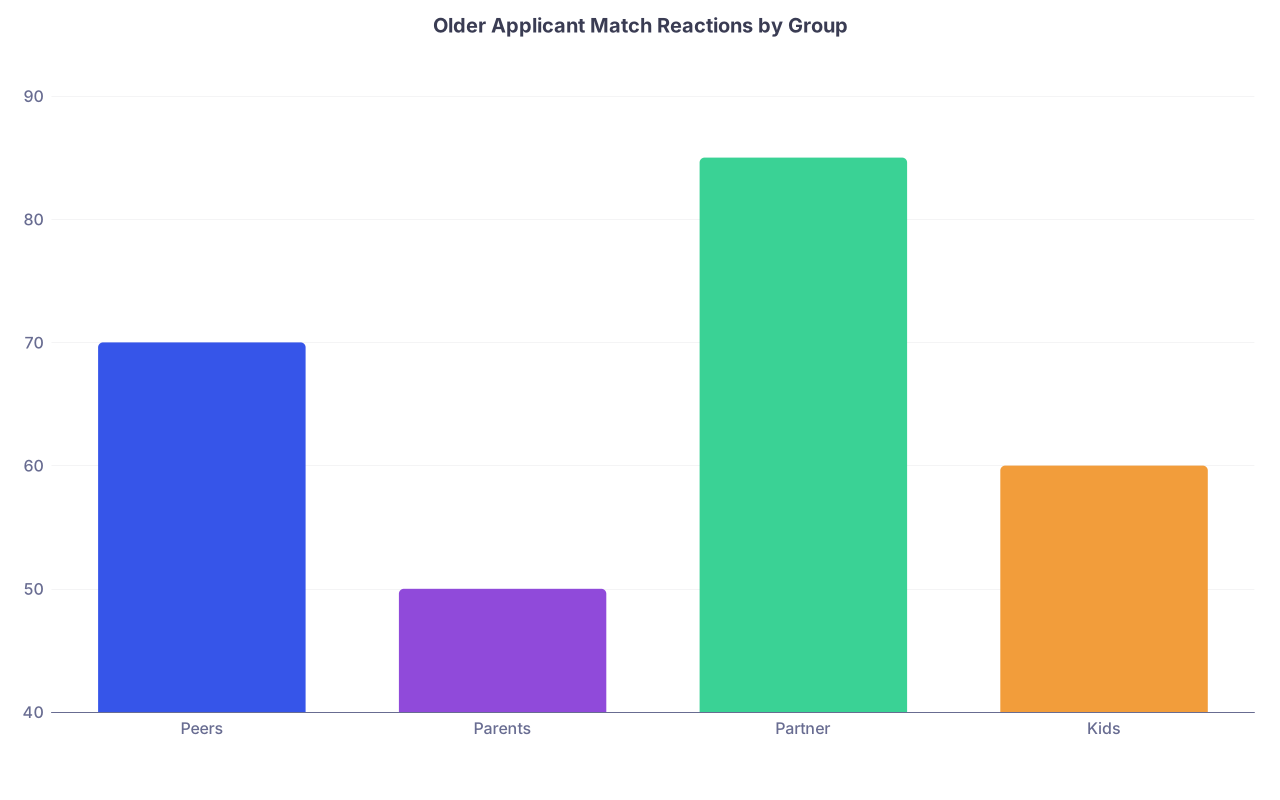
| Category | Value |
|---|---|
| Peers | 70 |
| Parents | 50 |
| Partner | 85 |
| Kids | 60 |
(Think of those numbers as “percentage likely to say something unintentionally insensitive.” You know this is true.)
Talking to peers (especially younger classmates)
You’ll get the standard hallway question:
“Where’d you match?!”
Here’s what to do:
Decide your default, one-line answer ahead of time.
Example:“I matched internal medicine at [Program]. Really happy and relieved.”
If you’re older and matched in a less “prestigious” place than you’d hoped, don’t invite comparison.
Bad version:
“I only got [Program], it’s community, not academic…”
Better:
“I’m going to [Program] for IM. It’s a strong fit for me and my family, so I’m happy about it.”
You don’t owe anyone your rank list or your disappointment scale.
If someone pushes:
“Was that your first choice?”
You can say:
“It was high on my list and a good fit, so I’m satisfied with how it turned out.”
That ends most conversations without a fight and without lying.
Talking to your partner
If the result is good or acceptable, you still need to walk through the logistics. Older applicants do not live on vibes. They live on schedules and childcare.
That first conversation should cover three buckets:
Emotional:
- “How are you feeling about this place and this city?”
- “Anything you’re immediately worried about?”
Practical (first 3–6 months):
- When do we need to move?
- Do we need to sell/rent our place?
- Kids’ school timelines?
Boundaries for telling others:
- “Are you okay if I tell my parents tonight?”
- “Do we want a couple days before everyone knows?”
A sample opener if it’s a solid but not dream outcome:
“So, I matched [specialty] at [Program]. It’s not the top dream city, but it’s a stable program, and career-wise it’s good. I think we can make this work, but I want to talk through what it means for you and the kids.”
You’re sending three messages there:
- I’m not pretending it’s perfect
- I see the impact on you
- I’m not in denial about logistics
Talking to kids (if you have them)
Kids care about three things:
- Are we moving?
- Will my schedule/friends change?
- Are you still going to be around?
Skip all the Match mechanics. Say something in their language:
If you’re staying local:
“I got a doctor job here, so we don’t have to move. I’ll be working more, but I’ll still do [bedtime, weekends, soccer] with you.”
If you’re moving:
“I got a doctor job in [City]. That means sometime around [month] we’ll move there. You’ll have a new school and new friends, and we’ll talk a lot about it and visit if we can.”
If you’re mid-30s or 40s with school-aged kids, be ready for them to ask:
“Are you going to be gone all the time?”
Don’t sugarcoat residency, but don’t scare them:
“I’ll be working more than I do now, especially at the beginning. But we’ll still have time that’s just for us, and we can plan special days around my schedule.”
Step 3: If You Matched, But You’re Disappointed or Embarrassed
This is a big one for older applicants. You went back to school, sacrificed a prior career, and now you’re explaining:
- A backup specialty
- A community program you ranked low
- A far-away city you didn’t want
- A prelim-only spot
And you’re picturing your cousin saying, “But can you switch later? Can’t you just reapply?”
First, reset your own narrative
If you talk like you failed, everyone around you will treat you like you failed. Even if you technically met your base goal: becoming a physician.
Your internal script should be something like:
- “I matched into a training position that leads to board eligibility as a physician.”
- “Is this my perfect fantasy? No. Is it a valid path to a real career? Yes.”
Now you translate that for different audiences.
When you matched a backup specialty
Your parent:
“I thought you wanted radiology. Why are you doing internal medicine?”
You:
“Radiology is extremely competitive. I stayed realistic and ranked programs where I had a solid chance of matching and still building a career I like. Internal medicine gives me a stable path, and from there I can sub-specialize or adjust.”
Short, calm, factual. No justification monologue.
With peers, you don’t need a confession:
“I’m going to [specialty] at [Program]. It’s a good fit for me.”
If someone knows you were aiming for something else and asks:
“I decided to prioritize matching into a solid program and moving forward in training, rather than risking not matching. This is still work I can see myself doing.”
That’s an adult answer. Which you are.
When you matched somewhere geographically tough
Older applicants get hammered here. Partner’s job, kids’ schools, parents’ health. Suddenly you’re explaining why you’re moving four states away.
To family:
“Residency spots are assigned through a national system. You don’t just pick a city. I matched at [Program] in [City], which gives me a stable training position. It’s not where we hoped to be, but it’s what we have, and we’re going to work with it.”
If they ask, “Can’t you just reapply somewhere closer?”:
“Reapplying after a match is usually a bad idea and very risky. This is the path forward. Once residency is done, I’ll have more control over locations.”
You don’t need to argue. Just repeat that: “This is the path forward.”
Step 4: If You Didn’t Match or You SOAP
Now the heavy one. You’re older, you didn’t match, and you’re watching 25-year-olds post Match Day photos while you’re refreshing your email about SOAP offers or planning a reapplication year.
This is where conversations get dangerous. People project their own anxieties onto you.

Immediate rule: You don’t owe anyone an explanation on Monday
The Monday “You did not match” email is a gut punch. Older applicants often have the instinct to immediately call spouse, parents, etc.
Delay. A few hours at least.
Your first call should be to:
- Your dean’s office / student affairs
- Your specialty advisor
- Your partner (if they already know match timing and you have a plan to talk)
For everyone else, you’re allowed to say:
“Match Week is complicated. I’m in the middle of the process and don’t have anything final to share yet. I’ll update you when I know more.”
That buys you days. Use them.
Talking to your partner when you didn’t match
You can’t hide this from a partner. And you shouldn’t. But you can frame it.
You want three pieces in the first 2–3 sentences:
- Where things stand
- What the next 72 hours look like
- Emotional permission
Example:
“I got the email this morning that I didn’t match. I’m upset, but there’s a process this week called SOAP where I can still get a position. I’m meeting with advising this afternoon to figure out options. I need you to know this is not the end of the road, but it is going to be a rough week.”
Then pause. Let them react. They may go to logistics or panic. You keep it anchored:
“Right now, the only job is to get through this week. Once we know if I get something in SOAP or not, we can sit down and talk bigger-picture.”
Your partner does not need an NRMP policy seminar. They need a clear picture of:
- Is there still a chance this year?
- What happens if that fails? (You can say, “If SOAP doesn’t work, we’ll plan a reapplication year. But we’re not there yet.”)
Talking to parents/extended family when you didn’t match
They will likely respond from fear or disappointment. That’s their problem, not yours, but it becomes your conversation.
Here is a template for that first explanation:
“I didn’t match into a residency position this year. For medical graduates, this happens to a portion of applicants every year. There’s a follow-up process this week called SOAP where I might still get a position in a different program or specialty. If that doesn’t work out, I’ll likely need to reapply next year while working or doing research. It’s a setback, not the end of becoming a doctor, but it does change the timeline.”
Then stop. Let them ask questions.
If they push with unhelpful stuff:
“But you worked so hard. How could this happen?”
“Did you not apply broadly enough?”
“Your cousin’s friend got derm, how…?”
You have every right to say:
“I’m not going to rehash the whole process right now. It’s very numbers-driven and complicated. What I need from you this week is support, not analysis. Once I know the final outcome, we can go over details if you really want to.”
You’re older. You can set that boundary. Use your age to your advantage.
Talking to peers when you didn’t match or you SOAP into something you didn’t want
You are not obligated to tell classmates your status on Monday. Many will assume no news = you matched and are just busy.
If you want a simple, low-drama approach:
On Monday/Tuesday:
“Match Week is still in progress for me. I’ll share once I know where things land.”
After SOAP, if you ended up with a spot you’re not thrilled with:
“I ended up taking a [prelim/transitional/other specialty] spot through SOAP. Not what I originally aimed for, but it keeps me in the system and gives me options for next steps.”
That’s enough. The ones who get it will get it. The ones who don’t—doesn’t matter.
Step 5: Dealing with Age-Specific Comments and Nonsense
Older applicants hear things younger ones don’t. Some of it is subtle, some of it’s offensive.
Let’s go through a few you’re likely to hear and what to say.
| Comment Type | Example Comment | Suggested Short Response |
|---|---|---|
| Age-focused | "You’ll be almost 40 when you finish!" | "Yes, and then I’ll have a 20+ year career doing this." |
| Comparisons | "Did you get as good a program as [younger peer]?" | "We’re in different situations and specialties. I’m happy with what fits my life." |
| Second-guessing | "Was going to med school this late worth it?" | "For me, yes. This is the work I want to be doing." |
| Location complaints | "That city is so far/unsafe/boring." | "It’s where my training is, and we’ll make it work for this phase." |
| Specialty judging | "Why that specialty? Isn’t it lower paid / competitive?" | "It fits my skills and the life I want long term." |
You do not have to defend your existence.
When someone brings up your age directly
Family member:
“So you’ll be, what, 41 when you’re done? That’s… late, isn’t it?”
You:
“I’ll be in my 40s doing work I care about instead of spending another decade regretting not doing this. I’m okay with that tradeoff.”
If they keep poking:
“I’ve thought through this more than anyone else. I’m comfortable with my timeline.”
That’s it. No debate.
When people compare you to younger classmates
This happens more than anyone admits.
“Sarah matched at Mayo for derm. Where did you end up?”
You’re allowed to shut that down:
“Our situations and specialties are completely different. I’m focused on what works for me and my family, not competing with 20-somethings.”
Direct. Slightly sharp. That’s fine.
Step 6: How Much Detail to Share With Whom (Quick Reference)
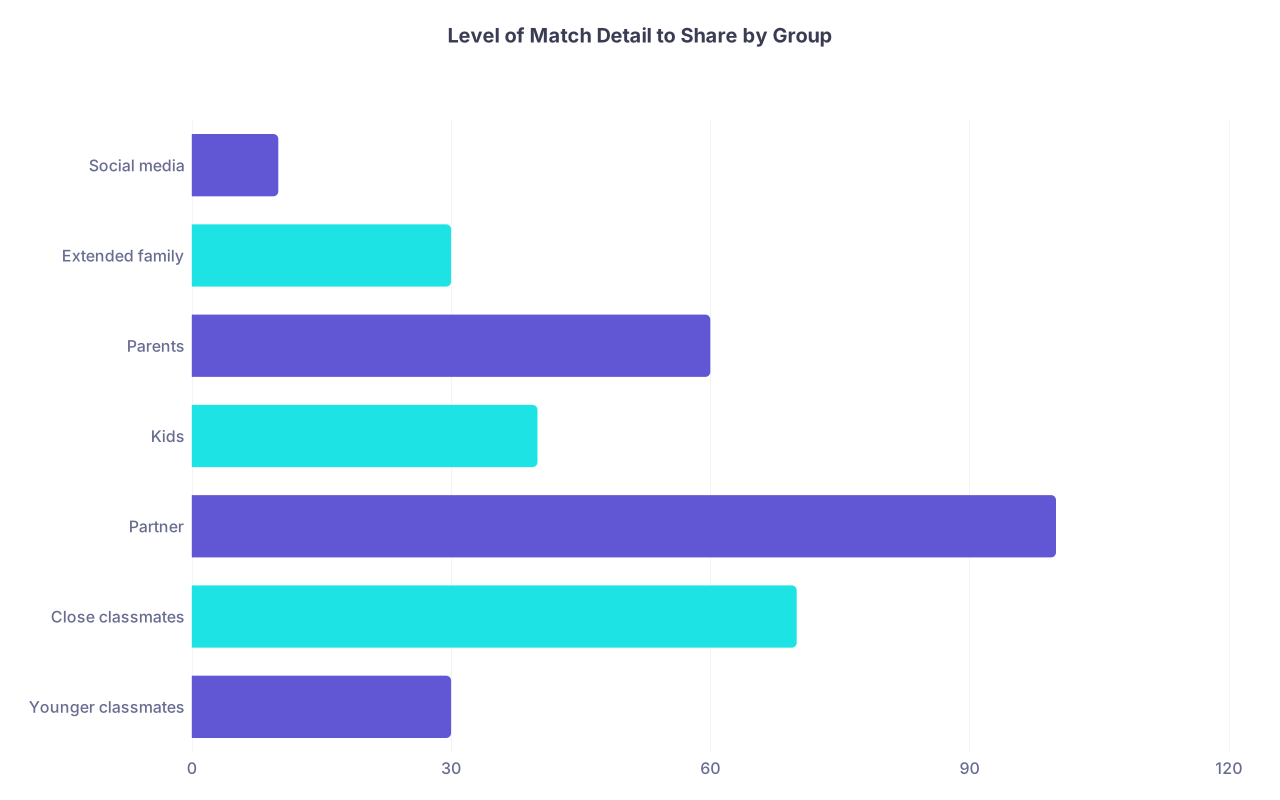
| Category | Value |
|---|---|
| Younger classmates | 30 |
| Close classmates | 70 |
| Partner | 100 |
| Kids | 40 |
| Parents | 60 |
| Extended family | 30 |
| Social media | 10 |
(I’m using 0–100 as “how detailed to get.” You get the idea.)
Here’s the principle:
- Partner – maximum detail: rank list logic, SOAP outcomes, reapplication plans, finances
- Close classmates / mentors – enough detail to get support and strategy
- Parents – medium detail: where/what, rough timeline, high-level plan if things go sideways
- Kids – what it means for their lives, in plain language
- Extended family – minimal: specialty, location, “I’m in / I’m reapplying”
- Social media – optional; if you’re older, you lose nothing by skipping the public Match Day billboard
If you’re tempted to post out of pressure, ask yourself: “Will I want to answer comments about this if I end up changing specialties or programs later?” If the answer is no, keep it simple or skip it.
Step 7: Planning the “Re-Group” Conversation if Things Didn’t Go to Plan
For older applicants especially, if you didn’t match or you took a stopgap SOAP position, you need to sit down with your partner (and maybe later with parents) for a structured conversation once the dust settles.
Not a vague “We’ll see.” An actual plan.

| Step | Description |
|---|---|
| Step 1 | Final Match/SOAP Outcome |
| Step 2 | Discuss move and schedule |
| Step 3 | Reapply plan meeting |
| Step 4 | Timeline - 1-2 years |
| Step 5 | Finances and work plan |
| Step 6 | Family impact and decisions |
| Step 7 | Matched? |
Agenda with your partner:
- What happened
- Brief explanation of match/SOAP outcome
- Short-term plan (next 3–6 months)
- Work, research, prelim year, whatever is actually happening
- Reapplication or redirection plan
- Specialty goals, realistic target programs, any shifts (e.g., from ortho to FM)
- Financial implications
- Income gap, loans, side work
- Family decisions
- Stay or move, kid school issues, care of parents
You talk through it like any other major life pivot. Because that’s what it is.
Step 8: Taking Care of Your Own Head While Everyone Has Opinions
Last piece. Older applicants often feel they have to be the “resilient adult” in every conversation—calm, rational, grateful, no matter what happened.
That’s not sustainable.
You need one or two people where you do not have to be composed:
- A trusted attending or advisor who actually understands the match data
- A classmate who’s also a non-traditional student
- A therapist (strongly recommend if you didn’t match)
- Your partner—if they can hear your raw feelings without trying to “fix” everything in one night

With those select people, you can say:
- “I feel humiliated.”
- “I’m questioning everything.”
- “I’m angry at how this process works.”
Get that out there so you don’t dump it on your kids or your 70-year-old mom who barely understands what residency is.
Final Thoughts: If You’re an Older Applicant on Match Week
Three things to walk away with:
You control the narrative more than you think.
Decide ahead of time what you will say, to whom, and how much detail they actually deserve. “I’ll share once I’ve had time to process” is your best friend.Your age is not an apology.
When people comment on your timeline, match location, or specialty, you’re allowed to answer briefly and confidently, then move on. You made adult tradeoffs. Stand by them.Match results are a phase, not your worth.
Whether you matched your dream, matched something workable, SOAPed into a compromise, or didn’t match at all—this week is not your entire story. Handle the conversations like the adult you are, and then focus on the next step in front of you.