
The most dangerous thing you can do after matching into a prelim-only spot is to just “be grateful” and do nothing else.
You do not have a guaranteed career yet. You have a one-year job. You need a plan starting on Match Day, not “later in residency.”
This is the article I wish more people read the moment they saw “Preliminary” without an advanced spot.
1. First 48 Hours: Get Your Head Straight And Your Facts Clear
You’ll be tempted to either celebrate like you’re fully set or spiral because you “failed the Match.” Both extremes are useless right now.
Here’s what to do immediately once you see you matched to preliminary only.
Step 1: Clarify exactly what you matched into
Do not trust your memory. Open your NRMP email, log into your NRMP account, and write down:
- Program name
- Specialty (usually prelim medicine, prelim surgery, or transitional year)
- Location
- PGY level (almost always PGY-1)
- Duration (usually 1 year)
Then confirm:
- Is this a categorical program with a prelim track, or a standalone prelim year only?
- Does this institution also have an advanced program in the field you want (e.g., they have a Neurology, Anesthesiology, Radiology program)?
Get it in front of you in writing. I’ve watched people waste weeks just being “upset” without ever clearly naming what they actually matched into.
Step 2: Control the story you tell yourself
Here’s the truth, whether you like it or not:
- You did match. You are not SOAPing. You’re not unmatched.
- You do not have a full training pathway yet. Your path is now a two-step: prelim → reapply advanced.
If you keep calling this “I failed,” you will start behaving like someone who failed. That means avoidance, shame, procrastination. You do not have time for that.
Call it what it is:
“I matched to a one-year preliminary position and now I need to secure an advanced spot.”
That framing keeps you in problem-solving mode.
Step 3: Decide your target specialty and backup options
By Match Day, you probably already know what you wanted: anesthesia, radiology, derm, neuro, etc.
You now need to decide:
- Are you going to reapply to that same advanced specialty?
- Are you open to switching into something else that might be more realistic?
- Is there a categorical option at your prelim institution that could eventually absorb you (IM, FM, psych, etc.)?
Write this down in three columns:
| Column | Content Example |
|---|---|
| Primary target | Anesthesiology advanced PGY-2 |
| Secondary/backup | Categorical Internal Medicine at same or nearby institution |
| Absolute no-go | Surgical subspecialties, no path, no interest |
If you do not pick a primary target, you’ll scatter your energy across 4–5 specialties, badly, and end up nowhere.
2. Reality Check: What Matching Prelim-Only Actually Means For Your Path
Let me be blunt.
Programs read “Preliminary only” as:
- Something in your app did not convince an advanced program to commit to you for the long haul.
- You are now in a prove-it year.
That’s not fatal. But you’re on a shorter leash than your categorical co-interns.
Here’s the basic landscape you’re in:
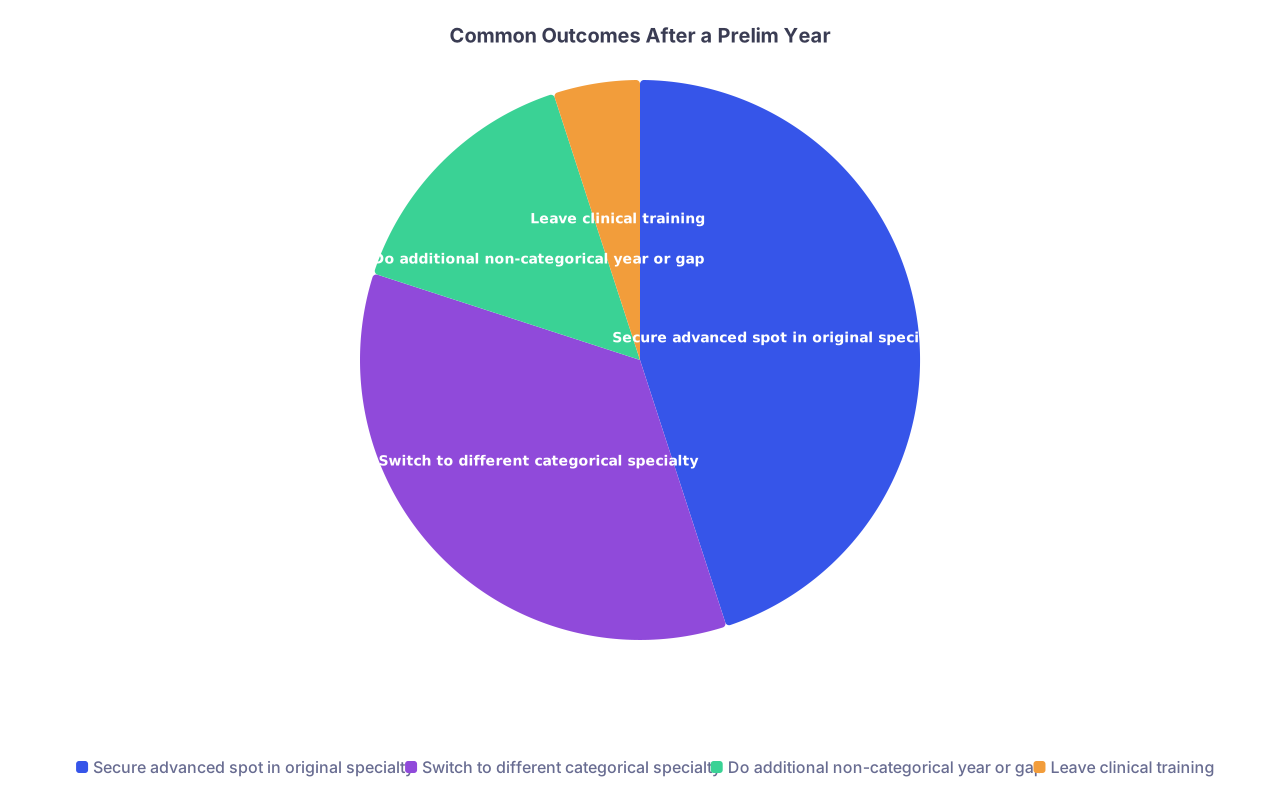
| Category | Value |
|---|---|
| Secure advanced spot in original specialty | 45 |
| Switch to different categorical specialty | 35 |
| Do additional non-categorical year or gap | 15 |
| Leave clinical training | 5 |
These numbers are approximate from experience, not an official NRMP chart. But the pattern holds: most people do move forward. Some in their original field, some in a different one. A smaller chunk get stuck looping or leave.
Your goal is to stay in the first two slices of that pie.
3. Match Week To July 1: Set Up Your Reapplication Infrastructure
The worst mistake I watch prelim interns make? They promise themselves they’ll “figure out the reapplication stuff” once residency starts.
By the time you’re on 6 straight weeks of wards, working 70–80 hours and getting crushed by notes and night float, you will not “find time” to overhaul your personal statement, chase letters, and research 80+ programs.
You do that work before July 1.
A. Debrief your original application – brutally
Print your ERAS. Open your score reports. Look at your interview list and results. Ask:
- Were your scores low for your intended specialty?
- Weak or generic letters?
- Almost no research for a research-heavy field?
- Very few interview invites?
- Any obvious red flags – gaps, failures, professionalism issues?
Circle the 2–3 largest problems. Those are now your projects for the next cycle.
If you can, set up a 30–45 minute meeting with:
- A trusted faculty mentor in your intended specialty
- Or your med school dean/advising office
You don’t need a full career counseling seminar. You need someone to say, “Yeah, with a 215 and no research, matching radiology will be tough; have you thought about IM or neuro?” Or, “Your scores are fine, but your application read as unfocused and your letters were bland.”
Ask for honesty. If all you get is, “Just keep trying, you’ll do great,” you picked the wrong person.
B. Decide if you’re reapplying right away or after the prelim year
There are two main paths:
Apply during your prelim year for a PGY-2 start right after
- You submit ERAS in September of your prelim year.
- If successful, you go directly into your advanced spot the next July.
Delay reapplication
- You complete prelim year, then do research or another year (e.g., chief, non-categorical) and apply later.
For most people, barring huge red flags, I recommend trying to reapply during the prelim year. You can always do it again later if needed. Waiting by default is usually just procrastination dressed up as “strategy.”
C. Build a concrete pre-July 1 to-do list
Between Match Day and residency start you should:
- Draft a new personal statement with a clearer, more specific narrative.
- Update your CV with:
- New rotations, sub-Is, any new research, posters.
- Identify 3–5 potential letter writers at your med school (and some planned at your prelim program).
- Start a rough program list:
- Stretch programs
- Realistic targets
- Safety options, including community and less competitive regions.
This doesn’t need to be perfect. It needs to be 70% done before the chaos of intern year hits.
4. Strategy Inside Your Prelim Year: How To Turn One Year Into A Launchpad
Once July hits, your life is going to feel like a constant game of survival. But a few deliberate choices will completely change your trajectory.
A. Day 1–30: Understand your prelim program’s politics
Have this sequence in your head:
- You are an employee.
- You are being constantly evaluated, even when no one says they’re evaluating you.
- A few key people’s opinions of you will determine your letters and your opportunities.
Within the first month, identify:
- Program director (PD)
- Associate PDs
- Chiefs
- Any faculty who are closely connected to your desired advanced specialty (e.g., the medicine attending who’s also the liaison to cardiology or critical care).
Set up a short meeting with your PD or APD once you’re a few weeks in:
- Be honest but not dramatic:
“I matched prelim-only and plan to reapply to [specialty]. I want to do well here and also position myself for that next step. How do past residents here usually handle that? What do you recommend I focus on early?”
People appreciate straightforwardness. What they hate is finding out in October you’re scrambling for letters and interviews with zero heads up.
B. Crush the things that actually matter
You don’t have to be a genius. But you cannot be the intern everyone complains about. That kills reapplication.
Focus on being:
- Reliable: show up on time, respond to pages, finish notes without being chased.
- Safe: know when to ask for help; do not wing things beyond your level.
- Low-drama: don’t gossip, don’t badmouth the program, don’t whine about “just being a prelim.”
I’ve watched PDs torpedo otherwise decent candidates simply because: “I’m not going to stake my reputation on someone who can’t get their notes done and constantly complains.”
C. Target key rotations for letters
Your letters this time need to be:
- From residency faculty, not just med school.
- Specialty-aligned if possible. If you want anesthesia, a strong letter from an ICU attending or perioperative internist goes further than a random clinic doc.
Look at your rotation schedule early. Mark the months where you’ll be:
- On a service where faculty actually get to know you (wards, ICU, ED).
- Not drowning so hard you can’t also think about applications.
Plan to ask for letters right after those rotations. Not six months later.
And when you ask, say explicitly:
“I’m planning to apply to [specialty] this fall. Would you feel comfortable writing me a strong letter of recommendation?”
If they hesitate, thank them and ask someone else.
5. Reapplying While Working 70+ Hours: How To Not Get Crushed
You’re now in the worst Venn diagram in medical training: heavy clinical workload + job hunting.
You’ll fail if you treat reapplication as “extra credit.” It’s another job. You schedule it like one.
A. Build a mini-ERAS calendar with intern reality in mind
Start with the usual ERAS timeline, then overlay your rotation schedule:
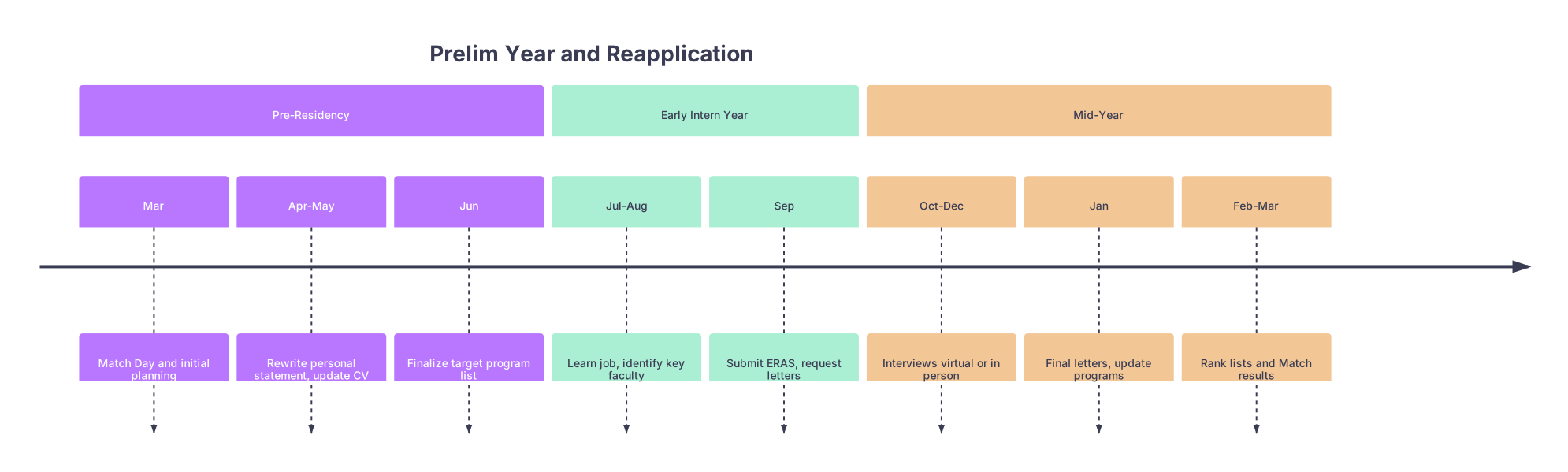
| Period | Event |
|---|---|
| Pre-Residency - Mar | Match Day and initial planning |
| Pre-Residency - Apr-May | Rewrite personal statement, update CV |
| Pre-Residency - Jun | Finalize target program list |
| Early Intern Year - Jul-Aug | Learn job, identify key faculty |
| Early Intern Year - Sep | Submit ERAS, request letters |
| Mid-Year - Oct-Dec | Interviews virtual or in person |
| Mid-Year - Jan | Final letters, update programs |
| Mid-Year - Feb-Mar | Rank lists and Match results |
Then do something most people skip: identify your heavy and lighter months.
- Heavy (e.g., wards + call, ICU): aim only for maintenance tasks (email replies, small edits).
- Lighter (e.g., electives, ambulatory): batch the big lifts (writing, program research, mock interviews).
If all your heavy months line up with critical application tasks, talk to your chief or PD early. Sometimes they’ll swap an elective later in the year into September so you’re not trying to build ERAS from a call room.
B. Rewrite your narrative, don’t just recycle
Your new personal statement cannot be “I’ve always wanted to be a [specialty] doctor” again.
You now have a stronger and more complex story:
- You applied once, didn’t secure an advanced spot, but you still showed up, worked hard, and proved yourself in a residency setting.
- You’ve seen real clinical work and still want this specific specialty, for concrete reasons.
A better frame sounds like:
“During my preliminary year in internal medicine, I found myself drawn repeatedly to [specific types of patients / cases / clinical environments that align with your target specialty]. Working nights in the ICU confirmed that I want to focus my career on…”
Then briefly and directly address your previous Match outcome if needed:
“In my initial Match cycle, I secured a preliminary position but not an advanced spot. That experience, combined with my work this year, has clarified my commitment to [specialty] and given me the maturity and clinical foundation to contribute meaningfully as a PGY-2.”
Own it. Don’t write a sob story. Don’t pretend it didn’t happen.
C. Use your prelim program as an asset, not a secret
Programs will ask what you’re doing now. You want them to hear:
- “They matched prelim and are thriving, not floundering.”
- “Their PD supports them.”
Ask your PD or an APD:
- If they’ll write a letter for you.
- If they’re willing to take a 5-minute call from PDs at other programs who might ask about you.
Your goal is to turn “Prelim-only” from a question mark into a plus:
“They had a setback, but they came here, worked hard, and we’d 100% take them if we had a spot.”
6. Backup Planning: What If You Don’t Match An Advanced Spot Next Round?
If you’re in this situation, you need a plan A and a real plan B. Not magical thinking.
Here are the realistic paths I see after a prelim year if you don’t match advanced:
| Option | Pros | Cons |
|---|---|---|
| Another prelim / non-designated year | Keeps clinical skills active, buys time | Risk of looping, limited growth |
| Switch to categorical IM/FM/Psych | Stable pathway, broad job market | May not align with original dream |
| Research year in your target field | Strengthens application, networking | Income drop, not always available |
| Leave clinical track | Mental relief for some | Huge decision, hard to reverse |
Let’s be honest: another prelim year is almost never ideal. Sometimes necessary, rarely optimal.
What you should do during your prelim year is quietly investigate:
- Are there categorical positions in your prelim department that sometimes open PGY-2 spots?
- Are there nearby programs that have historically absorbed strong prelims into categorical?
- Are there research groups in your target specialty that routinely hire post-residency fellows?
Talk to senior residents who’ve been around. They know which roads are actually used vs just talked about.
7. Mental Health And Identity: Not Letting “Prelim Only” Define You
This part gets skipped all the time, and people pay for it later.
Matching prelim-only hits your ego hard. You watched classmates blast Instagram with balloons and “PGY-1 Neurology, Class of 20XX!” while you’re squinting at “Preliminary Internal Medicine” and doing emotional math.
You’re allowed to be angry. Or embarrassed. Or ashamed.
You’re not allowed to let those feelings run your year.
Here’s how to keep this in check:
- Pick 2–3 people you can speak uncensored with (friend, partner, therapist, mentor). Tell them explicitly: “I need you this year. I matched prelim only and I’m going to be grinding on reapplication while working full-time.”
- Decide what you’re going to say publicly and stick with it. Something like:
“I matched to a preliminary internal medicine year in [city] and plan to pursue [specialty] after that.”
That’s it. No defensive oversharing.
If possible, seriously consider a therapist or counselor, especially if you already know you lean anxious or perfectionistic. Intern year is already brutal; adding career uncertainty is like strapping a weight to your chest.
8. Concrete 30-/90-/365-Day Action Plan
If you want something you can almost use as a checklist, here it is.
Next 30 days (starting Match Day)
- Confirm exact prelim position details and program structure.
- Do a post-mortem on your original application: scores, letters, research, interview spread.
- Meet (in person or virtual) with one honest advisor or mentor.
- Decide primary target specialty + backup pathway.
- Start new personal statement draft.
- Make a rough program list.
Before July 1
- Finalize updated CV.
- Finish a solid draft of personal statement.
- Identify med school letter writers and let them know you’ll be reapplying.
- Research your prelim institution: advanced programs on-site, historical pathways for prelims.
- If you know your prelim schedule, mark heavy vs lighter months.
First 3 months of prelim year
- Meet with your PD/APD to state your goals and ask about support.
- Identify 2–3 rotations where you’ll aim to earn strong letters.
- Lock in at least one faculty mentor at your prelim site.
- Refine program list using real-time intel (which places interview prelims, which are realistic for your profile).
- Submit ERAS on time with updated materials.
By end of prelim year
- Apply broadly but intelligently for advanced spots.
- Maintain strong evaluations and relationships with faculty.
- Parallel-process backup options (categorical switch, research year, etc.) so you’re not starting from zero if things don’t hit this cycle.
9. When Match Day Comes Around Again
If you go through the Match a second time from a prelim year, that week will be tense on a different level. You’re not just waiting for news; you’re waiting to find out if the last year of grinding paid off.
Two key moves:
- Do not disappear from your prelim job emotionally while you wait. People notice when an intern “checks out” in February.
- If you match an advanced spot: tell your PD and key faculty early, thank them, and ask if they’ll stay in touch as mentors.
If you don’t match: make an appointment with your PD within days. No ghosting, no avoidance. Ask directly:
- “Given how this year went, what do you think is my best next step?”
- “Are there any internal opportunities here (categorical openings, research, non-designated positions) that could be realistic for me?”
You want your next step to be purposeful, not just the least-terrible thing you found in a panic.
Key Takeaways
- Matching prelim-only is not the end of your career, but it is a forcing function: you now need a deliberate two-step plan, starting on Match Day, not “after intern year settles down.”
- Use the prelim year as a high-stakes audition: crush your clinical work, secure strong residency-level letters, and rebuild your narrative so programs see growth, not stagnation.
- Always have a backup pathway in motion—categorical options, research, or internal opportunities—so you’re never stuck at the end of the year with only panic and no plan.