The hospital will absolutely steal your Match Day if you let it.
Not out of malice. Just out of inertia. Patients are sick, staff are short, the census is high, and everyone else’s crisis feels more urgent than your once-in-a-lifetime moment. If you do not actively protect your time, you’ll blink and realize you spent Match Day pre-rounding on bed 14 instead of opening that email with your people.
Let’s fix that.
This is for you if you’re thinking: “I’m on wards / ICU / surgery that week, my team’s intense, and I have no idea how I’m supposed to handle Match Day without pissing people off or abandoning patients.”
You can have both: safe patient care and a meaningful Match Day.
But you need a plan. Days to weeks before. Not the morning-of, whispering to your senior, “Uh, can I go step out for a sec?”
Step 1: Know Your Exact Constraints Early
First move: stop guessing, start gathering data.
You need answers to three basic questions as early as humanly possible:
- Where will you physically be on Match Day morning?
- Who controls your schedule that day?
- What are the non‑negotiable responsibilities (rounds, cases, clinics, conferences)?
Do this 1–2 weeks before Match Day, not the Friday before.
Script for your senior or chief resident (use something like this at the end of a normal check-in, not as a dramatic announcement):
“Hey, quick thing looking ahead — my Match Day is on [date]. I’m scheduled to be on this rotation then. Do you have a sense yet what our day usually looks like that morning? Rounds start time, typical census, any must‑attend conferences or cases?”
You’re not asking for permission yet. You’re mapping the battlefield.
From their answer, pin down:
- Typical pre-round and round timing
- How long rounds realistically last
- Any “you absolutely must be there” events (M&M, OR start, clinic)
- Whether people usually duck out to do things (lab, procedures, etc.) without drama
Write it down. Don’t trust your memory when you’re anxious.
Now, line that up with your Match details:
| Time Slot | What Usually Happens | Match Impact |
|---|---|---|
| 7–8 am | Pre-rounding | You’ll be busy seeing patients |
| 8–10 am | Team rounds | Prime conflict with Match email |
| 10–12 pm | Notes/tasks | Best window to celebrate/call family |
Then check your school / NRMP timing:
- NRMP Main Residency Match results emails: typically 11:00 AM ET (adjust to your time zone).
- School events: often 10:30–12:30 local, but verify the exact schedule.
Once you know: “Email hits at 10 AM local, our rounds run 7:30–9:30,” you can start designing a realistic request.
Step 2: Decide Your Non‑Negotiable
Before you talk to anyone, you need to know what you actually want.
Different people care about different things:
- Some want to be at the official school ceremony.
- Some don’t care about the ceremony but want 30 minutes alone to open the email with a partner/parent on FaceTime.
- Some just want to not be scrubbed in a case at the exact second the email drops.
Decide your bare minimum acceptable version of Match Day. Not the dream scenario. The floor.
Examples of non‑negotiables:
- “I want to be off the floor for 30–60 minutes starting 15 minutes before emails hit so I can open it with my spouse and call my parents.”
- “I need to be physically at the school ceremony from 10–12.”
- “I don’t need a big deal, but I do not want to be in the OR or ICU admission at 10:00.”
Rank them:
- Absolute must (you’ll fight for this)
- Strong preference (you’ll ask for this)
- Nice-to-have (you’ll let this go if needed)
This way, when negotiating with your team, you know what you can flex on.
Step 3: Make the Ask — Clearly and Early
This is the part most students screw up. They either:
- Say nothing and hope the team magically protects their time, or
- Drop a vague, apologetic, last-minute ask: “Um, is it okay if I maybe step out for Match stuff later?”
You’re going to be better than that.
Timeline: bring it up 5–7 days before Match Day. So people have time to adjust.
Who to talk to:
- Your senior resident (first)
- Attending (if needed, usually after senior is on board)
- Clerkship coordinator or dean’s office (if the rotation is truly rigid or the team is unhelpful)
Here’s a script that works in most settings:
“I wanted to touch base about Match Day next [Friday]. The results email comes out at [time], and my school has [describe ceremony or your plan].
Would it be possible for me to step away from the team from [time window] so I can open my results and call my family? I’m happy to pre‑round earlier, get all my notes done ahead, and help front-load tasks so the team is covered while I’m gone.”
You are doing three things here:
- Giving a specific time window
- Showing you understand the workflow
- Offering to make their lives easier, not harder
If you want the ceremony:
“Our formal Match ceremony is from 10–12, and the email hits around 11. I would really like to be there; it’s our school’s main event. Is there a way I could be excused for that window if I come in earlier and handle my patients’ pre-rounding and notes before?”
If you’re on a brutal service (ICU, trauma, busy surgery), soften the edges:
“I know this service is intense and the patients come first. I still wanted to ask if there’s any way I could step out for at least 30 minutes around [time], and I’ll do whatever I can to front-load work so nobody’s stuck covering my stuff.”
Most residents and attendings remember their Match Day. Many will try to help.
Step 4: Match Strategy to Rotation Type
Match Day on a sleepy outpatient clinic is one thing. Match Day on trauma call is another. You need different tactics.
Medicine Wards / ICU
Biggest threats: long rounds, new admissions, “just one more thing” tasks.
Your moves:
- Pre‑round earlier than usual that day. Have vitals, labs, overnight events, and even draft plans ready. That buys credibility.
- Tell your intern: “I’m planning to step out from 9:45–10:45 for Match. I’ll have all my patients ready and can help you with orders before I go.”
- Swap roles on the team: maybe you don’t present as many patients near the Match window, or you’re not the one scrubbing in for a procedure at that time.
Morning huddle phrasing (day-of):
“Quick reminder: I’ll be stepping out at [time] for my Match results. I’ve pre-rounded on all my patients, notes are started, and I’ll finish anything outstanding as soon as I’m back.”
OR / Surgery
Biggest threat: scrubbed in when the email hits.
Your goal is not to disappear in the middle of a case. Your goal is to be between cases, at lunch, or the “non-scrubbed” student when the email comes.
A week before, say to your chief:
“For Match Day, could I be assigned to cases that either finish before [time] or where I’m not the primary student scrubbed in around then? I don’t need the whole day off, but I would really like to not be scrubbed at the exact Match email time, and to have 30 minutes to step away.”
They might give you:
- A shorter case early
- An outpatient or minor room
- Permission to not scrub the case that overlaps the time
If they say: “We can’t predict that far ahead,” then shift the goal: be in a role where you can step back when a natural break appears.
Day-of tactic:
- Be extra useful before and after. Hold retractors, run to get supplies, see post‑ops.
- When there’s a natural pause: “Dr X, my Match email is about to come out. Is now an okay time for me to step out for 20–30 minutes?”
Most humans with a pulse will say yes.
Outpatient Clinic
Easiest setting, but people still find ways to get trapped.
- Look at the schedule in advance. Where’s the gap or light period around Match time?
- Ask the attending: “Would it be alright to block one slot around [time] for Match? I’ll see all other patients as usual.”
If they can’t block a slot, you can still say:
“When there’s a no-show or quick visit near [time], could I step out for 20–30 minutes to open my Match email and call my family?”
Night Float
If your Match email hits during your “sleep” period:
- Protect your sleep window and your Match moment.
- Tell your team: “I’m on nights, but my Match email hits at [time]. I’ll plan to be up for that, but I’ll still be back in for shift at [time].”
Do not martyr yourself by staying up extra hours beyond that. You’ll make mistakes that night.
Step 5: Front‑Load Your Work So No One Resents You
You want your team thinking, “They earned this,” not “Great, now I have to do their scut while they party.”
Concrete moves for the 24–48 hours before Match Day:
- Be hyper‑reliable. Show up on time, do your notes early, anticipate tasks. People are more flexible with the helpful student.
- Volunteer for less glamorous stuff earlier in the week: discharge summaries, calling families, chasing records.
- The day before, say: “I know I’ll be stepping away tomorrow around [time]. Is there anything I can do today to make tomorrow smoother?”
On Match morning:
- Pre‑round earlier if possible.
- Have your notes started (even if they’re drafts) before rounds.
- Ask your intern/resident, “Anything specific I can knock out before I step away?”
You’re signaling: I care about my Match, but I also respect the team.
Step 6: Set Boundaries With Yourself Too
The hospital isn’t your only problem. Your own anxiety will try to hijack your day.
You need rules for:
- Your phone
- Social media
- Group chats
Decide:
- Will you have notifications on or off before the email?
- Are you okay seeing other people’s “I MATCHED XXX!” posts before you open your own email?
My honest recommendation if you’re on a busy rotation:
- Silence every non-essential notification for the first part of the day.
- Keep your phone in your pocket or locker during heavy patient care.
- Only fully engage with your phone during your protected window.
If your school has a ceremony but you’re stuck at the hospital, decide:
- Are you going to FaceTime in?
- Are you okay skipping it and just doing your own mini-ceremony later?
No right answer. But you’ll feel better if you decide ahead of time, not in a panic on rounds.
Step 7: Coordinate With Your People
Protecting your Match Day isn’t just about your team. It’s about not getting ambushed by 17 family FaceTimes while you’re trying to present a GI bleed.
Do this 2–3 days before:
Message your core people (partner, parents, siblings, best friend):
“I’m on a busy rotation for Match Day. My plan is to open my email around [time] when I can step away.
I won’t be able to respond much before then. Once I know, I’ll call you between [window].”
Set expectations so they are not spam-calling you from 30 minutes before the email until you leave a code stroke.
If you want them live on FaceTime when you open it:
- Give them a specific time and confirm your time zone.
- Tell them, “If I’m a little late, it’s work. Don’t panic.”
If you’re not sure exactly when you’ll be able to open it (e.g., unstable ICU patient), tell them:
“I’ll open it as close to [time] as safely possible. I might be a bit late if we’re in the middle of something critical.”
Step 8: Have a Micro‑Plan for the Worst-Case Timing
Assume this scenario: at 10:55, your email hits. At 10:54, a patient desats. What then?
You need a rule for yourself now, before emotions kick in:
- Patient > Match. Every time.
- You can open an email late. You cannot fix a bad outcome because you were in the stairwell refreshing Gmail.
So your rule might be:
- If something acute is happening within 15–30 minutes of Match time, I stay and help. I open my email after stability returns.
- If a true code or emergency happens and lasts into my protected time, I text my family: “Emergency at work. I’m okay. I’ll open results after this.”
Write that down. It’ll help you not resent your patients for “ruining” your day. You’ll know you made the right call.
Step 9: Plan the 30 Minutes After You Open the Email
People over-focus on the exact moment of opening, and completely ignore the next 30 minutes. Those 30 minutes are chaos if you don’t plan.
Pick one of three approaches:
Private + one person.
You step into a quiet room (stairwell, empty conference room, call room), open the email alone or with one person on FaceTime. Make the key calls, then go back to work.Group with classmates (if possible).
If you’re at the same hospital, coordinate to duck out together to a break room.Video in to the ceremony.
Your school may have a Zoom link. Use that only if your workload is light and your team doesn’t mind.
Where are you going to be physically? Decide:
- Best place: quiet, private, with decent cell service.
- Worst place: crowded nursing station where half the floor will stare at you crying.
And answer this before the day:
- Who are the first 3 people you will tell?
- Who can wait until lunch or the end of the day?
This keeps you from losing an entire hour cycling through your entire contact list while your team wonders where you went.
Step 10: If Your Team Says No or is Difficult
Sometimes, despite all of this, you’ll get:
- “We’re short-staffed, you can’t leave.”
- “You’re a student; this is your job.”
This is where you decide how hard you’re willing to push.
Options, escalating:
Clarify the ask:
“Even 15 minutes away from rounds around [time] would help. Is there really no way to arrange that?”Bring in your school:
Email/call your clerkship coordinator or dean:“I’m scheduled on [service] on Match Day, and my team feels they can’t spare me. Is there a school policy for students being allowed to attend Match or have time for results?”
Many schools do have norms: half-day off for Match, excused absence for the ceremony, etc. They can advocate.
- If all else fails:
You may open your email in a suboptimal way (on a computer between patients, in the hallway). It’s not fair, but it happens.
If that’s you, reframe: your real celebration can still happen later that day or weekend with your people. Do not let one difficult attending ruin the entire memory.
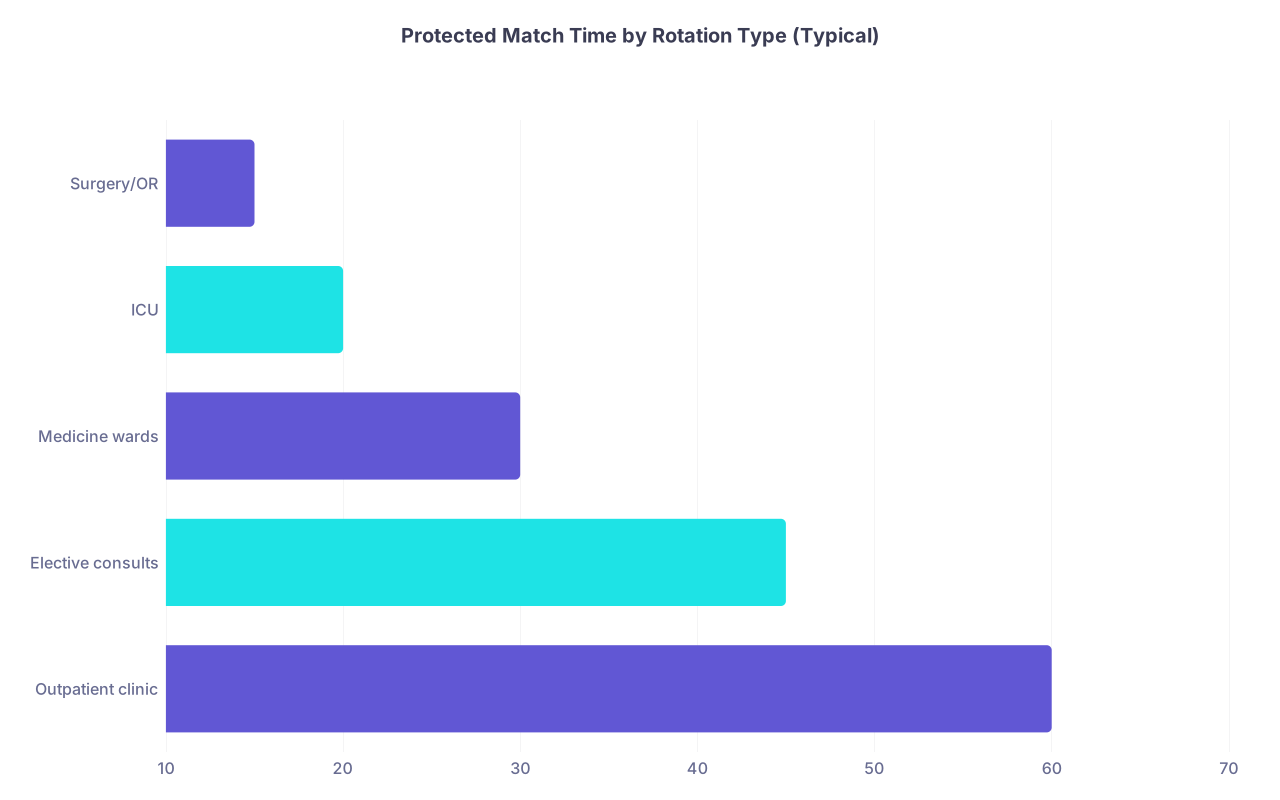
Quick Visual: Protecting Time vs Rotation Intensity
| Category | Value |
|---|---|
| Outpatient clinic | 60 |
| Elective consults | 45 |
| Medicine wards | 30 |
| ICU | 20 |
| Surgery/OR | 15 |
(Values approximate “easier to get this many minutes off” — not gospel, but you get the idea.)
Step 11: After the Dust Settles
You protected your time. You matched. You’re running on adrenaline and maybe some tears.
Do two things before the day ends:
Thank your team.
“Thanks again for making space for me earlier today. I really appreciate it.”
If you matched somewhere exciting, you can share if you’re comfortable: “I matched at [program]!”Take 5 minutes alone.
Even in a call room. Just sit, breathe, and actually feel what happened, instead of letting it blur into patient lists and pager beeps.
And then, practically: go home on time that day if you can. You earned it. The work will be there tomorrow.
If You’re Reading This Weeks Before Match Day
Here’s what to do today:
- Look up the exact Match results time and your school’s ceremony details.
- Check your schedule for that day. Identify the attending/senior you’ll be with.
- Draft a 2–3 sentence ask using the scripts above.
- Put a reminder in your phone for 5–7 days before Match Day: “Talk to team about Match time off.”
Do those four steps now, not the week of.
Then, when the busiest rotation of your year collides with one of the biggest days of your life, you won’t be relying on luck or other people’s memory. You’ll be walking into Match Day with a plan — and enough protected time to actually live it.
Open your calendar right now, find Match Day, and write in that time window you want protected. That’s your starting line.