
It’s Match Day morning. Your classmates are blasting music in the group chat. Someone’s already practicing their “ugly cry for Instagram.” The school keeps talking about “the energy in the room” and “once-in-a-lifetime celebration.”
You’re staring at the RSVP email thinking: “I want my envelope. I want my result. I do not want 300 people screaming in my ear while I pretend this is fun.”
You’re not broken. You’re introverted. And Match Day is built for extroverts.
So let’s build you a version of Match Day that doesn’t leave you emotionally hungover for three days.
Step 1: Decide Your Level of Participation (And Be Honest About It)
First decision: Are you actually going to the ceremony?
There are three realistic options, and all of them are valid. Not socially acceptable in every dean’s speech, but valid in real life.
| Option | Social Intensity | Emotional Control | Logistics Complexity |
|---|---|---|---|
| Full Ceremony | High | Low | Low |
| Partial Event | Medium | Medium | Medium |
| Skip Ceremony | Low | High | Medium |
Option A: Full Ceremony (You Go, You Sit, You Open There)
This is what the school expects:
- You show up early.
- You sit in a crowded auditorium or ballroom.
- You wait while everyone screams at each speech.
- You open your envelope at the exact same time as everyone else.
- You react. Publicly.
This is draining if you’re introverted. Not impossible, but it will cost you energy. Do this only if:
- You actually want to share the moment with classmates or family.
- You can tolerate a few hours of noise and chaos.
- You have a decompression plan afterward.
If you choose full ceremony, your strategy is not “be less introverted.” Your strategy is “treat this like a marathon” and manage your energy deliberately.
We’ll get to that.
Option B: Partial Event (You Go on Your Terms)
This is the middle ground most introverts don’t realize is allowed.
Some variants I’ve seen work:
- Show up late just for envelope pickup and a quick photo, then leave.
- Go at the start, sit in the back, pick up the envelope, then walk outside to open it.
- Attend the ceremony but step out right before the mass opening to open privately, then come back for quick hellos.
The key here: communicate your plan in advance to people who might expect more (partner, parents, close friends).
Try something like:
“I’m planning to go to the ceremony, but I’m going to slip out to open my envelope somewhere quiet and then come back. Crowds are a lot for me, so this is the best way I’ll actually enjoy the day.”
Option C: Skip the Ceremony Entirely
You’re allowed to not go. Seriously.
You might choose this if:
- You know crowds wipe you out for days.
- You want to open the email/envelope alone or with one or two people.
- You’re already running on fumes from interviews, rank list stress, and med school.
You can still:
- Pick up the envelope later.
- Take photos somewhere else.
- Celebrate in your own way.
If you skip, email whoever is coordinating and say:
“I won’t be able to attend the ceremony, but I’d like to pick up my envelope afterward / get my results by email. What’s the process?”
You don’t owe them a full psychological explanation. You’re not applying to their residency.
Step 2: Script the Day in Advance (So You’re Not Making Decisions While Fried)
Introverts burn out faster when we have to make a ton of on-the-fly social decisions. So you pre-load decisions before Match Day.
Here’s what to decide at least 3–4 days before:
- Where you’ll physically be at envelope-opening time
- Who will be with you (if anyone)
- How long you’re willing to stay at any event
- Your “exit phrases” when you’re done
Build Your Personal Match Day Timeline
Let’s sketch this using a simple flow.

| Step | Description |
|---|---|
| Step 1 | Wake up |
| Step 2 | Quiet morning routine |
| Step 3 | Travel to campus or chosen location |
| Step 4 | Sit in back with ally |
| Step 5 | Arrive near envelope time |
| Step 6 | Stay home or quiet spot |
| Step 7 | Open envelope in chosen space |
| Step 8 | Share results with selected people |
| Step 9 | Short celebration |
| Step 10 | Decompress alone or with one person |
| Step 11 | Ceremony plan |
Put actual times and people in there. For example:
- 7:30–9:00: Slow morning, no social media.
- 9:30–10:00: Drive with partner to campus, sit in car for a moment before going in.
- 10:00–11:00: Sit in back with 1–2 friends, no wandering around.
- 11:45: Step outside with partner, open envelope under a tree.
- 12:00–12:30: Text parents / FaceTime siblings.
- 12:30–1:00: Quick photo with friends who want to meet up.
- 1:00–3:00: Go home, alone time. Phone on Do Not Disturb except favorites.
- Evening: Small dinner with 2–4 people, max.
If you don’t write it down, the day will get hijacked by other people’s expectations. And extroverts are very good at “oh just stay a little longer!” when you’re already done.
Step 3: Control the Physical Environment (As Much As You Can)
You can’t make the room quieter. You can make it less hostile to your nervous system.
Pick Your Location Strategically
If you’re going to the ceremony:
- Sit on an aisle, near the back or side. So you can get out without climbing over 12 people.
- Avoid the center “high energy” clusters if your class is very loud.
- Identify an exit path and a quiet nearby area before the event starts (hallway, lobby corner, outside bench).
I’ve watched people panic because they felt trapped. A simple “I’m on an aisle; I can step out” changes how your brain handles the noise.
Use Simple Sensory Defenses
This is not overkill:
- Wear earplugs or loop-style ear filters. You’ll still hear, just less intensely.
- Keep a water bottle and maybe a small snack (low blood sugar plus overstimulation is a bad combo).
- Dress in something that doesn’t add to your discomfort. If your school pushes “professional dress,” fine. But don’t wear shoes or clothes that you know make you miserable.
Step 4: Set Boundaries With People Who Love You (But Drain You)
Introverts often aren’t drained by “people” in general. We’re drained by certain kinds of people and interactions.
So decide:
- Who do you actually want physically there?
- Who gets a same-day call vs. a text later?
- Who doesn’t need real-time anything?
Managing Family Expectations
Here’s where it often goes sideways: big extroverted families who think this is a wedding.
If your family is intense, send something like this a few days before:
“Match Day is a big deal and I’m excited, but large crowds really drain me. Here’s my plan: I’m going to [go to / skip] the ceremony and open my envelope [there / outside / at home]. I’d love to share the news with you by [FaceTime / call / text] around [time window]. After that I’m going to take some quiet time. We can plan a full celebration [this weekend / when things settle].”
Don’t wait until the day of. Day-of your bandwidth is already low.
Friend Group Management
The loud friend group will want group photos, group reactions, group everything.
If you like them but know you can’t do the full thing:
“I’m probably going to step away from the crowd when we open, but I’d love to meet up for photos afterward if I’m still around.”
Or if you’re skipping:
“I’m going low-key for Match Day and not doing the ceremony, but I definitely want to see your updates and hear where you end up. I’ll text you after I open.”
You’re not antisocial. You’re rationing social energy for something that matters.
Step 5: Handle the Exact Moment of Opening
This is the core. The 30 seconds where noise, emotions, expectations, and adrenaline all slam together.
Choose Your Opening Context
You need to decide three things:
- Who is physically next to you: partner, best friend, no one
- Where you’re standing/sitting: inside, hallway, outside
- How public your reaction will be
For introverts, the best setups I’ve seen:
- On campus but outside the main room, with 1–2 people.
- In the back corner of the room, sitting down, with one person, earplugs partly in.
- At home, on the couch, laptop or envelope, with a pet or one human.
You don’t need a crowd to authenticate the moment.
Managing Your Emotional Reaction Under a Spotlight
Let’s be honest: some people will scream, sob, collapse, or jump on chairs. That might not be you. That’s fine.
You can:
- Take a breath.
- Read it once.
- Let it sink in.
- Whisper it to the person next to you.
You don’t owe anyone a performance. If someone pushes you—“Why aren’t you more excited?”—you can literally say:
“I’m processing. I’m excited, but it takes me a bit.”
That’s true. And it shuts down the commentary.
Step 6: Prepare for Both Outcomes (Win and Gut-Punch)
Match Day is emotionally loud even if you match perfectly. Your brain is still getting slammed with adrenaline and social noise.
If You Match Where You Wanted
People assume “good outcome = no stress.” Wrong.
Even with your top choice:
- You’ll be flooded.
- People will demand your attention.
- Your phone will blow up.
Have a simple auto-response ready. You can literally type this in a notes app to copy-paste:
“Just opened my Match letter – I’m going to [Program] in [City]! I’m trying to be present and not on my phone all day, but I’ll reply more later. Thanks for thinking of me.”
Use it. Don’t individually craft 47 text responses. You’re not a concierge.
Schedule decompression the same day. Not “I’ll crash sometime next week.” Same day.
If You Don’t Match or You’re Disappointed
This is the scenario nobody wants to talk about publicly. Which makes it even harder if it happens to you.
If you SOAPed earlier that week, you already know your fate. So Match Day is less shock, more “how do I survive watching everyone else celebrate?”
In that case, be ruthless about self-protection:
- You do not need to attend the ceremony.
- You do not need to watch everyone open.
- You can take the day for yourself, your partner, your therapist, whoever you trust.
If you matched but not where you hoped:
- You’re allowed to have mixed feelings.
- You’re not obligated to plaster “SO BLESSED!!!” everywhere 30 seconds after reading something that detonated your five-year plan.
If someone says, “You should be grateful, at least you matched,” you’re allowed to think “thanks, I hate that sentence” and keep your distance.
For others, you can use:
“I’m glad I matched and grateful to be moving forward. I’m also processing the change in plans, so I might be a bit quiet about it for a bit.”
That buys you space.
Step 7: Build Your Recovery Plan (So You Don’t Spend the Weekend Fried)
Introverts often make one big mistake: they over-index on surviving the event, and forget about the aftermath. Then they wonder why they feel flattened for 48–72 hours.
So you plan recovery like you’d plan a long call shift.
Match Day Recovery Basics
You’ll need:
- At least a few hours of zero expectations afterward
- Food that doesn’t require effort
- A low-stimulation activity: walk, quiet coffee shop, lying on the floor staring at the ceiling, whatever works
Don’t schedule:
- Big parties the same night unless you genuinely want that and have protected time beforehand.
- Multiple family events in one day. Pick one.
- Heavy planning or logistics conversations about moving, apartments, contracts, etc. Give your brain a beat.
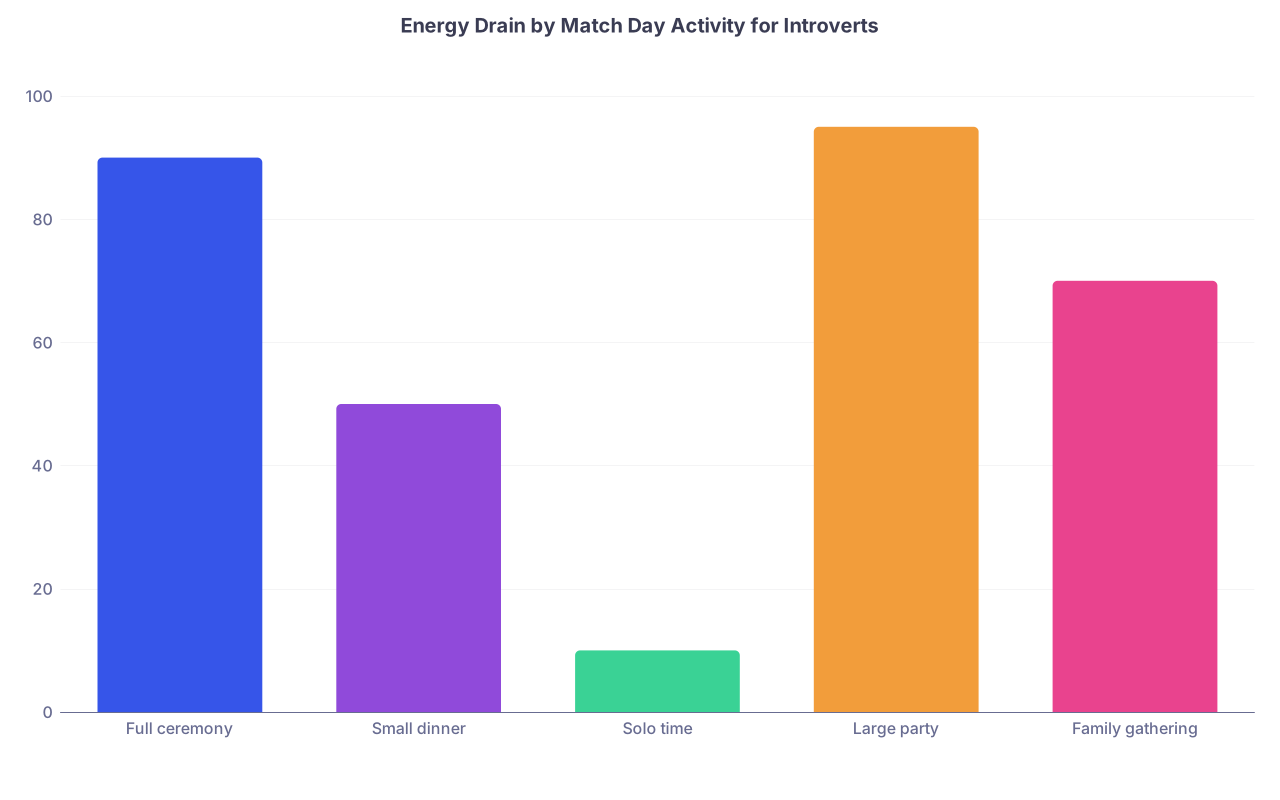
| Category | Value |
|---|---|
| Full ceremony | 90 |
| Small dinner | 50 |
| Solo time | 10 |
| Large party | 95 |
| Family gathering | 70 |
Treat your energy like this chart: big social events are near 90–95% drain. Plan recovery accordingly.
Step 8: Social Media, Group Chats, and Comparison Traps
If there’s one thing that spikes introvert fatigue: 200 people performing their joy online simultaneously while you’re still processing.
Options that work:
- Delete or hide Instagram/LinkedIn for 24–48 hours.
- Mute the class GroupMe / WhatsApp for the day.
- Pre-write one simple post (if you feel obligated to post) and then log off.
If you want to be minimally present without drowning:
“Matched to [Specialty] at [Program] – grateful and excited for the next step.”
Post it. Close the app. Walk away.
You don’t need to reply to every “congrats” immediately. You’re allowed to respond in batches later or not at all.
Step 9: If You’re Going Solo or Nearly Solo
Some introverts aren’t just dealing with crowds. They’re also dealing with the fact that they don’t have a big friend group or a large family support system.
Here’s what you do.
Build a Minimal Support Net
Aim for 1–3 people across any distance:
- One classmate you can text “just opened” to.
- A sibling, cousin, or old friend you can call or FaceTime.
- An attending, mentor, or advisor you can email later in the day.
If you don’t have those, consider:
- Posting anonymously on a med forum or subreddit after you open. Sometimes you just need someone to say “congrats” who understands the process.
- Scheduling an appointment (telehealth) with a therapist that week if Match outcomes are likely to trigger big feelings.
You’re not dramatic. You’re preparing for a high-stress event with real consequences.
FAQs
1. What if my school “strongly expects” everyone to be at the ceremony?
You’re not property. If they push attendance, you can still protect yourself. At minimum, sit in the back, plan to step out for opening if needed, and leave early. If anyone in administration challenges you:
“Crowded events are very overwhelming for me. I’m glad to celebrate, but I’ll be stepping out as needed.”
They’re not going to fail you in March for that.
2. How do I handle a super-extroverted partner who wants the full spectacle?
Be direct beforehand:
“I know this day is exciting, but big crowds really drain me. Here’s what I can do: [describe your plan]. What matters most to you so we can meet in the middle?”
Maybe they get photos and a short time in the room, but they agree to leave when you give a pre-arranged signal. This is a stress test for how they handle your needs. Useful data.
3. I feel guilty for not wanting the “full Match Day experience.” Is that a red flag about me?
No. It’s a red flag about how narrow the culture’s definition of “celebration” is. You’re allowed to want a quiet, meaningful, lower-sensory version. Your reaction to being overstimulated has nothing to do with how much you care about medicine, your match, or your future patients.
4. What if my friends or family take it personally that I leave early or skip parts?
Some will. That’s reality. You can acknowledge their feelings without sacrificing yourself:
“I get that you wanted to stay longer. I really appreciate you being here. For me, once I hit a certain point in crowds, I stop enjoying anything. Leaving early helped me actually remember the good parts of today.”
People who care about you will adjust over time. People who only care about the picture they wanted? They’ll be annoyed. Let them.
Key points to walk away with:
- You’re allowed to design a Match Day that fits your nervous system, not just the dean’s slideshow.
- Decide your level of participation, script the day, and protect recovery time like a post-call sleep.
- You don’t owe anyone a performance or a crowd-pleasing reaction; you owe yourself a version of this day you can actually remember without flinching.