
If You Matched Close to Home but Wanted Away: Managing Expectations
It’s Match Day afternoon. Your phone is buzzing, your group chat is chaos, families are on FaceTime popping champagne. You open your email, see “Congratulations, you have matched,” scroll…and there it is.
You matched. At the hospital 20 minutes from where you grew up. The same city you swore you’d leave. The one you said, out loud, on more than one tired post-call rant: “I just need to get out of here.”
And now you’re stuck between two emotions:
- Relief that you matched.
- A deep, quiet disappointment that you did not get away.
If that’s you, this is the situation: you matched close to home but you really wanted distance, independence, a fresh start. You’re trying to act happy in front of everyone, but inside you feel trapped, guilty, and maybe a little resentful.
Here’s how to handle it. Practically. Not the Instagram version.
Step 1: Allow Yourself to Be Disappointed (Without Torching Bridges)
You don’t fix this by pretending you’re thrilled.
You fix it by being honest with yourself in a controlled way.
For the first 24–72 hours:
- Stop performing. If your family is ecstatic and already talking about “you can come over for Sunday dinners!” you do not have to match their energy.
- Do your obligatory “I matched!” post if you want, but you do not owe anyone a TED talk about how this was your dream program.
- Have 1–2 people (max) you can be completely honest with: “I’m grateful I matched. I am also really upset that I didn’t get to leave.”
What you don’t do:
- Don’t blast your disappointment on social media. The intern class group chat will see it. PDs have burner accounts. It will come back to you.
- Don’t send angry texts about the program that could be screenshot and forwarded.
- Don’t tell family, “I wish I’d matched literally anywhere else.” They will remember that quote at every family gathering for the next 3 years.
You’re allowed this internal monologue: “This is not what I wanted.”
You’re not allowed to burn your professional reputation before Day 1.
Step 2: Get Clear on What You Actually Lost (And What You Didn’t)
Right now it feels like you lost everything: independence, adventure, anonymity. That’s not actually true. Let’s dissect it.
Most people who want to go away are chasing some mix of:
- Distance from family expectations or drama
- Proof they can succeed on their own
- A new city / different culture
- Room to reset relationships or identity
- Space from old friend groups or exes
You didn’t lose:
- The ability to grow up
- The ability to set boundaries
- The chance to build new habits and a new identity
- Your career trajectory
I’ve watched plenty of residents start residency in their hometown and end up more independent than they ever were in med school:
- New apartment across town, different grocery store, new gym
- Boundaries on family visits: “I’m post-call. I’m not coming for brunch.”
- Entirely new friend group (your co-residents), social life centered around residency, not high school friends
If you want to be away because of family pressure or lack of independence, the hard truth is this: you didn’t need 1,000 miles. You needed boundaries. And you can still build those.
Make a quick, honest list:
- “I’m sad about missing out on: [different coast, specific city, living totally alone, blank slate with no one knowing me.]”
- “I’m worried about: [parents dropping by, friends expecting me to be always available, not feeling like a ‘real adult’].”
Now we know what to target. This is no longer just vague disappointment. It’s specific problems you can work on.
Step 3: Reality Check – Your Program vs. Your Zip Code
You matched into a program, not into a city.
- Your performance
- Your professionalism
- Your clinical growth
- Your board performance
- Your letters
They do not care that you can drive by your high school in 10 minutes.
If you’re feeling “stuck,” separate two things in your head:
- How good the program is for your training and career.
- How you feel about your personal life being geographically close to home.
Sometimes people are actually mad about #2 and then start telling themselves weird stories about #1 (“This program is second-rate,” “No one will respect this name”). Often not true.
If you’re aiming for a competitive fellowship or job later, what really matters:
| Factor | Impact Level |
|---|---|
| Program reputation | High |
| Letters from leaders | Very High |
| Research output | High |
| Clinical evaluations | High |
| City where you trained | Low |
You can match Cards from your hometown academic center. You can match Heme/Onc or Ortho from the institution you grew up driving past. I’ve seen it repeatedly.
So here’s the professional mindset shift:
“I didn’t get the location I wanted, but I can still become the physician I want.”
Step 4: Decide Who Gets the Full Story (and Who Doesn’t)
You can’t walk around for three years playing “this wasn’t my first choice” on repeat. But you also don’t need to fake some epic love story about your program.
Filter your honesty:
- With co-residents you trust (months in, not Day 1): “I actually wanted to go out of state, but I’m glad I’m here now.”
- With faculty: “I’m really happy to be here and excited to learn.” Full stop. They don’t need the internal conflict.
- With family: “I’m grateful I matched somewhere solid. I also need to build some independence even though I’m nearby.”
Do not overshare your rank list with attendings. Nothing good comes from: “Yeah, this wasn’t my top choice…”
You’re building a professional identity. Protect it.
Step 5: Build “Away” Inside “Close to Home”
You didn’t get to move across the country. Fine. So now you create distance in other ways.
5.1. Physical and Routine Distance
- Live in a different neighborhood than your parents, even if it’s slightly more inconvenient. Do not move back home “just for intern year to save money” unless you are genuinely okay with sacrificing independence. Most people regret it.
- Get a new primary care doctor, a new dentist, a new coffee shop. Quit the “everything is the same” loop.
- Change your commute pattern. Different route, different podcast, different schedule. Your brain will treat it as a new phase.
5.2. Social Distance and Boundaries
Have explicit conversations before residency starts:
“Residency is going to be intense. I won’t be available as often as before. I might not come to every family event. That doesn’t mean I don’t care.”
Then enforce it.
That means:
- Saying “No, I’m post-call” and actually sleeping instead of going to every cousin’s birthday.
- Not answering non-urgent family texts all day while at work. You’re a physician now, not an on-call therapist for your family drama.
- Not feeling obligated to spend every free weekend at home.
You can be 20 minutes away and emotionally 2,000 miles away. That’s not cold; that’s residency survival.
Step 6: Guard Your Mindset Without Gaslighting Yourself
You don’t need to lie to yourself and pretend this is your dream scenario. Forced gratitude is exhausting. But you also cannot sit in bitterness for three years.
The middle path looks like this:
- “This is not the location I wanted. That’s real.”
- “I can still make this a strong training experience.”
- “Staying close to home gives me some advantages I wouldn’t have had away.”
Let’s name those advantages so you’re not ignoring them out of spite:
- Easier logistics during awful months (someone can bring you food post-call or help if your car dies).
- Built-in emotional support when something truly catastrophic happens (patient death, lawsuit, major mistake).
- Financial breathing room if needed (yes, boundaries still apply, but a nearby safety net has value).
Then write down 3–5 specific things you’re going to use to your advantage by being local:
- “I will use my local network to line up shadowing or mentorship with X specialist I’ve known since undergrad.”
- “I’ll actually go to therapy once a week because I don’t have to learn a new city’s system.”
- “I’ll keep my support system close but on my terms.”
This isn’t toxic positivity. It’s refusing to waste a match on sulking.
Step 7: Protect Your Next Move (Post-Residency Freedom)
Residency is not your final destination. It’s 3–7 years.
If you want to end up elsewhere long-term, treat this like a launchpad, not a sentence.
Use a simple strategy:
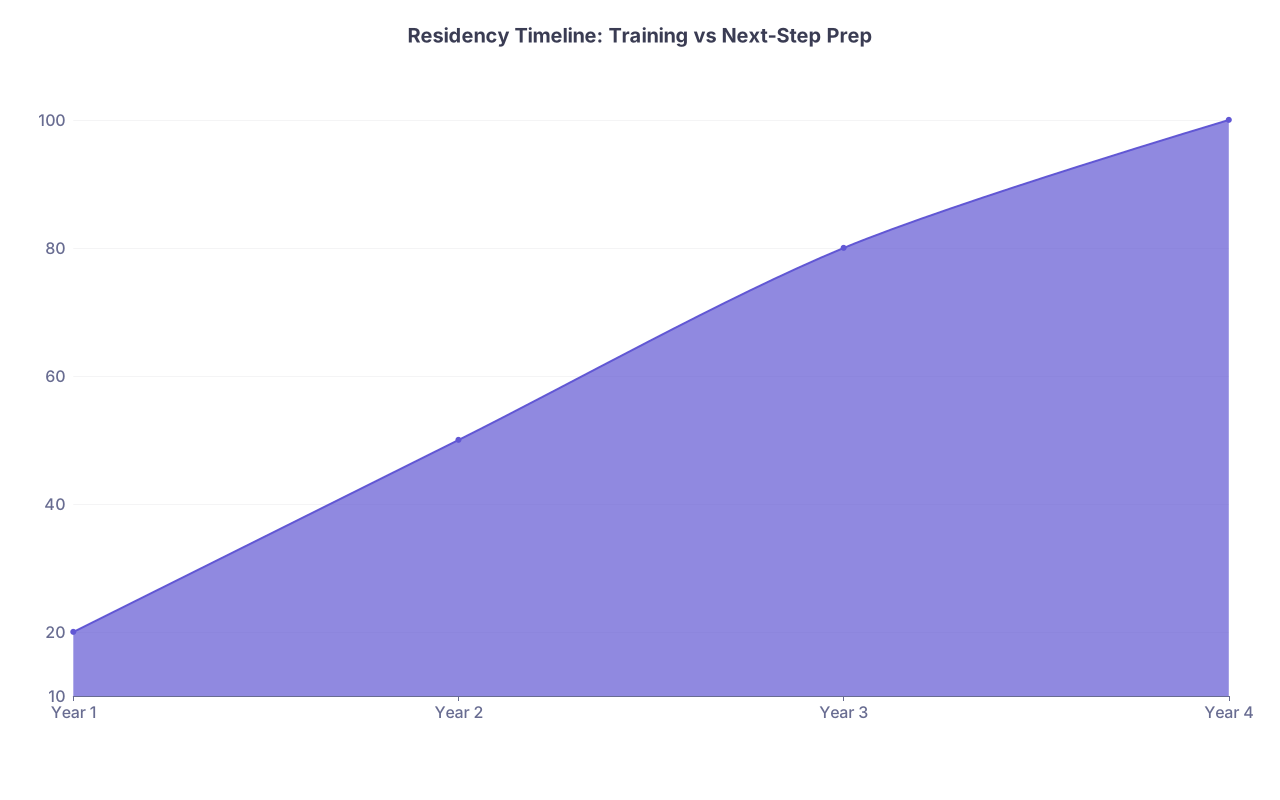
- Year 1: Learn to be a competent resident. Get good evaluations. Learn the system. Don’t be a disaster.
- Year 2: Add research / networking in the direction you want to go (fellowship, geographic region, specific institution).
- Year 3+: Apply out. Fellowships, jobs, whatever gets you to the city or region you really wanted.
| Category | Value |
|---|---|
| Year 1 | 20 |
| Year 2 | 50 |
| Year 3 | 80 |
| Year 4 | 100 |
Percent here is not productivity; it’s how much your career positioning matures. You don’t have to fix your whole geographic life in PGY1.
If you play it right:
- You’ll have strong letters from attendings who actually watched you grow (they may have known you since med school).
- You can leverage the “local success story” narrative when you leave: “Trained here, now taking my skills to X.”
The real trap is checking out mentally because you’re salty about the location. That’s how people end up with weak letters and limited options.
Step 8: Handling the Awkward Social Scripts
You will get questions. Repeatedly. Prepare your scripts now so you’re not caught off-guard.
“So you must be so happy to stay close to home!”
Default answer:
“Yeah, it’s nice to be near family, and I’m excited about the training here.”
You don’t have to add: “I actually wanted out so badly I could cry.”
“Was this your top choice?”
You are not on oath. You do not need to reveal your entire rank list.
Use:
“I ranked a group of places where I knew I’d get solid training. I’m really glad I matched here.”
Or if you want even shorter:
“I’m really happy with how it worked out.”
That’s it. Conversation over.
Friends who went away saying “Wow, I could never stay near my parents”
Try:
“Yeah, there are pros and cons. Being close has its upsides, and I’m going to use them. Residency is rough anywhere.”
Don’t turn this into a competition over who’s more “independent.” You’re all getting crushed by call. None of you are that free.
Step 9: Watch for Two Specific Danger Zones
There are two ways people in your situation commonly self-sabotage:
9.1. Overcompensating With Over-Involvement at Home
You feel guilty for not being ecstatic, so you overdo the “good child” role:
- Saying yes to every invitation
- Letting family treat your schedule as flexible when it’s not
- Letting them expect drop-ins and constant texting because “you’re so close”
Result: You burn out faster, resent them more, and start blaming them for a situation you actually have some control over.
Fix: Decide in advance how often you’ll see them during heavy rotations vs lighter ones. Communicate it. Stick to it.
9.2. Emotional Withdrawal from the Program
You think: “I didn’t want to be here anyway,” so you half-engage:
- You skip optional teaching
- You avoid committees / projects
- You show up, do the minimum, go home
Programs notice. Letters reflect that. Fellowship directors can sniff out people who were “fine” but never fully invested.
Fix: Behave like this was your top choice, even if it wasn’t. Not for ego. For leverage. For future you who wants options.
Step 10: If You’re Truly Miserable – When Is It Reasonable to Consider Changing?
Sometimes the issue isn’t just location. Sometimes it’s:
- Toxic culture
- Unsafe workload
- Repeated harassment or discrimination
- Program instability (mass exodus, failed accreditation issues)
Those are different problems.
Relocation or transfer because you’re homesick for another city? Very unlikely.
Transfer due to serious program problems? Not common, but possible.
If things are truly bad:
- Document specifics: dates, events, emails.
- Find a trusted mentor or faculty member who is not directly in your chain of command.
- Talk to GME, not just co-residents.
But be honest with yourself: is the program genuinely harmful, or are you just mourning the life you imagined somewhere else? Those are very different.
Quick Mental Reset: A Simple Reframe Exercise
End of the day, you need a working mental model to carry into July.
Do this once, on paper or in a notes app:
- Write: “What I wanted from going away:” and list 5 things.
- Next to each, write: “How I can still get 70–100% of this while staying here:” and be concrete.
- Then add: “Unexpected advantages of staying nearby:” and force yourself to list at least 3.
You’re not pretending location doesn’t matter. You’re refusing to let it define the value of the next 3–7 years.

FAQs
1. Should I move back home with my parents to save money during residency?
Usually no, unless you have an unusually healthy, boundary-respecting dynamic and you genuinely want to. Financially it can be tempting, but the cost to your independence, sleep, and mental space can be high. If you do it, treat it like a formal arrangement: set clear expectations about privacy, noise, chores, and unannounced visitors. And give yourself an exit timeline (e.g., “I’ll reassess after intern year”).
2. How do I respond when attendings or PDs say “We’re so glad you stayed!” and I feel fake?
Keep it simple and professional: “I’m glad to be here and really looking forward to training with you all.” That statement can be true even if your internal story is more complicated. You are not lying by not sharing your entire emotional journey. You’re just choosing the appropriate layer of honesty for a professional environment.
3. I feel jealous of classmates who moved to big-name programs in cool cities. How do I deal with that?
Don’t pretend you’re not jealous. Acknowledge it, then zoom out. You are all going to be exhausted, overworked residents, regardless of city. Their rent is higher, their commute might be worse, and prestige does not immunize anyone from terrible call nights. Put your energy into becoming excellent where you are. Big fellowships and good jobs care far more about performance and letters than your zip code.
4. Is it too early to start planning how to leave this city after residency?
No, but don’t let long-term plans derail the short term. In PGY1, your job is to become competent and reliable. That reputation is what will open doors. You can keep a running list of fellowships or jobs in your target regions, and casually follow their faculty or research, but don’t spend hours daily fantasizing about leaving. Do good work now; use PGY2 and beyond to actively position yourself for your next geographic move.
Key points, stripped down:
- You’re allowed to be disappointed you stayed close to home and still be a professional who shows up fully.
- Use residency to build independence, boundaries, and career capital, even if your zip code stayed the same.
- Treat this match as a launchpad, not a prison: perform well now so future you actually has options to go where you wanted.