
The comforting myth about the Match is that “if I rank programs honestly, the algorithm will take care of the rest.” That is only half-true. The data show that your final result is not random, but it is also much less directly “predictable” from your rank list than most applicants think.
Let me be blunt: most people massively overestimate how much their #1 rank drives their final Match, and massively underestimate how much the shape of their whole list and the behavior of every other applicant influence where they land.
You asked: “Ranking Behavior vs Final Match: How Predictable Was Your Result?” The honest, data-driven answer is: probabilistic, not deterministic. Your rank list set up a distribution of likely outcomes; the Match just sampled one value from that distribution.
Let’s walk through what that actually means using numbers, not vibes.
1. What the Algorithm Really Optimizes (And What It Does Not)
The NRMP algorithm is applicant-proposing. That matters.
At a high level, the steps are:
- The algorithm tries to place you into your highest ranked program that has a corresponding rank for you and an open spot.
- Programs are not “choosing” in real time. They already submitted their preference lists. The algorithm just enforces those preferences when positions are over-subscribed.
- If multiple applicants want the same slot, the program’s rank order decides who sticks and who gets “bumped” down to lower choices.
So: the algorithm optimizes for your preferences, subject to programs’ preferences and capacity. It does not optimize for:
- “Fairness” beyond respecting the two rank lists.
- “Fit” in the human sense.
- “Who interviewed better on the day” after those impressions were turned into ranks.
From a data perspective, think of it this way: you supply an ordered vector of preferences; programs supply ordered vectors; the algorithm finds a stable matching where no applicant–program pair would both rather be with each other than with their assigned partners.
You do not get the best program you “deserve.” You get the best program that is:
- high on your list, and
- not overrun by higher-ranked applicants on the program’s list.
That difference matters when you ask, “Was my result predictable?”
2. How Often Do Applicants Match at Top Choices?
Let us anchor this in actual numbers, not speculation. NRMP publishes this every year.
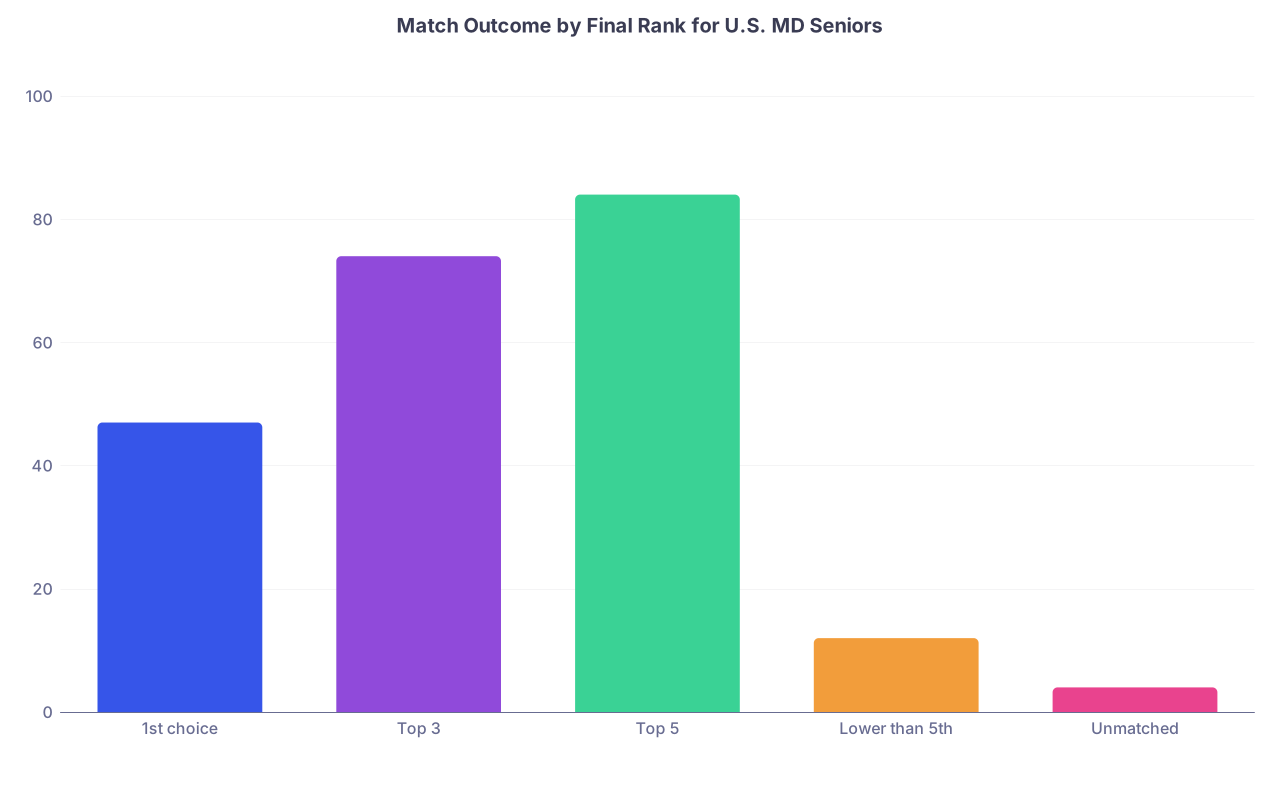
For U.S. MD seniors (the group with the cleanest data), the pattern is shockingly stable year after year:
| Category | Value |
|---|---|
| 1st choice | 47 |
| Top 3 | 74 |
| Top 5 | 84 |
| Lower than 5th | 12 |
| Unmatched | 4 |
These are round numbers that track closely with recent NRMP outcomes:
- Around 45–50% match at their 1st choice.
- Roughly 70–75% match within their top 3.
- Around 80–85% match within their top 5.
- Only about 10–15% match at ranks lower than 5th.
- A small but non-trivial minority do not match at all.
What does this say about predictability?
If you are a U.S. MD senior who eventually matched, the base rate probability that your final result was within your top 3 is about three in four. So before you even reveal someone’s specific rank list, the data already tell you: odds strongly favor a top-3 outcome.
That is why so many people feel like “the algorithm worked for me.” Statistically, it usually will. But the important nuance: for any individual, the exact program is still a probabilistic outcome, not a guaranteed one.
3. The Shape of Your Rank List: Not Just the First Line
The biggest misunderstanding I see every year: applicants treat the rank list like a wish list, not like a probability-weighted risk strategy.
Let us reduce it to a simple mental model: each program on your list has some probability of ultimately being your final match. Those probabilities are determined by:
- How high you rank the program.
- How many total applicants it ranks and where it ranks you.
- How competitive the field is for that program and specialty.
- How many spots the program has.
You do not see those probabilities explicitly, but they exist.
Think of three very different list structures:
| List Type | Example Length | Risk Profile | Typical Outcome Pattern |
|---|---|---|---|
| Top-heavy, short | 5 programs | High risk | More variance, higher unmatched risk |
| Long, mixed tiers | 15 programs | Moderate, balanced | Most match in top 5–8 |
| Long, safety-heavy | 20+ programs | Low unmatched risk | More match in mid to lower tiers |
I have seen this exact scenario multiple times:
- Student A ranks 6 extremely competitive programs, then stops.
- Student B ranks those same 6 programs, then adds 12 mid-tier and a few true safeties.
They both “really want” Program #1. They both interview there. They both rank it first.
Program #1 has 5 spots, ranks 80 people, and the applicant is around position 20. If 15 people above them are also ranking it high enough, they never get a slot. The algorithm never even looks at their “dream” beyond that constraint.
Student A may go unmatched or slide to a very low-choice program.
Student B almost certainly ends up somewhere within their top 8–10.
Same dream. Same #1 rank. Completely different outcome distributions because of the back half of the list.
So when you ask “How predictable was my result?” one of the first diagnostic questions is: did your list function like a portfolio with diversification, or like a lottery ticket stapled onto a cliff?
4. Interpreting Your Own Match Outcome: Reading the Signal in What Happened
You can reverse-engineer a surprising amount about “how the algorithm saw you” from where you matched on your list.
Case 1: You matched at your 1st choice
The data say you are in the plurality group. But that does not mean your list was perfect or that lower programs loved you too. Several sub-scenarios exist:
- You were ranked very highly at your #1, and many higher-ranked applicants went elsewhere.
- You were in the middle of their list, but yield at that program was low (lots of people got offers from more competitive programs and went there).
- You were barely within their fill zone, but the order of who the algorithm tried to place put you into that last spot.
You cannot distinguish these just from your own result. But you can make rough inferences:
- If #1 was a clear reach (big-name program, very competitive specialty, you know your Step/COMLEX/research were average), your match there probably says you interviewed very well or had strong institutional ties or advocacy.
- If #1 was a “safety” relative to your stats and you still ended up there, that suggests programs above it on your list either did not rank you or ranked you below their fill line.
So yes, matching at #1 is “predictable” in the global sense (about 50% do), but the why is not trivial.
Case 2: You matched at your 2nd–5th choice
Statistically, this is the most informative band.
You are in the 25–35% of U.S. MD seniors who do not get #1 but still match high on their list. What this usually means:
- Your #1 either did not rank you, or ranked you below the positions that ultimately filled.
- OR you were “bumped” by higher-ranked applicants who had ranked the program lower but still above their other options.
Two important interpretations:
- Matching at #2 or #3 does not mean #1 “did not like you.” It often means competition density at #1 was higher than at #2/#3.
- It suggests your self-assessment of competitiveness was roughly calibrated. You were in the cluster of applicants these programs thought were acceptable, just not necessarily their top few.
From a prediction standpoint: matching in this range is very consistent with the overall probability distribution. If I know nothing except “U.S. MD, applied realistically, made a 12–16 program list,” I would put a large probability mass here.
Case 3: You matched low on your list (say #8 or lower)
This is where the data start shouting at you.
For U.S. MD seniors, only about 10–15% end up beyond their 5th choice. The base rate for landing at #8 or below is even smaller.
In other words, it was not the most likely outcome at the time you certified your rank list.
If you ended at #8, that tells you:
- At least seven programs you preferred either
- did not rank you at all, or
- ranked you below their ultimate fill positions.
That is a lot of “no’s” in a row. It usually reflects one or more of:
- Overestimating your competitiveness for the programs at the top.
- Listing many “reach” programs early, without enough realistic ones before your “floor.”
- Being in a specialty or region with intense clustering of strong applicants.
This is where I see the biggest disconnect between expectation and outcome. Students tell me, “I thought I was a strong candidate,” yet their final position on the list is in the 8–12 range. The data response is blunt: programs you wanted evidently did not agree, or you were just heavily outcompeted in that cohort.
Predictable in hindsight? Yes. Predictable to you at the time? Usually not, because most applicants rely more on anecdote than on base rates.
5. How Many Programs You Ranked: A Quiet but Huge Predictor
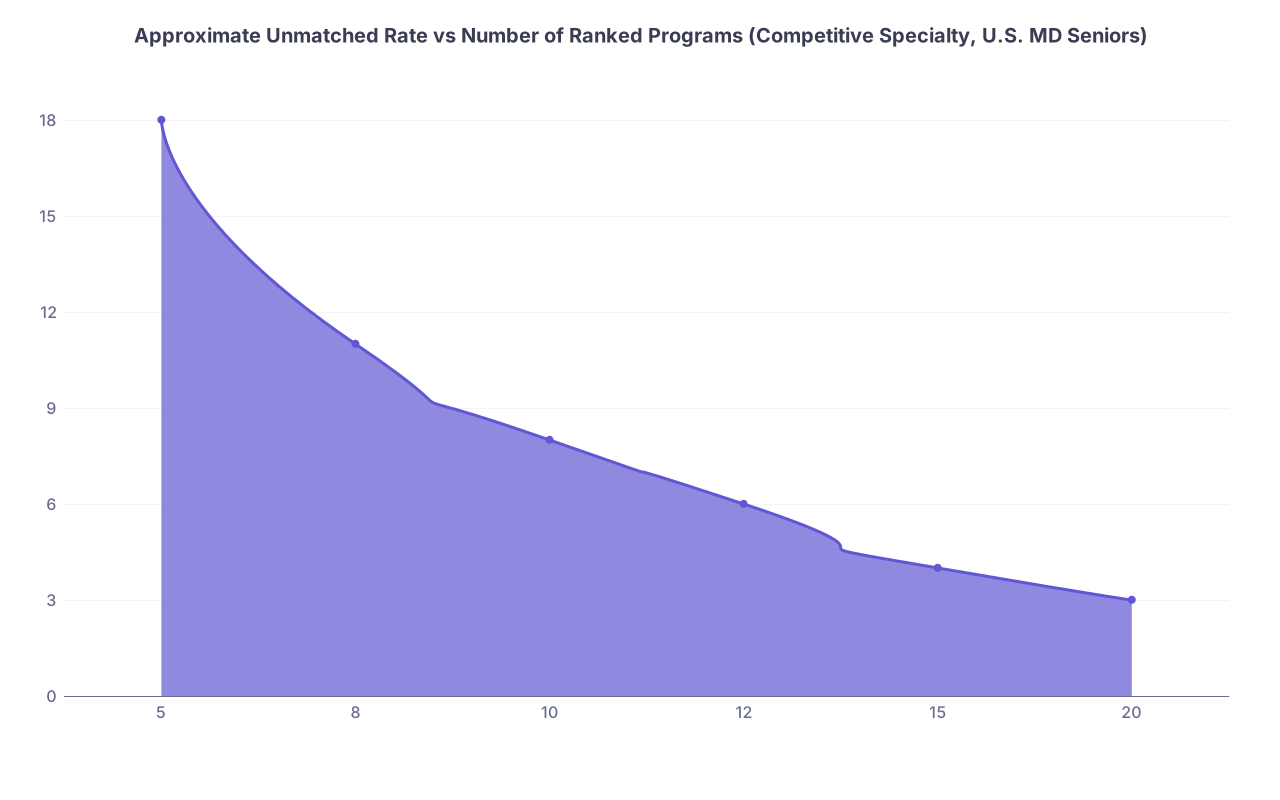
Your individual Match outcome is partly determined the moment you decide how long your rank list will be. NRMP data on unmatched rates by number of contiguous ranks is unambiguous.
For U.S. MD seniors in competitive specialties, the unmatched rate falls steeply as the number of ranked programs rises. For many fields, you see something like:
| Category | Value |
|---|---|
| 5 | 18 |
| 8 | 11 |
| 10 | 8 |
| 12 | 6 |
| 15 | 4 |
| 20 | 3 |
The exact curves differ by specialty, but the pattern is identical: short lists are high risk. Longer lists compress the tail risk.
If you made a list with 5–7 programs in a moderately competitive specialty, the probability you would go unmatched was objectively higher. That was baked into the system long before Match Day.
So when you look back asking, “Was my result predictable?” start here:
- How many programs did you rank, relative to NRMP’s recommended minimum for your specialty?
- Did you concentrate mostly in one geographic area or one type of program (e.g., all university programs in a single coastal city)?
If the answers are “fewer than recommended” and “yes, very clustered,” then yes, a disappointing result was statistically more likely than you wanted to admit.
6. Reading the Tea Leaves: What Your Match Says About How Programs Ranked You
We will never see a program’s list. But we can infer bounds from your personal outcome.
You matched at program P at your rank position k. What must be true?
- P ranked you somewhere within its “effective fill range.” That range might be 1–3x the number of positions, depending on how conservative they are.
- For all programs you ranked 1 through k–1, at least one of these holds:
- They did not rank you at all.
- They ranked you below every applicant they ultimately filled with.
- Or, extremely rarely, you ranked them in such a way that the algorithm never explored that pairing (this edge case is rare).
There is a simple mental exercise that is more informative than people expect:
Step 1: List your top 10 programs and circle where you actually matched.
Step 2: For every program you ranked above your match, ask, honestly:
- Did I have strong ties there?
- Did my board scores, research, letters, and school pedigree put me in their “core” target pool, or was I closer to their margins?
If the honest answer is “I was on the margin for half of them,” then the fact several did not effectively accept you is not anomalous. It is the system working exactly as a probability model would predict.
Put differently: the closer you are to the edge of a program’s acceptable range, the higher the variance in whether you actually end up there. Your personal match result is one draw from a plausible set of outcomes.
7. The Psychology Trap: Overfitting a Single Outcome
Here is where most people get it wrong analytically.
They observe a single outcome: “I matched at my #4.”
Then they build an elaborate narrative: “Program 1 secretly hated me, 2 was just using me as backup, 3 did not care about research,” and so on.
From a data analyst’s lens, that is classic overfitting. You are explaining noise as if it were signal.
The Match is a one-shot, high-variance process. For every person who matched at #4, there is a counterfactual world where tiny changes in other applicants’ lists bump them up to #2 or drop them to #6. You never see those alternate universes.
What you do know from NRMP data:
- Matching at #4 is entirely common and sits smack in the main body of the outcome distribution.
- The fact you did not match at #1–3 is more likely due to straightforward competitive dynamics than to some opaque conspiracy or catastrophic interview failure.
So rather than asking, “Was my exact program predictable?” a better, more honest question is:
- “Given my specialty, scores, and application portfolio, was it predictable that I would land somewhere between programs 2–7 on my list?”
For most well-prepared applicants, the answer is yes. The data say your “likely band” is early in your list. Which specific node in that band you landed on? That is where stochasticity and everyone else’s decisions dominate.
8. A Simple Back-of-the-Envelope Framework You Can Apply
If you want a rough sense of how “predictable” your result was, run yourself through this framework:
Specialty competitiveness
- Highly competitive (Derm, Ortho, Plastics, ENT): wide variance, more noise.
- Less competitive (FM, Peds, Psych in many cycles): narrower variance, more predictability.
Number of ranked programs vs NRMP guidance
- Below guidance → you accepted higher risk, more unpredictable outcomes.
- At or above guidance → you stayed within the “lower tail risk” zone.
Distribution of programs on your list
- Many true reaches early → higher chance of landing lower than you hoped.
- Mix of reach / target / safety → outcomes cluster nearer the top.
Final match position on your list
- 1st–3rd: high-alignment with global statistics; nothing surprising here.
- 4th–7th: middle of the distribution; probably mild overestimation for a few top choices or just normal competitive dynamics.
- 8th or lower: either your list was aggressively top-heavy, the specialty or region was overloaded that year, or your perception of your competitiveness was off.
Put all four pieces together, and you will have a reasonably accurate reading on how “on-script” your result was relative to the data.
9. So, Was Your Match Result Predictable?
From a strict probabilistic standpoint, yes—within a band.
- If you are a U.S. MD senior with a realistic list in a moderate-competitiveness specialty, the data say you had something like a 70–80% chance of landing in your top 5, and a 90%+ chance of matching somewhere.
- If you ranked 5 programs in a cutthroat specialty, your outcome was much less predictable and much riskier, by choice.
- If you ended up at #1, you joined roughly half of your peers. If you ended up at #8, you are in a smaller tail that NRMP reports every year.
The mistake is treating the Match as a deterministic mapping from “I ranked you #1” to “You should take me.” That is not how the algorithm or the market works.
Your ranking behavior set the possibility space of where you could land.
The competitiveness of your application and the behavior of thousands of other applicants determined how the algorithm navigated within that space.
If your outcome feels off from what you expected, the data-driven autopsy is not “the algorithm failed.” It is usually:
- You anchored too much on individual anecdotes and too little on aggregate NRMP charts.
- You over-weighted prestige or geography and under-weighted risk mitigation.
- You ignored or did not know the guidance on how many programs to rank for your specialty.
The next cohort will not fix that error by manifesting harder. They will fix it by treating their rank lists like portfolio construction, not wish fulfillment, and by respecting the actual numbers instead of the stories people like to tell.
For you, Match Day is done. The result is in. The more useful question now is not “Could I have strictly predicted this?” but “What does my outcome tell me about how the system saw my application, and what can I learn from that for fellowship, future job searches, and every other matching market I will enter?”
With that lens, your Match result stops being a singular mystery and starts looking like what it truly is: one statistically plausible outcome in a market that behaves the same way, year after year. Understanding that prepares you far better for what comes next—the contract negotiations, relocations, and career-defining choices that follow the Match—but that is another dataset to dissect on another day.