The uncomfortable truth is this: if your residency program barely filled, the data is telling you something your faculty may not want to hear.
Not “bad luck.” Not “this was just an odd year.” A pattern. A signal. And if you ignore the metrics, you will repeat the same outcome—or worse—next cycle.
Let me walk through what “barely filled” actually means in hard numbers, what NRMP data say about programs like yours, and what you should infer (and do) if you are sitting on a roster that only just crept across the finish line.
1. What “Barely Filled” Actually Means in Numbers
Programs throw around “we filled” like it is a binary variable. It is not. The fill rate is a continuous metric with massively different implications at 80% vs 99%.
Conceptually, the fill rate is simple:
Program Fill Rate = (Number of Matched Positions / Number of Offered Positions) × 100
But the real signal is in how you got there:
- Did you fill in the Main Match or only after the SOAP?
- How far down your rank list did you go?
- What proportion of your positions went to US MD, US DO, and IMGs?
“Barely filled” typically looks like one or more of these:
- You reached the bottom 10–20% of your rank list to fill.
- You left ≥10–20% of positions unfilled in the Main Match and had to rely on SOAP to finish out.
- Your mix of applicants shifted sharply toward lower-stat, higher-risk, or last-minute applicants compared to prior years.
To anchor this with some structure, here is a simplified way I categorize program fill status:
| Status Category | Main Match Fill Rate | SOAP Reliance | Typical Rank List Depth |
|---|---|---|---|
| Strong Fill | ≥ 98% | 0–1 spots | Top 40–60% |
| Stable Fill | 95–97% | 1–2 spots | 50–70% |
| Barely Filled | 90–94% | Several spots | 70–100% |
| Partially Unfilled | < 90% | Many spots | Bottom of list / exhausted |
If you are in the “Barely Filled” band, do not kid yourself by saying “we filled, so we are fine.” The data says your market position is weak or deteriorating.
2. What National NRMP Data Say About Programs That Barely Fill
Every year, the NRMP publishes the “Results and Data” and “Program Director Survey.” If you read them with a program director’s anxiety instead of an applicant’s anxiety, a few patterns become obvious.
2.1 Fill rates and specialty competitiveness
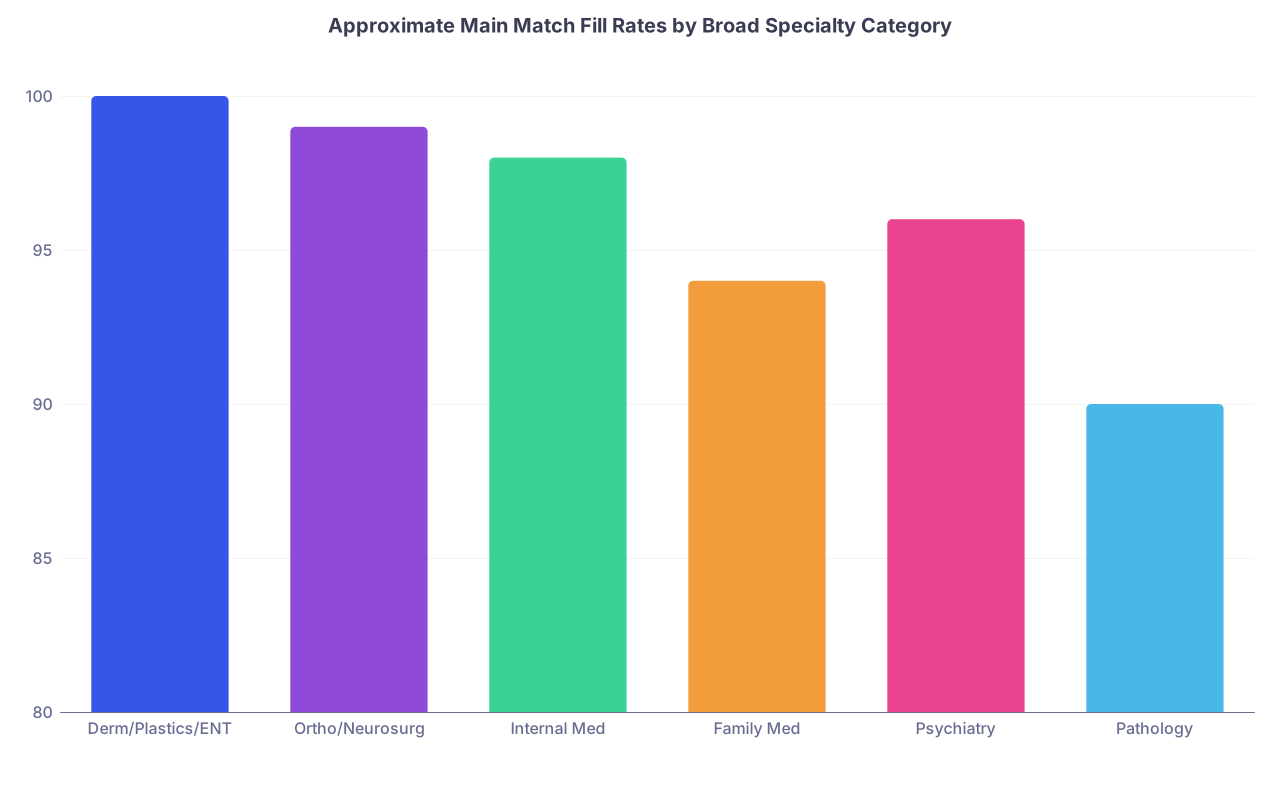
Competitiveness is not mysterious; it shows up very cleanly in fill rates and applicant type mix. Here is a stylized snapshot for illustrative purposes (values approximate but pattern-accurate):
| Category | Value |
|---|---|
| Derm/Plastics/ENT | 100 |
| Ortho/Neurosurg | 99 |
| Internal Med | 98 |
| Family Med | 94 |
| Psychiatry | 96 |
| Pathology | 90 |
Notice two things:
- Ultra-competitive specialties fill 99–100% consistently.
- Primary care and less competitive fields show more volatility and lower averages, with a long tail of programs that struggle to fill.
If your program is in a specialty where the national fill rate is 98–100%, but you are sitting at 92–94%, that is not a “specialty problem.” That is a program-specific signal.
If you are in a specialty where the national fill is already lower (e.g., some community internal medicine, family medicine, psychiatry, pathology, prelim surgery), then a poor year may still partly reflect national dynamics: geographic maldistribution, applicant pool preferences, and step score changes. But even then, you are being compared against peers facing the same macro environment.
2.2 Applicant type mix: US MD vs DO vs IMG
Programs that slide toward “barely filled” levels almost always show a shift in who is willing to rank them:
- Drop in US MD seniors
- Variable but often smaller drop in US DO seniors
- Increase in non-US IMGs and late applicants
This is not about applicant quality as human beings. It is about how the broader marketplace perceives your brand, training, and outcomes.
If, for example, your 5-year trend looks roughly like this:
- Year 1: 80% US grads (MD+DO), 20% IMGs
- Year 3: 60% US grads, 40% IMGs
- Year 5: 35% US grads, 65% IMGs, plus a SOAP-dependent fill
You do not need a regression model to see the trajectory. Applicants—especially US MD seniors with multiple options—are voting with their rank lists.
2.3 Rank list depth as an early warning signal
Rank list depth is probably the most underrated metric programs ignore. I have seen PD meetings where someone says, “We matched all 8 positions,” and no one asks the obvious question: “At what rank number did we fill the last one?”
Let us define a simple normalized metric:
Rank Depth Ratio = (Highest Rank Number Matched) / (Total Number Ranked)
Interpretation:
- 0.30: You are a high-demand program. Applicants high on your list also ranked you aggressively.
- 0.50–0.70: Normal, stable.
- 0.80–1.00: Red flag. The market is not prioritizing you, and you are skimming the bottom of your own pool.
If your last spot matched at rank 145 out of 160, your ratio is 0.91. That is flirting with disaster, even if the official fill rate remains 100%.
3. Reading the Subtext: What a Barely Filled Program Signals
Let me be blunt. When a program barely fills, the rest of the ecosystem usually assumes one or more of the following:
Location disadvantage
Rural or less desirable urban areas, regions with poor flight access, harsh climate, or limited spousal employment options.Reputation or brand drag
Word spreads fast. Residents talk. Medical students read Reddit, SDN, and the hidden grapevine. If there are consistent reports of:- Malignant culture
- Poor teaching
- Weak board pass rates or fellowship matches
your rank position falls.
Workload / wellness imbalance
80-hour weeks that are actually 90. Chronic under-staffing. Call schedules that look like they were built in 1995. Applicants nowadays detect this instantly from residents’ tone on interview day.Outcomes that do not justify the pain
If your residents are grinding but not matching into competitive fellowships or jobs, high-stat applicants bail for programs with better ROI.Signal of last-minute scrambling
Heavy SOAP participation tells future applicants a simple story: “Residents did not want to come here last year.”
You might disagree with the fairness of those perceptions. That is irrelevant. The NRMP match is a marketplace, and perception is data.
4. Dissecting Your Own Numbers: A Minimum Diagnostic
If your program barely filled this year, treat it like a root-cause investigation. You would not ignore a patient’s hemoglobin drop from 13 to 8; stop ignoring your own metrics.
At minimum, I would pull 3–5 years of data on:
- Applications received per open position
- Number of applicants invited to interview
- Interview-to-rank conversion rate
- Rank list length and rank depth ratio
- Fill rate and SOAP usage
- US MD / DO / IMG mix
- Average USMLE/COMLEX scores of matched residents (pre-Step 1 P/F, Step 2 still matters)
Here is a simplified “program health snapshot” layout that I recommend building in a spreadsheet or dashboard:
| Metric | 5 Years Ago | 3 Years Ago | This Year |
|---|---|---|---|
| Applications per Position | 120 | 95 | 60 |
| Interviewed per Position | 20 | 18 | 15 |
| Rank Depth Ratio | 0.55 | 0.68 | 0.88 |
| Main Match Fill Rate | 100% | 100% | 90% |
| Positions Filled in SOAP | 0 | 0 | 3 |
| US MD + DO % of Matched Class | 70% | 55% | 35% |
Those numbers tell a story very clearly: shrinking interest, weaker positioning, and creeping reliance on SOAP.
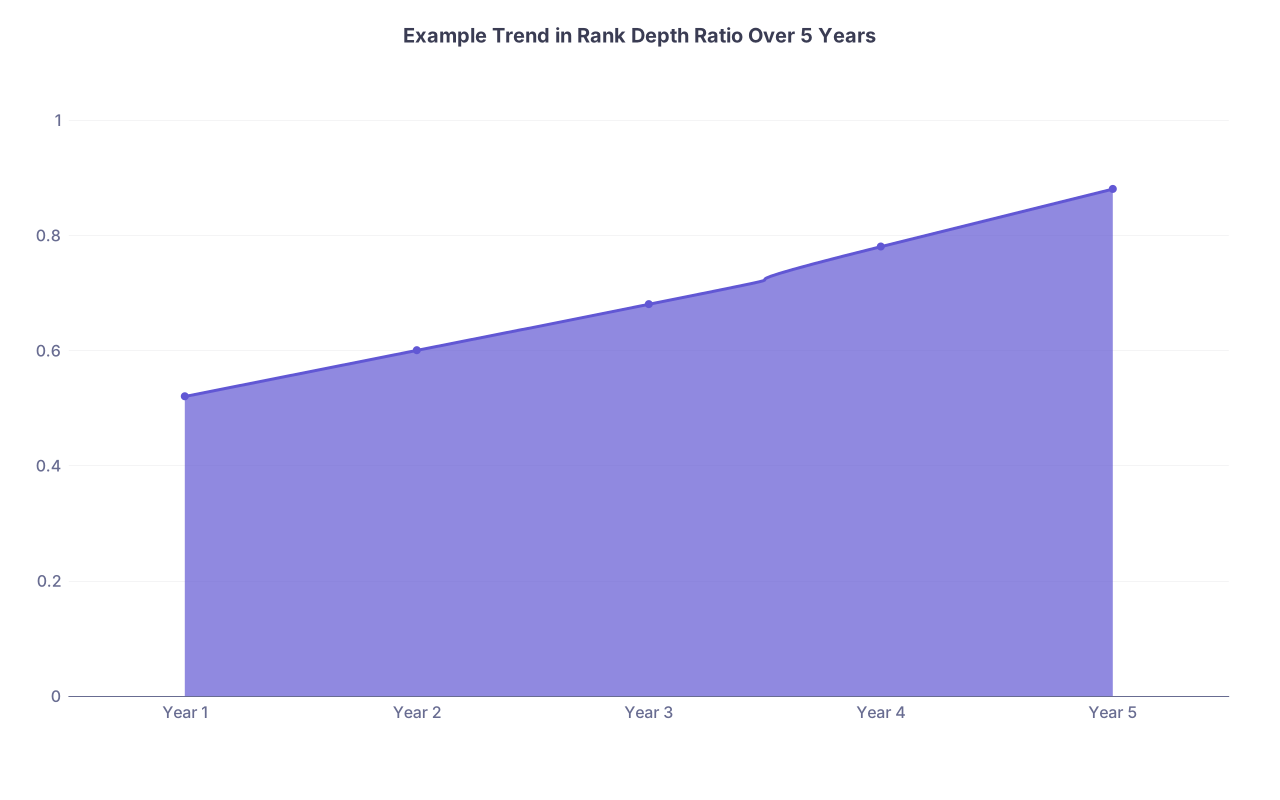
If you plotted the Rank Depth Ratio across time, the trend usually looks ugly:
| Category | Value |
|---|---|
| Year 1 | 0.52 |
| Year 2 | 0.6 |
| Year 3 | 0.68 |
| Year 4 | 0.78 |
| Year 5 | 0.88 |
By Year 5, you filled. But barely. That is not “success”; that is an early warning before outright unfilled status.
5. What This Means Operationally: For PDs and Coordinators
If you are running or helping run the program, “barely filled” translates into several hard operational realities.
5.1 Higher future volatility and risk of unfilled years
Programs on the edge rarely hover there indefinitely. The pattern I have seen:
- Year 1: Fill 100%, deep rank list usage.
- Year 2: One or two unfilled spots in Main Match, fixed by SOAP.
- Year 3 or 4: Significant unfilled positions and stressful SOAP scramble.
Once you have one clearly “bad” year, students remember. Word-of-mouth moves faster than your ability to rebrand. Unless you visibly change, the next cycle’s applicant pool will treat you as risky.
5.2 Faculty morale and resident perceptions
Residents notice when their classmates were SOAP matches or when the last few spots were filled by people who obviously had the program low on their list. Whether fair or not, they infer:
- “We are not a top-choice place anymore.”
- “Our program must be slipping.”
That perception feeds back into how they talk to applicants on interview day. Which then affects your future recruitment. It is a feedback loop.
5.3 Financial and service implications
In some hospitals, every unfilled position is a direct revenue hit. Either:
- FTE coverage has to be picked up by hospitalists or advanced practice providers, or
- Residents who remain are stretched thinner, making burnout worse, which then harms reputation and recruitment.
Barely filling is a small buffer between “short staffed” and “dangerously short staffed.” If you are relying on SOAP repeatedly, you are functionally managing staffing with emergency stopgaps.
6. What This Means Strategically: If You Are a Med Student or Resident Watching This
Flip the perspective. You are an applicant or an MS3 on rotation, and you find out a program you are considering “barely filled” last year.
What does the data say you should infer?
You probably have leverage—but be careful how you use it.
If your board scores and CV are solid, a program struggling to fill is more likely to:- Offer you an interview quickly
- Rank you highly if you show strong interest But that does not mean you should ignore obvious red flags. A desperate program is not always a safe bet.
Outcomes matter more than fill status alone.
If a rural family medicine program barely fills, but graduates are:- Passing boards >95%
- Getting good jobs or fellowships
while offering strong procedural volume and sane hours, the “barely filled” label may simply reflect geography, not quality.
If multiple similar programs in the same city are filling easily, and one is not, that is a warning.
Same city, same specialty, similar pay. One barely fills while peers are oversubscribed. That discrepancy almost always maps to culture, leadership, teaching quality, or service burden.SOAP reliance is a big, loud signal.
Programs that perennially patch 20–40% of their class in SOAP are telling you: “We are not being ranked highly by the main applicant pool.” That does not automatically mean “avoid,” but it does mean “ask harder questions,” especially about why residents leave or fail.
7. Common Misinterpretations: What Barely Filling Does Not Automatically Mean
The data is clear about risk, but not every barely-filled program is malignant or incompetent. Some nuances:
New programs often struggle early.
With no track record, little alumni network, and untested leadership, they may initially rely heavily on IMGs or SOAP. Over time—if leadership is strong—numbers improve. A 3-year-old program that barely fills is not the same as a 30-year-old program that suddenly barely fills.Geographic outliers can be high-quality but low-demand.
I have seen outstanding programs in very remote areas that barely fill on paper but offer phenomenal hands-on experience. The applicant pool is narrower for lifestyle reasons, not educational defects.Step 1 pass/fail and shifting US grad preferences have skewed some markets.
Some previously mid-tier but urban programs are now flooded; others more rural are drained. That shift is structural, not always individual failure.
So you have to read your local context. Compare your performance not just to national averages but to nearby programs and same-specialty peers.
8. Concrete Actions If Your Program Barely Filled
If I were advising a PD who just scraped into a full match, I would push them through a three-part plan: data audit, structural change, and messaging.
8.1 Data audit (zero spin)
You need a brutally honest dashboard:
- 5–10 year trends on:
- Applications per position
- Interview rates
- Rank depth ratio
- US grad proportion
- SOAP usage
- Board pass rates
- Fellowship/job placement
- Resident attrition and remediation
Run this like a morbidity and mortality conference. No euphemisms. Put numbers on the screen and ask, “What changed between the years we were strong and the years we struggled?”
8.2 Structural change (not cosmetic)
Applicants are not dumb. You cannot rebrand your way out of structural problems like:
- Chronic, unsafe workloads
- Toxic leadership
- Poor exam prep and academic support
- Lack of procedural exposure or autonomy
If the data shows your board pass rate dropped from 95% to 80%, “adding a wellness day” is not the intervention. You need actual academic infrastructure: protected didactics, exam prep resources, faculty accountability.
If your ACGME surveys show residents rating the program low in “faculty accessibility” or “patient safety,” that is a governance issue, not a marketing one.
8.3 Messaging and transparency
Once you fix—or at least genuinely start fixing—problems, then you communicate that change clearly:
- Update your website with:
- Actual board pass statistics (multi-year)
- Graduate outcomes by fellowship/job
- Call schedules and duty hour oversight
- Train residents on how to honestly describe the program:
- Acknowledge past weaknesses
- Explain specific improvements Applicants trust, “We had real problems with workload three years ago; our call system changed to X, and here is how it feels now,” much more than hollow “We are a family” clichés.
9. How to Track Whether You Are Recovering
You cannot fix a trend you do not measure. For the next few cycles, treat your match data as a performance scorecard.
At minimum, track annually:
- Applications per position (target: trending upward)
- Rank depth ratio (target: moving back toward ≤0.7)
- US MD/DO share (if that matters for your goals)
- SOAP reliance (target: 0 or near 0)
- Feedback from applicants on why they ranked or did not rank you highly (informally gathered via exit interviews, visiting student feedback, etc.)
You should see changes one year after visible improvements, sometimes two. If you make real changes and your metrics refuse to move, then either:
- Your changes were too minor, or
- The core problem (location, system culture, hospital finances) is too sticky for quick repair
At that point, you are making strategic decisions: scale down, reconfigure, merge, or accept a narrower applicant pool and adjust expectations.
10. The Bottom Line: What “Barely Filled” Should Mean to You
Strip away the rationalizations. A barely filled residency program is not a curious anomaly. It is a quantitative signal.
Three core takeaways:
Fill rate and rank depth are leading indicators of your market position.
When both start to worsen over 2–3 years, you are on a trajectory toward unfilled status, not “just a bad cycle.”Applicants and residents read the same signals you do.
High SOAP use, deep rank list usage, and falling US grad percentages shape your reputation. You cannot hide those trends. You can either fix the root causes or accept a permanent downgrade in your competitive tier.Serious improvement starts with ruthless measurement.
If your program barely filled, you should be staring at multi-year tables and graphs, not telling comforting stories. The data will show you where you are hemorrhaging interest—workload, outcomes, location, culture—and whether your interventions are moving the needle.
Ignore the metrics, and you will see this year’s “barely filled” turn into next year’s “we did not fill.” Listen to them, and you at least give yourself a chance to climb back into stability.