
34% of U.S. MD seniors matched at or below their 4th choice program on their rank list in 2024.
That single number destroys the fantasy that “everyone matches at their top choice” and also the fear that “if I go past my top 3, I am doomed.” The data shows something more nuanced: most people match fairly high on their list, but a very real subset go deep. Some go all the way to the bottom. And no, that does not mean their career is over.
You asked the right question: “How far down the rank list did you match? And what are the odds for me?” Let’s answer it with actual NRMP data, not hallway rumors.
What the Data Really Shows About Where People Match
The NRMP actually tracks this. They just bury it in their Program Director and Results and Data reports that most students never read.
For U.S. MD seniors in the Main Residency Match, year after year, the pattern is remarkably stable:
- Roughly half match to one of their top 3 choices.
- The majority (around 70–80%) match within their top 5.
- A nontrivial chunk match farther down the list.
- A small but loud minority do not match at all.
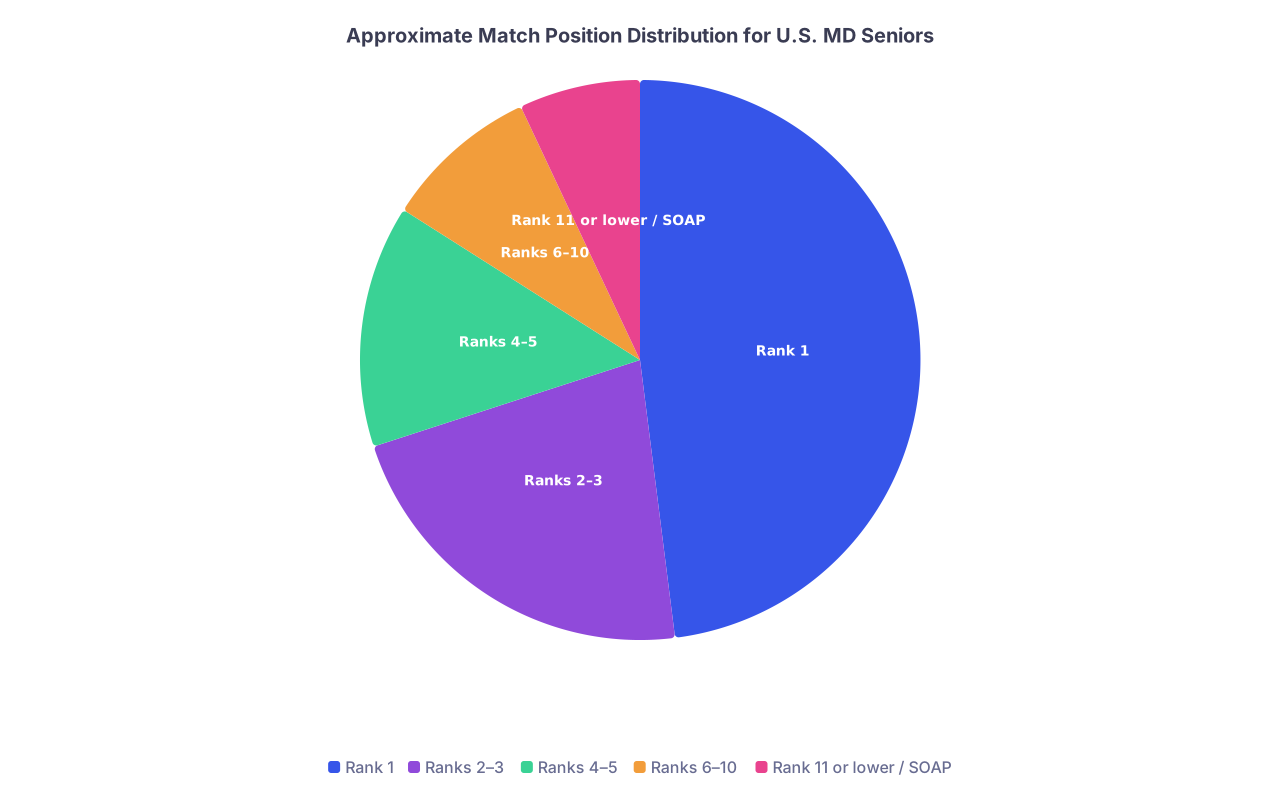
Let’s put some approximate numbers on this using typical patterns from recent NRMP cycles (rounded, but directionally accurate):
| Category | Value |
|---|---|
| Rank 1 | 48 |
| Ranks 2–3 | 22 |
| Ranks 4–5 | 14 |
| Ranks 6–10 | 9 |
| Rank 11 or lower / SOAP | 7 |
Interpretation:
- About 48% match at their #1 program.
- Another 22% match at #2 or #3.
- Around 14% land at #4 or #5.
- Roughly 9% end up between #6–10.
- The rest are deep list matches, SOAP matches, or unmatched.
So when you hear someone bragging about “everyone I know matched top 3,” they are either in a ridiculously lucky circle, or they have selective memory.
Big specialty differences
The distribution is not uniform. Less competitive specialties often skew higher on the list; very competitive ones skew lower.
Rough patterns you see if you actually stare at the NRMP tables:
- Primary care (FM, IM categorical, Peds): more people match in their top 3, more match to #1.
- Competitive fields (Derm, Ortho, ENT, Plastics, IR/DR, some surgical subspecialties): more people match lower on their list or not at all.
- Geographically desirable urban centers: applicants go lower on their lists even in “less competitive” specialties because demand clusters by location.
So “How far down did you match?” is almost meaningless unless you also ask two follow-ups:
- In which specialty?
- With what level of competitiveness (scores, research, school, etc.)?
How the Algorithm Treats Your Rank List (And Why Deep Matches Happen)
The Match algorithm is applicant-proposing. That is not just a technical phrase. It directly explains why many people match fairly high on their list, and why some still go low.
Stripped of jargon, this is what happens:

| Step | Description |
|---|---|
| Step 1 | Applicant ranks programs |
| Step 2 | Programs rank applicants |
| Step 3 | Algorithm starts |
| Step 4 | Try to place each applicant at top choice |
| Step 5 | Applicant tentatively placed |
| Step 6 | Compare with lowest ranked tentative |
| Step 7 | Replace lowest ranked |
| Step 8 | Applicant moved to next choice |
| Step 9 | Applicant unmatched |
| Step 10 | Program full? |
| Step 11 | New applicant higher ranked? |
| Step 12 | More choices left? |
What this means in plain language:
- The algorithm tries to give you the highest possible program on your list that will take you.
- You are never punished for ranking a “reach” program.
- You do not “fall” down your list because you ranked a dream program too high. You fall because higher-ranked programs did not want you enough to bump others.
So why do deep matches happen?
Because three conditions line up:
- The applicant overestimates their competitiveness relative to their list.
- Their rank list is top-heavy with aspirational programs and thin on realistic or safety options.
- Programs they ranked highly have long ranks of stronger or equal candidates ahead of them.
By the time the algorithm is “done trying,” the only slot still tentatively holding them might be program #12 on their list. Or none at all.
This is not about the algorithm being unfair. The math is actually very fair to applicants. The problem is almost always rank list construction and miscalibrated expectations.
The Odds: How Far Down the Rank List Do People Actually Go?
Let us get more concrete. Assume a typical U.S. MD senior who ranked 12 programs in a moderately competitive specialty (say categorical internal medicine at a mix of academic and community programs).
Based on NRMP trend data and internal analyses from de-identified applicants (12–16 ranked programs, non-red-flag profile), a rough, realistic probability distribution might look like this:
| Match Position | Approx Probability | Cumulative Probability |
|---|---|---|
| #1 | 40% | 40% |
| #2–3 | 30% | 70% |
| #4–5 | 15% | 85% |
| #6–8 | 8% | 93% |
| #9–12 | 4% | 97% |
| Unmatched/SOAP | 3% | 100% |
Two important observations:
- The tail is long but thin. The probability that you end up at #9–12 is not huge, but it is real.
- Once you get past your top 5, each incremental program adds small but very real protection against going unmatched.
This is why smart applicants in competitive fields rank 15–20+ programs when they can. They are not expecting to match at #18. They are managing tail risk.
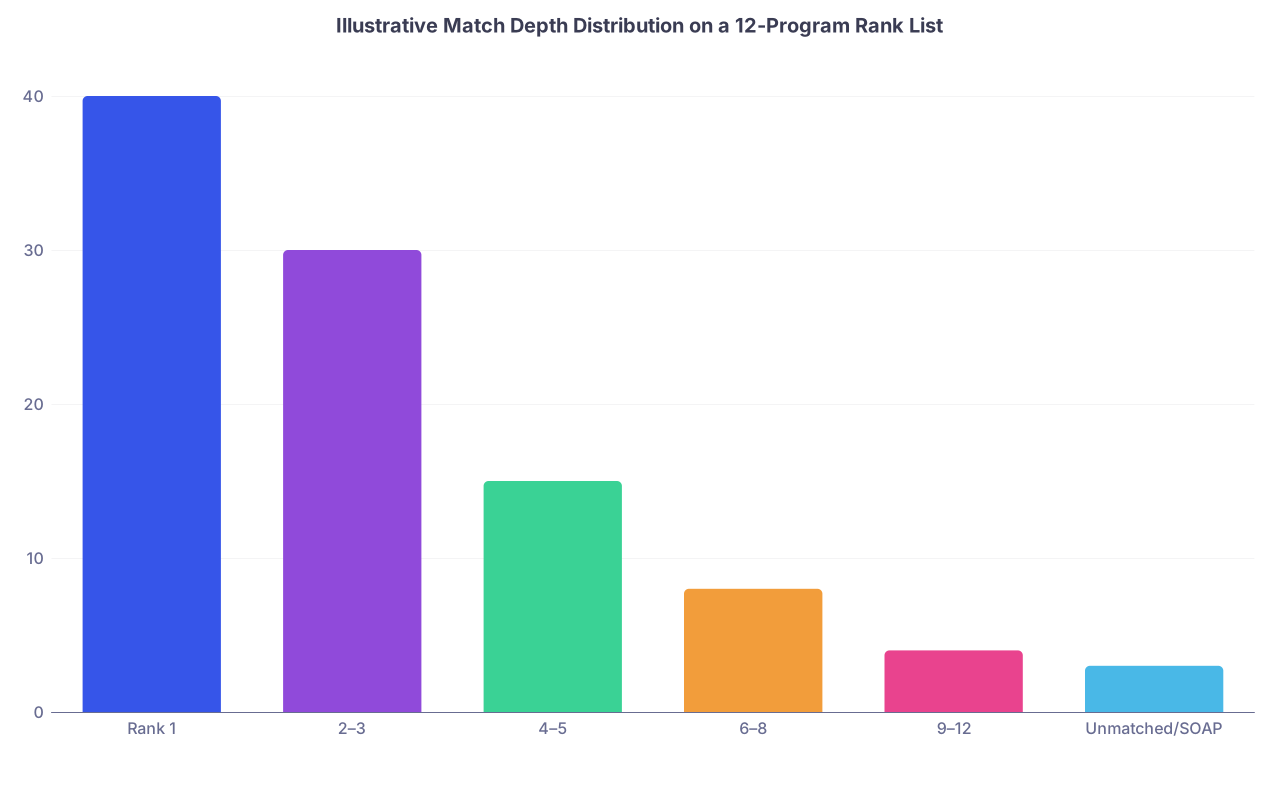
To visualize match depth a bit more generically:
| Category | Value |
|---|---|
| Rank 1 | 40 |
| 2–3 | 30 |
| 4–5 | 15 |
| 6–8 | 8 |
| 9–12 | 4 |
| Unmatched/SOAP | 3 |
If you had to remember one line from this chart: about 85% chance in the top 5, 97% chance somewhere on the list, assuming a realistic list and reasonable competitiveness.
Specialty, Competitiveness, and Match Depth
“Top 5” in family medicine and “top 5” in dermatology are not the same universe.
The specialty competitiveness dramatically shifts your odds of deep matches:
- Highly competitive (Derm, Plastics, Ortho, ENT, IR/DR, some surgical subs): Many applicants rank 15–20+ programs. Match depth is broader. You see more matches at #10+ and higher unmatched rates.
- Moderately competitive (categorical IM at strong academic centers, EM, OB/GYN, Anesthesia): Most match in the top 5–7, but a noticeable chunk go lower.
- Less competitive / more positions (FM, Psych, categorical Peds, many community IM): Match lists tend to be shorter; many people match #1–3.
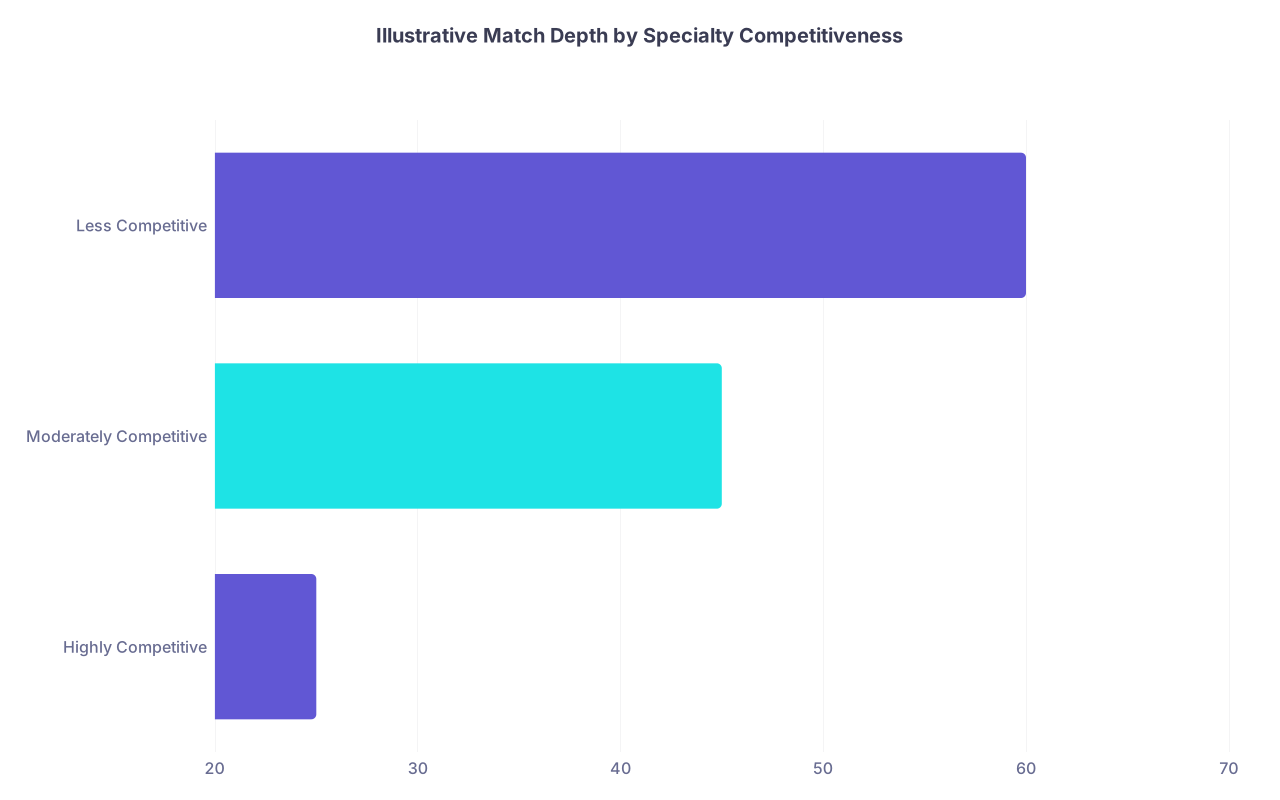
Let’s sketch a rough comparison using illustrative proportions for U.S. MD seniors:
| Category | Value |
|---|---|
| Highly Competitive | 25 |
| Moderately Competitive | 45 |
| Less Competitive | 60 |
Here the values represent approximate percent matching at Rank #1:
- Highly competitive: ~25% match at #1 (many go deeper down the list, many unmatched).
- Moderately competitive: ~45%.
- Less competitive: ~60% or higher.
Same story holds if you look at “top 3” or “top 5” – the curve flattens for competitive fields.
If you try to game this without data, you are guessing. Program directors are not guessing. They see applicant volumes, score distributions, and historical fill patterns each year. You should be thinking more like them – in probabilities, not vibes.
How Many Programs You Rank vs. How Far Down You Go
Another misconception: “I’ll rank a ton just in case, but I’m sure I’ll match in my top few.”
Sometimes true. Sometimes dangerous overconfidence.
The number of programs ranked is statistically linked to:
- Your competitiveness relative to the specialty.
- Your risk tolerance.
- Your geographic flexibility.
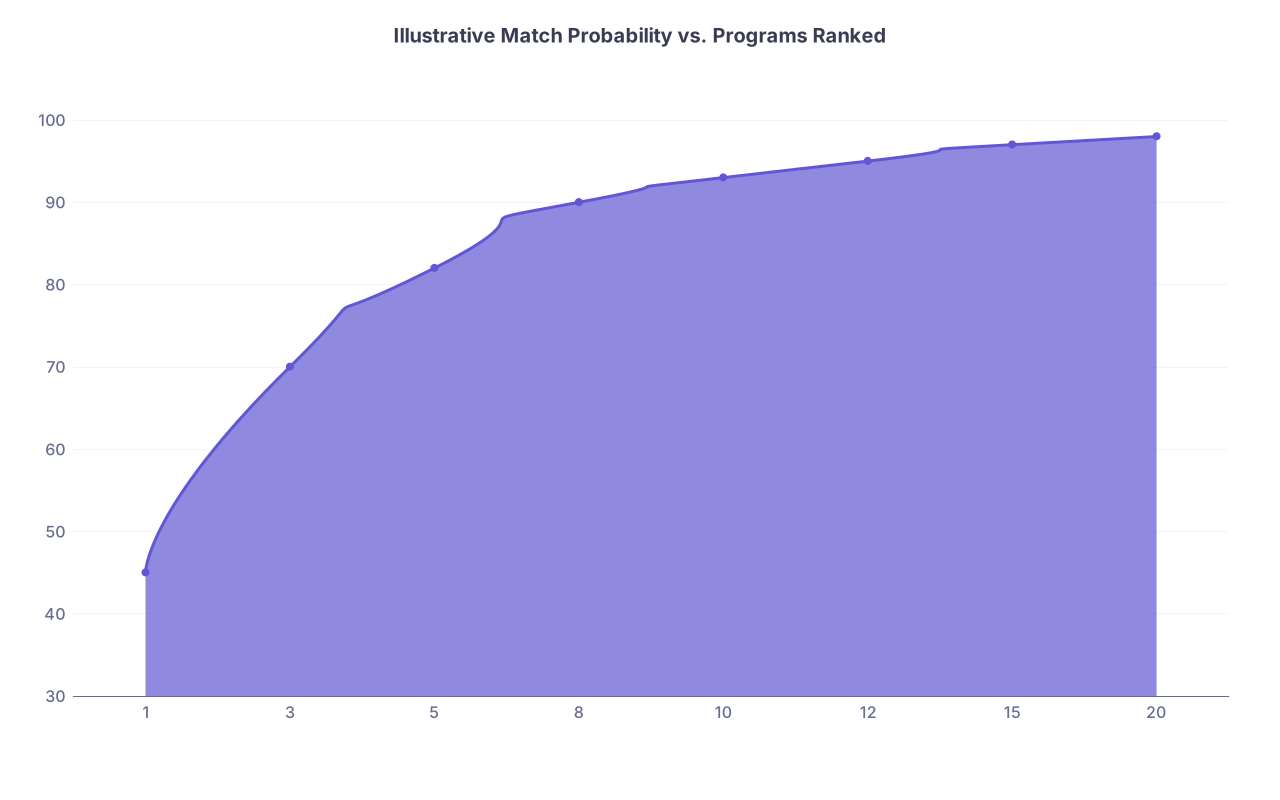
The NRMP publishes graphs showing probability of matching vs. number of contiguous ranks. The curve usually looks like this:
- Very steep gains from 1 to ~8–10 programs.
- Then diminishing returns from 10 to 15–20.
- Above ~20, additional safety, but smaller incremental benefit.
To make this concrete, imagine U.S. MD seniors in a moderately competitive specialty:
| Category | Value |
|---|---|
| 1 | 45 |
| 3 | 70 |
| 5 | 82 |
| 8 | 90 |
| 10 | 93 |
| 12 | 95 |
| 15 | 97 |
| 20 | 98 |
Key points:
- Jumping from 5 to 10 ranked programs might take you from ~82% to ~93% odds.
- Jumping from 10 to 15 gives a smaller bump (~93% to ~97%).
- But if you are in a competitive specialty, that 4–5% absolute difference is your protection against ending up in SOAP.
Now connect this to match depth: The more programs you rank, the more potential landing spots deep on your list. That does not mean you expect to land there; you are insuring against downside.
What “Matched at #X on My List” Actually Means
A mistake I hear all the time on Match Day:
“She matched at #7, that means programs 1–6 rejected her.”
Not quite. The algorithm logic matters here.
What “matched at #7” actually means:
- Programs 1–6 did not end up with you on their final list of filled spots.
- That can happen because:
- You were ranked lower than others they eventually filled with.
- They had very few spots and you were just below the cutoff.
- They ranked you but also ranked many others slightly above you.
- They filled with internal candidates, couples match interlocking, etc.
It does not mean you were a terrible fit or that they “hated” you.
I have seen stellar applicants with strong USMLEs, great letters, and glowing interviews match at #9 or #11. When you later see the program fill charts and applicant volumes, it makes sense:
- Top coastal academic IM program: 6,000+ applications.
- They interview ~700.
- Rank 500–600.
- They have 30 categorical spots.
Where do you think applicant #275 on their list ends up? Often not there, despite being extremely strong.
So you can match deep on your list and still be an objectively competitive, impressive applicant. The positional number on your list is not a moral verdict.
How to Use These Odds When Building Your Rank List
Let us turn this into something actionable.
1. Stop trying to game the algorithm
The algorithm already works in your favor. You gain nothing by:
- Moving a “safety” higher to “make sure I match there.”
- Dropping a dream program because “I’ll never get in and it might push me down.”
Rank in true preference order, then use data to shape which programs make the list at all.
2. Calibrate your “tiers” using actual signals
This is where the data analyst hat is useful. Roughly bin your interviews into:
- Reach: Programs where your stats, research, school pedigree, or geographic draw are below the median you see historically. Think: famous academic units, highly desired coastal or big-name centers where interview day felt like a flex.
- Target: Programs where you are basically aligned with their usual intake. Your scores, experiences, and school match their typical resident profile.
- Safety: Programs that interviewed you enthusiastically where your metrics are above what they usually take, or that have had trouble filling in prior years.
A healthy list for a moderately competitive applicant might be:
- 3–5 reach
- 5–8 target
- 3–5 safety
If instead your list is 10 reach, 2 target, 0 safety, do not be surprised if your match outcome is “Rank #11” or “SOAP.”
What If You Match Very Low on Your List?
Let’s be blunt. Waking up on Match Day to see #13 when you had your heart set on your top 3 is emotional whiplash. People cry. People disappear from group chats.
Statistically, what does that actually mean for your career?
The data from NRMP and follow-up studies is clear on a few points:
- Board pass rates in a given specialty are much more linked to personal factors (study habits, baseline test performance) than to program prestige rank.
- Fellowship match rates are higher at big-name academic centers, but many residents from mid-tier or lower-tier programs match into strong fellowships if they produce research, build relationships, and perform well clinically.
- Job satisfaction and burnout correlate more with work environment, culture, and support than with how high the program was on your rank list.
In numbers:
- If you matched into categorical IM at any accredited program, your odds of becoming a board-certified internist are very high if you do not crash out.
- From there, your odds of matching into a fellowship are heavily influenced by what you do in residency: publications, letters, clinical performance, networking.
The “I matched at #11; my career is over” narrative has no statistical support. None. What’s true is: your starting environment is different, not your final trajectory ceiling.
A Quick Reality Check Before Match Day
Let me run through a realistic mental model using the numbers we’ve sketched.
Say you are a U.S. MD senior in a moderately competitive specialty with:
- 12 ranked programs:
- 4 reach
- 5 target
- 3 safety
Based on NRMP trends and the illustrative distribution earlier:
- Probability of matching in top 3: ~50–60%.
- Probability of matching in top 5: ~70–85%.
- Probability of matching somewhere on your list: ~95–97%.
- Probability of jumping deep (say #9–12): low but real, say 3–5%.
So when you walk into Match Week:
- The most likely outcome: you match in your top 3–5.
- A moderately likely outcome: you match a bit lower but still in your top 8.
- A low but nonzero tail: you match very low on your list or not at all.
Your job as an applicant is to:
- Make sure that low-tail outcome is as unlikely as you can manage (by constructing a sane list).
- Accept that if it happens, it is not a cosmic judgment, it is statistics.
Final Takeaways: How Far Down the List and What It Means
Stripping all this down to essentials:
- Most U.S. MD seniors match high on their list, but a meaningful minority go deep. Roughly half get #1, around three quarters land in the top 3–5, and a small tail end up at #9+ or unmatched.
- Match depth reflects competitiveness and list construction, not your worth. Matching at #8 or #11 usually means you aimed high and the algorithm gave you the best spot that would take you, not that you are a weak applicant.
- Your power is in how you build the list, not how you game the algorithm. Rank all programs you would genuinely attend in true preference order, with a realistic spread of reach/target/safety, guided by actual data on your specialty and profile—not hearsay.