
The NRMP Match is brutally efficient at telling you how competitive you actually were. Not how competitive you felt. Not what your dean told you. What your Match Day result says about your competitiveness is written, in numbers, across every NRMP outcomes table.
Let me walk you through how to read that signal correctly.
The Match Is a Measurement Device, Not a Ceremony
If you strip away the emotion, Match Day is a dataset with one primary outcome variable: matched vs. unmatched, plus some nuance on where and how.
The NRMP publishes enough data to reconstruct most of your competitiveness profile after the fact. Their annual “Charting Outcomes in the Match” and “Main Residency Match Results and Data” reports show, with painful clarity, where you fell on the distribution.
Here is the core reality:
- Your Match result is mostly a function of:
- Specialty competitiveness
- Applicant type (US MD, US DO, US-IMG, non-US IMG)
- Board scores and exam performance
- Number and type of programs ranked
- Research, AOA, and advanced degrees (for some specialties)
- The algorithm itself is applicant-favorable. If you “under-matched,” that is usually a signal about your application strength or strategy, not the algorithm.
So when you open that email or envelope, you can interpret the outcome like a statistician, not just like a stressed PGY-0.
Step 1: Benchmark Your Specialty Against the NRMP Data
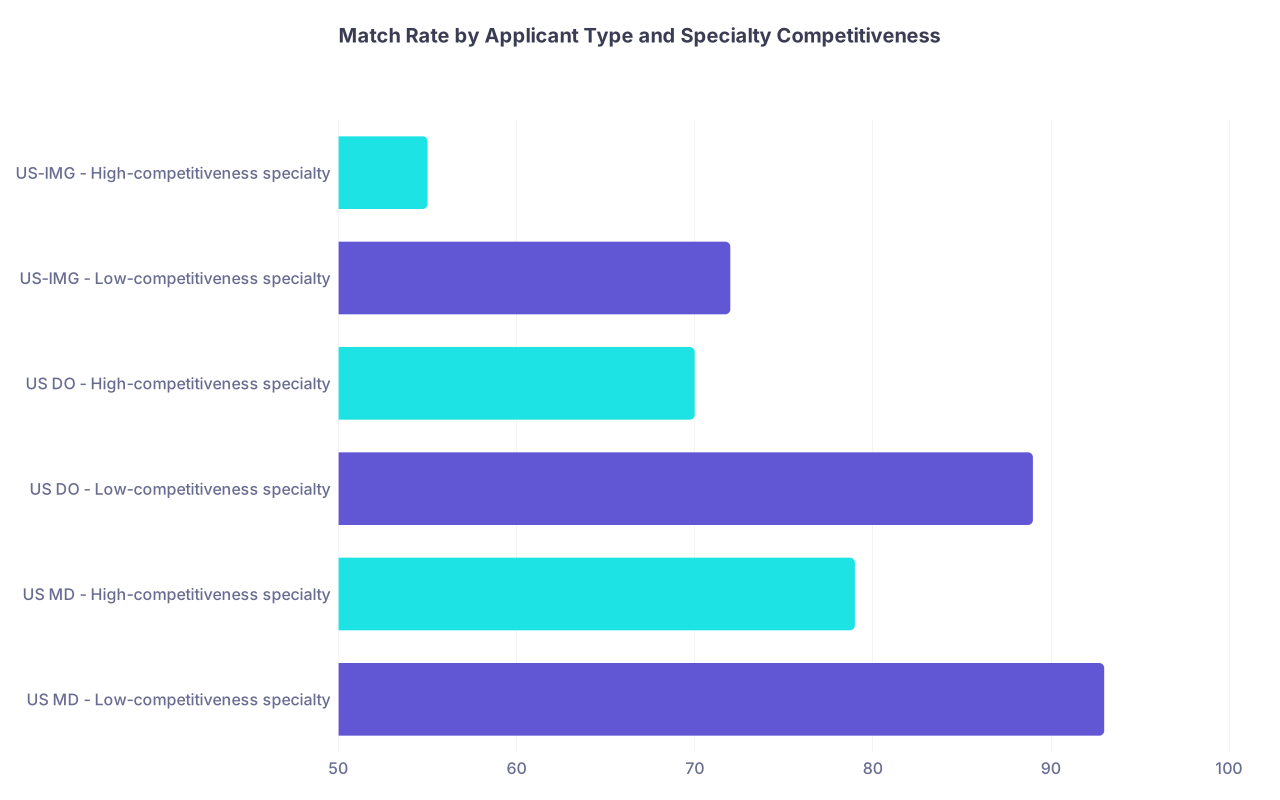
Before talking about your individual competitiveness, you need to know the baseline difficulty of what you attempted.
| Category | Value |
|---|---|
| US MD - Low-competitiveness specialty | 93 |
| US MD - High-competitiveness specialty | 79 |
| US DO - Low-competitiveness specialty | 89 |
| US DO - High-competitiveness specialty | 70 |
| US-IMG - Low-competitiveness specialty | 72 |
| US-IMG - High-competitiveness specialty | 55 |
Those numbers mirror NRMP patterns across recent years (exact percentages vary by cycle, but the order does not).
You cannot interpret “I matched” without asking “Into what?” Matching into family medicine from a US MD program with solid but unspectacular scores is a fundamentally different signal than matching into dermatology with the same academic record.
Use the NRMP’s specialty-specific match rates as your first lens. If you matched in a specialty where:
- US MD seniors match >90% of the time → low to moderate competitiveness
- US MD seniors match 70–85% of the time → moderate to high competence needed
- US MD seniors match <70% of the time → elite pool, especially for top-tier programs
Now layer in your own result.
Step 2: Where You Matched on Your Rank List
Your own rank list is the best internal metric you have. The lower you go on it before matching, the more likely the market saw you as mid-pack or lower relative to your target niche.
| Where You Matched | Implication About Competitiveness | Typical Signal |
|---|---|---|
| Ranks 1–3 | Strong or well-aligned applicant | You were wanted by top choices |
| Ranks 4–7 | Solid, but not elite in your pool | Some programs preferred others |
| Ranks 8+ | Borderline or risky strategy | You were near the margin of matching |
This is crude but directionally useful.
Matching at rank #1 or #2 in a competitive specialty:
- Suggests you were clearly within the competitive band for that specialty
- Or, that your pre-interview signaling (home program, away rotation, personal ties) boosted you above your raw stats
Matching at rank #11 in the same specialty:
- Suggests you were at or below the median in that applicant pool
- Or, that your list was short or geographically constrained, limiting your options
If you do not remember how many programs your peers ranked, you are not alone. I have sat in sessions where fourth-years guessed their classmates ranked “around 10” programs for internal medicine, when the NRMP median for matched US MDs was closer to the mid-teens, and unmatched applicants ranked fewer.
Step 3: Number of Programs Ranked vs. NRMP Medians
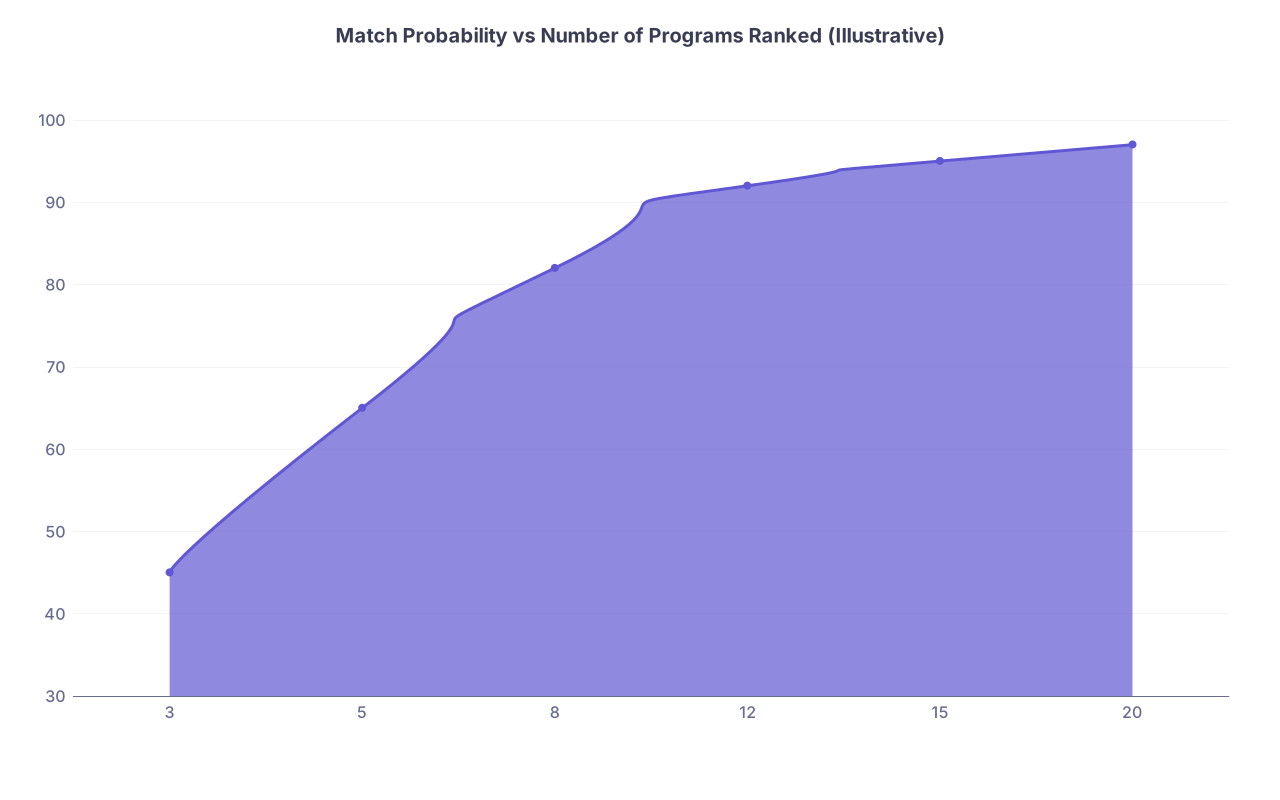
The NRMP’s graphs relating “number of contiguous ranks” to match probability are some of the most clinically useful data they publish. They show the point where additional programs stop helping much and start reflecting anxiety instead.
For US MD seniors, these are approximate 90% match-probability thresholds seen repeatedly across cycles:
| Specialty Type | Programs Ranked (Contiguous) |
|---|---|
| Family Medicine / Pediatrics | ~7–8 |
| Internal Medicine | ~10 |
| General Surgery | ~12–14 |
| OB/GYN | ~12–14 |
| EM (fluctuates year to year) | ~12–15 |
| Competitive (Derm, Ortho, ENT) | ≥15 and still <90% |
If you:
- Matched after ranking far fewer programs than the median → you were likely above-average in that pool (or highly constrained geographically with strong local ties).
- Needed double the median number of programs to match → your competitiveness was probably below the specialty median, but your backup volume compensated.
| Category | Value |
|---|---|
| 3 | 45 |
| 5 | 65 |
| 8 | 82 |
| 12 | 92 |
| 15 | 95 |
| 20 | 97 |
Look at where you sit on curves like that. If you ranked 5 programs in a specialty where the 90% line sits near 12, and you still matched, your underlying signal was relatively strong. If you ranked 20 and matched at #18, your signal was weak but rescued by volume.
Step 4: Applicant Type and How Harsh the Market Is
The data show a tiered system.
US MD seniors sit at the top of most pools. US DO seniors face a bit more friction, especially in historically ACGME programs. US and non-US IMGs face a brutally steep gradient in competitive specialties.
NRMP results over many cycles show:
- US MD seniors overall match rate: typically ~92–94%
- US DO seniors: upper 80s to low 90s depending on year
- US-IMGs: ~60–70%
- Non-US IMGs: ~55–60%
Now cross that with specialty competitiveness.
If you are a US DO senior who matched categorical general surgery on your top five ranks, in a year where DO match rates in surgery lagged MDs significantly, that outcome is strong evidence you were well above-average in your applicant subgroup. The same result for a US MD may simply indicate “solid, not exceptional.”
For IMGs, any categorical match in a historically ACGME-controlled field (like categorical internal medicine at a mid-to-high tier academic program) is, statistically, a strong signal of competitiveness, often above the median of all applicants, even if the program is not “prestigious” by lay rankings.
Step 5: What “Where You Matched” Says About Program Tier
This is the part nobody likes to say out loud but everyone quietly infers: the prestige tier of the program that ranked you high enough reflects the market’s judgment of your file.
I am not talking about US News noise. I am talking about tangible signals:
- University vs community
- NIH funding rank for research-heavy fields
- Fellowship match lists for IM, peds, etc.
- Case volume and operative autonomy for surgical fields
You can think of these “tiers” in rough buckets:
- Nationally top-tier academic programs with strong reputations and highly competitive fellowship pipelines
- Solid regional academic centers and well-known community programs
- Smaller community or newer programs with less name recognition, sometimes weaker resources
Now combine:
- Specialty competitiveness
- Your applicant type
- The tier of program where you matched
If you are a US MD who matched internal medicine at a small community program after ranking 18 programs, that suggests you were in the lower band of competitiveness for IM, relative to your peers.
If you are a US DO who matched internal medicine at a strong university program with a subspecialty fellowship track, that strongly suggests you were on the high end relative to DO peers (and competitive even among MDs).
A simple way to think about it:
- Same specialty, higher-tier program → you outcompeted many of your peers
- Same specialty, lower-tier program → your application was likely mid- or lower-tier in that pool
- Different specialty, lower-tier program, after applying to a more competitive field initially → the market moved you where your metrics better fit
Step 6: If You Under-Matched Relative to Your Metrics
I have seen plenty of students with strong numbers land at unexpected places. The data almost always reveal why.
Common patterns when someone with “competitive” numbers under-matches:
- Too few applications / overly short rank list for the specialty’s difficulty
- Overly narrow geography (e.g., only one state or metro area) in a mid-competitive specialty
- Weak or generic personal statement and letters that did not differentiate them
- Red flags (failed exams, professionalism issues) that are not fully captured in simple score tables
From an NRMP-data perspective, the biggest unforced error is too-short rank lists. The curve of match probability vs. programs ranked is unforgiving, especially for DOs and IMGs in competitive fields. If you stopped at 7 programs in general surgery and matched at #7, that is not proof you were “barely competitive.” It might just mean you played with very little buffer.
So ask yourself:
- How many programs did I rank compared with the NRMP median for matched applicants in my specialty and applicant category?
- Did I include a realistic spread of program tiers, or only reach programs?
- Were there exam failures, late improvements (e.g., high Step 2 after weak Step 1), or other timing issues that made my final competitiveness look better than what programs saw at application time?
Under-match is often a strategy error compounded by slightly-below-elite metrics, not a verdict that you were “weak.” But the market does not care about potential; it reacts to what is visible during the application window.
Step 7: If You Over-Matched Relative to Your Metrics
Sometimes the opposite happens. A student with modest scores matches at a program clearly above where the raw stats alone would predict.
Data-driven reasons:
- Strong fit signal: Away rotation at that program, strong letters from faculty there, clear geographic or personal ties.
- Niche program priorities: Emphasis on underserved care, language skills, research interest in a specific area that aligned with the department’s needs.
- Hidden strength: Significant research output, leadership, or a previous degree (MPH, PhD) that carries weight beyond scores.
If you match at your #1 in a high-tier academic program with board scores at or below the specialty median, your competitiveness was not in the 3-digit score. It was in the narrative, the relationships, and the non-quantified parts of the file.
That does not mean your success was random. It means your true “signal” was not fully captured by NRMP summary tables. You leveraged the parts of your application that data tables underweight.
Step 8: If You Did Not Match – What the Data Say
Unmatched outcomes are painful, but from a data perspective, they are usually predictable.
The NRMP publishes unmatched applicant profiles by:
- Specialty
- Number of programs ranked
- Exam scores
- Applicant type
Three patterns dominate unmatched US seniors:
- Too few programs ranked in a competitive field
- Below-median board scores for that field, without a parallel backup in a less competitive specialty
- Late or weak Step 2 performance when Step 1 was already marginal
| Category | Value |
|---|---|
| 3 | 25 |
| 5 | 40 |
| 8 | 55 |
| 10 | 65 |
| 12 | 75 |
| 15 | 82 |
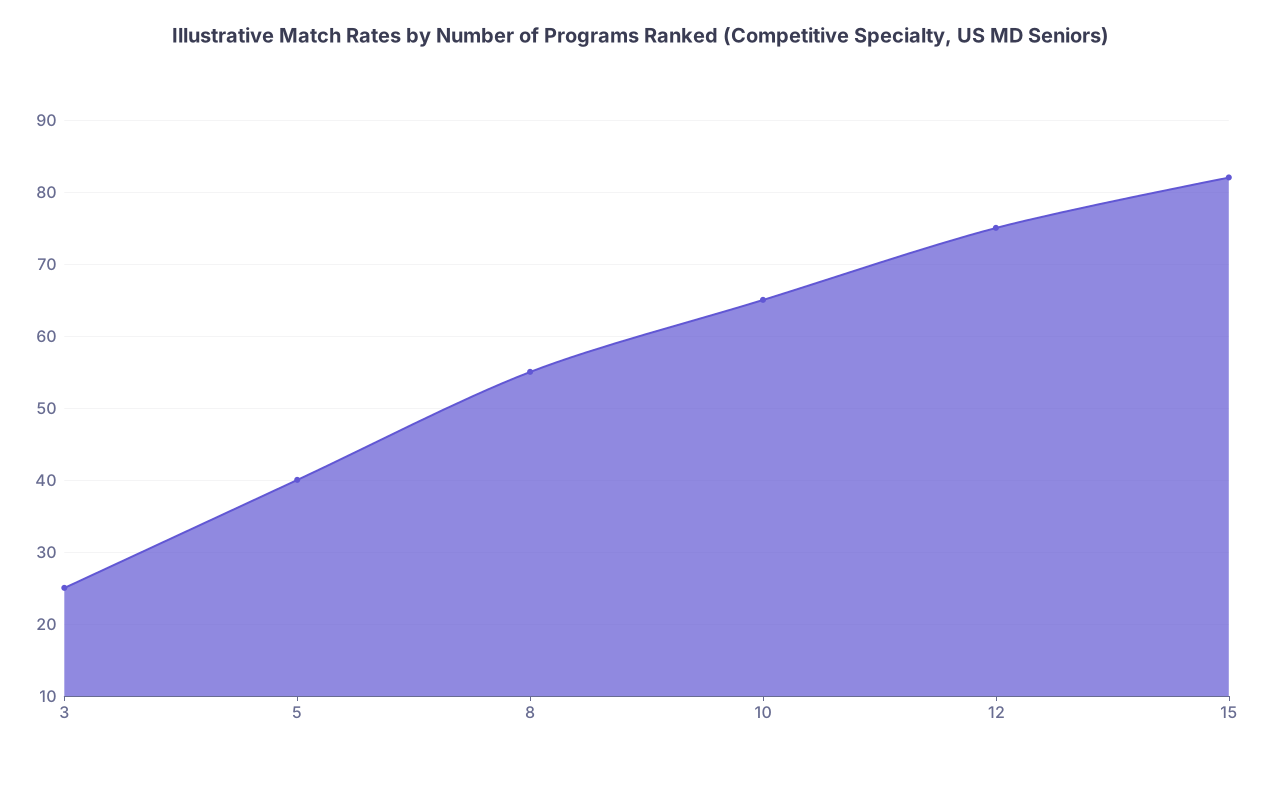
If you fell into that lower part of the curve, you were operating with a low match probability the entire time, whether anyone said it out loud or not.
From a pure analytics perspective, not matching usually indicates:
- Your self-assessed competitiveness was higher than your market-assessed competitiveness, and
- You did not build enough backup options to offset that gap
That is harsh, but it is actionable. For SOAP or reapplication, you can re-align with the actual NRMP data: more applications, more realistic specialty choices, and earlier remediation of any exam or performance gaps.
Step 9: Using NRMP Data to Reconstruct Your “Scorecard”
If you want to quantify where you actually stood, do this:
- Identify your specialty and applicant category (e.g., US MD senior, US DO senior, US-IMG).
- Pull the NRMP “Charting Outcomes” tables for that combination.
- Look up:
- Median Step scores for matched applicants
- Median number of programs ranked for matched vs unmatched
- Match rates at your score level or AOA / research profile
- Compare:
- Your Step 1 / Step 2 (or COMLEX) to the matched median and IQR
- Your programs ranked vs median (and your match position in that list)
- Program tier vs typical outcomes at your score band
You can treat this nearly like a z-score analysis:
- If your scores were 1+ SD above the matched mean and you matched at a lower-tier program or low in your rank list → strategy or narrative problem.
- If your scores were 1 SD below the matched mean and you matched at your #1, mid-to-high-tier program → narrative/fit advantage; you outperformed your raw metrics.
- If your scores hugged the median and you matched around your #5–7 at a mid-tier program → the market treated you as a median applicant. Nothing mysterious there.

| Step | Description |
|---|---|
| Step 1 | Match Outcome |
| Step 2 | Identify Specialty and Applicant Type |
| Step 3 | Review Unmatched Profiles |
| Step 4 | Pull NRMP Specialty Data |
| Step 5 | Compare Scores and Programs Ranked |
| Step 6 | Likely Strategy or Fit Factors |
| Step 7 | Market Aligned With Metrics |
| Step 8 | Assess Applications and Backup Plans |
| Step 9 | Matched? |
| Step 10 | Above or Below Median? |
Once you walk through that, the “mystery” of why you ended where you did shrinks. The numbers are usually consistent.
Step 10: What to Actually Take Away From Your Match Result
Let me translate all of this into a few blunt truths.
Matching does not automatically mean you were “competitive”; it means you crossed the minimum bar for at least one program on your list, given the constraints you created (specialty, geography, volume). You might have been barely competitive or highly competitive; that depends on where and how you matched.
Under-matching or not matching is rarely about the algorithm being unfair. The applicant-favorable algorithm still cannot manufacture interviews you did not earn or rank positions you were never offered. If you played in a too-competitive pool with too little backup, the NRMP data would have predicted your risk.
Over-matching, relative to your scores, is not luck. It is your letters, your rotations, your story, and your relationships doing their work. You showed value that the usual dashboards understate.
If you treat your Match Day as a data point rather than a personal judgment, you can extract a clean signal:
- How your metrics compared to your peers in that specialty
- Whether your application strategy amplified or diluted your true competitiveness
- Where you likely sit in the national talent distribution for your chosen field
Use that information going forward. For fellowship applications. For career planning. For how you counsel the MS3 who corners you on wards and asks, “Do I have a shot at EM with my scores?”
Because the data show this: the market is remarkably consistent year after year. You either learn its patterns, or you let them blindside you.
Key takeaways:
- Your Match Day result, combined with NRMP tables (specialty, scores, programs ranked), gives a surprisingly precise read on how competitive you actually were in your field.
- Where you matched on your list and what tier of program it is, relative to your metrics and applicant type, is a more honest indicator of competitiveness than “matched vs unmatched” alone.
- Under- or over-matching usually reflects strategy and alignment with the data, not randomness. The more you read the NRMP numbers like a statistician, the less confusing your outcome looks.