
The calls after a surprising Match are not random. They are calculated, political, and more revealing than anything that happened during interview season.
You see the Instagram posts and group texts. You hear, “My program director called me right away!” or “The chair personally called me after I matched there!” And then you look at your own silent phone and wonder what that means.
Let me tell you what actually happens in the back rooms, on the morning of Match Day, when faculty decide whom to call—especially when the result is a surprise.
What Match Morning Really Looks Like Behind the Scenes
Strip away the ceremony. Match morning for faculty is basically a mix of joy, triage, and damage control.
Most programs do some version of this: the program director, coordinator, maybe the associate PDs and a chief or two meet in a conference room or hop on Zoom. The NRMP list drops. Someone prints or projects it. Then the “Oh wow” phase starts.
A typical sequence:
They scan the list for disasters.
- Did we fill?
- Any catastrophic surprises?
- Did our top couple of ranked applicants actually match here?
Then they scan for emotional landmines.
- The beloved rotator who did not match here.
- The home student who ranked them first but matched elsewhere.
- The candidate they thought was a lock who clearly put another program higher.
Only after that do they get to the “Who are we calling?” conversation.
This is where the myths begin. Students think: “If they don’t call me, they regret getting me.” That’s usually wrong. The call list is almost never about how much they like you. It’s about optics, politics, and relationships.
And yes, surprising Matches are where it gets interesting.
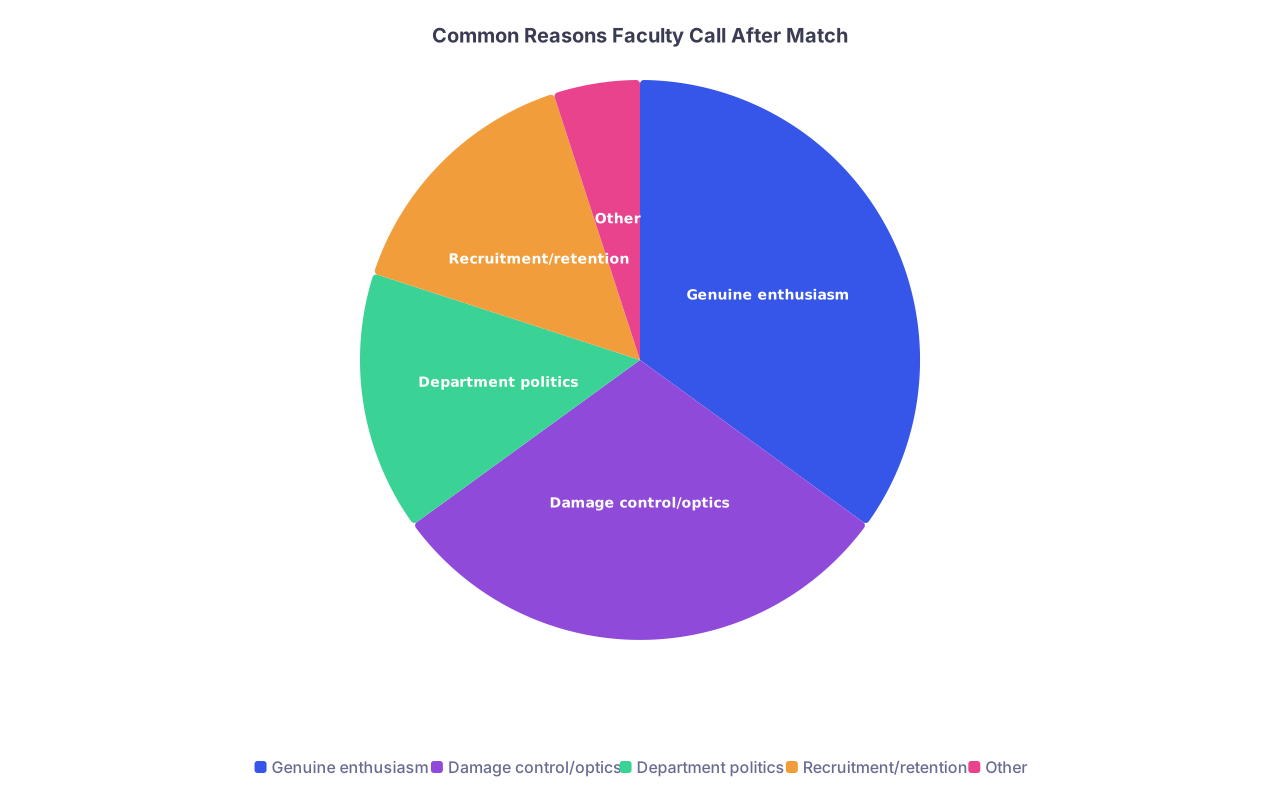
| Category | Value |
|---|---|
| Genuine enthusiasm | 35 |
| Damage control/optics | 30 |
| Department politics | 15 |
| Recruitment/retention | 15 |
| Other | 5 |
The Real Hierarchy of Who Gets Called
Every program has its own style, but the underlying hierarchy is depressingly similar. It usually looks something like this, even if no one says it out loud.
Tier 1: The “Headline” Matches
These are the people who make the program look good:
- The rock-star candidate that everyone wanted and they actually landed.
- The superstar home student who stayed.
- The applicant from a big-name school that boosts the program’s prestige.
These are guaranteed calls. Often multiple calls. PD, chair, maybe even a division chief. These calls are easy: “We’re thrilled you’re joining us! You were one of our top choices.” Everyone’s in a good mood. No surprises here.
Tier 2: The Political Obligations
Then come the “we sort of have to” calls. These are about internal politics and relationships:
- The dean’s favorite home student.
- The child or mentee of a senior faculty member.
- The applicant advocated for by a powerful person in the department.
If the Match was “surprising” in the sense that no one actually expected them to land this person, they definitely get a call. It’s a way of signaling, to internal people, “We took care of your person.”
You’ll never hear this admitted publicly, but I’ve sat in these meetings and heard some version of:
“Look, we need to call X. The chair personally pushed for them.”
Or: “Y matched here. You know Dr. Z will be watching. One of us has to call.”
Tier 3: The Strategic Reassurance Calls
This is where it intersects with your world if you had a weird or surprising outcome.
These are the calls for:
- The applicant who matched somewhere they clearly did not rank first.
- The student who seemed cool or noncommittal on interview day.
- The rotator who hinted they might be disappointed if they didn’t get their ‘dream program.’
Faculty know you may be confused or even upset. They also know you may still be on the fence emotionally about them, even after the Match algorithm did its thing. So they call to stabilize the relationship.
The subtext of these calls is often: “Look, we know this might have been a surprise for you, but we want you to feel wanted here.”
Now, what about everyone else?
Tier 4: The Silent Majority
Here’s the part almost no one tells you: most residents do not get a call on Match Day. Not from the PD. Not from the chair. Not from any faculty. At a lot of programs, they don’t call anyone, maybe one or two exceptions.
Silence does not mean:
- You were low on their list
- They regret getting you
- They think you’re a backup
Usually it just means this: the PD is exhausted, in clinic, dealing with service coverage, and trying to manage the logistics of graduation, orientation, and block schedules. They like you. They’re happy you matched. They just don’t do the phone-call performance.
| Program Type | Likelihood of PD Calls | Who Usually Gets Called |
|---|---|---|
| Big-name academic center | High | Top recruits, political picks |
| Mid-sized university | Medium | Top few, home stars |
| Community program | Low–Medium | Occasionally top or local grads |
| Small new program | High | Nearly everyone, for recruitment |
So no, your classmates’ experiences are not the baseline. Different programs have different cultures; you just never see that on social media.
When the Match Is a Surprise: What Triggers a Call
Let’s talk about the real topic: how faculty decide whom to call when the result is unexpected.
There are four main kinds of “surprising” Matches that matter here.
1. You Matched Higher Than They Expected
This is the scenario where the faculty say, “Wait, we got them?”
Sometimes you:
- Came off as lukewarm during the interview.
- Were rumored to be ranking a more prestigious program first.
- Had ties elsewhere everyone thought would pull you away.
When the Match list hits and your name is on it, the room gets quiet for a second. Someone will say, “Wow, I thought they’d end up at X.” Then two things happen:
- They’re thrilled.
- They realize you might have to mentally reorient from what you thought was your plan.
So they call to:
- Make it very clear you’re wanted.
- Start securing your emotional buy-in.
- Get ahead of any narrative that you “missed out” on something else.
The PD will often explicitly say, “We were really excited to see your name. You were one of our top choices.” Sometimes that’s literally true; sometimes it’s…flexible. The purpose is the same: make sure you don’t show up bitter or ambivalent in July.
2. You Matched Lower Than You Hoped (and They Know It)
Faculty are not stupid. They talk to your deans, they talk to your mentors, they read between the lines of your emails. They know when they’re not your first choice.
If:
- You’re a strong applicant who mostly interviewed at “higher tier” places.
- Your home advisors were pushing you toward more competitive programs.
- You expressed clear regional or institutional preferences that do not match where you ended up.
Then your program may read the Match and think: “This might sting for them.”
This is where the more emotionally intelligent PDs will make a point to call.
The goal is not to convince you they’re “better” than the places you wanted. The goal is to keep you from deflating so much that you start off residency with resentment. They’ll say things like:
- “We’re really glad you’re coming here. You’re going to do very well with us.”
- “You’ll get great operative volume / research / fellowship support here.”
- “If you have any concerns or questions, reach out—I mean that.”
They’re not guessing blindly. Often the student affairs dean will have already hinted: “FYI, this student might be disappointed if they don’t land X.” That information gets passed forward, quietly.
3. The Home Student Who Did Not Stay
This is the most politically charged version.
Let’s say you’re a home student who:
- Rotated with them.
- Got strong letters from their faculty.
- Gave every impression that you liked them enough to rank them highly.
And then you matched somewhere else. That’s a surprising match from their perspective. The call dynamic flips.
Now it’s not about them calling you with joy. It’s about deciding whether to call at all.
Inside those meetings, I’ve heard:
- “Do we call them to congratulate?”
- “Or does that look like we’re chasing them?”
- “Let their dean handle it, we’re swamped.”
Some programs are gracious and always call their home students, no matter where they match. Others don’t, either out of busyness or bruised ego.
So if you were a home student and your home PD did not call after you matched elsewhere—that’s often ego and bandwidth, not purely punishment. They may be annoyed. They might also have just decided not to make a big thing about it.
4. The “How Did This Happen?” Outcome
There’s another kind of surprise: the applicant who clearly overreached and ended up in a program that knows it wasn’t originally high on their list.
Think:
- You applied mostly to hyper-competitive places and barely got interviews.
- You scrambled to rank some safer programs lower on your list.
- You match at one of those “safety” programs.
Those programs see your profile and your interview behavior. They can tell where you thought you belonged. So, when they see your name on the Match list, there’s a question: Is this person going to be resentful?
Some PDs respond by calling quickly.
Others do not call at all, by design.
I’ve heard one PD say bluntly:
“I’m not chasing someone who clearly thought they were too good for us during the interview. They’ll get an email like everyone else.”
That’s the brutal honesty. Your demeanor during interviews can dictate how much emotional effort they invest in you on Match Day.

How Faculty Actually Build the Call List
Let’s walk through how the “call list” usually gets created, because this is where the pattern reveals itself.
Picture the PD, APDs, maybe a chief resident, and the program coordinator. They’ve just digested the list. Now someone says: “Okay, who are we calling?”
Common factors they weigh:
Public image:
“If we landed that big-name applicant, we probably should call them.”Internal politics:
“We need to call the chair’s mentee. Also the dean’s student. Non-negotiable.”Emotional risk:
“This student might be disappointed. Someone should reach out.”Time and bandwidth:
“I have clinic in an hour. I can make maybe 3–5 calls, tops.”
They almost never sit there and say, “Let’s call everyone we like the most.” They use a mix of priorities: visibility, risk, obligation.
I’ve literally watched a PD say:
“Okay, I can do A, B, C. You [to the APD] do D and E. Chief, text F and G. Everyone else gets the standard email.”

| Step | Description |
|---|---|
| Step 1 | Match List Released |
| Step 2 | Handle unfilled or issues |
| Step 3 | Review incoming class |
| Step 4 | Add to call list |
| Step 5 | Add to call list |
| Step 6 | Add to call list |
| Step 7 | Everyone else |
| Step 8 | PD/Chair calls |
| Step 9 | Standard email/contact later |
| Step 10 | Any disasters |
| Step 11 | Top recruits landed |
| Step 12 | Political/mentored students |
| Step 13 | Potentially disappointed |
Here’s the harsh truth: whether you’re on that list is a function of how much emotional, political, or reputational leverage your situation has, not just how excited they are to train you.
They may be thrilled about you and still not call.
What Your Call (or Silence) Does and Does Not Mean
Let’s decode the signals, because students wildly misinterpret this part every year.
If You Get a Call Right Away
It usually means one or more of these:
- You were genuinely high on their rank list.
- You were politically important (home star, heavily advocated for).
- They thought you might be surprised and want to stabilize you quickly.
- They have a culture of personal calls for a few key residents.
It does not mean:
- You were #1 on their list. Programs say “We ranked you very highly” to lots of people.
- You’re now guaranteed special treatment.
- Your career is set. It’s a nice signal, not a golden ticket.
If You Get an Email but No Call
This is the default at many programs, especially bigger ones.
Often there’s a group email:
“Welcome to the Class of 20XX!” with some photos, meet-the-team slides, etc. Then maybe a follow-up from a chief, coordinator, or APD. That’s very normal.
Does it mean you were low on the list? Generally no. It means:
- The PD is busy.
- They don’t do phone calls as a norm.
- They may save individual outreach for later, after the dust settles.
If You Hear Nothing For a While
This is where anxiety spikes.
You matched. You see friends getting calls and texts from their programs. You have…crickets.
Faculty explanation is usually painfully boring:
- They’re in clinic or the OR.
- They’re still organizing the official welcome email.
- They assume your dean and med school are already celebrating you, so they don’t rush.
I’ve seen PDs send their first contact on Monday after Match Day, not Friday. The residents still turned out fine.
The silence doesn’t feel great on your side. But inside the program, no one’s thinking, “Let’s intentionally ignore them so they know we aren’t thrilled.”
How You Should Interpret a “Surprising” Match Call
Now let’s turn this into something practical. You get a call you didn’t expect. What do you do with that?
Scenario A: You Matched Somewhere You Secretly Ranked Lower
You pick up, and the PD is warm, effusive, maybe a little more enthusiastic than you feel. The temptation is to half-pretend, half-withdraw. Bad move.
They are extending an early olive branch. They know this may not be what you dreamed of. They’re trying to make it better. Use that.
Be:
- Gracious: “Thank you so much for calling, I really appreciate it.”
- Positive but honest enough: you do not have to lie and say it was your number one if it was not. Just don’t dump your disappointment on them.
This call plants the first seed of your professional reputation. If you sound sulky or unenthusiastic, that will be remembered. Not in a vindictive way—in a, “We might need to keep an eye on how they adjust” way.
Scenario B: You Matched at a Place You’re Thrilled About, and They Call
This one’s easy. Match their enthusiasm. Ask one simple, thoughtful question (“Anything you recommend I start reviewing before July?” or “What’s the first day usually like?”) and end the call on a high note.
Scenario C: You Do Not Get a Call, and You’re Spinning
Here’s the blunt advice: stop using phone calls as a metric of how wanted you are.
Your true signals of value will show up later:
- How they treat you on day one.
- The opportunities they give you (cases, research, conference time).
- How your attendings advocate for you when it comes to fellowship or job hunting.
If the silence really bothers you, send one short, gracious email after the dust settles (like early the next week):
“Dear Dr. X,
I just wanted to thank you again for the opportunity to join your program. I’m very excited to train with you all and I’m looking forward to getting started in July.
Best,
[Name]”
That’s it. Do not mention that others got calls. Do not ask where you were ranked. Don’t fish for reassurance. It reads insecure and naive.
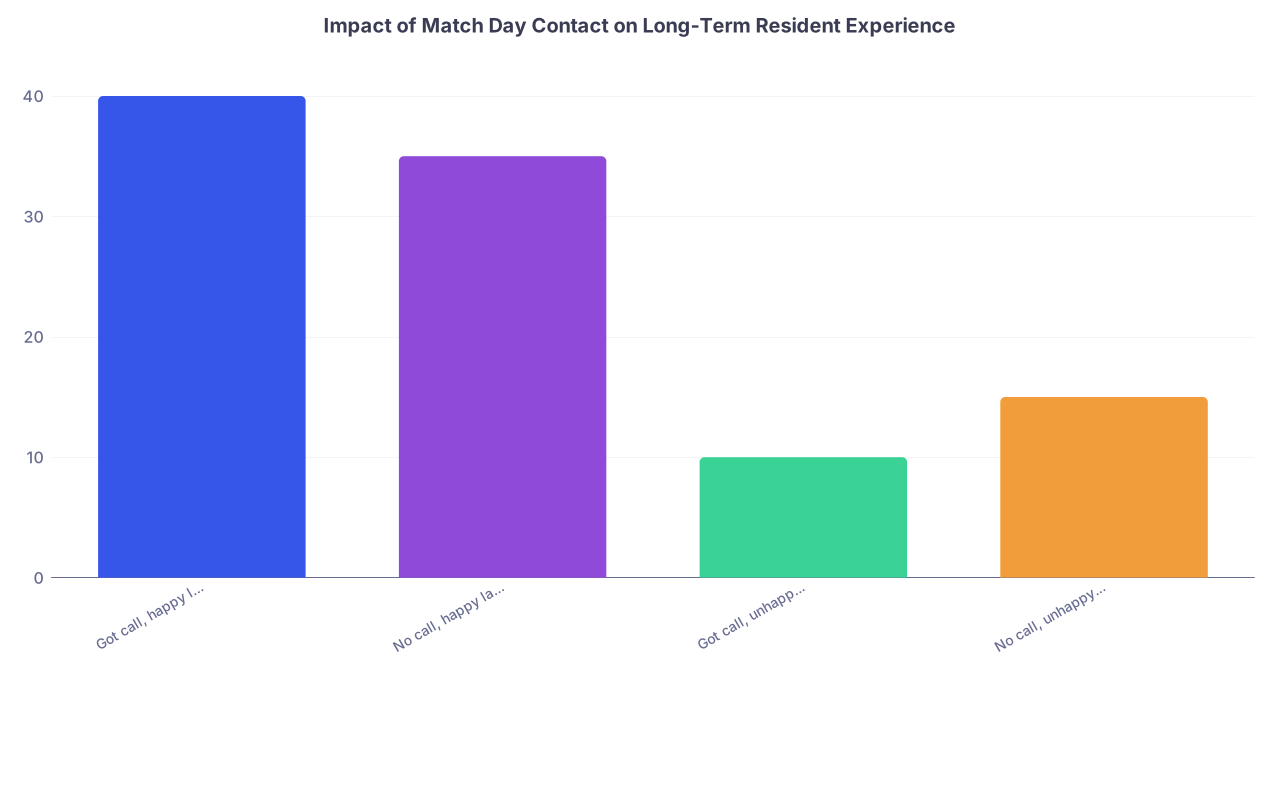
| Category | Value |
|---|---|
| Got call, happy later | 40 |
| No call, happy later | 35 |
| Got call, unhappy later | 10 |
| No call, unhappy later | 15 |
Notice something about that distribution: Match Day contact is a weak predictor of how content you’ll be after PGY-1. Day-to-day culture and training quality swamp that early signal.
What Faculty Say to Each Other About You After the Match
One last layer of insider truth: the conversation about you does not end with the Match list.
Typical behind-the-scenes commentary:
- “I’m really glad we got her; she’ll be a workhorse.”
- “He’s going to need support; I think missing out on X is going to bother him.”
- “I liked them more in person than on paper; I think they’ll be a great fit.”
None of that is visible to you. The phone call (or lack of it) is the only piece you see. But it’s just the surface.
The more thoughtful PDs will assign early mentors specifically based on those conversations. They’ll say:
- “Pair this person with a strong, kind senior—they might have some disappointment to process.”
- “Connect them with faculty in their interest area quickly; they were very research-focused.”
- “Watch for burnout—they pushed hard for top-tier places, and we don’t want them to feel like they ‘settled.’”
So yes, they are thinking about you. Yes, your emotional process matters. No, the existence or absence of a 90-second Match Day call is not the full measure of that.

FAQs
1. If I did not get a Match Day call, does it mean I was low on their rank list?
No. Most programs simply do not call everyone, and many call almost no one. The rank order list is confidential by rule; they’re not going to tell you where you were anyway. Silence usually reflects time constraints and program culture, not regret.
2. The PD told me on the phone, “You were one of our top choices.” Is that always true?
Not always in the literal, numerical sense. It typically means you were in the group they were genuinely happy to match, or you were important politically or strategically. The exact number on the list is irrelevant now; focus on the fact that they are signaling investment in you.
3. Should I ask my program where I was on their rank list?
Absolutely not. It’s both unprofessional and pointless. They’re not allowed to disclose it under NRMP rules, and even if they slip and hint, the number does nothing for your day-to-day training. You’ll be judged on performance, not your match position.
4. How should I respond if I’m disappointed by where I matched and they call me?
Be courteous, restrained, and forward-looking. Thank them for the call, express that you’re looking forward to training there, and keep any processing of disappointment for your trusted mentors and friends—not for the PD. Your reputation starts that day, whether you like it or not.
Key points: post-Match calls are about optics, politics, and risk management far more than affection. Most residents will not get a call, and that silence means almost nothing about your value. Your real standing will be determined by how you show up and perform once July starts—not by who dialed your number on Match Day.