
Match Day is exactly when smart people do stupid things with protected health information.
Everyone is excited, everyone has a phone out, and everyone assumes “it is just a personal Instagram story” or “only my friends will see this.” That is how careers get damaged before residency even starts. I have watched it happen in real time.
If you think “I would never violate HIPAA,” you are already at risk. Almost nobody commits a privacy breach on purpose. They do it because they are distracted, emotional, or copying what everyone else seems to be doing.
Let me walk you through the mistakes that actually get students in trouble around Match Day—and how you can avoid becoming the cautionary example your dean talks about next year.
The Match Day “Perfect Photo” That Can End Up in a Report
Here is the pattern I have seen over and over:
Student rips open envelope. Screams. Friends and family crowd around. Someone snaps a photo: you, in a white coat, in the hospital hallway. Behind you: a workstation-on-wheels with an open chart. Or a unit whiteboard. Or an ED tracking screen. Or just a stack of papers on the nurses’ station desk.
You post it. It gets shared. Someone zooms in.
There is a name. A birthdate. A medical record number. A diagnosis. Maybe all of the above.
That is a HIPAA violation. It does not matter that the patient is “not identifiable to non-medical people.” It does not matter that you “did not mean it.” It does not matter that “everyone does it.” The legal standard is not your intent. It is whether individually identifiable health information was disclosed.
Your first rule: The hospital is not your Match Day backdrop
Do not make this mistake:
No photos in patient care areas. That includes:
- ED bays
- ICUs
- Hallways with room signs
- Nurses’ stations
- Workstations-on-wheels
- Anywhere you can see screens, charts, whiteboards, or labels
No photos while on shift, in scrubs, in active patient spaces. You are thinking “Match!” but your badge, background location, and screens suggest “on duty.”
No celebrating Match with pictures during rounds or between patients. The optics are terrible, and the privacy risk is high.
If you want celebration photos at your institution, take them:
- In a designated Match Day venue (auditorium, lobby, outdoor space)
- Away from any clinical area
- With no computers, charts, whiteboards, or patient signage in the frame
“Just step outside” is not optional. It is self-protection.
The Social Media “Flex” That Becomes Discoverable Evidence
HIPAA and confidentiality violations do not need a visible face or name to be a problem. People forget that. They believe that if they skip the name or blur the bed number, they are safe.
They are not.
On Match Day, social media posts tend to fall into a few risky categories:
1. The “Look What Happened On My Shift Today” Post
You know the type:
- “Matched into EM and actually ran my first code today, wild.”
- “What a day to find out I matched surgery – just scrubbed on a GSW that rolled into the ED.”
Add a few details:
- Time of day
- Location
- Age of patient
- Mechanism of injury
- Publicly known event (crash, shooting, celebrity, news story)
Now that post is potentially tied to a specific patient encounter. Combine it with your program’s location and it is not as anonymous as you think.
On Match Day especially, your posts get more views, more shares, more scrutiny. You are suddenly interesting.
2. The “De-identified But Actually Not” Story
You have probably heard someone say, “It is fine, I am not using names.” So they write:
- “Right after finding out I matched IM, took care of a 37-year-old pregnant woman with new diagnosis of cancer. Devastating.”
No name. But:
- The encounter is temporal (today, this morning, right after Match)
- The details are unusual (pregnant, age, cancer type, specific floor)
- Combined with your hospital and specialty, this can easily point to one person
That is still PHI. That still creates risk.
On Match Day, anything tied to “today” or “this morning” becomes easier to track. Families talk. They see your badge, your name, your social accounts. Do not be the person whose emotional venting turns into a complaint and an investigation.
3. The Group Photo With Invisible PHI That Is Actually Visible
Classic scenario:
- Big group of you holding Match envelopes in a classroom.
- Behind you, there is a projected list of patients for afternoon rounds.
- Or a printed OR schedule tacked to the door.
- Or a board listing “Room 12 – 54F CHF,” etc.
All it takes is one person to enlarge the photo. The internet loves to zoom.
You must get used to scanning every background in every picture that even touches your clinical identity.
The Real Stakes: It Is Not “Just a Slap on the Wrist”
Let me be blunt. The consequences are not theoretical.
I have seen:
- Students pulled from rotations while an investigation happens.
- Deans calling program directors to “proactively disclose” an incident.
- State boards asking about “professionalism and confidentiality” issues.
- Match outcomes strained because programs suddenly doubt your judgment.
Programs are already nervous about unprofessional behavior. They rank you expecting that you:
- Will not post about patients.
- Will not drag the hospital into scandals.
- Will not create legal exposure on social media.
A HIPAA-adjacent problem right as you are transitioning into residency is exactly the kind of headache they do not want. If another candidate with similar credentials seems less risky, guess who looks worse in comparison.
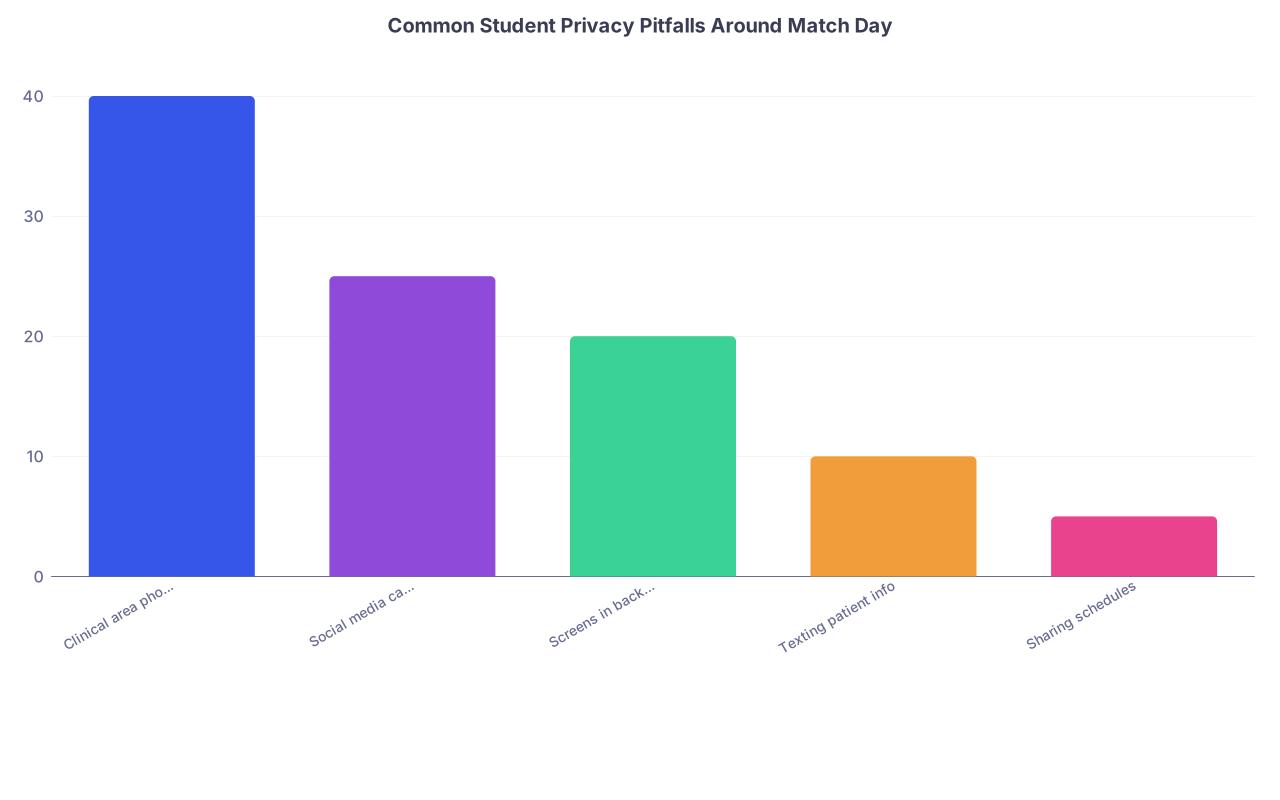
| Category | Value |
|---|---|
| Clinical area photos | 40 |
| Social media case posts | 25 |
| Screens in background | 20 |
| Texting patient info | 10 |
| Sharing schedules | 5 |
Those numbers are approximate, but the pattern is real: seemingly harmless photos and “interesting stories” do the most damage.
Where Students Slip: Subtle Forms of Confidentiality Breach
HIPAA is the legal framework, but you also have institutional confidentiality policies and professional ethics. You can avoid a technical HIPAA violation and still get nailed for “unprofessional conduct” or “breach of confidentiality.”
Here is where smart students miscalculate during Match season.
Talking Too Freely in Public Spaces
On Match Day there is a lot of milling around. Hallways. Cafeterias. Elevators. Group chats. People are:
- Comparing where they matched
- Rehashing crazy cases
- Processing patient interactions emotionally
The mistake: combining your Match news with clinical gossip.
For example:
- “I cannot believe I matched derm. Remember that teenager with Stevens-Johnson from last week? That case sold me.”
- Said loudly in a crowded café attached to the hospital. Family members, visitors, nurses, and a volunteer are within earshot.
You think it is harmless storytelling. Someone else hears enough details to recognize a situation they lived through. Now there is a complaint. Now there is a record.
Assume any hospital-adjacent public space contains:
- Patients
- Families
- Staff who know exactly which patient you are describing
You do not need a name for it to land badly.
Careless Use of Screens and Shared Devices
Match season also means:
- Emailing updated CVs
- Opening ERAS or NRMP in shared computers
- Checking email constantly in workrooms
The privacy mistake is not just PHI. It is also:
- Leaving patient charts open while you check Match results.
- Walking away from a workstation for a photo with charts exposed.
- Taking Match selfies while EPIC, Cerner, or whatever system is up behind you.
Two problems:
- Direct PHI exposure in photos.
- Documented evidence that you were inattentive to patient data handling during a hectic, emotional time.
Both look terrible in any institutional review.
Where HIPAA Actually Bites: What Counts as PHI in This Context
You cannot protect what you do not understand. So here is the simplified rule set you need drilled into your spine before Match Day.
Protected Health Information (PHI) includes any health-related information tied to an identifiable individual. It is not just names and faces.
On or around Match Day, high-risk data in photos or posts includes:
- Names on:
- Wristbands
- Door placards
- Whiteboards
- Charts
- Monitors
- Numbers and codes:
- Medical record numbers
- Account numbers
- Room and bed numbers when linked to other details
- Demographic details:
- Exact age
- Exact date of birth
- Exact admission date combined with diagnosis
- Clinical information:
- Diagnoses
- Procedures
- Test results
- Any narrative about an identifiable event (trauma, arrest, OB complication)
So when you are hyped about Match and want to document your “last day on service,” do not post:
- Photos with the ED tracker board visible
- Screens showing ECGs or radiology images with patient identifiers in a corner
- OR board schedules
- Lists of consults or sign-out sheets
Even if you do not see the risk at first glance, assume someone else will.
Practical Rules for a Safe Match Day (That Still Feels Like a Celebration)
I am not telling you to hide in a dark room and refuse to enjoy your own Match. You deserve to celebrate. You just need guardrails.
Here is how to do it without walking into trouble.
Before Match Day: Set Some Boundaries
Decide, in advance:
- No photos in clinical areas. Period. Tell your friends and family so they do not force you into bad spots.
- No “today’s wild case” posts until you are off-site, off-duty, and not mentioning any clinical details that could identify a patient.
- No posts combining “I matched X at Hospital Y” with specifics of cases you just saw there.
If you are unsure whether a photo is safe:
- Zoom in on every corner.
- Look for:
- Names
- Room numbers
- Boards
- Labels
- Computer screens
- If you have to “hope no one notices,” delete it. That photo is not worth the risk.
Designate someone in your group as the “privacy check” friend. The one who will say, “Nope, that background is bad” instead of just snapping and posting.
During the Match Ceremony
Most schools hold Match in a controlled area for a reason:
- Less risk of patient exposure
- Fewer clinical identifiers in the background
Still, you can screw it up by:
- Wearing a visible hospital badge with your full name and institution while you post live updates about your location and schedule.
- Including random staff or attendees in your photos without consent.
- Livestreaming from within institutional spaces.
Safer habits:
- Take your celebration photos in the event venue, not the wards.
- Use neutral backgrounds—the school banner, a blank wall, outdoor space.
- Keep your badge flipped or out of frame for public social posts, especially if you are saying anything emotional, ranty, or borderline.
Matching While On Rotation
This is where people get messy.
You are on rotation. You find out where you matched. You are excited and distracted. Residents and attendings may congratulate you between patients or during downtime. Fine.
What you must not do:
- Start taking group selfies at the nurses’ station.
- Record TikToks in the ICU celebrating your specialty.
- Take photos “to remember your last day on this service” with patients or identifiers in the background.
If staff want a “team photo,” ask:
- Can we move to a non-clinical space?
- Can we make sure no screens or patient boards are visible?
- Can we check the photo for anything identifiable before anyone posts?
If the answer is basically “no one cares,” you should. It will be your name on the investigation, not theirs.
Program Announcements and Group Photos: Hidden Landmines
Schools and hospitals love to advertise Match success:
- Group photos of the class with match envelopes
- Lists of where everyone matched
- Department posts congratulating “our future surgeons,” etc.
Those are usually vetted through institutional channels. The risk comes when:
- You re-post with added details.
- You cross-link that content with clinical anecdotes about patients.
- You tag locations and departments in ways that connect you to specific cases you have talked about online.
Also watch group photos that include:
- Whiteboards or glass walls with scribbled notes.
- Team sign-out lists.
- Visible computer monitors with open charts.
Just because “the department Instagram posted it” does not mean you are automatically safe reusing it. Review it with the same paranoia you apply to your own content.
Texting, Group Chats, and “Private” Spaces
Do not relax just because something is “only in the GroupMe” or “just our class WhatsApp.”
On Match Day group chats blow up with:
- Screenshots of match emails
- Photos from rotations
- Comments about “the crazy code we just had”
Medical students get in trouble for:
- Sharing photos taken in clinical areas that clearly show patient identifiers.
- Joking about specific patients (“our favorite frequent flyer finally came back on Match Day lol”).
Group chats are not legally safe havens:
- Screenshots travel.
- People fall out with friends.
- Someone forwards a message to a faculty mentor “for advice.”
If you would be embarrassed seeing a chat screenshot in front of your dean or PD, do not send it. Your future self will thank you.
Quick Reality Check: You Are Wearing Two Hats That Day
On Match Day you are both:
- A private person, celebrating a huge life milestone.
- A health care professional, bound by confidentiality rules that do not magically turn off.
The mistake is acting like the first and forgetting the second.
So before you post, ask:
- Am I in any clinical space or touching anything clinical?
- Is there any chance a patient, family member, or colleague could recognize a clinical situation I am referencing?
- If the hospital’s privacy officer reviewed this, would I feel sick to my stomach?
If the answer to that last question is not a clean “no,” you already know what to do.
| Location | Risk Level | Why |
|---|---|---|
| Match ceremony hall | Low | Controlled, non-clinical space |
| Outdoor campus courtyard | Low | No patient data nearby |
| Hospital cafeteria | Medium | Patients/families may be present |
| Ward hallway | High | Room signs, staff, PHI nearby |
| Nurses’ station / ICU | Very High | Screens, charts, whiteboards |

| Step | Description |
|---|---|
| Step 1 | Want to take or post a photo |
| Step 2 | Do not take or post |
| Step 3 | Move or crop until none visible |
| Step 4 | Remove all clinical details |
| Step 5 | Photo is reasonably safe |
| Step 6 | In clinical area? |
| Step 7 | Any screens or boards in view? |
| Step 8 | Any patient stories mentioned? |
The Bottom Line
Three points you should not forget:
- The hospital is never an appropriate Match Day backdrop. Any clinical space plus cameras plus emotion equals risk.
- “De-identified” stories about cases tied to your Match Day are almost never as anonymous as you think. If a specific patient or family could recognize themselves, you have already gone too far.
- Screens, boards, charts, and careless group chats are the silent killers. Most students hurt themselves not with dramatic breaches, but with background details they did not bother to check.
Celebrate hard. Just do it like someone who actually deserves the MD or DO after their name.