Last-Minute Prep for Residency Match Day: Essential Tips You Don’t Want to Miss
Residency Match Day is unlike any other milestone in medical school. It represents the culmination of years of exams, clinical rotations, personal sacrifices, and growth. In a single moment, you learn where you will spend the next several years of your medical training, and often, where your professional and personal life will be rooted.
In the days leading up to that Friday in March, emotions tend to run high—excitement, anxiety, pride, fear, and everything in between. While much of the heavy lifting is already done (applications submitted, interviews completed, rank lists certified), there is still meaningful, last-minute preparation you can do to optimize your Match Day experience and set yourself up for the next phase of your career development.
This guide expands on key Preparation Tips with practical, step-by-step student advice to help you stay grounded, organized, and ready—no matter what outcome Match Day brings.
Understanding the Stakes: Why Residency Match Day Preparation Matters
The Role of Match Day in Your Medical Journey
Residency Match Day is not simply an announcement; it is a transition point. On Match Day, you learn:
- Where you will train for the next 3–7 years
- What geographic region you’ll likely live in
- The type of institution and patient population shaping your clinical skills
- The mentors and networks you’ll build early in your career
All of these factors influence your future fellowship options, subspecialty interests, and professional opportunities. While Match Day is not the only determinant of your long-term career, it is a major pivot point in your career development.
Why Last-Minute Prep Still Matters
By Match Week, your application has been submitted, your interviews are over, and your rank list is locked. You might feel like there’s nothing left to do but wait. In reality, the days before Match Day are an important time to:
- Protect your mental health and emotional stability
- Clarify your logistics and communication plans
- Prepare for multiple possible outcomes
- Position yourself to respond quickly and strategically if things don’t go as hoped
This phase is less about impressing programs and more about taking care of yourself, preparing your support system, and planning for what comes immediately after you open your results.
Final Checks: Reviewing Your Application and Professional Profile
Even though the match process is essentially complete, revisiting your application materials and professional profile is still valuable.
1. Revisit Your ERAS Application, CV, and Personal Statement
You’re entering a transition period where you’ll start interacting with your future residency program, colleagues, and mentors. Reviewing your materials now helps you:
- Align your narrative: Remind yourself of how you presented your story, values, and goals.
- Prepare for early introductions: Program directors or chief residents may invite informal meet-and-greets, welcome sessions, or early contacts.
- Reflect on your growth: Reading your application and personal statement can reinforce how far you’ve come and why you chose your specialty.
Focus on:
- Key experiences you highlighted (leadership posts, research projects, volunteer work)
- The themes and values you emphasized (patient advocacy, academic interest, underserved care)
- Any specific career interests you discussed (fellowship aspirations, research focus, practice setting)
This reflection supports both confidence and clarity as you step into residency.
2. Refresh Your Specialty Knowledge and Trends
You don’t need to study like it’s an exam, but it’s wise to:
- Review recent major updates or trends in your specialty (e.g., telemedicine adoption, value-based care, new guidelines).
- Skim specialty society websites (e.g., ACP, AAFP, ACOG, ACEP) to see current priorities and educational resources.
- Think about how your future residency training aligns with your long-term goals.
This mindset shift—from “applicant” to “incoming resident”—helps you move beyond anxiety and toward proactive career development.

Managing Mindset and Mental Health Before Match Day
The emotional intensity around Match Day is very real. Proactive attention to your well-being can make a profound difference in how you experience it.
3. Practice Intentional Gratitude and Reflection
Gratitude is not just a feel-good exercise—it’s a practical coping strategy.
Concrete ways to practice gratitude:
- Gratitude journal (5–10 minutes daily):
- List 3–5 things you’re grateful for (mentors, resilience, support systems, clinical experiences).
- Reflect briefly on one meaningful moment from your training.
- Reflection prompts:
- “What am I most proud of in my medical school journey?”
- “Whom do I want to thank—mentally or directly—for helping me here?”
- “How have I grown as a person and clinician over the last four years?”
These reflections help shift your focus from outcome anxiety to appreciation of your journey, reinforcing that your worth is not defined by a single day.
4. Lean on Your Peer and Support Network
Your classmates and friends are experiencing similar emotions. Use that shared experience to your advantage.
Practical ways to connect:
- Create a small group chat (3–6 people) specifically for Match Week support.
- Plan a low-pressure activity together: shared meal, walk, or quick coffee.
- Share what you’re most nervous about and how you’d like to be supported on Match Day (e.g., “Please text me no matter what,” or “Give me a few hours before checking in.”)
Also consider connecting with:
- Trusted mentors or residents you know, especially if you’re worried about certain outcomes.
- Family members to explain what Match Day is and what to expect—this can help manage their expectations and your own stress.
Staying Organized: Logistics and Planning for Match Week
Logistics may seem mundane, but they can meaningfully reduce unnecessary stress on Match Day.
5. Double-Check Match Day Logistics and Technology
Well before Match Day:
- Confirm the timing:
- Know precisely when results are released (time zone included).
- Understand your school’s ceremony schedule (if applicable).
- Verify where and how you’ll receive results:
- NRMP portal access (username/password up to date, test login).
- Email account functional and accessible from your main device.
- Back-up access options:
- Ensure your phone, tablet, and/or laptop are charged and have internet access.
- Consider a secondary device if one fails, especially if your school requires online viewing.
Run a “mini-tech rehearsal” the day before:
- Log into the NRMP or institutional system (without clicking anything that might accidentally lock you out).
- Confirm your email forwarding or notification settings.
- Ensure you know where you’ll physically be at the exact time results are released.
6. Organize Personal and Professional Information
This is also a good time to gather key documents and information in one place, including:
- Your CV and ERAS application PDF
- Copies of Step/Level scores and medical school transcript
- Contact information for key mentors, advisors, and program leadership
- A simple digital folder labeled “Residency” to store Match documents and correspondence
This becomes especially important if you:
- Need to respond to SOAP opportunities (if applicable)
- Begin credentialing or onboarding paperwork shortly after Match
- Receive early communication from your residency program
Preparing Emotionally for Multiple Possible Outcomes
Even if you are optimistic, emotionally preparing for various scenarios can make Match Day less overwhelming.
7. Normalize a Range of Outcomes
On Match Day, several things can happen:
- You match into your top-choice program.
- You match into a program lower on your list—but still a solid fit.
- You match into a different geographic area or type of program than expected.
- You match into a preliminary/transitional year only.
- You do not match (information typically comes earlier in Match Week).
All of these paths are survivable, and many physicians thrive after careers that did not begin with their “dream” program. To prepare:
- Remind yourself that your worth is not defined by rank order, prestige, or location.
- Recognize that medicine is full of second chances, nonlinear paths, and late pivots.
- Recall stories of residents or attendings who did not take a straight path—and yet built meaningful, successful careers.
8. Plan Your Response to Different Scenarios
It may help to write down a simple plan for each possible scenario:
- If I get my top choice…
- Whom will I call first?
- How will I express gratitude to those who supported me?
- If I match but not where I hoped…
- What is one positive aspect I can focus on (training, city, program strengths)?
- Which mentor can I debrief with later?
- If I do not match…
- Whom will I contact immediately (advisor, dean’s office, career counselor)?
- How will I take care of myself emotionally that day?
- What steps will I take in the next 24–48 hours (e.g., SOAP strategy)?
Creating a framework now gives you a sense of control, no matter what happens.
Fine-Tuning the Details Before Match Day
9. Clarify Match-Related Communications
While the NRMP rules strictly govern communications before and during the Match, some students may already have a clear sense of where they’re likely to end up (e.g., couples matching, military match, or certain specialty pathways).
In the final days:
- Review any prior communication from programs so you’re not surprised by their policies or preferences.
- Check your email and spam folder daily so you don’t miss important announcements.
Avoid:
- Attempting to influence or re-negotiate your match outcome—this is not allowed under NRMP rules.
- Overinterpreting casual communication (or silence) from programs.
After Match Day, once you know your program:
- Respond promptly and professionally to any welcome emails.
- Save important contact information and instructions for onboarding.
10. Reflect on Your Interview Performance (Without Ruminating)
While the interviews are over, a brief, constructive review of your experience can serve as a career development exercise:
- Identify what you did well (connecting with interviewers, sharing patient stories, demonstrating insight).
- Note areas to improve for future opportunities (fellowship, academic jobs, leadership roles).
- Capture any “lessons learned” about how you like to present yourself professionally.
Keep this reflection short and forward-looking. The goal is growth, not self-criticism.
Prioritizing Self-Care: Protecting Your Body and Mind
As Match Day approaches, treating yourself like an athlete on the eve of a major event is a sound strategy.
11. Focus on Sleep, Nutrition, and Movement
Sleep:
- Aim for consistent, 7–8 hours of sleep in the days leading up to Match Day.
- Avoid doom-scrolling or checking forums late at night.
- Establish a simple wind-down routine (dim lights, reading, stretching, meditation).
Nutrition:
- Opt for balanced meals with protein, complex carbs, and healthy fats.
- Stay hydrated—keep a water bottle nearby.
- Limit excessive caffeine and alcohol, especially the night before Match Day.
Physical activity:
- Short walks, yoga, or light exercise can help offload anxiety.
- Choose movement you enjoy, not something that feels like punishment or pressure.
12. Build a Brief Daily Mental Health Routine
Consider a 10–15-minute daily routine that you’ll keep through Match Week:
- 2–3 minutes of deep breathing or a mindfulness app.
- 5 minutes of journaling (fears, hopes, reflections).
- 2–5 minutes reviewing a short list of affirmations, such as:
- “I have done everything I reasonably could.”
- “My value as a physician is not defined by one day.”
- “Whatever happens, I can adapt and move forward.”
These small rituals create a buffer between you and the intensity of the moment.
Communication and Social Media Strategy for Match Day
13. Decide How You’ll Experience the Moment
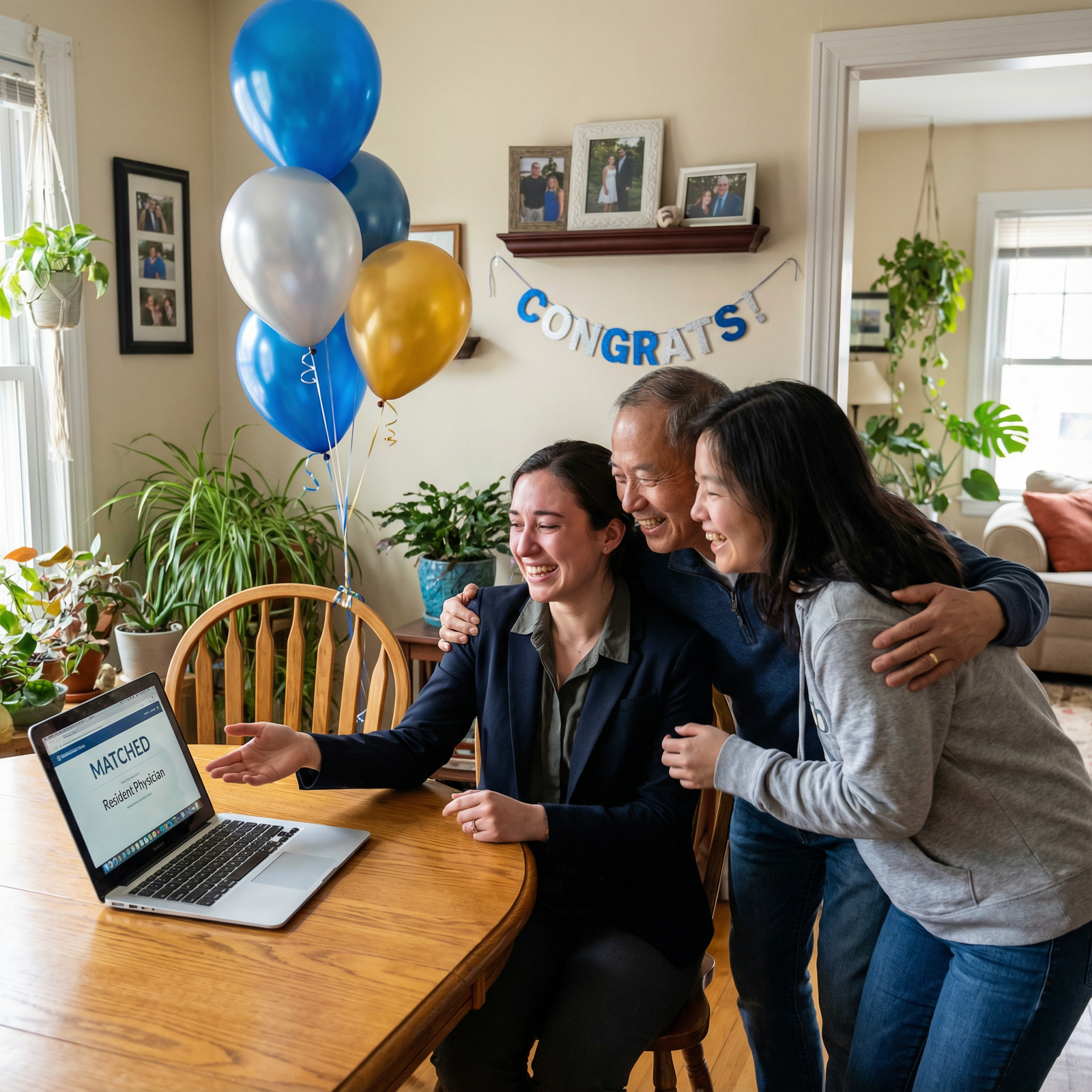
Think intentionally about your environment when you open your results:
- Where? At home, with friends, at a school ceremony, or privately?
- With whom? Alone first, with one close person, or with a group?
- How public? Do you want photos or videos taken, or would that feel intrusive?
There is no “correct” way—only what best supports your emotional needs.
14. Plan Who You’ll Tell and How
Create a brief communication plan:
- First circle: Immediate family, partner, or closest friends.
- Second circle: Mentors, advisors, key faculty members.
- Third circle: Extended family, classmates, social media (if desired).
Decide ahead of time:
- Whether you want to share instantly or give yourself a few hours to process.
- How you’ll communicate (text, call, group message, email, social post).
- What you’ll share if the result is not what you hoped for (you control your narrative).
15. Use Social Media Thoughtfully
Social media can amplify both joy and distress on Match Day.
Tips for healthy use:
- Consider limiting time on social platforms that morning.
- Mute or snooze certain apps if you anticipate comparison stress.
- If you choose to post, focus on gratitude, growth, and acknowledgement of your support network, not just the name or prestige of your program.
Frequently Asked Questions About Last-Minute Residency Match Day Prep
1. How can I boost my confidence and reduce anxiety leading up to Match Day?
Confidence often comes from preparation plus perspective.
Actionable steps:
- Revisit your application and remind yourself of your strengths and accomplishments.
- Practice a short, daily grounding routine (breathing, gratitude, brief journaling).
- Avoid overconsuming forums, rumors, or speculation—they tend to increase anxiety, not reduce it.
- Talk openly with trusted peers or mentors about your fears; simply voicing them can lessen their intensity.
Remind yourself: you have already completed the bulk of the work. Match Day is about receiving information, not performing.
2. What should I have with me or prepare on Match Day itself?
You don’t need a long checklist, but a few essentials help the day go smoothly:
- Fully charged phone and/or laptop with reliable internet access.
- Login information for the NRMP portal and your email.
- A small notebook or journal to capture your thoughts, reactions, or questions.
- Tissues or a handkerchief—it can be an emotional moment.
- A basic plan for your day (where you’ll be, who you’ll be with, when you’ll call family).
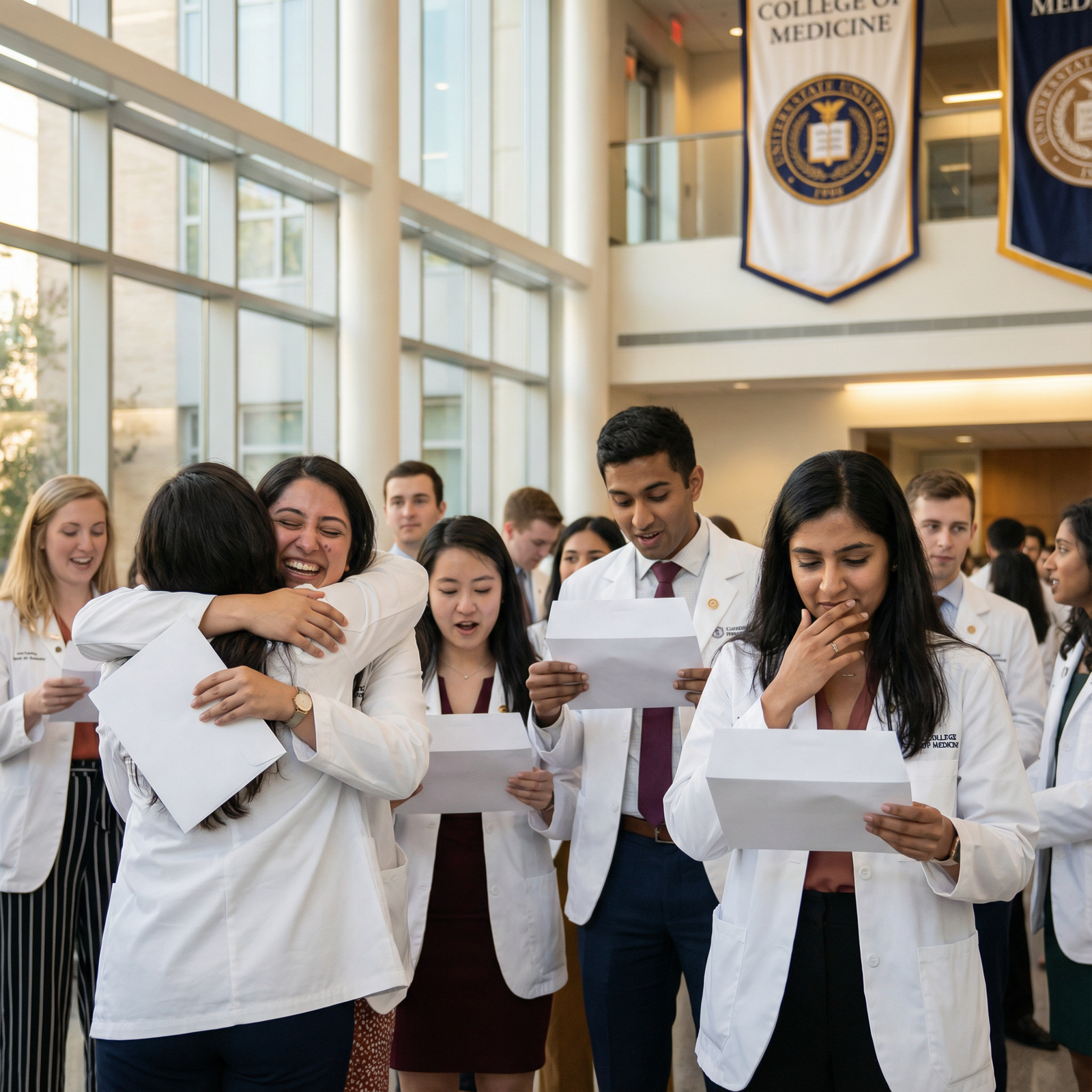
If your school hosts a ceremony, confirm dress expectations (white coat or not, business casual vs. casual) and arrival time.
3. How should I handle disappointment, anxiety, or unexpected outcomes on Match Day?
Difficult emotions on Match Day are common and valid, especially if:
- You matched to a program lower on your list.
- You are far from family or preferred geographic region.
- You did not match or matched into a preliminary year only.
Ways to cope:
- Give yourself permission to feel upset—no need to force immediate positivity.
- Reach out to a trusted friend, partner, mentor, or mental health professional.
- Avoid making big, definitive statements about your future in the first few hours.
- If you did not match, contact your school’s dean’s office or career advisor immediately to strategize SOAP or alternative plans.
Over time, many residents come to appreciate aspects of programs they initially felt uncertain about. Space and perspective matter.
4. What if I don’t match—how can I quickly pivot and protect my career trajectory?
If you receive notice early in Match Week that you did not match:
- Meet with your school’s Student Affairs or career advising team as soon as possible.
- Develop a SOAP strategy:
- Identify specialties and programs that align with your skills and experiences.
- Prepare an updated, concise version of your application if needed.
- Practice brief, focused communication for SOAP interviews.
- Consider your medium-term options if SOAP doesn’t work out:
- Research positions
- Clinical or educational fellowships
- Additional degrees (MPH, MBA, etc.) in line with your goals
- Observerships or preliminary programs for reapplication
Not matching is painful but not the end of your medical career. Many successful physicians took more than one cycle to match.
5. How can I start thinking about my long-term career development on or after Match Day?
Once you know your program, you can begin to integrate Match Day into a bigger career vision:
- Research your matched program’s strengths: research tracks, fellowship outcomes, leadership development.
- Identify potential mentors based on your interests (e.g., hospital medicine, global health, health policy, surgery subspecialties).
- Draft a short list of learning goals for your intern year (clinical skills, procedures, research, teaching).
- Start a digital “Career Development” folder where you capture opportunities, ideas, and goals during residency.
Viewing Match Day as the start of a new phase—not the end of a journey—helps orient your mindset toward growth.
Conclusion: Entering Residency Match Day With Clarity and Resilience
As Residency Match Day approaches, remember that you have already demonstrated persistence, adaptability, and commitment through years of medical training. The final days before Match Day are less about changing the outcome and more about:
- Protecting your mental health
- Organizing your logistics
- Preparing thoughtfully for multiple scenarios
- Leaning on your support network
- Setting the stage for ongoing career development
Whether you match into your dream program, a surprising new location, or face an unexpected setback, your journey as a physician does not begin or end with a single email or envelope. It continues with every patient you meet, every skill you build, and every mentor you connect with.
By using these last-minute preparation tips, you can approach Match Day with greater clarity, confidence, and resilience—ready to embrace whatever comes next and to shape your future in medicine with intention.
For more in-depth student advice on exploring specialties and planning your next steps, consider reading related resources such as “Navigating the Medical Specialty Maze: Tips for Future Physicians.”