
What do you do when you’re staring at a lease for an apartment you’ve never seen, in a city you barely know, with a start date you might not even be able to move in by—while every co‐intern on the group chat is bragging they “locked in a place already”?
That panic is exactly where people sign the worst leases of their lives.
Let me be blunt: the housing rush right after Match Day causes more financial damage than any single interview trip you took. I’ve watched new residents walk into orientation already screwed by a 12‑month contract they regret and cannot easily escape.
You’re smart enough to match. Don’t be dumb about housing.
The Post‑Match Panic That Landlords Count On
The second NRMP emails go out, three things happen:
- Your program bombards you with onboarding paperwork.
- Your future co‑interns light up a GroupMe or WhatsApp with “Where are you living?”
- Every “luxury” apartment near the hospital seems to magically “only have a few spots left.”
You’re tired. You just survived ERAS, interviews, rank lists. Now people are telling you, “Units go fast around here—you should lock something in this week.”
That’s how you get trapped.
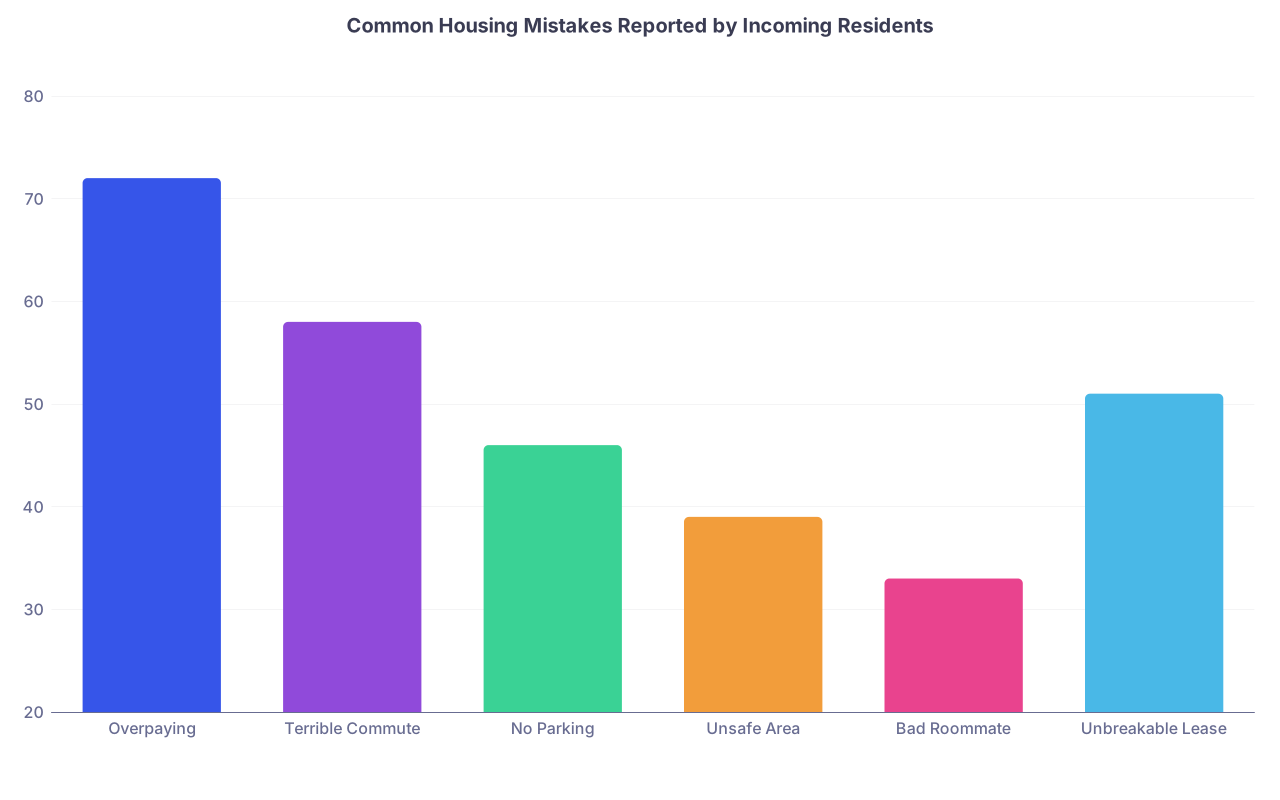
| Category | Value |
|---|---|
| Overpaying | 72 |
| Terrible Commute | 58 |
| No Parking | 46 |
| Unsafe Area | 39 |
| Bad Roommate | 33 |
| Unbreakable Lease | 51 |
These aren’t theoretical. I’ve seen:
- An intern in Philly paying $2,200/month for a studio because “everyone said Center City or nothing,” commuting 25–30 minutes by trolley at 4:30 a.m.
- A surgery resident in Houston who didn’t realize she needed a car, signed near downtown, and then discovered the “short commute” was 40 minutes each way in traffic.
- A psych intern in Boston who picked a cheap place found on Facebook, then learned his roommate’s boyfriend essentially lived there too—no mention in the lease, zero recourse.
The pattern is the same: rushing + fear of missing out + unfamiliar city = bad housing decisions.
You’re not just signing a lease. You’re shaping your daily baseline stress for the entire PGY‑1 year.
Trap #1: Signing Before You Understand Your Schedule and Commute
The biggest rookie mistake? Locking in a lease before you understand how you’ll actually live as a resident.
You look at Google Maps at 2 p.m. on a random weekday, see “12 minutes to hospital,” and think you’re golden. Except you’ll be:
- Driving in at 4:45–5:30 a.m.
- Leaving between 5–8 p.m. (or later)
- Coming in for night float at 7–9 p.m.
- Sometimes leaving the hospital exhausted and half‑functional
That “12 minutes” might become 30 on real days. Or the bus that looks perfect doesn’t actually run before 6 a.m.
What you must know before signing anything
Do not sign a lease until you’ve:
- Seen (or requested) your sample block schedule for PGY‑1
Ask: “What’s the earliest I need to be at the hospital? What are typical end times for wards, ICU, ED?” - Understood call structure
Q4 in‑house call? Night float? Home call? It matters for where and how you live. - Checked commute times at your real hours, not fantasy lunchtime traffic
Open your map app and check:- 4:45–5:30 a.m. (inbound)
- 5–8 p.m. (outbound)
- Midnight or 2 a.m. (if you ever leave at that time)
I’ve watched people choose a “cute neighborhood” 20–25 minutes away, then realize on week 2 of ICU it feels like a different city.
Rule of thumb:
- Under 15 minutes door‑to‑door is ideal.
- 15–25 minutes is tolerable if everything else (safety, price, parking) is good.
- More than 30 minutes? You’d better really like something about that place, because post‑call you will hate it.
Trap #2: Falling for “Luxury” Near‑Hospital Buildings
You’ll see them in every major academic center: glass towers with names like “The Lofts at [Something]” or “[City] Med Residences.” Fitness center. Rooftop. Pet spa. “Preferred employer” discounts for hospital staff.
They know exactly who you are and how much you’re panicking.
Here’s the problem:
- The “discount” is often a joke. $50/month off a $2,400 rent is nothing.
- You’re paying for amenities you will not use. That rooftop deck? You’ll see it twice a year.
- Some of these places nickel‑and‑dime residents—$150/month parking, “amenity fees,” pet rent, trash fees, you name it.
| Option | Base Rent | Parking | Other Fees | Total Monthly |
|---|---|---|---|---|
| Luxury tower 5 min walk | $2,300 | $175 | $75 | $2,550 |
| Mid‑range 10 min drive | $1,600 | $75 | $50 | $1,725 |
| Older building 15 min drive | $1,250 | $0 | $40 | $1,290 |
That difference over a 12‑month lease is thousands of dollars. On a PGY‑1 salary that already feels insulting, that money actually matters.
The mistake isn’t choosing a nicer building. It’s doing it reflexively, because “all the residents live there.” No. All the loud ones in your group chat live there. I promise there are quieter, more frugal people living 10 minutes away who are not broadcasting their floor plan on Instagram.
If you decide to go this route, do it with eyes open:
- Ask current residents: “Anyone regret living at [building name]? Hidden fees? Noise?”
- Get total cost: rent + parking + utilities + required fees. Not just the listing number.
- Check noise. A tower full of med students and residents can be loud and chaotic, especially in July–September.
Trap #3: Blind Roommate Agreements With Strangers
The housing equivalent of rank‑ordering a program you’ve never visited: moving in with someone you barely know because “We’re both incoming IM at the same place, so it’ll be fine.”
Sometimes it is. Often it isn’t.
Common disaster setups I’ve seen:
- You’re on nights, your roommate is on clinic. You’re trying to sleep; they’re on Zoom calls.
- Their partner basically lives there.
- You thought you were both quiet. Turns out they decompress with loud video games at 1 a.m.
- They “forgot” to mention their dog has separation anxiety and barks for hours when they’re gone.
Two key problems:
- Residents underestimate how incompatible schedules can destroy a shared space.
- Many of these roommate arrangements are rushed, with no real conversation about expectations.
If you’re going to live with someone:
- Do a real video call. Not just a “hey, I’m normal” five minutes. Thirty minutes minimum.
- Ask intrusive questions. This is your sanity on the line:
- How clean are you actually? Dishes? Bathroom?
- Do you have a partner who will be here a lot?
- Pets—yes or no? Any future plans to get one?
- Night owl or morning person?
- How do you feel about guests, pre‑gaming, friends staying over?
- How loud do you like your music/TV?
- Talk explicitly about quiet hours and how you’ll handle conflict.
Then, pay attention to the lease structure. Huge trap here:
- Are both your names on the lease (joint and several liability)?
If they bail, you might owe the entire rent. - Or are you subleasing their “extra room” in a place they control?
The worst I’ve seen: an intern subleased a room from a “friendly PGY‑3,” no written sublease, just Venmo. PGY‑3 decides to move in their partner, wants the whole place. Intern gets told to leave mid‑year. Legally? Messy. Practically? Chaos.
You’re allowed to be picky. A bad roommate is harder to escape than a bad rotation.
Trap #4: Ignoring Safety and Nighttime Reality
New interns do this constantly: they walk a neighborhood at 3 p.m. on a sunny Saturday, see people with strollers and coffee, and think, “Seems fine.”
But you won’t always be walking home at 3 p.m. on Saturdays.
You will:
- Leave the hospital at 10–11 p.m.
- Walk to your car at 5 a.m.
- Stagger home post‑call like an exhausted target.
The question isn’t: “Is this neighborhood cute during the day?”
The question is: “Do I feel reasonably safe here at 11 p.m. and 5 a.m.?”
What to avoid:
- Long walks from garage to front door in poorly lit areas.
- Street parking only, in areas with frequent car break‑ins.
- Isolated back stairwells or alley entrances.
Ask current residents straight up:
“Are there any areas near the hospital you tell people not to live in?”
Most places have them. They’re not always obvious from Google Maps.
The other piece people forget: personal safety when exhausted.
You’re not at your sharpest post‑call. That’s not the time you want to be:
- Riding 3 different public transit lines
- Walking 0.8 miles through a deserted industrial area
- Navigating a dark parking lot four blocks from your building
I’m not saying “live in a bubble.” I’m saying do not sacrifice basic safety because something was $200 cheaper.
Trap #5: Not Reading (or Understanding) Lease Fine Print
You’re used to signing click‑through forms without reading. That’s how you get destroyed on housing.
Leases are written to protect the landlord, not you. There are clauses in there that can make your life unnecessarily painful.
Read the damn thing. Every page. Use your attending brain for one hour and save yourself thousands.
Watch for:
- Early termination rules
- Is there any clause for relocation/hospital transfer? Some don’t care at all.
- Is there a buy‑out fee option? (e.g., 2 months’ rent)
- Subletting
- Allowed or not? Written process or “landlord may refuse for any reason”?
- Rent increases on renewal
- Some leases sneak in “automatic 8–10% increase if renewed.”
- Utilities and fees
- Are utilities included?
- Is there “ratio utility billing” (mystery fluctuating shared bill) that spikes in winter/summer?
- Parking
- Assigned space or first‑come first‑served?
- Any towing or guest rules that will trap your friends?
If the lease is unclear, you email and ask questions. Get answers in writing.
And if they refuse to send you a blank copy of the lease to review before paying an application fee? That’s a red flag by itself.
Trap #6: Overcommitting on Timing (Move‑In, Start Date, Orientation)
Another sneaky way residents get stuck is by not syncing their lease date with reality.
Common pattern:
- Orientation starts June 20‑25.
- Lease starts July 1.
- You arrive in the new city with nowhere stable to live for 1–2 weeks.
- You cobble together an Airbnb + friend’s couch solution while starting residency.
Or the reverse:
- You sign a lease starting June 1 “to be safe.”
- You don’t move until June 25.
- You literally pay a full month of rent for an empty space.
Both are avoidable, if you do basic planning instead of panic‑signing.
Get dates in writing from your program:
- Exact orientation start date
- Expected first day of clinical responsibilities
- Any “encouraged” early arrival (e.g., badge pick up, HR, drug screen)
Then aim for:
- Move‑in 5–10 days before orientation if possible.
Enough time to unpack, learn the commute, get groceries, and not show up to Day 1 in chaos. - Avoid paying for more than 2 useless weeks of rent if you can negotiate another start date elsewhere.
Some landlords will shift a start date by a week if you ask early. Some will not. But people rarely even ask—they just accept whatever default the listing shows.
Trap #7: Over‑Extending Financially Because “I Deserve It”
I get it. You survived med school. You’re tired of living like a student. You want an actual couch, maybe in‑unit laundry, maybe a building that isn’t collapsing.
You do deserve comfort. But you also deserve to not spend PGY‑1 constantly stressed about money.
Here’s the cruel joke: residency salaries haven’t kept up with housing costs in many cities. That “nice but not crazy” 1‑bed in coastal cities can be 40–50% of your take‑home pay.
Most financial folks suggest housing at or under 30% of gross income. In reality, for many residents in expensive cities, 30–35% of take‑home is as good as it gets.
The mistake is not running the numbers.
- Look up your actual PGY‑1 salary at your program.
- Use a paycheck calculator for your state (federal + state + FICA).
- Look at real take‑home and subtract:
- Minimum loan payments (if any)
- Car payment and insurance (if you have one)
- Phone, internet
- Realistic food cost (hospital meals aren’t free)
- Required hospital fees (parking, union dues, etc.)
Whatever’s left is what you have for rent, utilities, gas, and life. If your rent kills that number, you’re volunteering for perpetual financial stress.
Is it sometimes worth stretching slightly to live truly walkable distance to the hospital? Yes.
Is it worth stretching to pay for quartz countertops and a pool you’ll never use? Usually not.
Trap #8: Waiting Too Long Or Moving Too Fast
There’s a timing sweet spot, and most incoming residents miss it on one side or the other.
- Group A panics, signs housing in March before they’ve even processed where they matched.
- Group B procrastinates, hoping for the “perfect” place, and ends up scrambling for the leftovers in late June.
Neither is good.
Bad rushing signs:
- You haven’t talked to any current residents yet.
- You’ve never seen a street view of the place during daytime, much less at night.
- You don’t know your call schedule but you’re signing for a 40‑minute commute because the unit has “a view.”
Bad delay signs:
- It’s mid‑June and you haven’t seriously applied anywhere.
- You’re ignoring messages from future co‑interns about housing while secretly anxious.
- You’re telling yourself “something will open” without evidence.
You have a narrow but real window between Match Day and early June where:
- More listings are available.
- Current residents are moving out.
- Programs are willing to connect you with people leaving units.
Use that window. Not the last week of June.
How to Avoid Getting Burned: A Sanity Checklist
Here’s what a non‑disastrous process looks like.

| Step | Description |
|---|---|
| Step 1 | Match Day |
| Step 2 | Gather Info from Program and Residents |
| Step 3 | Define Budget and Commute Limits |
| Step 4 | Research Neighborhoods |
| Step 5 | Shortlist 3 to 5 Options |
| Step 6 | Request Lease and Fee Details |
| Step 7 | Apply and Sign Lease |
| Step 8 | Confirm Move In Before Orientation |
| Step 9 | Red Flags? |
At minimum, do this before you sign:
- Talk to at least 2–3 current residents about:
- Where they live
- What they regret
- Areas to avoid
- Define a hard rent cap (including parking and fees) based on your real budget.
- Decide your maximum acceptable commute in minutes, at realistic times.
- Check safety, not just vibes. Crime maps + resident comments + your own judgment.
- Get the full lease and read it. No shortcuts here.
- If doing roommates, have an actual conversation, not just “We both like hiking.”

Trap #9: Ignoring Hospital‑Affiliated or Transitional Housing Options
Sometimes the best temporary move is not a perfect one, it’s a flexible one.
A lot of hospitals or universities quietly offer:
- Short‑term, furnished units for incoming residents and fellows
- Dorm‑style housing for 3–6 months
- Partnerships with nearby apartment complexes for shorter leases
People ignore this because it feels like “living in a dorm again.” Huge mistake sometimes.
A 3‑month, slightly overpriced but walkable and flexible lease can be fantastic if:
- You’re moving cross‑country alone.
- You have zero sense of the city.
- You don’t want to pick a 12‑month lease sight unseen.
You use that time to:
- Learn which neighborhoods you actually like.
- Scope out commute patterns.
- Meet co‑residents and maybe pick sane roommates.
- Search for housing with local knowledge instead of panic.
Is transitional housing always glamorous? No.
Will you care when you’re on 6 straight days of wards? Also no.
I’ve seen people use 3 months of hospital housing, then move to a much better, cheaper, more appropriate yearlong place in September. Versus their co‑interns stuck in July‑signed leases they hate through next June.
Trap #10: Forgetting That Plans Change
Nobody wants to think about things going wrong before residency even starts, but here’s reality:
- People transfer programs.
- People switch specialties.
- Visas fall through.
- Family situations change.
- Health issues happen.
Your lease won’t care.
You cannot plan for everything, but you can avoid making it worse:
- Prefer places that allow subletting with approval.
- Be wary of 15–18 month leases disguised as “special deals.”
- Don’t sign a lease that requires massive fees for any change in occupancy.
And get renter’s insurance. It’s $10–20/month and covers your belongings, sometimes liability. You’d be shocked how many residents find out the hard way that their landlord isn’t covering anything that gets stolen from their car or apartment.
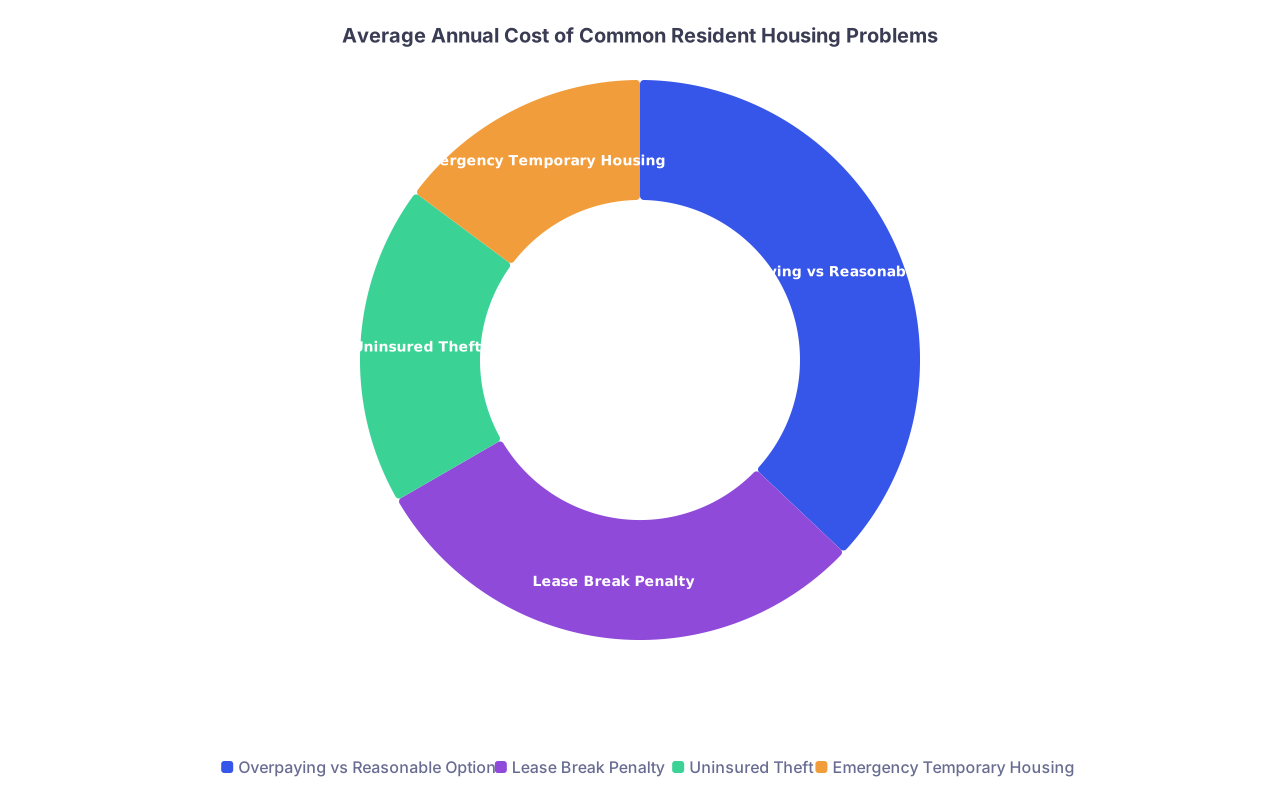
| Category | Value |
|---|---|
| Overpaying vs Reasonable Option | 3000 |
| Lease Break Penalty | 2400 |
| Uninsured Theft | 1500 |
| Emergency Temporary Housing | 1200 |
Quick Reality Check: Walking Through a Real Example
Let’s take a hypothetical internal medicine intern in Chicago at a major academic center.
Bad path:
- Matches, joins co‑intern GroupMe.
- Sees multiple people say, “We all got places at Lakeside Lofts, it’s mostly residents, 8‑minute Uber to hospital!”
- Panic sets in. Leasing office says, “We only have three 1‑beds left.”
- Signs 12‑month lease for $2,350 + $200 parking + $60 fees = $2,610/month.
- Commute in traffic turns out to be 25–35 minutes most days.
- Streets around parking garage have frequent break‑ins. Leaves shift at 11 p.m. feeling anxious walking alone.
Better path:
- Waits 7–10 days post‑Match.
- Talks to 3 current residents:
- One at fancy near‑hospital tower (regrets cost)
- One in mid‑range building 12 minutes away (happy balance)
- One in older building 15 minutes away (cheapest, still safe)
- Runs budget, realizes $2,600/month housing equals financial misery.
- Chooses mid‑range option: $1,650 + $125 parking + $50 utilities = $1,825.
- Commute is 12–18 minutes real‑time, safe area, modest but comfortable building.
Over a year, that difference is literally a couple thousand dollars of breathing room and a much lower stress baseline. Same residency. Entirely different quality of daily life because of one decision.

Last Word: Set Yourself Up, Don’t Box Yourself In
Three things to walk away with:
- Do not let post‑Match panic push you into a fast, blind lease. Talk to current residents, understand your schedule, and test real commute times before signing anything.
- Read the lease like a grown adult, not a rushed student. Watch early termination, sublet rules, fees, and total cost (rent + parking + utilities), not just the headline number.
- Prioritize sane basics—safety, reasonable commute, and affordability—over shiny amenities and FOMO. You’re building a life you can sustain, not curating a brochure.
Residency is hard enough. Your housing shouldn’t make it harder.