The secret nobody tells you: Match Day is not just about judging you. It’s also the day chairs quietly judge their own program. Hard.
You see your result. They see a diagnostic report on their reputation, recruiting, and internal politics—all condensed into one spreadsheet.
Let me walk you through what actually happens behind those closed doors, and how chairpersons read the Match like a lab value panel on the health of their department.
What Match Day really looks like from the chair’s side
Picture this. It’s 6:55 AM. The NRMP files just dropped. The program coordinator has already printed three versions of the match list. The PD (program director) is in the chair’s office. Door closed. Coffee on the table. The chair opens the email, scrolls, and in five seconds knows if they’re happy or pissed.
You think they’re asking, “Did we fill?”
They’re not. That’s step zero.
They’re asking:
- Who did we fill with?
- Did we get any of our top people?
- Did we get “our own” med students?
- What does this say about our brand this year?
Most of you never see this part. You see the balloons and T-shirts. The chair sees the failure analysis.
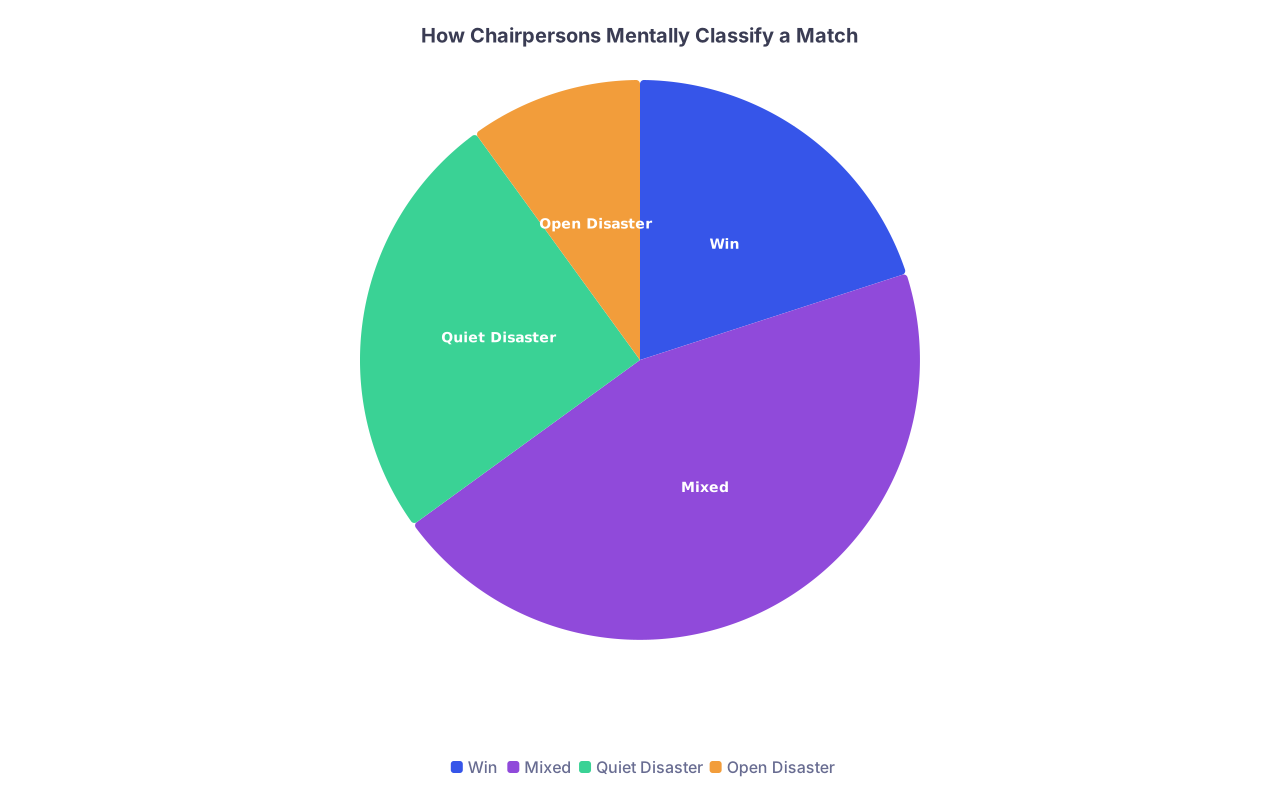
| Category | Value |
|---|---|
| Win | 20 |
| Mixed | 45 |
| Quiet Disaster | 25 |
| Open Disaster | 10 |
That “Quiet Disaster” slice? That’s what you never hear about. Outwardly the program “filled all positions.” Internally, everyone knows they got hammered.
Step 1: The instant scoreboard – fill status and SOAP signal
The very first metric is brutally simple: did they fill in the main match or not?
If a program goes into SOAP, every chair in that specialty knows by noon. There’s no hiding. The NRMP doesn’t publish the SOAP list publicly, but within 24 hours there’s a specialty-wide group text of PDs and chairs who know exactly which programs didn’t fill.
Here’s how chairs interpret it.
Filled in the main match
If they fill every categorical position in the main match, this is baseline survival. Not success. Survival. The way chairs actually break this down in their heads:
- Filled + strong rank positions = “We’re fine, maybe even trending up”
- Filled + mostly lower-ranked = “We’re still standing but leaking prestige”
- Filled + almost all IMGs / prelims flipping to categorical = “We’re in trouble but we temporarily patched the hole”
They’ll never say this on a town hall. In the privacy of leadership meetings? I’ve heard exact phrases like, “We’re barely hanging on to being mid-tier.”
Didn’t fill and went into SOAP
Different level.
Most chairs have a mental tier list of programs in their specialty. If they land in SOAP, in that private hierarchy, they just dropped a tier. And they know it.
What they really look at is how many spots and what kind:
- 1 empty spot = bad year, but recoverable narrative
- 2–3 = “What changed? What did we screw up?”
- 4+ = “Our reputation just took a public beating”
And yes, they absolutely connect this to specific factors: did we lose key faculty? Go malignant? Scorched someone on SDN? Collapse conference quality? Residents leave?
SOAP becomes a mirror they can’t avoid.
Step 2: The rank list reality check – where did we actually land?
Once the chair knows they filled, the next line they look at is the rank list summary. Every PD gets a standard NRMP report that shows how far down the rank list they went to fill each slot.
Chairs basically see three patterns.
| Outcome Pattern | Chairperson’s Mental Interpretation |
|---|---|
| Mostly top 1–5 positions filled | Strong brand year, we are a destination |
| Regularly filling at 15–30+ | Solid but not preferred, we’re a backup |
| Deep in the list / scrambled | We’re losing the market, something’s wrong |
Now here’s the part nobody tells you: they don’t care only about how high the matched applicants were ranked. They care about which segments hit.
They want to see:
- Did we match any of our top 5-10 “must-get” recruits?
- Did we land at least a few from “hard-to-get” schools (Harvard, UCSF, Penn, etc.)?
- Did we get diversity in geography, gender, and background consistent with what they’ve been selling the Dean?
If they missed every single one of their “priority” recruits—those people they rolled out the red carpet for—that stings. You will hear this in hallway comments like, “We spent three dinners on that guy from Hopkins and he went to our rival across town.”
No one says that to residents. They say it to each other in the workroom, off-mic.
Step 3: The prestige scan – where did our accepted applicants choose instead?
This is the genuinely painful part for chairs.
When a PD shows the chair the “top 10 who got away” list, that’s where the judgment hits. Because every lost recruit tells them exactly where the market places their program.
I’ve seen chairs literally draw an arrow on a printout: our program → where the applicant chose. And they rank the pain:
- Chose a clear top-5 national program over us? Fine. “We were in the right league.”
- Chose a comparable program across town? That’s political and reputational. Very concerning.
- Chose what they view as a “weaker” program or a newer, community-based program? That’s when chairs start talking about “our brand is slipping.”
They are not thinking in the polite “every program is great in its own way” language that gets used publicly. Behind the scenes, there’s a very real, very blunt hierarchy.
I’ve heard lines like:
“She turned us down for there? What are we not seeing?”
Or more cutting: “If they’re picking that place over us, our messaging is broken, or our residents are badmouthing us.”
Match Day tells them where the invisible reputational gravity is pulling.
Step 4: Reading the class composition – fit, risk, and politics
Once the initial numbers sink in, chairs look at the incoming class as a whole. Not just “Great, we have 10 humans.” They see risk clusters.
They notice:
- How many IMGs vs US MD vs DO
- How many couples match pairs (logistical risk)
- How many lower-board-score “projects” they took this year
- How many “legacy” or internal pipeline people vs total outsiders
There’s always a quiet balance between what the PD wants and what the chair expects. Attend carefully to this: chairs care about risk exposure.
Conversations I’ve actually heard:
- “We’ve got too many academic lightweights this year, this is going to drag our in-training scores.”
- “We leaned too heavily into Step-2 rescue kids; this is going to be a remediation-heavy class.”
- “We have almost all local people. That’s going to make us look insular on the next site visit.”
They also pay attention to political optics:
- Did they match UIM (underrepresented in medicine) candidates in line with institutional goals?
- Did the department snag any “star” candidates that they can parade to the Dean as proof of influence?
- Did they secure any strong research candidates for future fellowship placement numbers?
Match Day is partly about next July. But for chairs, it’s also about their next ACGME site visit, their fellowship match downstream, and the Dean’s future opinion of their department.
Step 5: Internal vs external – what did our med students tell us?
This one stings more than you think.
Chairs look very closely at: did their own medical school graduates rank and match at their home program?
If a home program:
- Gets none of their top home students
- Or gets only the ones who were struggling elsewhere
- Or watches their “stars” go to direct competitors
…the chair sees that as a referendum on the internal perception of the program.
I’ve watched chairs say, almost word for word:
- “If our own students won’t stay, they see something we’re not fixing.”
- “We’re losing the room. Our third- and fourth-years don’t buy our narrative.”
On the flip side, when strong home students match there voluntarily, that gets interpreted as, “We still have internal loyalty and credibility.”
So when you as a student match somewhere else, yes, your home chair might congratulate you warmly in public—and then use your decision as data about how their program ranks in your eyes.
They keep score.
Step 6: Comparing up and down – watching rivals and neighbors
You know how applicants compare programs on Reddit and SDN? Chairs do the same thing—just with more accurate information and sharper knives.
Match Day, PDs and chairs are texting each other, especially in the same city/region. They quietly gather:
- Which programs in the city went unfilled
- Which ones landed the “big name” applicants everyone interviewed
- Which fellowships attracted which kinds of candidates
There’s a mental leaderboard running every year. If a rival that has historically been “equal” starts consistently winning top recruits over them, chairs notice. And they don’t forget.
I’ve heard:
“They beat us for both of those Stanford kids. That’s twice in three years. They’re out-recruiting us.”
Sometimes this triggers real changes: upgraded facilities, refreshed curriculum, ED call coverage adjustments, a “fix-the-schedule” task force.
Sometimes it just triggers resentment. And denial.
But the comparison is always there.
Step 7: Chair vs PD – blame, credit, and what “success” really means
Here’s the part most residents never see: Match Day is also a performance review of the PD in the chair’s mind.
A “good” match buys the PD political capital:
- Easier time getting approval for extra positions
- Support for new rotations or global health tracks
- Leeway on resident-driven projects
A “bad” match, especially repeated, puts the PD under quiet scrutiny. You won’t see it documented—but you’ll feel the tension if you’re around long enough.
Typical thought process of a chair:
- Two strong match cycles in a row = “Our PD is working. Don’t micromanage.”
- Mediocre classes but solid fill = “Our PD is safe but not untouchable.”
- SOAP once = “What happened this year?”
- SOAP twice, or deep rank list every year = “We need new leadership or a total strategy shift.”
Sometimes the PD blames “the market” or “changing Step 1 scoring.” Chairs nod. But inside, they’re comparing: other similar programs still filled fine.
Match Day either strengthens or erodes the PD–chair relationship.
What this means for you as an applicant
You’re probably wondering, “So why should I care how chairs interpret Match Day?”
Because once you understand their metrics, you can read programs more accurately. A few consequences your advisors rarely spell out:
Programs that just went through SOAP are usually on edge.
Leadership is defensive, hyper-focused on optics, and suddenly “listening” to residents. This can be good (you’ll get improvements) or toxic (performative fixes, blame culture).If you’re a “rescue” candidate they took late, they already see you as high-risk or proof of desperation.
Not fair, but real. You need to over-deliver early to reset that perception.Programs that just had a “dream” match class may coast.
Leadership feels validated. They’re less likely to overhaul schedules or address cultural issues residents complain about, because “look, the match shows we’re doing great.”Home program behavior after Match Day is revealing.
If their best students all left and suddenly leadership is “rebranding,” that tells you they took a reputational hit internally and know it.Where your co-interns come from shapes your training environment.
A class packed with low-board-score, last-minute SOAP interns is very different from a class of heavily recruited, high-achieving applicants. Chairs know that. You should too.
How chairs use Match Day to justify changes
The last piece: Match Day data becomes ammunition.
When chairs want something—from the Dean, from GME, from the hospital—they weaponize the match results.
Common plays:
- “We lost X top-tier candidates to newer programs with better duty hours. We need to fix our schedule.”
- “We fell in the match because we cannot compete on salary and benefits. Here’s the list of where we lost people.”
- “Our diversity numbers this year are unacceptable compared to peer programs. We need funded positions for pipeline and mentorship.”
Conversely, if they do not want to change, they hide behind the match:
- “Residents are unhappy about call, but our match is strong. Clearly the market doesn’t see this as a problem.”
- “We continue to recruit top-tier candidates, so any issues are isolated and not systemic.”
You, as a resident or applicant, are rarely shown how your presence in that class becomes a bullet point in someone’s PowerPoint to the Dean.
But it does.
FAQ: What you actually want to know
1. If a program just went into SOAP, should I avoid applying there next year?
Not automatically. But be cautious. Ask blunt questions on interview day: “I saw the program did not fill last year—what changed since then?” Good programs will own it and show you clear fixes (new PD, new schedule, improved support). Bad programs will hand-wave, blame “the market,” or get defensive. That’s your signal.
2. Does being ranked low on a list make a chair see me as “lesser”?
Some will say no. Many actually do see a difference. If you were ranked #3, they view you as “highly desired.” If you came in at #45 because everyone ahead went elsewhere, they may subconsciously treat you as more replaceable or higher risk. You counter that by performing well early and making it impossible to maintain that bias.
3. Do chairs really track which programs their applicants rejected them for?
Yes. Religiously. PDs keep internal files: applied → interviewed → ranked → matched elsewhere. Chairs look at that pattern yearly. Those “lost to” programs form a gray map of where their prestige sits. It’s not always written, but it’s absolutely discussed.
4. As a home student, will my chair take it personally if I don’t rank my home program first?
Some will. They won’t tell you that directly, but they may treat it as feedback about their program. Smart chairs are happy when their students match well anywhere—that’s department prestige. More insecure chairs get offended when their own students leave. Don’t let that drive your rank list. Just be polite and factual about your goals.
5. How can I tell if a program is secretly unhappy with their recent match results?
Watch the behavior after Match Day. Are they suddenly pushing hard on recruitment branding, overhauling rotations, or aggressively surveying resident satisfaction? That often follows a bruising match. Also, listen to residents: if they say, “Leadership has been weirdly on edge since last year’s match,” that’s your answer. The official line will always be “We’re thrilled with our incoming class.” Read past the script.
Key takeaways:
Match Day is not just your verdict—it’s the chair’s report card. They read fill status, rank depth, who they lost to, and class composition as blunt evidence of their program’s health. And they quietly use that data to justify changes, protect the status quo, or blame leadership. If you understand their side of Match Day, you can interpret programs more accurately—and protect yourself from the spin.