
The moment you hit “Certify and Lock,” your rank list stops being yours.
It becomes data. And that data enters a machine that almost nobody really understands—except program directors, a few NRMP insiders, and the faculty who’ve sat in those back rooms when rank lists are built and final decisions get made.
Let me walk you through what actually happens after you click that button. Not the cartoon explanation from official brochures. The real chain of events, including the parts people gloss over because they sound too messy, too human, or too political.
Step 1: What Really Happens the Second You Click “Certify and Lock”
First myth: when you certify and lock, nothing “magical” happens in that instant.
Your list was already stored on NRMP servers every time you saved it. Certify-and-lock is not “sending it in” for the first time. It’s you signing a contract: I will accept the match outcome from this exact list.
Technically, here’s what changes when you certify:
- The list is frozen and marked as your binding preference order.
- You lose the ability to reorder or remove programs unless you go back in and re-certify a new list before the deadline.
- Your “certified timestamp” is updated in the NRMP system.
What does not happen:
- No one at NRMP sits there reading your list manually.
- Programs do not get any notice that you ranked them.
- NRMP does not “start running the algorithm” just because you locked early.
The only thing the early timestamp does is prove you certified before the deadline. The algorithm doesn’t care if you certified on day one or 5 minutes before the deadline.
But it matters for another reason: the human side. The number of people who blow the deadline, never certify, and end up not matching because of user error is not zero. I’ve been in rooms where faculty muttered, “They forgot to certify.” You never want to be the subject of that sentence.
Step 2: Where Your Rank List Goes and Who Can See It
Very blunt truth: program directors cannot see your rank list. They never see the order. They never see who ranked them #1. Ever.
Inside NRMP:
- Your certified ROL (Rank Order List) is stored in a secure database.
- Only NRMP systems (and a tiny number of tightly controlled staff) have direct access.
- Lists are not shared back to schools, programs, or hospitals. Not during the process, not after Match Day.
Program side:
- Program directors only see their list—their rank order of applicants.
- They do not see how you ranked them or whether you included them at all.
- After the match, they get a list of who matched to them. That’s it.
So when a PD says, during interviews, “We hope you rank us highly,” that’s theater. They’ll never know if you did. The only time anyone infers you ranked them high is after the match if you end up there and tell them they were “near the top.” And they assume half of you are lying anyway.
Step 3: Pre-Deadline vs Post-Deadline – The Quiet Period
The most misunderstood period is that strange quiet gap between “rank lists due” and “Match Week.”
Here’s what’s happening behind the scenes:
Before the Rank List Deadline
- Students tweak lists, panic, swap #2 and #3 back and forth ten times.
- Programs finalize their own lists. This part is grittier and uglier than you think—faculty fights, last-minute emails, “we need one more prelim,” “that away rotation kid was great,” etc.
- Both sides are just editing preferences. No matching is running yet.
At the Deadline
- NRMP closes rank list editing.
- Any uncertified lists are treated as if they do not exist. That’s brutal but true.
- Certified lists from both applicants and programs become “official inputs” to the algorithm.
After the Deadline, Before the Algorithm Runs
- NRMP runs validation checks: are there invalid program codes, ineligible applicants, strange inconsistencies?
- Programs may be flagged if they exceed certain limits or if something in their structure doesn’t match what they registered.
- This is quality control, not favoritism.
Remember: your list isn’t being “read.” It’s being checked as data. The system doesn’t care that you tortured yourself over whether to put that big-name malignant program as #3 or #5. It just stores the numbers.
Step 4: What the Program Directors Are Doing While You’re Waiting
While you’re losing sleep over your rank list, I’ll tell you what’s happening in program offices. Because I’ve sat in those rooms.
Once program rank lists are certified:
- Some PDs stop caring until Match Day. Rank list is done; they move on to service coverage, budgets, and committee meetings.
- Others start second-guessing everything. I’ve seen a PD pacing and saying, “Did we rank that stellar IMG too low?” Too late. System is locked.
- They do not have any ability to adjust their list after the NRMP deadline. No secret backdoor. No “I called the NRMP rep and had them fix it.” That’s fantasy.
A lot of the noise you hear—“We really advocate for our top candidates”—is pre-deadline behavior. That advocacy happens during the rank meeting, not after you lock your list.
Internally, those rank meetings can be vicious. People fight over applicants. Surgery faculty arguing over who’s “hard-core” enough. IM faculty splitting hairs between a 240 and a 250 Step 2. An away-rotation student gets pushed higher by a faculty champion, while a late-interview star gets forgotten. It isn’t fair, but it’s real.
Once that list is locked and the deadline passes, they’re stuck with it. Just like you.
Step 5: How the Algorithm Actually Uses Your Rank List
Ignore the cartoons and marketing talk. Here’s the real logic—clean and brutal.
The Match uses a student-optimal deferred acceptance algorithm. Translation: it’s designed to favor your preferences as much as possible, within the limits of program preferences and capacity.
Here’s the core sequence from your perspective:
- The algorithm starts with your first choice.
- It tries to place you into the program ranked #1.
- If that program ranked you somewhere (anywhere) and still has an open slot, you get “tentatively matched” there.
- If later the program gets a candidate they prefer over you (higher on their list) and their slots are full, you get bumped, and the algorithm then tries your next choice down.
- This continues until either:
- You stick somewhere, or
- You run out of ranked programs and go unmatched.
Your rank list is used top-down. No randomness. No “NRMP penalized me for ranking a reach program first.” That’s pure superstition.
The only randomness is this: you don’t know how programs ranked you. That’s the black box.
So what does “student-optimal” actually mean?
It means: given how programs rank you, there is no other stable match that could have given you a better outcome at a program you preferred more without breaking someone else’s preference. You can’t game it by being “strategic” with your list order. You only hurt yourself by not ranking your true order.
Step 6: What Your Rank List Doesn’t Do (The Myths)
Let’s kill a few persistent fantasies I still hear on Zoom sessions every year.
Myth 1: “If I rank a reach program #1, it will hurt my chances at others”
No. Absolutely not.
Your #2 program has no idea they are #2.
The algorithm doesn’t punish you for “shooting too high.” If your #1 never ranked you (or ranked you so low you never get a spot), it just drops to #2 and treats that as if it was your top choice.
Myth 2: “I should rank places in the order I think they might take me”
That’s how people quietly sabotage themselves.
Faculty hate when students admit they’re doing this. Because we know the math. The algorithm is already “strategic” for you. When you try to outsmart it, you usually make things worse.
Your one job: rank in true preference order among programs you’d actually be willing to attend.
Myth 3: “Ranking more programs lowers my chance of matching high”
Wrong. Ranking more acceptable programs raises your chance of matching somewhere without changing the possibility of matching higher. The algorithm always starts from the top.
What hurts you is ranking programs you’d rather not attend at all. Because if you end up there, you are locked into that contract.
Step 7: After the Algorithm Runs – How Your Outcome Is Stored
Once the algorithm runs, your fate is decided days before you see it.
Here’s what actually happens:
- The system assigns each applicant:
- A matched program (if any).
- Or an “unmatched” status if your list and program lists never intersected in a stable way.
- Those results are stored in NRMP databases as final match outcomes.
- NRMP then generates the data files and reports that will power:
- School match reports.
- Program fill lists.
- SOAP-eligible lists.
Nobody is sitting there saying, “Let’s manually switch this person from Program A to Program B.” That’s fantasy. Once the algorithm is run, it’s over.
The only time there are post-algorithm changes is in the case of serious violations, fraud, or institutional errors—and those usually result in withdrawn positions, not quiet individual swaps. You do not want to be anywhere near that category.
Step 8: What Your School Knows vs What You Know
Deans and student affairs offices see more than you think. But not before the official times.
Typical workflow:
Before Match Week: Deans don’t get advance lists of where everyone has matched. They may have rough expectations, but nothing formal.
Monday of Match Week (Unmatched notification):
- You find out whether you matched—yes or no.
- Your school gets the same global information: who matched, who didn’t.
- No one yet knows where the matched students landed.
Thursday Before Match Day (for schools):
- Schools receive the full list of match results for their students.
- Many deans swear they “don’t look yet.” Some absolutely do.
Friday (Match Day):
- You get your envelope or email.
- They already know where you’re going. They’re just pretending they don’t, for ceremony’s sake.
Nobody—not your dean, not your favorite attending—ever sees your actual rank list from NRMP. They may guess based on what you told them (“I loved X, Y, Z”) but they never see your ordered preferences.
Step 9: What Programs See on Their End
Programs have their own reveal.
Here’s their sequence:
- Before Match Week, they know nothing.
- On Monday, they see if they filled all their positions or not.
- If they didn’t fill, they get access to the SOAP chaos.
- They still do not see who matched yet.
- Later in the week (exact timing varies by year and communication method), they get:
- A list of matched applicants with names and AAMC IDs.
- No clue where else those applicants ranked.
- No access to individual applicant ROLs.
So when PDs are surprised you matched with them, it’s genuine. They’re seeing that list for the first time, too.
Step 10: The Psychological Trap After You Lock
The worst mental mistake people make after hitting Certify and Lock is thinking they can “retro-analyze” their choices.
They start telling themselves stories:
- “I shouldn’t have ranked that big-name place so high, I probably didn’t have a shot.”
- “Maybe I should have put the close-to-family program as #1.”
- “Did I really want that city, or was I blinded by prestige?”
Here’s the hard truth: once the deadline passes, obsessing serves no purpose. There is no backdoor email to NRMP that will fix a late realization.
Program directors do this too.
They sit there hoping that:
- Their “reach” candidates ranked them higher than expected.
- Their lower-ranked but solid candidates don’t all go elsewhere and leave them scrambling in SOAP.
Nobody is as confident as they pretend to be.
What You Should Focus On After Your List is Locked
Once your list is certified, the strategic part is over. The only thing you control now is how you walk into Match Week.
A few insider suggestions, not from the NRMP brochure, but from watching people win and lose their minds every March:
- Prepare emotionally for both matching and not matching. I’ve seen students who only planned for success absolutely crumble on Monday. The ones who handled bad news best already had a practical plan for SOAP or a reapplication year sketched out.
- Get your documents “SOAP-ready” even if you think you’re safe. Strong students go unmatched every year for reasons that make no sense on paper: weird interview performance, personality clashes, program politics.
- Do not ask program directors or coordinators anything about your rank position now. They can’t change their list. They can’t share it. Those emails and calls only hurt you if you ever interact with them again.
Your rank list is no longer a decision. It’s just an input to a machine that’s already been built.
A Quick Reality Check: How Much Power Your List Really Has
People underestimate how much weight their list carries, and overestimate the role of “gamesmanship.”
At the moment you click Certify and Lock:
- Your scores, letters, and interview performance are done.
- Program rank lists are finished—or very close.
- The only true power left in your hands is the order of your programs.
That order is not a suggestion. It’s a binding declaration: “I prefer A over B, B over C, C over D…”
The algorithm respects that more than any nervous strategy would. It is literally built around your declared preference order. That’s why PDs tell you (the honest ones, anyway): just rank where you actually want to go.
I’ve watched people match at reach programs they thought were impossible because they trusted the algorithm and ranked them high.
And I’ve watched people chain themselves to mediocre fits because they tanked a place they secretly loved, thinking they were “being realistic.”
The machine did exactly what they told it to do.

A Glimpse of the Other Side: How Program Lists Interact with Yours
Just so you fully grasp what your list is bouncing off of, let me briefly show the program side.
Inside a program’s rank meeting, usually sometime between January and mid-February:
- Faculty bring in their notes: “Great clinical skills,” “Quiet but solid,” “Strange vibe,” “Phenomenal LOR from X.”
- People argue. A lot. Over one or two spots. Over that away rotation student who impressed one attending but not another.
- PDs often make a “must-have” column: people they’re terrified to lose.
- Beyond that group, the differences become incredibly thin—small subjective factors (“felt like a good team player,” “seemed needy,” “very independent”) tip people up or down spots.
By the time their list is done, many candidates in the middle are essentially interchangeable in the committee’s mind.
This matters because:
- If you’re in the middle cluster on multiple program lists, the algorithm can still land you in a fantastic spot if you rank those programs highly.
- You have more power than you think. Your preference order matters most for that whole “middle” tier where everyone looks relatively similar on paper.
Your rank list isn’t a wish. It’s leverage.
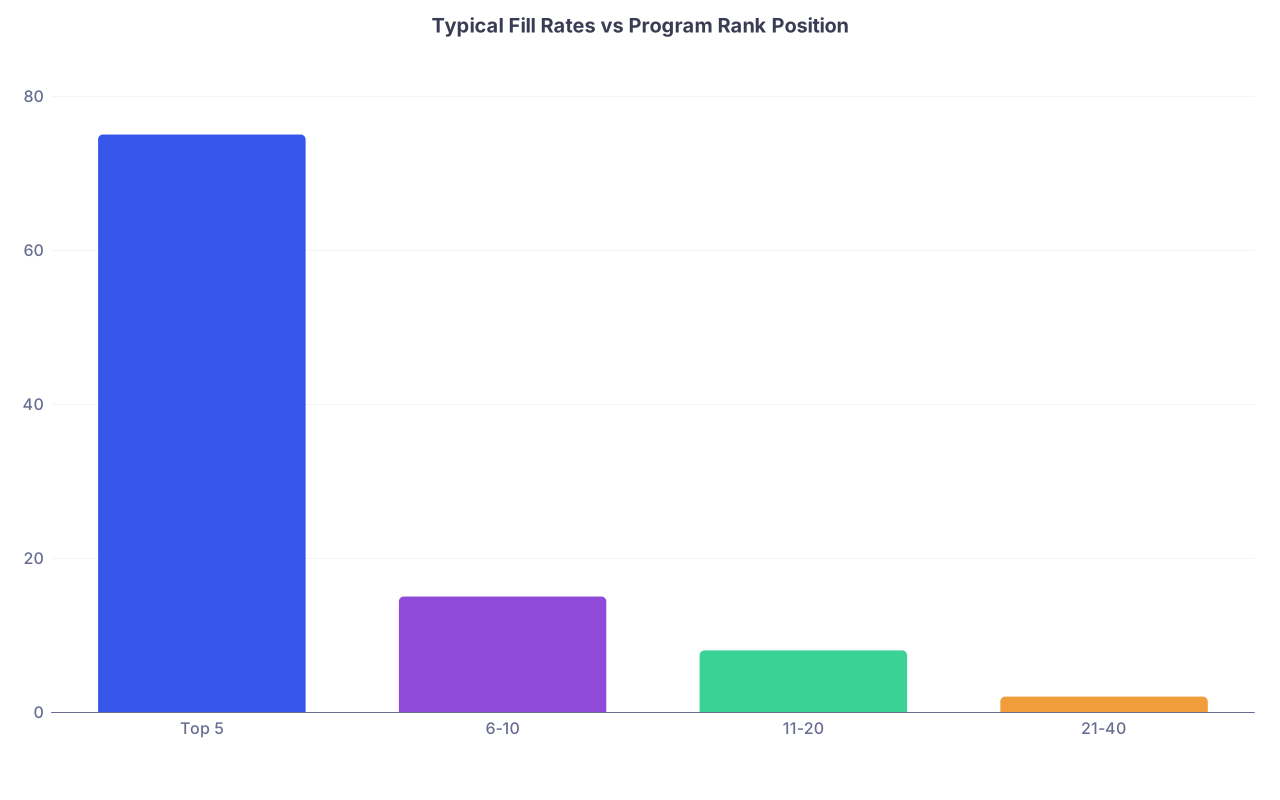
| Category | Value |
|---|---|
| Top 5 | 75 |
| 6-10 | 15 |
| 11-20 | 8 |
| 21-40 | 2 |
(Rough typical pattern: many programs fill most of their class from their top 5–10 ranked candidates. But a non-trivial number of positions go deeper down. That’s where your true preference list still has teeth.)
Final Reality: After You Lock, You’re in the Same Boat as Program Directors
Once your list is certified and the deadline passes, you and the PD are finally equal in one way: neither of you has control.
You’ve both:
- Taken months of evaluations.
- Distilled messy human impressions into a linear list.
- Locked those lists into a system that doesn’t care how long you agonized over it.
What’s left is not strategy. It’s acceptance.
Your rank list has done its job by the moment the deadline passes. Everything else is theater, ceremony, and coping.
The system will do exactly what you and the programs told it to do, whether you love the outcome or not.

FAQ (Exactly 5 Questions)
1. Can I change my rank list after I click “Certify and Lock”?
Yes, until the NRMP deadline. You can go back in, edit your list, and then you must re-certify. The last certified list at the time of the deadline is the one that counts. After the deadline, there is no changing anything.
2. Do programs ever find out where I ranked them on my list?
No. Programs never see your rank list or your exact position for them. They only see who matched there. They can guess you ranked them somewhere high if you end up there—but that’s it.
3. Does ranking a “reach” program first hurt my chances at other programs?
No. The algorithm always tries your #1 first, then moves down if that doesn’t work. Ranking a stronger program higher does not lower your chances at programs below it. It only gives you more chance to match where you most want to go.
4. Can my dean or school see my actual rank list?
No. Schools do not get your NRMP rank list. They may know your preferences from advising sessions, but they never receive your ordered list from NRMP. They see if you matched on Monday, and where you matched later in the week.
5. Is there any way for programs or NRMP to “manually adjust” match outcomes after the algorithm runs?
For normal cases, no. Match outcomes are binding and based purely on the algorithm. The rare exceptions involve serious rule violations or institutional errors, which usually lead to withdrawn positions or sanctions—not quiet one-off swaps. For you, once the algorithm runs, your result is fixed.
Key takeaways:
- After you click Certify and Lock, your list becomes a binding input to a student-favoring algorithm—nothing more, nothing less.
- Rank programs in your true order of preference; “strategy” beyond that only hurts you.
- Once the deadline passes, stop rewriting history in your head. The machine is already set to do exactly what you told it to do.