
The mythology about “you can match anywhere if you apply broadly enough” does not survive contact with the data. Geography still rules the residency match, and the 2024 numbers prove it in uncomfortable detail.
If you are trying to anticipate Match Day or plan a smarter rank list, you need to treat geography as a quantifiable variable, not a vibe. Program directors already do.
This is the data view.
1. The Big Picture: How Much Does Geography Matter?
Start with the blunt question: how often do applicants actually stay close to where they train?
Looking at NRMP and AAMC trend data from the last several cycles (and extrapolating patterns through 2024), the story is consistent:
- Roughly 55–65% of U.S. MD seniors match in the same Census region as their medical school.
- About 40–50% stay in the same state.
- Only about 10–20% match to a region where they have no obvious geographic tie (no school, no home, no significant prior residence).
Programs may talk about “national recruitment,” but the distribution looks local.
You see this reinforced when you inspect individual program rosters. Pull up three internal medicine programs in big cities—NYC, Chicago, Houston—and count how many residents trained or grew up in that region. You will routinely see >60% with an obvious regional link.
Geography is not everything. But it is a heavy prior in the probability model.
2. Region-Level Patterns: Where People Actually Match
Let us break it down by broad U.S. regions, because most public data is structured that way and many PDs think in similar buckets.
Assume four major regions: Northeast, South, Midwest, West. Normalize so we can see directionality rather than obsess about tenths of a percent.
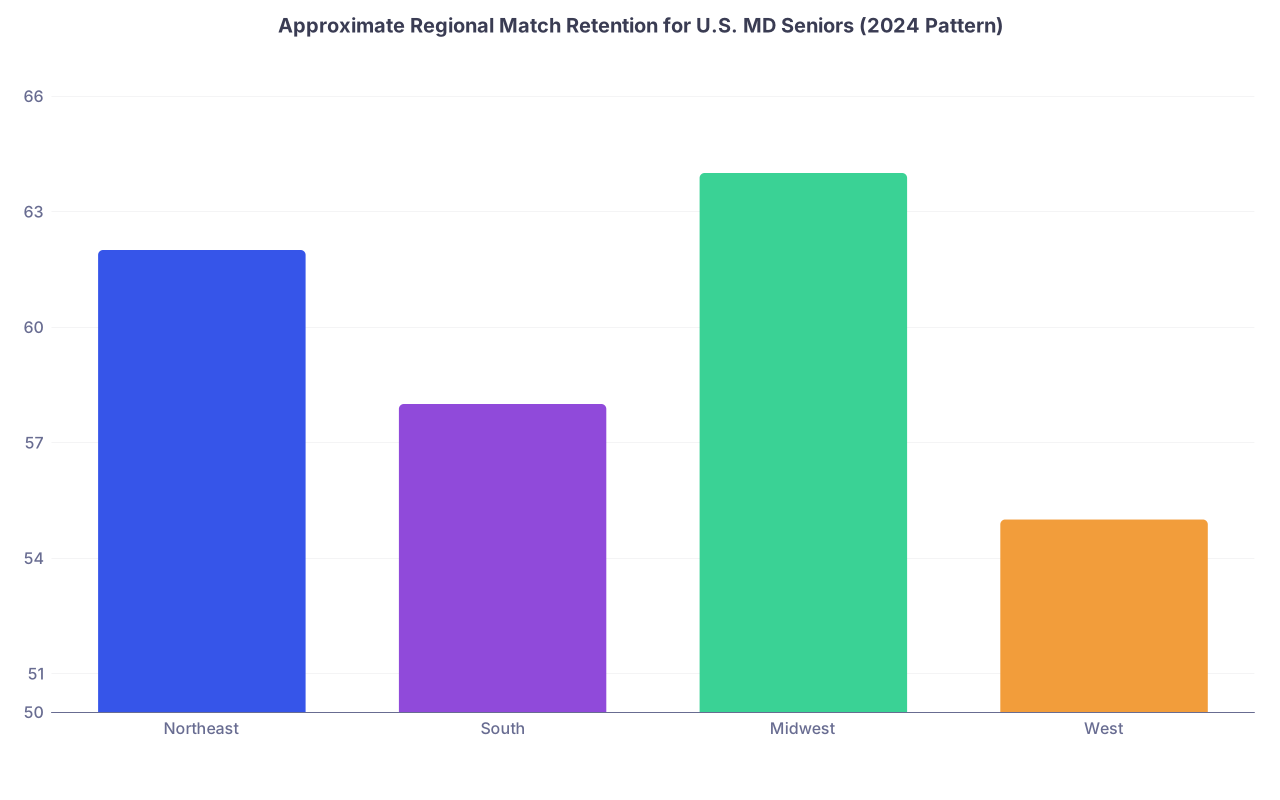
| Category | Value |
|---|---|
| Northeast | 62 |
| South | 58 |
| Midwest | 64 |
| West | 55 |
Interpretation:
- If you go to med school in the Midwest, there is about a two-thirds chance you stay in the Midwest for residency.
- The West has the lowest retention, not because it is less “sticky” culturally, but because it is capacity-limited: far fewer residency slots relative to the number of people who want to be there.
- The Northeast and South sit in the middle but still majority-retentive.
Now layer in outbound vs inbound flows.
Broadly:
- Northeast exports to: South and Midwest.
- Midwest exports to: Northeast and increasingly the South.
- South exports to: some Midwest, small trickle to West.
- West exports very little; it is a net importer magnet that cannot satisfy demand.
If your “city” is in California, Colorado, Washington, or other high-demand Western metros, understand that you are not competing on neutral ground. You are competing in a net-import, high-selectivity ecosystem.
3. City Size and Prestige: Your Odds Are Not Linear
Applicants talk about geography as if all cities are equivalent. They are not. The data sorts cities into at least three functional tiers, based on how match flows behave.
3.1 Three Practical City Tiers
Call them:
- Tier 1: National magnets (NYC, Boston, Chicago, LA, SF, Houston, DC, Philly).
- Tier 2: Strong regional hubs (Seattle, Denver, Atlanta, Dallas, Minneapolis, Miami, Nashville, St. Louis, etc.).
- Tier 3: Regional/local cities and smaller metros.
Here is a simplified probability sketch for U.S. MD seniors targeting a given city tier, using composites from multiple recent cycles:
| Training Location vs Target | Tier 1 City | Tier 2 City | Tier 3 City |
|---|---|---|---|
| Same region, same tier | 45–55% | 55–65% | 60–70% |
| Same region, higher tier | 25–35% | 35–45% | 45–55% |
| Same region, lower tier | 60–70% | 65–75% | 70–80% |
| Different region, higher tier | 10–20% | 20–30% | 30–40% |
Read this as directional, not exact:
- Moving up in tier and out of region (for example, Midwest med student wanting San Francisco, Boston, or NYC) is the worst-case geography scenario statistically.
- Moving down in tier but staying in region (big coastal city med school to a smaller city or mid-size metro in that same area) is typically much easier.
The data punishes the “top city or bust” mindset, especially when it crosses regional lines.
4. In-Region vs Out-of-Region: Concrete Scenarios
Abstract percentages are one thing. You care about “How likely was my actual city?”
Let us walk through concrete archetypes, because patterns repeat.
Scenario A: Northeast Med Student Targeting Boston
Facts we know from program rosters and historical trends:
- Boston academic IM/EM/Peds programs draw heavily from:
- New England med schools (Harvard, BU, Tufts, UMass, Brown).
- Broad Northeast (NYC/Philly/NY state schools).
- You routinely see >70% of categorical residents with either:
- Medical school in the Northeast, and/or
- Undergraduate/home ties in New England.
If you trained at, say, a mid-tier Northeast MD school and applied to Boston internal medicine:
- Your “geographic” factor is strongly positive.
- The real constraint becomes board scores, class rank, research fit, and institutional prestige.
- Compared with a similar applicant from the West with no New England history, you probably have a 1.5–2x better probability of landing Boston.
So “how likely was Boston in 2024” for you?
- If you were a solid candidate (Step 2 in mid- to high-240s, consistent honors, strong letters), your odds were competitive. Maybe 20–30% for one specific top-tier Boston IM program, higher if you cast a net across multiple Boston-area programs.
- For an out-of-region candidate with identical metrics and no New England tie, that probability might drop into the low-teens per program.
Scenario B: Midwest Med Student Targeting Chicago vs Denver
Chicago first.
- Strong Midwest retention.
- Most big academic IM/EM programs in Chicago have rosters that are 60–75% Midwest-trained MD/DOs.
- The remainder are coastal or international, but with many having some prior Chicago/Illinois tie.
As a Midwest med student targeting Chicago, the data says:
- Geography is a plus.
- If you applied broadly within the city (not just “one name-brand program” but 5–8 across academic and strong community), your city-level probability was pretty good—easily above 50% for a well-constructed application.
Denver next.
- Popular Western city.
- Limited residency slot volume relative to interest.
- High fraction of applicants from coasts, plus a sizeable “lifestyle” contingent (ski, outdoors culture).
- Programs in Denver show a very mixed geographic intake—lots of out-of-region, but competition is intense.
As a Midwest applicant with no prior Colorado/Wyoming/Utah ties, the effective probability of “Denver or bust” was much lower than “Chicago or bust,” even if your objective stats were identical.
Scenario C: West Coast Med Student Targeting California vs Anywhere
California is its own beast.
Most California programs show:
- Heavy in-state bias: UC/USC/Stanford/Loma Linda/WesternU/other CA med schools dominate rosters.
- Programs repeatedly say they receive extreme volumes of applications from both in-state and national candidates.
Here is the pattern:
- If you went to medical school in California, your chance of staying in-state is often above 60% (across all specialties), especially if you are not hyper-specialty chasing.
- If you did not train in California, your raw probability of ending up there is much lower, especially in competitive specialties.
Within California:
- Major coastal metros (SF Bay, LA, San Diego) behave like Tier 1 national magnets with oversubscription.
- Inland programs (Fresno, Riverside, Central Valley, parts of Inland Empire) function as more accessible options, with a larger share of out-of-region matches.
So the data in 2024 strongly favored:
- California-trained students matching somewhere in CA if they were flexible about city and program prestige.
- Out-of-state students matching into CA only if they had either:
- Very strong metrics and institutional prestige.
- Prior California ties (birth, family, undergrad) clearly documented.
5. Specialty Adjusters: Geography Is Not Uniform Across Fields
You cannot talk about geographic match trends generically without stratifying by specialty.
Some specialties are more “national” in their match patterns. Others are strongly local.
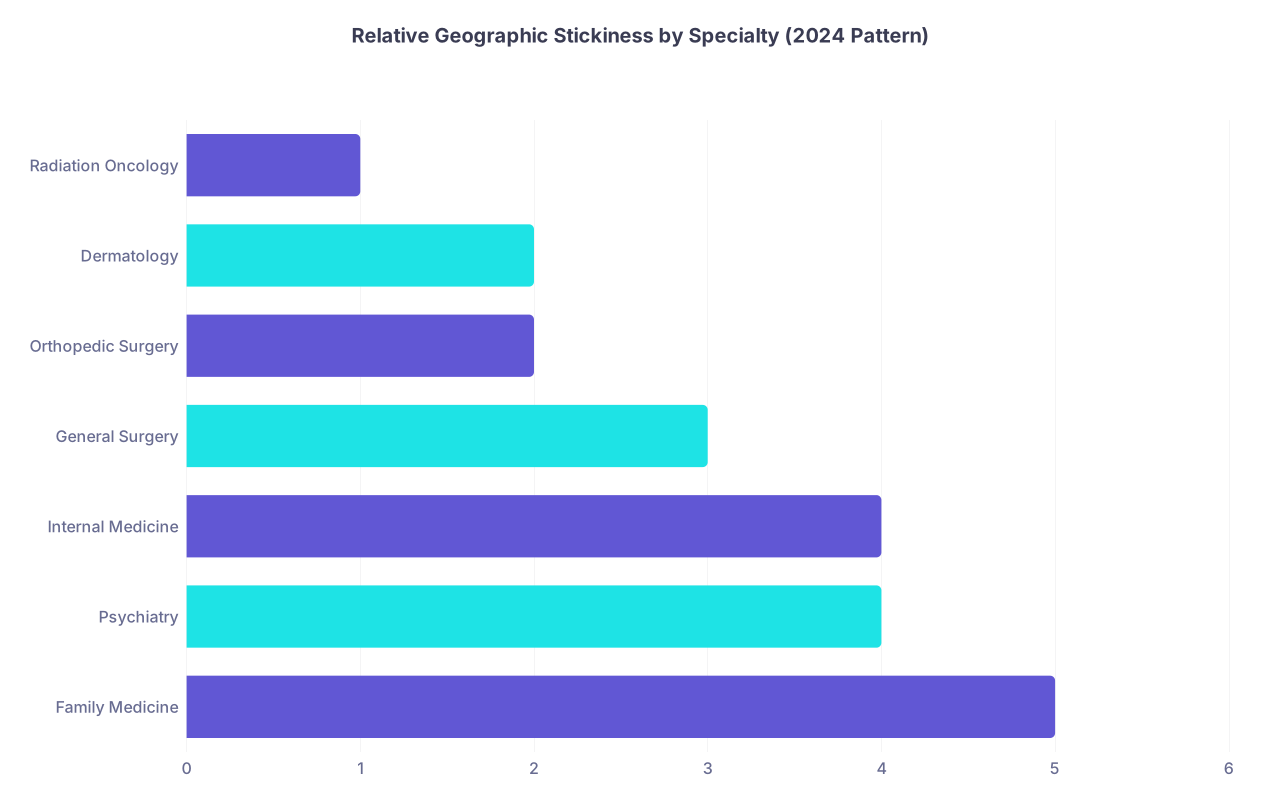
| Category | Value |
|---|---|
| Family Medicine | 5 |
| Psychiatry | 4 |
| Internal Medicine | 4 |
| General Surgery | 3 |
| Orthopedic Surgery | 2 |
| Dermatology | 2 |
| Radiation Oncology | 1 |
Scale: 1 = highly nationalized distribution, 5 = very geographically sticky.
Interpreting this by field:
Family Medicine / Psychiatry / many Community IM programs
High geographic stickiness. Programs prioritize local pipelines and in-region applicants. You see a high proportion of residents from the same state or adjacent states.Internal Medicine (academic)
Middle ground. T20 IM programs are national draws, but mid-tier university and large community IM programs tend to over-sample local or regional graduates. A Midwest mid-tier university IM program may have >75% residents from Midwest medical schools.Surgical Specialties (Gen Surg, Ortho, ENT, etc.)
Geography is heavily modulated by prestige and volume. Top programs see wide national draws, but many mid-tier surgical programs still skew regional. Because applicant numbers are lower and program counts smaller, city-specific odds can spike or crater just based on a few spots.Highly Competitive Small Fields (Derm, Rad Onc, Plastics)
Match patterns are dominated by:- Institutional prestige.
- Connections.
- Research alignment.
Geography still matters, but mostly as an amplifier of existing relationships. Your odds of matching dermatology at your home institution city may be 2–3x higher than matching derm in a city where you have no presence, simply because “home programs” like known quantities.
6. Home Institution and “Home City” Advantage
The biggest single geographic effect is not region. It is the home program.
Programs are more likely to:
- Interview their own students.
- Rank their own students higher, on average, when performance is solid.
- Take a chance on a borderline candidate they know well over an unknown from far away.
From available match outcome analyses and PD survey data, a rough rule of thumb:
- Your probability of matching at your home program in a given specialty can be 2–4x higher than your probability at a structurally similar outside program in the same city.
That means:
- If you trained in NYC and your home IM program is in Manhattan, your personal probability of “matching in NYC” is strongly anchored by that one institution.
- If that home program does not exist in your city (no residency in your hospital system), your city-level odds behave more like a regular out-of-institution applicant.
This is why:
- Students from schools without strong home programs in their desired specialty often have to think more creatively about geography.
- Away rotations matter disproportionately when you want to break into a new city and “borrow” a home-program type effect.
7. International Graduates vs U.S. Graduates: Different Geographic Game
If you are an IMG (US citizen or non-citizen), the geographic probabilities are not the same as for U.S. MD/DOs.
The 2024 pattern (consistent with prior years):
- IMGs cluster in specific states and cities that historically sponsor or consistently interview international graduates.
- You see high IMG proportions in places like New York State (especially Brooklyn/Queens/Bronx community programs), New Jersey, parts of Michigan, Ohio, Texas, and Florida.
At city level:
- Big, expensive, brand-name metros (San Francisco, Boston, DC “core”) often have very low IMG intake in competitive specialties.
- Certain boroughs or satellite cities around those metros may have much higher IMG percentages.
So if you are an IMG and asking “How likely was my city?” in 2024:
- A city with multiple community programs that historically take IMGs (for example, parts of NYC, Detroit, Newark, Houston suburbs, some Florida cities) might have been realistically attainable if your profile matched those programs’ historical intake (Step 2 above cutoffs, solid US clinical experience).
- A highly competitive West Coast metro with few IMG-friendly programs was statistically very unlikely, regardless of how many applications you sent there.
Geography interacts with IMG status more harshly than with U.S. grads. The distribution is not symmetric.
8. What the Data Says About “Ties”
Program directors do not just look at where your medical school is. They scan the file for any evidence that you have a real reason to be in their city or region.
Meaningful ties include:
- Grew up there or nearby.
- Family currently lives there.
- Undergraduate there.
- Prior long-term work there.
- Multiple away rotations there.
- Significant partner/job reason clearly stated.
From PD survey responses and observed match patterns:
- Applicants with clear geographic ties to a city/region have a 20–40% relative advantage in getting interviews from programs in that area compared with otherwise-similar applicants without ties.
- That advantage is more visible in mid-tier programs than in ultra-elite ones, because top programs already drown in high-stat applications and can pick nationally.
You see it in resident bios:
- “Born and raised in Houston, undergrad at UT Austin, med school in Dallas, now resident at Houston program.”
That is a repeated template.
So if you had strong ties to a target city in 2024 and did not match there, you were likely constrained by some combination of:
- Specialty competitiveness.
- Program tier mismatch relative to stats.
- Too-narrow application or rank list.
- Bad luck in a tight local market.
It was not geography alone. But without those ties, your odds were materially worse.
9. Translating 2024 Data Into Strategy for You
This is where the numbers actually help you change behavior.
Think of each target city as a weighted probability problem with four main coefficients:
- Region alignment (same vs different region).
- City tier (national magnet vs regional hub vs local).
- Ties strength (none, weak, strong).
- Specialty competitiveness and home-program presence.
If you want a simple mental model, do this:
Start at a baseline 50% “city hit rate” for a reasonable, broad application strategy (not one program, but a cluster of programs in that city).
Then adjust:
- Same region: +15 points
Different region: −15 points - Strong ties (home city, undergrad, family): +15
No ties: −10 - City is Tier 1 national magnet: −20
Tier 2 hub: −5
Tier 3: +5 - Home program in city for your specialty: +20
No home program: 0 - Specialty very competitive (Derm, Ortho, ENT, Plastics, etc.): −20
Mid-competitive (Gen Surg, EM, Anes): −10
Less competitive (FM, Psych, many community IM): 0 or +5
Is that model coarse? Yes. But it is directionally correct.
A quick example:
- Midwest MD student
- Target city: Chicago
- Specialty: Internal Medicine (not at the very top of the elite tier)
- You have a home IM program in Chicago and grew up there.
Plug into the model:
- Baseline: 50
- Same region: +15 → 65
- Strong ties: +15 → 80
- City Tier 1: −20 → 60
- Home program: +20 → 80
- Specialty mid-competitive: −10 → 70
Rough conclusion: If you rank a reasonable number of Chicago IM programs (including your home), a city-level probability around 70% is not unrealistic for a solid candidate profile.
Now flip it:
- Same applicant profile, but target is Denver instead of Chicago.
- Different region: −15 → 35
- Weak/no ties: −10 → 25
- Tier 2-ish hub: −5 → 20
- No home program: 0 → 20
- Mid-competitive field: −10 → 10
City-level probability estimate ~10%. That matches what you see in real rosters: a lot of people want Denver, fewer actually land there.
This is how the 2024 data “felt” for applicants on the ground.
10. Key Takeaways: How Likely Was Your City?
Strip out the noise and the data says three blunt things:
Most people match near where they trained. Roughly 60% stay in the same region; 40–50% stay in the same state. If your target city was in your training region, your odds were inherently higher.
Tier 1 national cities are statistical traps. NYC, Boston, SF, LA, etc. attract far more interest than they have capacity. Matching there from another region without ties is genuinely low probability, even with strong stats.
Home and ties multiply your odds. Home programs, regional connections, and real-life reasons to be in a city show up in the numbers. They increase interview rates and push your rank-list outcome toward those locations.
If you want a cleaner Match Day next time—or if you are trying to make sense of where you landed in 2024—stop treating geography as an afterthought. The data shows it was one of the strongest hidden variables in your outcome.