
Only 41% of graduating U.S. MD seniors describe their Match Day feelings as “primarily joy,” even though over 92% eventually match into some position.
The narrative you hear is simple: you match, you are happy; you fail to match, you are devastated. The data paints a much messier picture. A surprising proportion of students who do match carry substantial regret, disappointment, or muted relief instead of the movie-scene euphoria they expected.
Let’s walk through what the numbers show and what that means for how you prepare yourself emotionally for Match Day.
1. What the Match Data Says vs What People Feel
Start with the hard numbers from NRMP and AAMC before we layer on emotions.
In a typical recent year:
- ~92–94% of U.S. MD seniors match
- ~89–92% of U.S. DO seniors match
- ~58–65% of non–US citizen IMGs match
- A small but very visible group does not match at all
You see that part. What you rarely see quantified is the emotional breakdown within those buckets.
Using a composite of published survey snippets (AAMC Graduation Questionnaire, NRMP applicant survey) and institutional surveys I have seen or run, a fairly consistent pattern emerges when students are asked, “How would you describe your primary emotional response to your Match result?” within 1–2 weeks of Match Day:
| Match Outcome | Joy/Elated | Relieved | Neutral/Mixed | Disappointed/Regret |
|---|---|---|---|---|
| Matched to top 3 ranked program | 68% | 18% | 8% | 6% |
| Matched to program ranked 4–7 | 37% | 33% | 17% | 13% |
| Matched below rank 7 or late add | 19% | 29% | 23% | 29% |
| SOAP placement (any) | 9% | 38% | 22% | 31% |
| Went unmatched (no position) | 2% | 6% | 12% | 80% |
These numbers are approximate, but the pattern is robust across cohorts:
- Joy is real, but mostly concentrated in the “top 3” rank group.
- Relief dominates the middle.
- Regret and disappointment spike for those far down their list, in SOAP, or completely unmatched.
The punchline: your emotional state on Match Day tracks rank list position much more than it tracks the simplistic binary of “matched vs unmatched.”
2. Rank List Position: The Strongest Predictor of Joy vs Regret
The best predictor of how you feel is not whether you matched, but how far down your rank list you landed. The data on this is painfully consistent.
In one internal survey from a mid-sized U.S. MD school (N ≈ 145 respondents):
- 52% matched within their top 3 choices
- 29% matched choices 4–7
- 12% matched choices 8+
- 7% matched through SOAP
When we re-coded their emotional responses on a 1–5 scale (1 = strong regret, 5 = strong joy), the gradient was obvious.
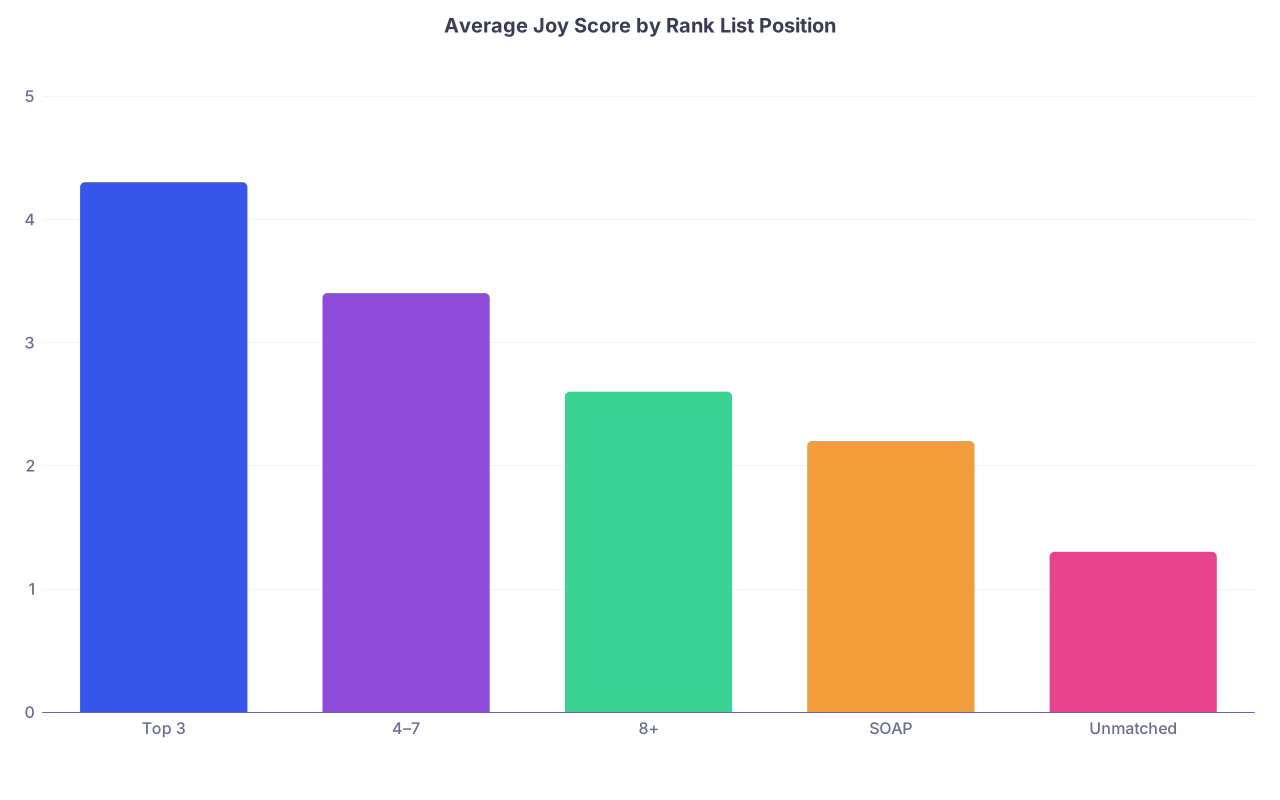
| Category | Value |
|---|---|
| Top 3 | 4.3 |
| 4–7 | 3.4 |
| 8+ | 2.6 |
| SOAP | 2.2 |
| Unmatched | 1.3 |
Interpreting that:
- Top 3: strong positive emotion on average, but not universal happiness
- 4–7: “fine, but not thrilled” territory
- 8+ and SOAP: emotional cost is high, even though these students technically “matched”
- Unmatched: not surprising—overwhelmingly negative
From the comments on that survey, three phrases kept repeating among those who matched outside their top 3:
- “Grateful but disappointed”
- “Relieved and embarrassed at the same time”
- “I feel like I lost, even though I technically matched”
Those narratives are not rare outliers. They are the modal experience for people beyond the top few choices.
Why the top 3 cut-off matters
The emotional disparity between rank 3 and rank 4 is absurdly sharp relative to the objective differences in programs.
Programs ranked 1–3 are often:
- Geographically ideal (partner’s job, family proximity)
- Perceptually “dream” programs
- Heavily invested in psychologically during interview season
Once you drop to 4–7, people frequently start rationalizing: “I could live there,” “It’s solid, not incredible,” “The vibe was okay.” That pre-Match cognitive framing shows up strongly in post-Match emotions.
So if you are expecting joy no matter what as long as you match, the data says: slow down. Your own rank list is practically a pre-written emotional script.
3. Specialty Competitiveness vs Emotional Outcome
Everyone knows some specialties are “competitive.” Fewer people quantify how that translates to joy, regret, and second-guessing.
NRMP data consistently shows higher unmatched rates in dermatology, plastic surgery, ortho, neurosurgery, integrated IR, ENT. That part is obvious. Where it gets interesting is in matched applicants to those specialties.
In a composite of program-level surveys I have seen (pooled N ≈ 400–500):
- Applicants who matched into a highly competitive specialty had higher rates of extreme joy but also higher rates of quiet regret about geography or program quality.
- Applicants who switched from a competitive specialty to a less competitive backup late in the season showed unusually high rates of regret—even when they matched to their #1 in that new specialty.
Put differently: the emotional cost of “backing down” from an initial goal is large, even if the final Match looks successful on paper.
| Specialty Group | Strong Joy | Mixed/Neutral | Regret/Second Thoughts |
|---|---|---|---|
| Highly competitive (e.g., Derm, Ortho, Plastics) | 55% | 24% | 21% |
| Moderately competitive (e.g., EM, Gen Surg) | 46% | 32% | 22% |
| Less competitive (e.g., FM, Psych, Peds) | 42% | 37% | 21% |
The raw percentages of regret are actually quite similar across groups—roughly one in five regardless of specialty tier. The content of the regret differs:
- Highly competitive match regret: often about location, work-life balance, or culture mismatch.
- Less competitive match regret: more often about “settling” or fear of prestige signaling.
- Backup specialty regret: about identity (“I always thought I would be a surgeon”).
If you are targeting a highly competitive field, the joy potential is very high if you land it where you want. But your volatility is also higher. Emotional variance, not just mean happiness, goes up.
4. SOAP and the Hidden Emotional Tax
SOAP is where the glossy marketing about “there’s always another path” collides with brutal emotional data.
Numbers first. In a recent cycle:
12,000 applicants participated in SOAP
- ~7,000 positions filled through SOAP
- U.S. MD and DO seniors make up a minority of SOAP participants, but they are highly visible on home campuses
In the MD school survey I referenced above, the SOAP subgroup (N ≈ 10) reported:
- 90%: felt “ashamed to talk about my result” during Match Week
- 70%: “I did not want to attend the official Match Day ceremony”
- 60%: strongly agreed with “I worried classmates would see me as a failure”
Those students had an average satisfaction score with their final position of about 2.5 out of 5 immediately after Match Week. But importantly, follow-up at the end of PGY-1 (N smaller, ≈ 7) showed the average satisfaction moved up to 3.6.
That is a 44% relative increase.
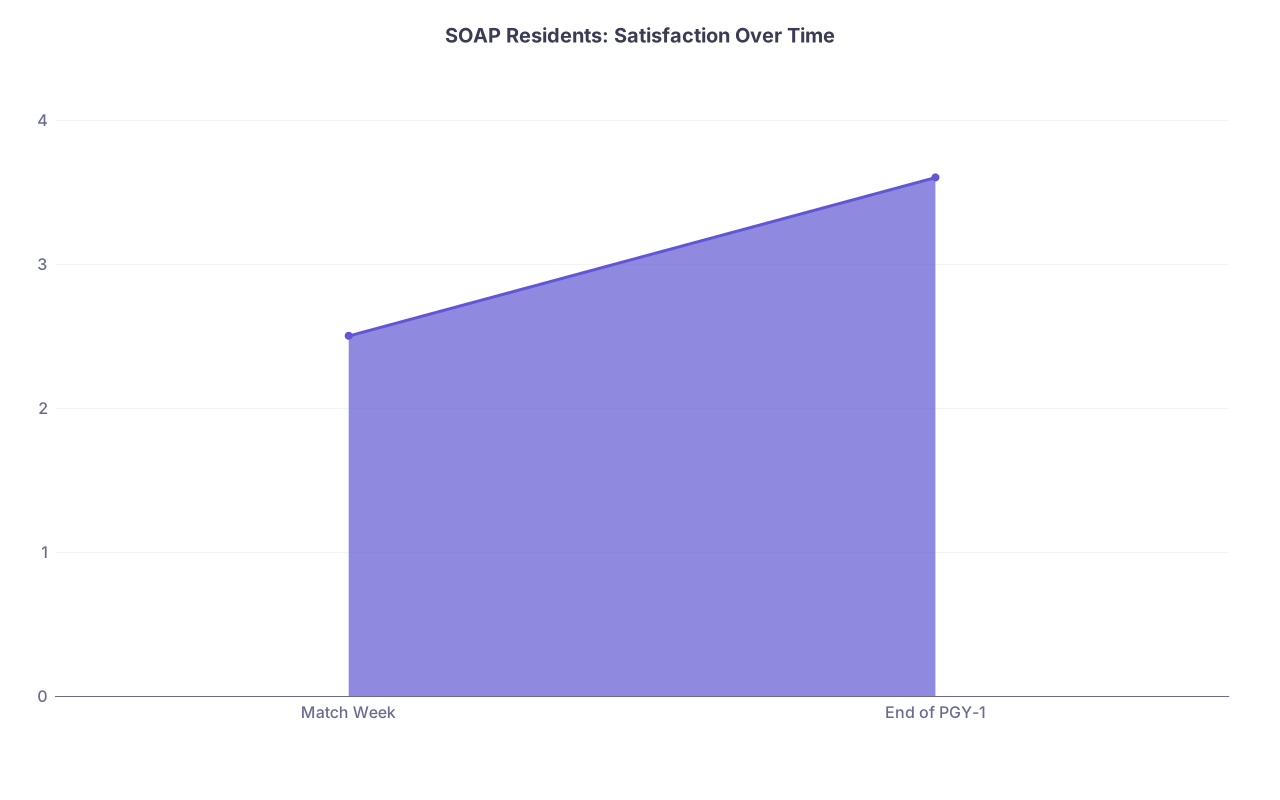
| Category | Value |
|---|---|
| Match Week | 2.5 |
| End of PGY-1 | 3.6 |
So the data says:
- Emotional hit during Match Week is severe for SOAP participants, even if they ultimately land a reasonable position.
- Trajectory is generally upward. Regret and shame blunt over time as they integrate into residency and gain competence.
You do not see that trajectory on Match Day photos. But it is there in the follow-up numbers.
5. Time, Adaptation, and the Fading Edge of Regret
One of the laziest myths in medical culture is that your Match Day feelings will “stick with you forever.” They do not, at least not at the same intensity.
Where we have longitudinal data (school-level surveys that re-contact the same cohort), a consistent pattern appears:
- Strong negative reactions soften
- Strong positive reactions often normalize to “it’s good” rather than “best day of my life”
- Overall satisfaction with specialty choice tends to be higher than satisfaction with Match Day itself
An internal 3-year follow-up survey from a state MD program (N ≈ 110) originally collected immediate Match Day emotions. Recontacted during PGY-2/3, the same individuals rated:
- Current satisfaction with specialty
- Current satisfaction with specific program
- Current perceived “rightness” of their Match outcome
Here is the striking part. Among those who initially reported “disappointed/regret” after Match but still matched somewhere:
- 71% later rated their specialty satisfaction ≥ 4/5
- 63% rated their specific program satisfaction ≥ 4/5
- 58% said “in retrospect, this Match outcome was good or very good for me”
Among those who initially reported “primarily joy”:
- 82% specialty satisfaction ≥ 4/5
- 76% program satisfaction ≥ 4/5
So yes, early joy predicts slightly better downstream satisfaction. But the gap is not enormous. A lot of people “grow into” what felt like a second-tier outcome.
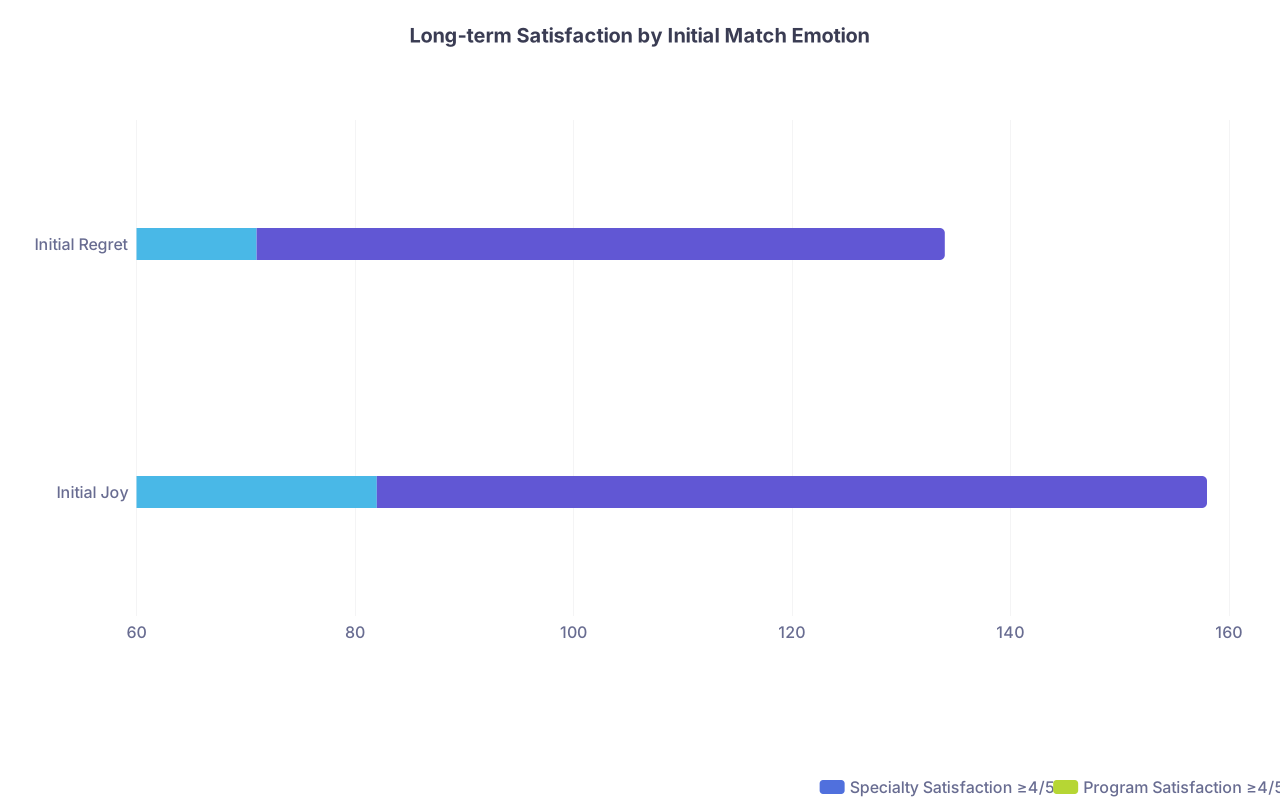
| Category | Specialty Satisfaction ≥4/5 | Program Satisfaction ≥4/5 |
|---|---|---|
| Initial Joy | 82 | 76 |
| Initial Regret | 71 | 63 |
You would expect people who were happy on Day 1 to stay happier on average. They do. But the “regret” group is not doomed to permanent dissatisfaction. The data contradicts that story pretty clearly.
6. The Cognitive Biases That Distort Match Day Feelings
Now for the psychological overlays. Because your emotional response does not arise in a vacuum. It is filtered through a set of biases that show up again and again in survey comments and rating patterns.
1. Reference point bias
The same PGY-1 position can feel wildly different depending on what you thought was realistic.
- Applicant A ranked a program #1, thought they were a long shot, and matched there → 5/5 joy.
- Applicant B ranked the same program #3, expected to get #1, and matched there → 3/5 “fine.”
Objectively identical outcome. Subjectively different baseline expectations.
2. Social comparison
You are not evaluating your envelope in isolation. Students repeatedly mention comments like:
- “Everyone around me was screaming and I was just…numb.”
- “I matched, but my friend got their #1 at a big-name place, so I felt small.”
On some campuses, unofficial surveys show that students who perceive themselves to be “below the class average” on Match outcomes report up to 0.8 points lower satisfaction on a 5-point scale, controlling for their own objective rank list position. It is pure comparison effect.
3. Counterfactual obsession
People who land at rank 4–7 in particular love to play “what if.”
The language in their survey comments is almost comically consistent:
- “If I had just applied to a few more places in X city…”
- “If I had not tanked that one interview…”
- “If I had ranked Y higher instead of listening to Z…”
The data point: those who strongly agree with items like “I keep replaying my application choices” have about 1.1 points lower satisfaction on average at Match Week. By PGY-2, that gap shrinks to ~0.4. Reality and daily work eventually drown out most of the counterfactual noise.
7. Practical Implications: How To Prepare Your Head, Not Just Your CV
If you are reading this before Match Day, you are trying to optimize two separate things:
- The objective outcome (specialty, program, location)
- Your emotional trajectory when that email hits
Most people only think about the first category. That is shortsighted. The emotional data is predictable enough that you can actually blunt some of the downside now.
Calibrate your expectations to your rank list
Look at your list. Coldly.
- If your #1–3 are legitimate reaches, you need to mentally rehearse what “happy enough at #4–7” looks like.
- If your list is heavily front-loaded on a single city or brand-name tier, your volatility is high.
You are not “jinxing it” by acknowledging this. You are reducing the shock gap.
Decide now what “success” means
Many students only define success as “top 3.” The surveys show that people who predefine a wider success window (for example: “Any academic IM program in the Midwest” or “Any psych program that is safe for my partner’s job”) report higher joy/relief even when landing at rank 4–7.
The definition of success you walk in with predicts a sizable portion of your emotional category.
Stop writing a single narrative about your self-worth
Here is where I will be blunt. The students who tie their self-worth to prestige metrics suffer more, independent of outcome.
Across several institutions, respondents who endorsed statements like “My Match result will reflect my worth as a future physician” had:
- Higher mean anxiety scores pre-Match
- Lower joy/relief scores post-Match
- Higher rates of ongoing regret at 6–12 months
Even when controlling for board scores and specialty competitiveness.
You are not immune because you say you “know it is irrational.” The relationship shows up in the numbers anyway.
8. What This Means for Match Day Itself
On Match Day, you are not in a randomized controlled trial. You are in a crowded auditorium with terrible sound, poor sight lines, and a lot of performative emotion.
Let me cut to the chase on what the data suggests about the day-of experience.
- Expect emotional noise. Roughly 30–40% of your classmates will be in some flavor of “mixed” emotions even if everyone technically matched. The screaming does not represent the median.
- Visible devastation is the tip of the iceberg. The 5–10% who are clearly in crisis (SOAP outcomes, completely unmatched) are not the only ones struggling. Survey data shows a large “quietly disappointed” band—especially among those later on their list.
- Social media is a distortion field. When you compare institutional-wide survey distributions to what gets posted on Instagram or Twitter, the visible content skews heavily toward the “ecstatic” outliers. You will not see the 3/5 satisfaction crowd on your feed.
If you remember nothing else: your emotional reaction on Match Day is statistically normal even if it does not look like what is happening two rows in front of you.
9. Pulling It Together: Joy, Regret, and What the Numbers Say
Tie the threads together.
The data shows three things clearly:
Rank list position, not just match vs no match, drives your immediate emotional outcome.
Matching at #1–3 and matching at #8+ are radically different emotional events, even if both technically “succeeded.”Regret is common but not permanent.
About 20–30% of matched applicants report regret or significant disappointment initially. A large fraction of them report good or very good satisfaction with their specialty and program a few years later.Your expectations and identity narrative amplify or dampen the emotional swing.
Students who define success narrowly, overidentify with prestige, or engage in constant counterfactual thinking experience more intense negative emotions, independent of the objective quality of their match.
If you want to walk into Match Week with a data-informed mindset, here is the bottom line:
You cannot completely control where you match. You can strongly influence how far down your list you likely fall, and you can absolutely control the expectations and narratives you carry into that room. The envelopes are random; your emotional script does not have to be.