
The romantic debate about “big academic city program vs small community rural program” misses the financial math. The data show that urban vs rural match choices can shift your real net worth by six figures over a decade—without changing your specialty or hours worked.
Let me walk through the numbers the way program directors and banks quietly do. Not the way social media does.
1. What Actually Changes With Urban vs Rural Matches
Strip away the anecdotes. Three variables dominate the economic gap between an urban and a rural match:
- Cost of living (housing, transportation, daily expenses)
- Effective take‑home pay (after taxes and local costs)
- How aggressively you can attack your med school debt
Residency salaries are relatively compressed. In 2024, most PGY‑1 salaries cluster in the $60,000–$75,000 range nationwide. The variance is not huge. The environment around that salary is what explodes the difference.
Here is a simplified comparison using realistic, mid‑range data for internal medicine PGY‑1:
| Program Type | Base PGY-1 Salary | Local Cost-of-Living Index* | Effective Purchasing Power** |
|---|---|---|---|
| Urban (high-cost coastal) | $73,000 | 150 | $48,700 |
| Urban (mid-cost large city) | $68,000 | 120 | $56,700 |
| Rural / Small town | $62,000 | 90 | $68,900 |
* Index vs national baseline 100
** Salary ÷ (COL index / 100); rough “national-equivalent” purchasing power
This is the first non‑intuitive punchline: that “lower paying” rural program at $62,000 can actually give you 40+% more effective spending power than the high‑prestige coastal program paying $73,000.
The numbers say: where you match matters more than your nominal salary.
2. Monthly Budget Reality: Urban vs Rural Resident
Let us turn that into a resident’s actual monthly budget. Assume:
- Single PGY‑1, standard federal repayment plan during residency (not PSLF for now)
- $250,000 medical school debt at 6.5%
- Federal + state marginal tax around 25% (varies, but acceptable for ballparking)
After‑tax income estimates
- High‑cost urban: $73,000 → take‑home roughly $54,750/year → $4,560/month
- Mid‑cost urban: $68,000 → ≈ $51,000/year → $4,250/month
- Rural: $62,000 → ≈ $46,500/year → $3,875/month
You might look at that and think: “So urban wins—more cash, right?” No. You have to hit expenses.
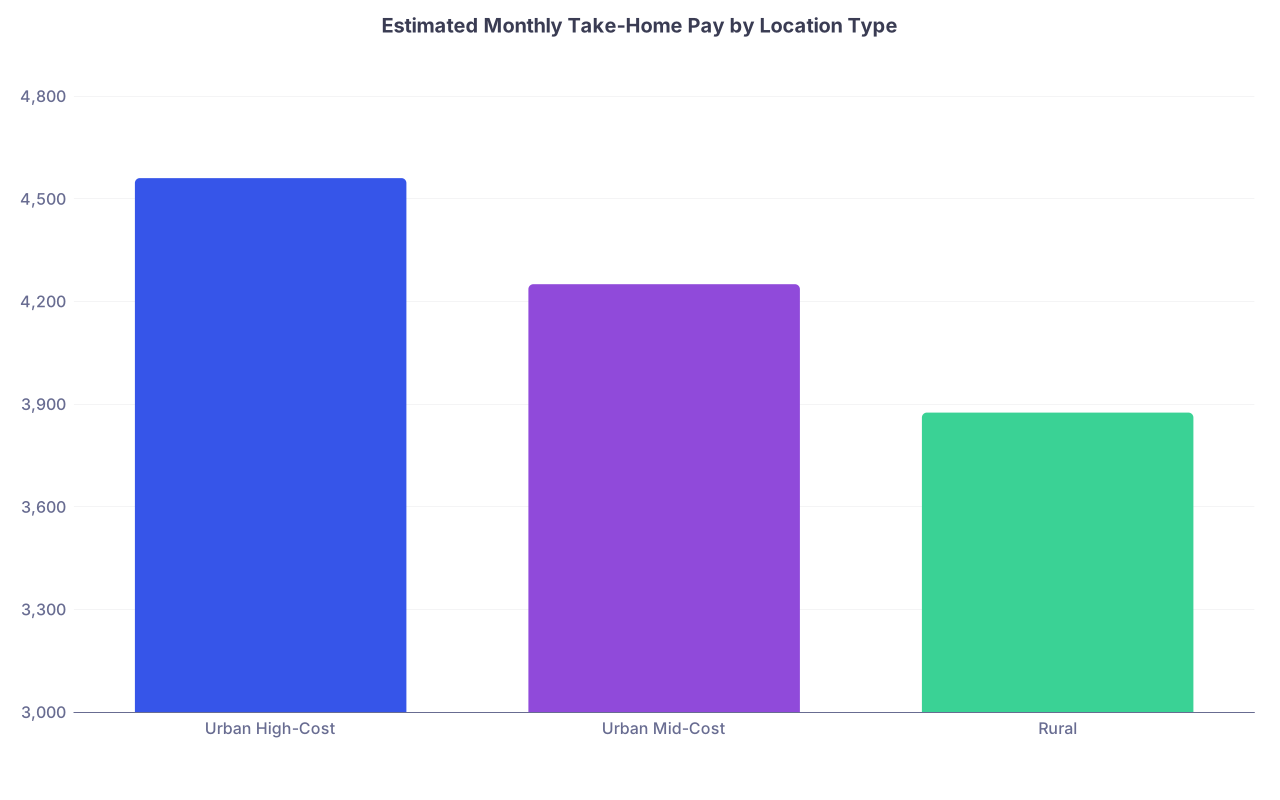
| Category | Value |
|---|---|
| Urban High-Cost | 4560 |
| Urban Mid-Cost | 4250 |
| Rural | 3875 |
Major monthly expense drivers (realistic 2024 numbers)
I have watched countless budgets with residents in NYC/Boston/SF vs places like Iowa City or rural Tennessee. The recurring pattern looks like this:
- Rent (studio/1BR, safe neighborhood near hospital)
- Transportation (car vs transit vs parking)
- Food / groceries / eating out
- Insurance / utilities / misc
Here is an aggregated, conservative view.
| Category | Urban High-Cost | Urban Mid-Cost | Rural / Small Town |
|---|---|---|---|
| Rent | $2,400 | $1,700 | $900 |
| Utilities | $200 | $180 | $160 |
| Transportation | $250 (transit) | $400 (car + gas/parking) | $450 (car, but cheaper gas/insurance) |
| Food | $700 | $600 | $500 |
| Other fixed | $300 | $300 | $250 |
| Minimum loan payment* | $300 | $300 | $300 |
| Total | $4,150 | $3,480 | $2,560 |
*Assumes IDR or reduced payment in training, not full amortization.
Disposable cash for debt or savings
Now subtract those totals from the monthly take‑home:
- Urban high‑cost: $4,560 – $4,150 = $410 left
- Urban mid‑cost: $4,250 – $3,480 = $770 left
- Rural: $3,875 – $2,560 = $1,315 left
That remaining amount is your firepower. That is what you can use for:
- Extra student loan payments
- Emergency fund
- Retirement contributions (yes, even as a resident)
- Or, if you are not disciplined, DoorDash and expensive hobbies
The raw numbers show that the rural resident may have 3x the monthly capacity to attack debt compared with the high‑cost urban resident—despite “making less.”
3. Debt Projections: What 3 Years of Different Matches Actually Do
Here is where the compounding bites—or helps.
Assumptions:
- Starting debt: $250,000 at 6.5% interest
- Residency length: 3 years (IM, Pediatrics, etc.)
- You pay minimum $300/month (IDR or reduced)
- Any extra monthly surplus you devote entirely to loans
- Ignore PSLF for this segment (we will handle it separately)
Scenario A: Urban High‑Cost Program
Surplus: $410/month → $110 above minimum → $410 total to loans
Annual payment: $4,920
Interest on $250,000 at 6.5% is ~ $16,250/year initially.
You are not touching principal meaningfully. Your balance still grows.
Rough projection over 3 years:
- Year 1 end: balance ≈ $261,300
- Year 2 end: balance ≈ $273,400
- Year 3 end: balance ≈ $286,400
You walk into attending life with about $286k of debt.
Scenario B: Urban Mid‑Cost Program
Surplus: $770/month → $470 above minimum → $770 total to loans
Annual payment: $9,240
Yearly interest ~ $16,250 initially, but you slow down growth more.
Rough projection:
- Year 1 end: ≈ $258,000
- Year 2 end: ≈ $266,000
- Year 3 end: ≈ $275,000
You start attending life with about $275k of debt.
Scenario C: Rural Program
Surplus: $1,315/month → $1,015 above minimum → $1,315 total to loans
Annual payment: $15,780
You are nearly covering yearly interest. Balance growth flattens.
Rough projection:
- Year 1 end: ≈ $252,000
- Year 2 end: ≈ $253,000
- Year 3 end: ≈ $254,000
You finish residency with about $254k of debt—almost unchanged.
Now look at the spread:
- Rural vs high‑cost urban: about $32,000 less debt entering attending life
- Rural vs mid‑cost urban: about $21,000 less
That is just 3 years. If your residency is 5–7 years (GS, neurosurg, ortho), the gap scales up brutally. I have seen neurosurgery residents in NYC exit with balances exploding past $400,000 while their rural counterparts kept things within 10–15% of their original debt.
4. Layer PSLF and IDR: Does Location Still Matter?
Many residents hope PSLF (Public Service Loan Forgiveness) will erase the damage. So you might think: “If both urban and rural hospitals are 501(c)(3) and PSLF‑eligible, who cares?”
The data say: you still should care. But the calculus changes.
Under IDR + PSLF
If you:
- Enroll in an income‑driven plan during residency
- Make qualifying payments for 10 total years (residency + attending)
- Work all those years for qualifying non‑profit / government employers
Then the total forgiven amount is:
Forgiven = Grown principal + unpaid interest – what you actually paid
Higher COL → higher debt growth (since you probably pay less extra) → more forgiven at year 10. That sounds like “free money,” right?
Not exactly.
- Your cash flow stress during residency is still very different.
- You are betting heavily on a federal policy and your career staying aligned for a decade.
- Many physicians do not stick with PSLF‑eligible jobs for all 10 years.
I have seen plenty of residents match at big shiny urban academic centers convinced they will do PSLF, then jump to a high‑pay private practice at year 5 because they are burned out or want geographic freedom. The PSLF plan evaporates; the extra debt does not.
Under IDR without PSLF (or if you exit early)
Then everything we just computed matters, and it matters a lot. Extra capital in residency that you could have used to suppress or reduce principal becomes real money lost. You will pay for that high COL choice for 10–20 years.
5. Long‑Term Net Worth: First 10 Years After Match
If you want a clean, quantitative way to think about this decision, stop obsessing over PGY‑1 salary and look at 10‑year net worth projections.
Let us do a simplified attending phase:
- After residency, you earn $260,000 as a general internist (urban or rural)
- Effective after‑tax: around $170,000/year → ~$14,170/month
- You live modestly and can allocate $4,000/month to student loans no matter where you are (you have “normalized” your lifestyle choices as an attending)
Difference at that point is initial debt on day 1 of attending life:
- Urban high‑cost: $286k
- Urban mid‑cost: $275k
- Rural: $254k
All at 6.5%.
Rough payoff times with $4,000/month:
- $286k: ≈ 7.5 years
- $275k: ≈ 7.2 years
- $254k: ≈ 6.6 years
Interest paid over life of loan (residency + attending):
- Urban high‑cost match: roughly $120k–$130k
- Urban mid‑cost match: roughly $110k–$115k
- Rural match: roughly $95k–$100k
So, by your early‑mid 40s, the cost of choosing that high‑cost urban match over the rural one can easily be in the $20k–$30k extra interest range. That is the low end. Stretch residency to 5–7 years, it is not hard to push this penalty into the $50k+ zone.
Now ask yourself: Is that big‑name brand or specific urban lifestyle worth a new luxury car, or a solid down payment on a house? For some people, yes. For others, absolutely not.
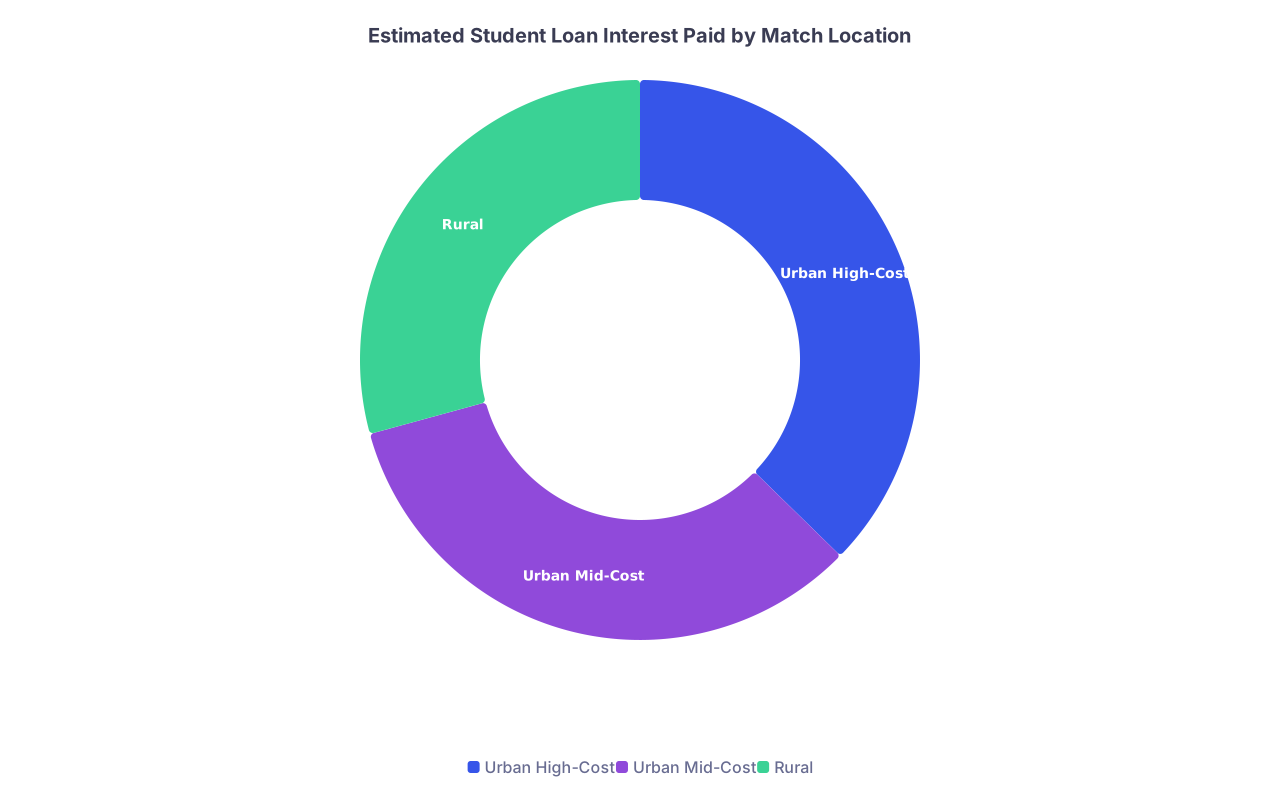
| Category | Value |
|---|---|
| Urban High-Cost | 125000 |
| Urban Mid-Cost | 112000 |
| Rural | 98000 |
6. Non‑Debt Financial Variables: Housing, Family, and Moonlighting
Debt is not the only lever here.
Home ownership potential
In a rural or small‑city match:
- Median home price might be $200,000–$300,000
- A resident with reasonable savings and maybe a partner income can sometimes buy a modest house by PGY‑2–3
- You build equity instead of just burning rent
In a coastal urban match:
- Starter homes at $700,000–$1,000,000+
- 20% down is fantasy for most residents
- Even attending physicians struggle with the math in some markets
That difference compounds. The rural match may allow you to own property early. After 8–10 years, that can mean:
- $80k–$150k in equity vs nothing
- Or at least avoiding getting stuck as a long‑term renter in a hyper‑inflated market
Moonlighting and side income
Rural programs often:
- Have more community hospitals with gaps in coverage
- Pay $100–$200/hour for moonlighting shifts, sometimes more
- Are grateful to have a competent resident cover nights or weekends
Urban academic centers often:
- Restrict moonlighting
- Have more residents and fellows competing for those shifts
- Lower hourly rates due to oversupply
I have seen rural FM or IM residents pull in an extra $10k–$25k per year from moonlighting during later years of training. Urban counterparts might get zero.
Scale that over 2–3 years, and you have another $20k–$60k swing.
7. How to Decide: A Data‑Driven Checklist
This is where you actually make a decision instead of just following prestige or vibes.
Step 1: Pull real COL numbers
Use a cost‑of‑living calculator and look at:
- Rent for a 1BR near each program
- Local tax rates (state income tax, city income tax)
- Transportation realities (must you own a car, parking costs, etc.)
Step 2: Build a 1‑page budget for each match possibility
Literally:
- Take expected PGY‑1 salary from program website
- Estimate taxes (simple online calculator)
- Plug in housing, utilities, car, food, etc.
- Calculate realistic monthly surplus
Do this for your top urban vs rural choices and compare on one sheet.
Step 3: Translate surplus into 3‑year debt projections
Use any compound interest calculator:
- Start at your projected med school debt
- Plug in rate (often 6–7%)
- Add your estimated monthly total payment for each scenario
- Look at the balance after 3–5–7 years
This sounds tedious. It is. But you are choosing the financial structure of the next 10–20 years of your life. You can spare 45 minutes with a spreadsheet.
Step 4: Overlay non‑financial variables consciously
Here is where you put the soft stuff back in:
- Quality of training, board pass rates
- Fellowship match data if you are aiming subspecialty
- Partner’s career options
- Family support, childcare access
- Your own preference for urban vs rural lifestyle
The key is to stop pretending the financial side is “fuzzy.” The data are not fuzzy. They are brutally clear if you run the numbers.
8. A Few Real‑World Patterns I See Over and Over
You are not the first to wrestle with this.
Patterns from residents and young attendings I have worked with:
Urban prestige + PSLF plan, then bail at year 5. They move to private practice, PSLF dies, and they are left with higher debt and no forgiveness. They regret not thinking harder about cost‑of‑living at match time.
Rural match, underestimated career options. They assume rural training will limit fellowship or academic options. Data from many mid‑tier community and hybrid programs show robust fellowship matches when residents perform well. Perception lags reality.
Mid‑cost city is the quiet financial sweet spot. Not everything is binary. Many residents land in mid‑sized cities (Cincinnati, St. Louis, Rochester) with enough pay, manageable COL, and solid academic training. On the spreadsheet, these often come out best.
Moonlighting as a financial equalizer. Rural programs with aggressive moonlighting can partially offset slightly higher debt growth—even in residents who are not naturally thrifty.