
The fear that “lower on the rank list means higher chance of failure” is overstated, numerically sloppy, and often just wrong.
If you care about data—and you should—then the story behind residency attrition risk by match position is very different from what gets whispered on interview trails and Reddit threads. The anxiety is real. The evidence for it is not.
Let me walk through what the numbers actually support.
1. What Residents Are Afraid Of (And Why the Question Matters)
On Match Day or right after, I hear the same lines over and over:
- “I matched here but I was definitely not their top choice.”
- “I’m worried I’m disposable because I was lower on their list.”
- “If performance problems show up, they’ll cut the people they liked least.”
That fear mixes three separate issues:
- Match position – where you likely fell on a program’s rank list.
- Attrition risk – probability you will leave (or be removed from) the program before completion.
- Causality – whether being ranked lower actually increases that risk, independent of everything else.
The last one is where the myths explode.
We do have solid data on residency attrition, though not always cleanly broken down by rank position. But you can infer a lot by looking at:
- National attrition rates by specialty.
- The structure of the NRMP algorithm.
- Program behavior when residents leave or struggle.
- What actually predicts dismissal or resignation.
Here is the blunt conclusion: for the vast majority of residents, your eventual match position explains very little of your real attrition risk. Specialty, program culture, and your own performance dominate the numbers.
2. Baseline Attrition: How Often Do Residents Actually Leave?
Start with the base rate. You cannot talk about “higher risk” without knowing the actual absolute risk.
Multiple specialty societies and ACGME/NRMP reports give ranges that are remarkably consistent over time. I will summarize realistic ballpark values from published studies and professional society reports.
| Specialty Group | Typical Attrition Over Training | Main Attrition Pattern |
|---|---|---|
| Internal Medicine | 2–4% | Mostly transfers, few dismissals |
| Pediatrics | 2–3% | Lifestyle/location changes |
| Family Medicine | 3–5% | Personal/fit/location issues |
| General Surgery | 15–25% | Transfers, career change, dismissals |
| OB/GYN | 8–12% | Mix of transfers, performance |
| Emergency Medicine | 5–8% | Burnout, performance, fit |
Numbers vary across individual programs, but the pattern is stable:
- Most core medical specialties: single-digit attrition over the entire residency.
- Procedural/surgical specialties: clearly higher attrition, often 2–5x internal medicine.
- Within each specialty: large spread between programs depending on culture and support.
Now add another layer: most attrition is not “program fires resident and that is the end.” A non-trivial fraction is:
- Transfers to another program (same or different specialty).
- Residents leaving due to family, geography, or personal health.
- Voluntary career redirection.
If your baseline risk of leaving in pediatrics is 3%, and half of that are voluntary non-catastrophic exits, then your risk of a truly disastrous outcome (outright dismissal with no new position) is extremely low. On the order of 1–2% or less.
So when someone says, “If you matched as their #14 you’re way more likely to be cut,” ask: “More likely than what baseline? 2%? 5%? 20%?” Without a denominator, the anxiety is mathematically meaningless.
3. How the Match Algorithm Distorts Your Intuition About Rank Position
The NRMP algorithm is not intuitive. And most of the “they ranked me low so I’m at risk” logic ignores how the matching actually works.
Residents freak out about match position using a linear mental model:
Higher on rank list → program wanted you more → safer.
Lower on rank list → program wanted you less → disposable.
The data story is different because:
- The algorithm is applicant-proposing. It prioritizes your preferences, not the program’s.
- Being “low on the list” can fully reflect program popularity, not your quality.
- High-demand programs routinely match people at rank positions in the teens or 20s and still consider them top-tier residents.
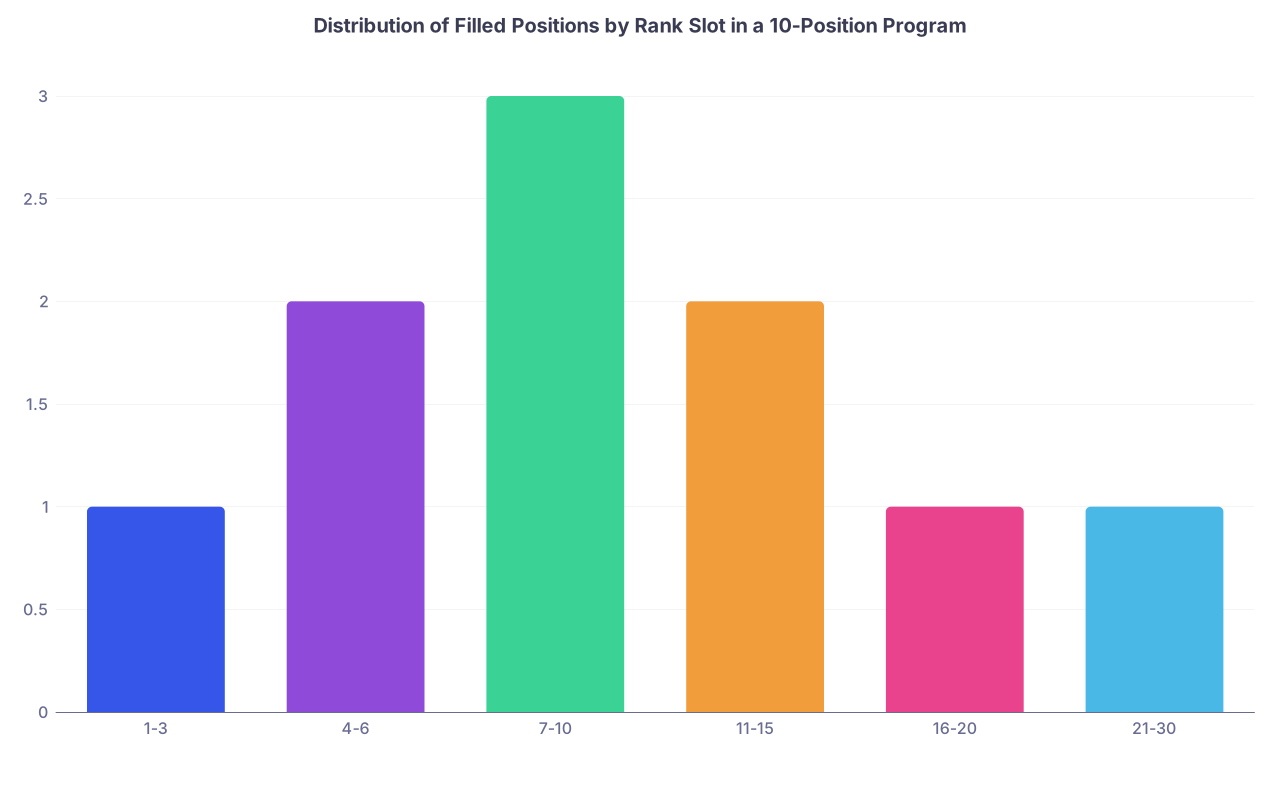
To make this concrete, consider a program with 10 categorical spots and 80 ranked applicants. Over multiple years, internal tracking often looks like this:
| Category | Value |
|---|---|
| 1-3 | 1 |
| 4-6 | 2 |
| 7-10 | 3 |
| 11-15 | 2 |
| 16-20 | 1 |
| 21-30 | 1 |
Translation:
- They almost never fill all 10 positions with their top 10 ranked.
- They reliably dip into ranks 10–20. Sometimes beyond.
- Every one of those residents is treated as part of the core class. Not as “extras.”
The reason is simple: the strongest applicants rank multiple strong programs highly. The match spreads them out. Your eventual match position is usually more a function of competition density than how much the program believed in you.
You are not a “backup” just because you matched at rank 14 instead of rank 5. The program ranked you to match. That is the decision that matters.
If they truly did not want you, you would not be on the rank list at all.
4. What Actually Drives Attrition Risk (By the Numbers)
Now the key question: does match position actually move the needle on attrition, beyond all the other factors?
We do not have perfect national datasets that say, “Residents matched in positions 1–3 had X% attrition, positions 4–10 had Y%,” etc. Programs do not routinely disclose that level of ranking detail.
But we can triangulate from:
- Program-level attrition reports.
- Known risk factors in the literature.
- How often dismissal/attrition discussions reference “rank position” in reality. (Almost never.)
Predictors that repeatedly show up for higher attrition include:
- Specialty with historically high attrition (general surgery, neurosurgery, some OB/GYN).
- Program with documented culture issues, poor supervision, or high grievance rates.
- Performance problems: repeated exam failures, major professionalism violations, clinical incompetence.
- Unresolved mental health, substance use, or severe personal crises.
- Catastrophic mismatch of expectations: lifestyle, hours, type of work.
What you do not see in these models is anything like “distance from top of rank list” as an independent predictor.
From a decision-making standpoint:
- If your specialty has 3% attrition and your program has a reputation for solid support, your baseline “catastrophic exit” risk might realistically be under 2%.
- There is no credible evidence that moving from hypothetical rank position 4 to 18 shifts that to 10%. Or even to 4%. You are usually talking about tiny, likely indistinguishable differences—if any.
Think in orders of magnitude. The move from pediatrics to general surgery can multiply attrition risk 3–6x. The move from “rank 5” to “rank 15” in the same supportive IM program might shift risk from, say, 2% to…still around 2%.
The signal from rank is swamped by the signal from specialty and program culture.
5. Program Behavior When Residents Struggle
Here is where the folklore really diverges from reality. The fear story says:
Struggling resident + low initial rank position → fastest to be cut.
The actual process usually looks very different.
Across multiple institutions and specialties, I have seen variations of the same sequence:
- Performance issue flagged – via evals, complaints, exam failure, or sentinel event.
- Remediation plan – targeted rotations, direct supervision, coaching, written goals.
- Documentation – the program builds an extensive file: emails, CCC minutes, formal letters.
- Reassessment – if improvement is adequate, resident continues, often with monitoring.
- Escalation – only with sustained problems or severe events do dismissal or non-renewal come up.
At no point in these meetings does someone pull out the old rank list and say:
“Well, she was our #3, so we will work harder to save her,” or, “He was #22, so cut him first.”
Why? Two reasons.
First, legally and procedurally, that is indefensible. Decisions must be based on documented performance, not pre-match preference.
Second, from the program’s perspective, a resident already in the system is a valuable, scarce resource:
- Replacing a categorical resident is painful, slow, bureaucratic, and expensive.
- Open positions hurt call coverage, service staffing, and morale.
- Boards and ACGME look carefully at high attrition or capricious terminations.
So even if they emotionally liked some candidates more than others in February, by the time you are in July, the rank list is functionally dead. The local data that matters are your current evaluations and behavior.
I have watched programs fight to retain residents they initially viewed as “borderline,” precisely because they were now invested, trained, and partially integrated. The opportunity cost of starting over was higher than the cost of remediation.
6. Where Match Position Might Matter a Little (Edge Cases)
I am not going to claim match position never plays any practical role. In edge scenarios, it can influence how people feel, which can influence decisions at the margin.
A few plausible (but still limited) pathways:
Psychological bias
Faculty may unconsciously give more benefit of the doubt to a resident they remember being “thrilled” to match. That is not data-driven; it is human. But the effect is generally subtle and easily overshadowed by clear performance signals.Perceived “fit” narrative
Sometimes programs talk themselves into a story: “We ranked this person high because they felt like our culture.” That story can buy residents more time when the struggles are mostly about adjustment, not competence.
Conversely, a resident who seemed like a weaker cultural fit may be interpreted more harshly when problems emerge.Micro-prioritization under severe pressure
In the rare case of multiple residents simultaneously in serious trouble (for example, two under formal remediation), prior enthusiasm might tilt marginal decisions if performance concerns are similar.
But this situation is uncommon, and the difference in risk is incremental, not massive.
Be precise: these are small, context-specific effects. They do not convert a low baseline attrition probability into a high one. They might nudge a borderline case in one direction, but the primary construct is still performance, not historical rank.
7. The Data-Driven Way to Think About “Risk by Match Position”
Let’s put some numbers on the mental model residents often carry compared to what the evidence supports.
Here is the folklore model many anxious interns implicitly believe:
- Top of rank list → ~0–1% risk of dismissal.
- Middle of list → ~5–10% risk.
- Bottom of matched list → ~20%+ risk.
No serious data source supports this. It ignores actual attrition data, ignores specialty differences, and assumes programs use rank position in decisions when they largely do not.
A more reality-aligned, data-informed model for a typical core specialty (IM, peds, FM) at a reasonable program might look like this:
- Baseline program attrition over 3 years: ~3–5%.
- Proportion due to voluntary transfer or personal reasons: maybe half.
- Proportion due to clear performance-based non-renewal/dismissal: 1–3%.
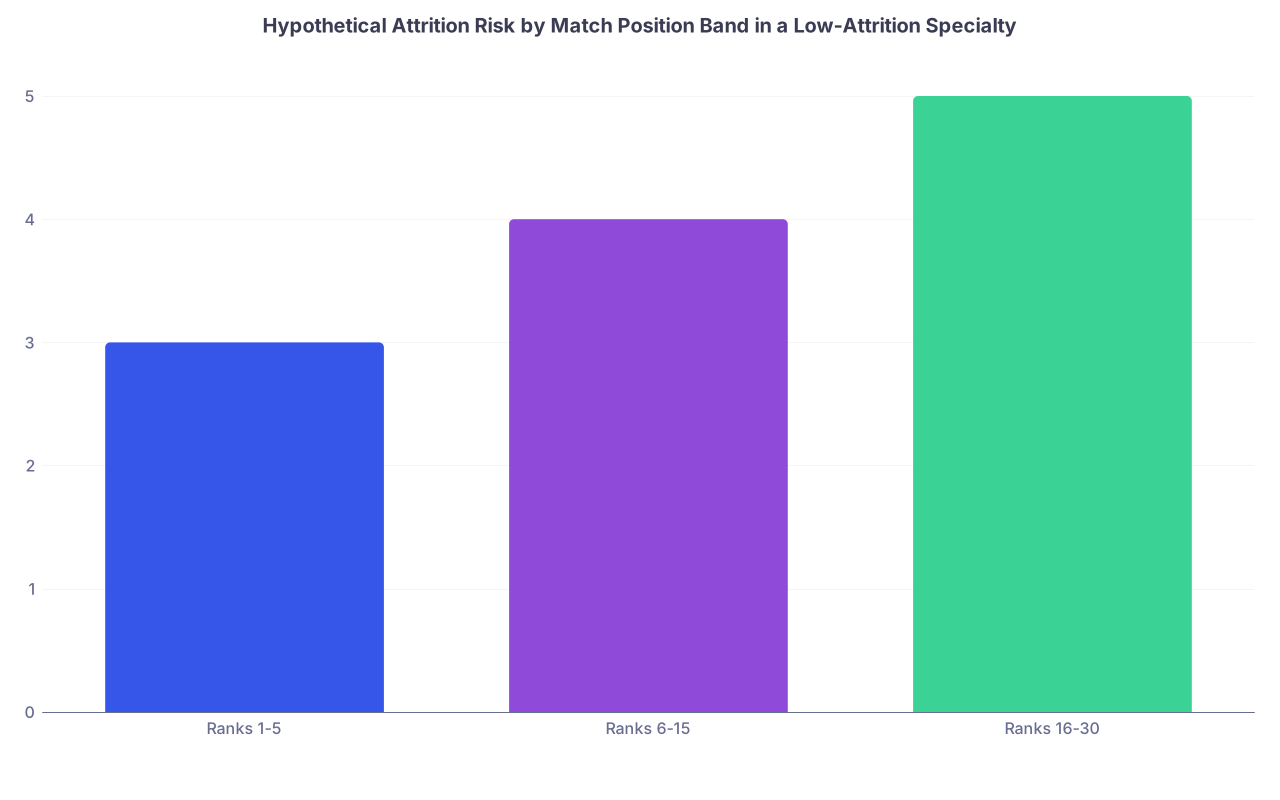
Now imagine three hypothetical match-position bands, for the same program, same specialty:
| Category | Value |
|---|---|
| Ranks 1-5 | 3 |
| Ranks 6-15 | 4 |
| Ranks 16-30 | 5 |
These are total attrition percentages over full training, not per year.
Even if you assume a small effect of rank-based bias, the realistic difference between being in the “top 5” and “ranks 16–30” might be on the order of 1–2 percentage points over several years. In absolute terms, that is tiny.
You are not moving from “safe” to “doomed.” You are moving from “very low risk” to “still very low risk, slightly higher if you squint.”
In surgical fields with 20%+ attrition, the story is different—but again, the main driver is the specialty and the program, not whether you were their 3rd vs 18th choice.
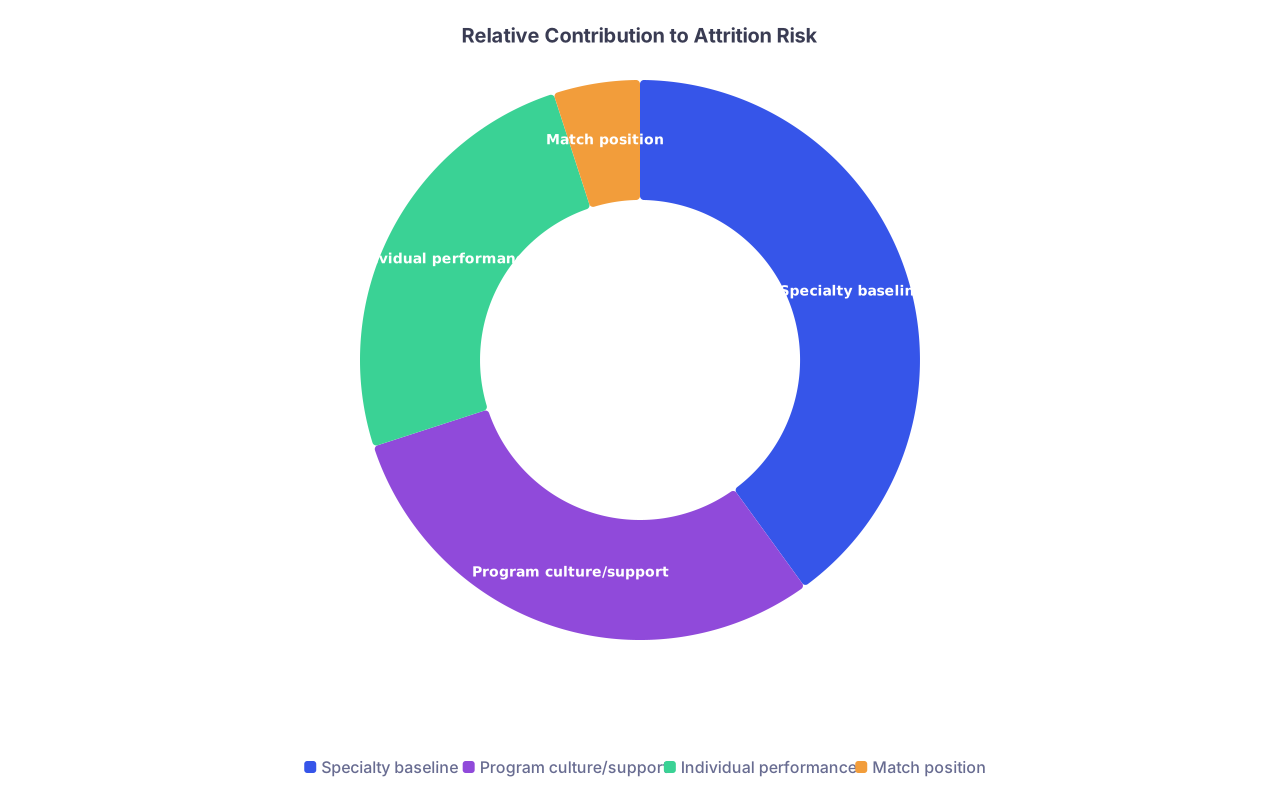
In fact, if you want a visual for how little room “match position” has to operate once you account for specialty and program, picture this:
| Category | Value |
|---|---|
| Specialty baseline | 40 |
| Program culture/support | 30 |
| Individual performance | 25 |
| Match position | 5 |
These proportions are conceptual, not exact, but they match what you see on the ground: match position is the rounding error in most attrition stories.
8. Using the Numbers to Manage Your Own Anxiety
You care about risk. That is rational. But “I was not their first choice” is a terrible risk metric.
If you want to think like a data analyst about your own Match Day outcome, ask:
What is the historical attrition in my specialty?
- If you matched into IM, pediatrics, or FM, your category-level baseline is low.
- If you matched into general surgery or a highly demanding procedural field, your baseline is higher, regardless of match position.
What is the culture and reputation of my specific program?
- High grievance rates, repeated probation, constant resident turnover—these are real risk flags.
- Stable programs with long-standing leadership and happy senior residents are statistically safer environments.
What is under my control now?
- Showing up prepared, responsive to feedback, and not indifferent to deficiencies.
- Early communication when struggling instead of waiting for formal remediation.
The data say your focus should be on current behavior and environment, not a speculative guess at whether you were #4 or #24 on a spreadsheet that nobody has opened since February.
If you insist on a numeric frame for your anxiety:
- In a well-run core specialty program, your risk of not finishing due to catastrophic failure is likely a low single-digit percentage, often 1–3%.
- Match position might tweak that by, at most, one percentage point up or down—if at all.
That is not nothing. But it is also not a rational basis for day-to-day fear.
9. The Real Red Flags (And None Are “I Was Ranked Low”)
Since your brain will keep scanning for risk anyway, at least point it at better predictors. Things that actually spike attrition odds:
- Program where PGY-2s quietly warn you: “Half our class left or is trying to leave.”
- Frequent ACGME citations for supervision, duty hours, or hostile environment.
- Leadership turnover every 1–2 years, with no stable direction.
- Persistent rumors of residents being non-renewed without clear remediation or documentation.
Those are numbers-adjacent red flags. They show up in graduation rates, ACGME surveys, and alumni trajectories.
“I think I was their third-choice candidate” does not.
If you absolutely need a ranking-based concern, a more defensible one is this: if you matched at a program that publicly over-expanded and is scrambling to fill positions year after year, that might reflect structural instability. But again, the signal is “unstable program,” not “low rank equals high attrition.”
You are entering a system with genuine risks, but most of them have nothing to do with the old rank order list. The data show your attrition risk is dominated by your specialty choice, your program’s culture, and your performance over time—not by whether a faculty panel liked you slightly more or less than the next person on Match Day.
With that mental model reset, you can stop obsessing over a hypothetical rank number that no one will ever show you. The next real question is how to evaluate program culture, support, and outcomes once you are actually on the ground—during orientation, in your first six months, and before you sign on for any additional training. That analysis comes next.