
The financial shock of matching into a high-cost city blindsides more residents than the Match results themselves.
You do not have time to “figure it out later.” The moves you make in the first 7–14 days after Match will determine whether you spend the next three years constantly stressed about money—or just normally stressed about residency.
You matched to a high-cost city. Good news for your career, tough news for your wallet. Here is exactly what to do, in order.
Step 1: Get Real About Your New Financial Baseline (Same Week You Match)
The fantasy version: “I’ll be making real money now, it’ll be fine.”
The reality: Your PGY‑1 salary in a high-cost city often feels like an underpaid admin job with 60–80 hour weeks. Plus moving costs. Plus deposits. Plus loan payments coming due.
Pull numbers, not vibes.
- Look up your actual PGY‑1 salary
Go to your program’s GME site or the residency handbook. Do not guess. Typical PGY‑1 in expensive cities:
- NYC: ~$73–80k
- SF Bay: ~$75–82k
- LA/Boston/DC: ~$68–78k
Call or email GME if you cannot find it. Ask for “PGY‑1 salary, meal stipends, housing stipends, and relocation allowance.”
- Convert salary to usable monthly take-home
You need the real monthly number, not the fake $75k line item.
Rough rule of thumb (federal, state, FICA, basic health, retirement if auto-enrolled):
- Assume you keep ~60–65% of gross in hand
- On $75k: $75,000 ÷ 12 = $6,250 gross
- 60% = ~$3,750 take-home
- 65% = ~$4,060 take-home
If your program has a cost-of-living adjustment or housing stipend, note that separately.
- Set your hard rent cap now
Do this before you look at a single apartment listing. Otherwise you’ll emotionally commit to the $3,000 studio with “great light.”
Use this framework:
- Survival mode (aggressive): 25–30% of take-home
- Still sane but tight: 30–35% of take-home
- Beyond 40% of take-home: you are entering chronic stress territory
Example on $3,800 take-home:
- 30% = $1,140
- 35% = $1,330
- 40% = $1,520
In SF, NYC, Boston, that means: you probably need roommates or a longer commute. If that sounds depressing, that’s fine. Still cheaper than three years of credit card debt.
Write this down:
“My max monthly rent share is $____. I will not tour anything above this.”
That sentence will save you thousands.
Step 2: Turn Match Euphoria into a 2-Week Money Plan
Most people use the week after Match to scroll group chats and Zillow. You’re going to be smarter.
You need a 2-week financial sprint: one focused burst instead of months of vague anxiety.

| Step | Description |
|---|---|
| Step 1 | Match Day |
| Step 2 | Day 1-2 - Confirm Income and Benefits |
| Step 3 | Day 3-4 - List Major Moving Costs |
| Step 4 | Day 5-7 - Check Credit and Build Cash Plan |
| Step 5 | Week 2 - Lock Housing Strategy |
| Step 6 | Week 2 - Decide Loan and Car Strategy |
List your major upcoming costs (real numbers, not guesses)
Here’s what usually hits residents in high-cost cities from April–August:
| Item | Typical Range |
|---|---|
| Security deposit | 1–2 months rent |
| First month’s rent | 1 month rent |
| Broker fee (some cities) | 0–1.5 months |
| Moving truck / shipping | $400–$2,000 |
| Flights / travel | $200–$800 |
| Furniture / basics | $300–$1,000 |
| Licensing / exams / fees | $300–$1,200 |
Run an actual estimate. Example for a new intern moving to Boston:
- Rent share target: $1,400
- Deposit (1st + last + security): $4,200
- Flights + AirBnB for apartment hunt: $700
- U‑Haul + gas: $600
- Furniture/basic setup: $500
- License, DEA, etc. (some covered, some not): $500
You’re staring at ~$6,500–7,000 of upfront costs, easily. This is why you feel broke before you’ve even started.
Now you know the hole you need to fill.
Step 3: Ruthlessly Optimize Housing Before You Fall in Love With an Apartment
Housing is the big lever. Nail this, and a lot of other things become manageable.
Decide your housing strategy in this order
- Roommates vs solo
If your take-home is under $4,500/month and you’re going to SF/NYC/Boston, solo living in a “nice” area is usually financial malpractice. Period.
Roommates save you:
- Hundreds per month in rent
- Internet/utilities divided by 2–3
- Sometimes furniture (someone already owns a couch)
Use every resident connection you have:
- Your program’s resident WhatsApp/Slack/Facebook group
- Incoming intern group chat (ask chief residents to connect you)
- Alumni from your med school in that city
Do not be shy about posting:
“Incoming IM PGY‑1, looking for roommate(s), budget $X, prefer walking distance or direct transit to Hospital Y.”
- Commute tradeoffs
Everyone tells themselves they’ll tolerate a 60–90 minute commute to save $300/month. Then they’re on nights, post-call, on a delayed train.
Here’s the honest trade table:
| Commute Type | Pros | Cons |
|---|---|---|
| Walk/Bike (<20 min) | Sleep more, cheap | Higher rent, limited options |
| Direct subway/bus | Predictable, no parking | Crowds, late-night safety |
| Driving, free parking | Flexibility | Car costs, traffic |
| Driving, paid parking | Closer housing options | Major monthly parking expense |
If you can find a shared place under 35–40 minutes door-to-door (especially with other residents), that’s usually the sweet spot.
- Non-negotiables vs nice-to-haves
Non-negotiables for most residents in high-cost cities:
- Reasonable safety walking home in scrubs at weird hours
- Access to 24/7 transit or safe parking
- A place you can actually sleep days post-call
Nice-to-haves that drive your rent up fast:
- Luxury building with gym/roof deck
- Washer/dryer in-unit
- Doorman
- “Trendy” neighborhood
Pick maybe 1–2 nice-to-haves. Not 6.
Move-in date and overlap
Try to overlap 1–2 weeks before orientation if possible:
- You need time to set up utilities, bank accounts, DMVs, new patient appointments, etc.
- You do not want to be unpacking on your first golden weekend.
But if money is brutally tight, you can negotiate a later start in some markets (e.g., July 10 instead of July 1), or sublet for 2–4 weeks before signing a long lease.
Step 4: Stop Bleeding Cash: Credit, Cash, and High-Interest Debt
High-cost city plus high-interest debt is how residents end up trapped.
Pull your credit reports and scores this week
You want zero surprises when you apply for an apartment.
- Go to annualcreditreport.com and get your reports (Equifax, Experian, TransUnion).
- Use a free service (Credit Karma, your bank) for score estimates.
If you see:
- Collections or late payments: expect landlords to want extra deposits or co-signers.
- Thin credit file: a secured card or responsible use of one card now will help later.
Do not apply for 5 new cards at once. Pick 1–2 strategic ones if you must.
Prioritize cash buffer over early loan payments
Until you start residency:
- Every dollar is at risk: moving, deposits, emergencies.
- Your first paycheck may be delayed or partial.
If you’re choosing between:
- Paying an extra $500 toward loans in April
- Or keeping that $500 in cash for May/June moves
Pick cash. Every time. You can attack loans later; you can’t negotiate with your landlord using “aggressive debt payoff strategies.”
Reasonable target: at least $2,000–3,000 in cash before you move. More if you can swing it.
Step 5: Tackle Student Loans With a Clear Starting Plan
You don’t need a 10-year projection. You do need a July 1 plan.
Decide: IDR / PSLF vs refinance vs deferment
Quick triage:
- If you’re even 20% likely to do PSLF (academic, government, non-profit hospitals) → get on an income-driven plan (SAVE, PAYE, IBR). Do not refinance federal loans in residency.
- If your hospital is for-profit and PSLF is off the table → either IDR for cash flow, or temporary deferment/forbearance if money is razor-thin.
- Private loans at crazy rates (8–12%) → consider refinancing, but only if you have stable income and can tolerate the payment.
Call your loan servicer before July and explicitly ask:
- “What are my repayment options as a resident with projected income of $X?”
- “What would my monthly payment be on SAVE or PAYE?”
- “When is my first payment due after graduation?”
Get the numbers. Plug into your monthly budget.
Step 6: Vehicle Decisions in a City Where Parking Costs as Much as a Bedroom
New interns get destroyed financially by car choices. Especially in places like SF, NYC, Boston, Seattle.
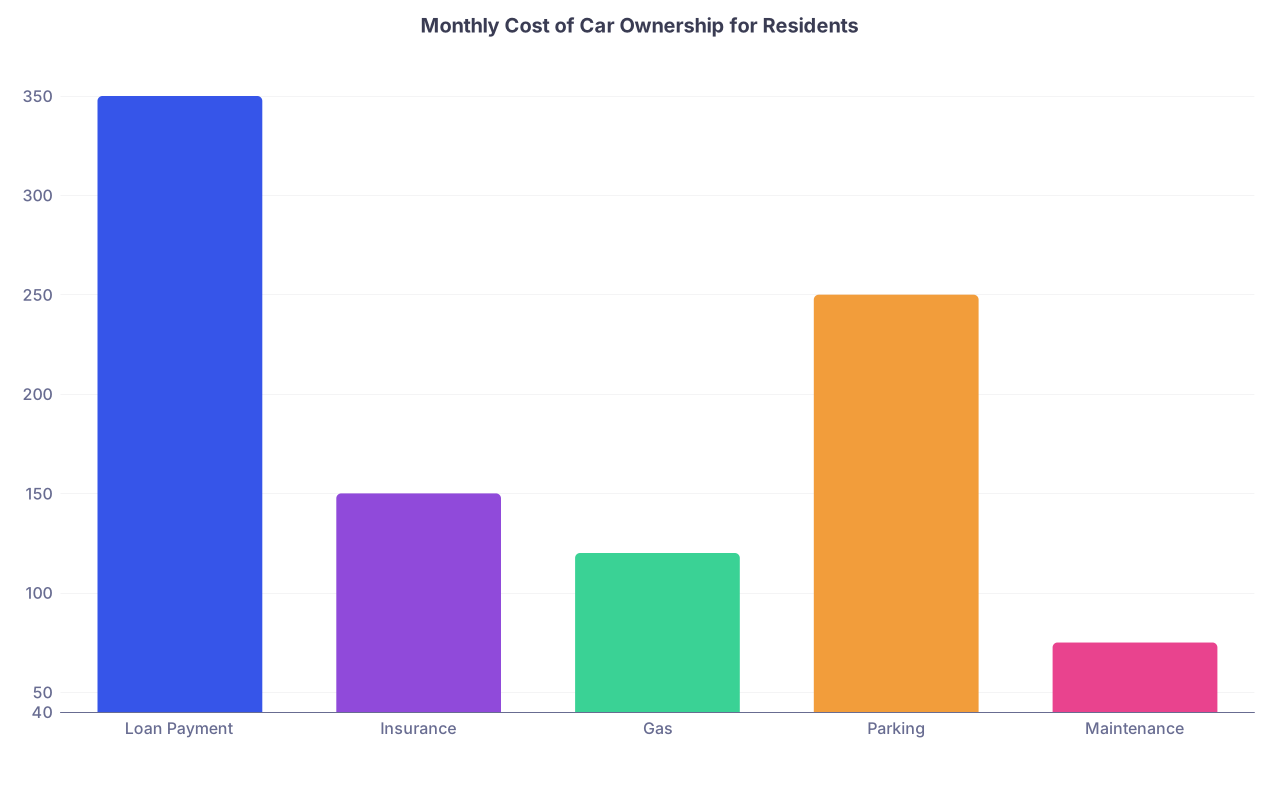
Here’s the honest breakdown:
| Category | Value |
|---|---|
| Loan Payment | 350 |
| Insurance | 150 |
| Gas | 120 |
| Parking | 250 |
| Maintenance | 75 |
Total: ~$945/month. That’s before tickets, tolls, and occasional repairs.
Ask these questions before you commit to a car:
Does my program specifically require a car for off-site clinics or rotations?
Ask senior residents, not just the coordinator.Can I realistically sleep and function while also driving home post-24s in this city?
Some places, driving exhausted in snow/traffic is dangerous and miserable.What are actual parking options at work and home?
“Street parking” in a brochure often means “40 minutes circling after nights.”
If your city has solid transit (NYC, parts of Boston, DC), and your program doesn’t require a car, you can absolutely survive without one, at least PGY‑1.
If you must have a car:
- Do not buy new. This is not a reward moment; it’s a utility purchase.
- Keep payment + insurance under $500–600/month total if you can.
- Pick housing that includes parking, even if it’s a bit more rent. You’ll likely come out even.
Step 7: Build a “Resident Minimalist” Budget That Actually Fits the City
Forget generic budgeting apps that assume you have time to track 45 categories. You need a simple structure that recognizes residency chaos.
Start with your monthly take-home, then assign:
- Housing (rent + renter’s insurance + utilities): 30–40%
- Food (groceries + eating out + coffee): 15–20%
- Transport (transit pass, gas, parking, Uber): 5–15%
- Loans / debt minimums: variable
- Everything else (phone, internet, clothes, subscriptions, tiny fun money): the remainder
Example on $3,800 take-home in San Francisco:
- Rent share: $1,300
- Utilities + internet: $120
- Renter’s insurance: $15
- Food: $550 (yes, this is tight)
- Transit: $120
- Loans (IDR): $240
- Phone: $60
- Misc/health/other: $300
- Leftover buffer: ~$1,095
That leftover isn’t “fun money.” It’s:
- Saving for irregular costs (board fees, travel, emergencies)
- Occasional trips home
- Maybe a bit of enjoyment so you don’t hate your life
The residents who survive high-cost cities financially are not the ones with the highest salaries. They’re the ones who lock in reasonable housing and then avoid lifestyle creep.
Step 8: Exploit Every Work Benefit and Local Hack You Can
Most residents leave money on the table because they don’t read the boring PDFs. Read the boring PDFs.
Look for:
- Housing stipends or COLA: some hospitals in NYC/SF/LA give $3–10k/year. That’s real money.
- Meal cards or cafeteria bucks: understand exactly how much and when it loads. Eat at work when possible.
- Pre-tax commuter benefits: in big cities, you’re dumb not to use these.
- Professional funds: CME/education money that can offset books, conferences, sometimes board fees.
- Moving/relocation stipends: ask GME when and how it’s paid (upfront vs reimbursement).
Local hacks from residents I’ve seen:
- Bulk cooking on one golden weekend, freezing meals in individual containers.
- Buying a $200–300 bike instead of a second metro zone pass + Uber.
- Sharing Costco/Sam’s memberships, splitting bulk essentials with co-residents.
- Using your hospital ID for neighborhood discounts (some gyms, cafes do this quietly).
Step 9: Guardrails Against the “I Deserve It” Spiral
You do deserve rest, some comfort, and the occasional nice thing. But the combination of:
- New city
- New friends
- High-cost restaurants/bars everywhere
- “I work so hard, I deserve this”
…is financially deadly.
Put basic guardrails in now:
- One “big night out” or expensive dinner per pay period, not every weekend.
- Pick 2–3 subscriptions you actually use; everything else gets cut.
- Delay major purchases (new laptop, fancy furniture, Peloton) 90 days into residency. If you still want it then, reconsider.
Immediate To-Do Checklist (Next 7–14 Days)
- Look up your exact PGY‑1 salary and benefits.
- Estimate your take-home pay and set a hard rent cap.
- Draft a realistic moving/startup cost estimate.
- Join your program’s resident chats and start the roommate/housing search with your rent cap in hand.
- Pull your credit reports and check for issues.
- Decide on your initial student loan plan (IDR vs defer/forbear) for July 1.
- Evaluate realistically whether you need a car in that city.
- Sketch a simple monthly budget on one page—nothing fancy.
- Read the GME benefits packet; list out every dollar of stipends and perks.
Then you refine over the next few months. But these moves in the first two weeks will massively change your stress level come July.
FAQ (Exactly 5 Questions)
1. I have zero savings and matched to SF/NYC/another brutal city. What’s the first financial move I should make?
Call your family or closest financial support system and have an honest talk about temporary, targeted help with moving costs—not lifestyle support. Then immediately:
- Ask your program if there’s a relocation stipends or zero-interest loan for incoming residents.
- Aggressively cut any current discretionary spending (subscriptions, travel, eating out) for the next 3–4 months to build even a $1–2k cushion.
- Prioritize finding roommates and an apartment that does not require three months’ rent upfront (consider sublets or hospital-affiliated housing if available).
Your job is to survive the move without taking on high-interest credit card debt that will haunt you for years.
2. Should I put moving costs on a credit card if I don’t have cash?
Only as a last resort, and only on a 0% promo APR card with an actual pay-off plan. If you can:
- Ask your program about any relocation assistance first.
- See if family can help with part of the deposits while you cover recurring monthly costs.
- Reduce upfront costs by buying minimal furniture and relying on Facebook Marketplace/secondhand options after you start getting paid.
If you must use a card, set a hard limit and create a 12–18 month payoff plan. “I’ll deal with it later” is how this becomes a multi-thousand-dollar problem.
3. Is it ever reasonable to live alone as a PGY‑1 in a high-cost city?
Yes—but only if the math is solid. If after a realistic budget you can:
- Keep your total housing costs (rent + utilities) under 35–40% of take-home, and
- Still cover loans, transport, food, and save at least a little each month
…then it can be worth it for sleep and sanity. But if solo living means:
- Housing is 50%+ of your take-home
- You’re putting basic expenses on a credit card
Then you’re trading short-term comfort for long-term pain. In that case, look for one good roommate and prioritize a building and layout that feels as private as possible.
4. My program is in a high-cost city but my hospital is non-profit and PSLF-eligible. How aggressive should I be with loan payments in residency?
If PSLF is a real possibility, your main goal in residency is:
- Minimize payments via an income-driven plan (e.g., SAVE)
- Get your 120 qualifying payments started
- Keep your financial head above water in a high-cost environment
There’s usually no prize for overpaying federal loans in this scenario. Use the extra cash flow to:
- Avoid new high-interest debt
- Build a small emergency buffer
- Handle board fees and surprise expenses without panic
Save the aggressive payoff mentality for after residency if PSLF ends up not being your path.
5. When should I talk to a financial planner, and is it worth it on a resident salary?
If you’re moving to a high-cost city with:
- Six-figure student loans, and
- Confusion about PSLF/IDR vs refinancing, and
- Anxiety about starting retirement savings
…then a fee-only planner who understands physicians can absolutely be worth it—even if it’s just one or two sessions.
Do not sign up for “free” planning connected to selling you whole life insurance or annuities. That’s how residents get locked into awful products. Look for someone who charges flat or hourly fees, and bring:
- Your loan details
- Expected salary
- Basic budget and goals
They can help you set a 3–5 year plan so you’re not guessing.
Open a blank note on your phone right now and write three numbers: your expected monthly take-home, your rent cap, and your estimated moving/startup costs. Those three numbers are the anchor for every decision you make in the next two months.