
The Match process does not care if you are queer, trans, or nonbinary. But your life after Match absolutely will.
If you’re LGBTQ+ and staring down rank lists or Match Day with a knot in your stomach about location, you’re not paranoid. You’re doing risk assessment. That’s what adults do when the system gives them limited control over where they live, work, and get healthcare.
This is the guide people should actually be given when they say, “I’m scared I’m going to match somewhere unsafe.”
Step 1: Get Very Clear On What You’re Actually Worried About
“Bad climate” is too vague. You need specifics. Otherwise you’ll just spin.
Break it down into concrete buckets:
- Legal risk
- Daily-life safety and harassment
- Access to gender-affirming care and queer-competent healthcare
- Community and dating
- Being out at work (program culture, attendings, co-residents)
- Partner/family issues (kids, spouse, immigration, etc.)
Different people prioritize different things. A trans resident on HRT is in a different situation than a cis gay guy with a long-distance partner or a married lesbian couple with kids.
Take 10 minutes and literally write:
- “Non‑negotiables for my safety/mental health:”
- “Would really like to have, but not absolute dealbreakers:”
- “Nice to have if possible:”
If you do not define these, programs and locations will define them for you. And they won’t default to safety.
Step 2: Do a Hard Data Sweep on Each Location
Stop going by vibes and rumors. You need specifics.
Check the legal landscape
This isn’t theoretical. Laws affect:
- Your health care (especially if you’re trans or on PrEP)
- Your ability to change documents
- Your partner’s and kids’ rights
- What your hospital might feel “emboldened” to get away with
Use these sources, systematically, for each state your ranked programs are in:
| Resource | What It Covers |
|---|---|
| Movement Advancement Project (MAP) | State-by-state LGBTQ policy maps and scores |
| HRC State Equality Index | Detailed breakdown of protections vs hostile laws |
| ACLU State Pages | Active and pending anti-LGBTQ+ legislation |
| Lambda Legal | Litigation, protections, and legal help info |
Look up:
- Nondiscrimination laws (employment, housing, public accommodations)
- Hate crime protections including sexual orientation / gender identity
- Trans healthcare restrictions (youth vs adult, insurance exclusions, Medicaid rules)
- Restrictions on name/gender marker changes
- “Religious exemption” laws that allow refusal of care/services
- Adoption/parenting protections for LGBTQ+ parents
You don’t need to memorize every statute. But you should know the basic risk level.
Check city vs state mismatch
Here’s the nuance people miss: state hostile, city protective is very different from rural hostile, state hostile.
A blue dot in a red state can still be livable, sometimes even excellent, if:
- The city has its own nondiscrimination ordinance
- There’s a visible queer community and events
- Hospitals have internal protections and benefits that exceed state law
Practical moves:
- Look up your program’s city in HRC’s Municipal Equality Index.
- Google “LGBTQ center [city name]” and see what actually exists.
- Look for local Pride organizations, queer sports leagues, meetup groups.
You’re not moving to “Texas.” You’re moving to “Houston Methodist” or “UT Southwestern in Dallas” or “Lubbock.” Those are not equivalent.
Step 3: Program Culture Matters More Than The Zip Code
I’ve seen residents survive and even thrive as queer people in politically hostile states because their program functioned as a protective bubble.
I’ve also seen residents miserable in “blue” cities because the department was quietly homophobic, transphobic, or just indifferent.
You need to evaluate the micro‑climate.
How to audit program culture (quietly but effectively)
Stalk their website and socials like it’s your job
- Do they have visible Pride posts, not just in June?
- Any out faculty or residents shown in DEI or Pride events?
- GME office with an LGBTQ+ affinity group?
Read between the lines on interview day
- Did they mention GME DEI groups, employee resource groups, or affinity groups?
- Any signs of “we don’t talk about that here” energy when diversity comes up?
- How did people react if someone mentioned a same-sex partner or pronouns?
Ask targeted, safe questions
You don’t have to out yourself to get real info. Use third-person or generalized language:- “Can you tell me about how the program supports residents from marginalized backgrounds, including LGBTQ+ folks?”
- “What institutional resources exist for residents who experience discrimination from patients or staff?”
- “Are there employee resource groups or affinity groups for LGBTQ+ staff or trainees?”
- “Has the program had openly LGBTQ+ residents or faculty? How has that gone?”
If they give vague PR answers or look uncomfortable, that’s information.
Back-channel with current or recent residents
This is where you get the truth.- Email or message someone who looks queer or lists pronouns on their profile.
- Use alumni from your med school who matched there.
- Ask specific questions:
- “Would you feel safe holding hands with a same-sex partner around the hospital?”
- “Have you seen or heard homophobic or transphobic comments from attendings or staff? How was it handled?”
- “Is anyone out in leadership? PD, APDs, chiefs?”
- “If a resident transitioned during residency, how do you think the program would handle it?”
If no one can name a single out queer person in the program or department, that doesn’t automatically mean it’s bad. But it should raise your caution level.
Step 4: Rank List Strategy When Location Risk Is Real
This is where the rubber meets the road. You have to answer one question honestly:
Would I rather be slightly less happy academically but safer as a human, or in my “dream program” with a constant, low‑grade fear for my body, relationship, or mental health?
If your brain says “depends,” that’s normal. But you need a framework.
Think in tiers, not a linear list
Group programs into three buckets:
Green – I would actually feel reasonably safe and okay living there for 3–7 years
- Legal protections decent or city strong
- Program culture clearly supportive
- Access to affirming healthcare and some kind of queer community
Yellow – I’d be uneasy but could probably make it work with planning and boundaries
- State hostile but city bubble, or neutral environment with limited blatant issues
- Program seems okay but not loudly affirming
- Healthcare/community require more effort but are obtainable
Red – My gut says no, and data backs it up
- State extremely hostile and city not much better
- Program evasive or dismissive about diversity / LGBTQ topics
- You already feel your chest tighten thinking about living there
Within each color tier, you rank by the usual factors: fit, training, research, family, etc. But do not let a red program jump above a green/yellow just because it’s “more prestigious.”
You are not a test score. You are a person who has to live there.
How much should location risk move a program?
More than you think.
Common scenario:
- Program A: Dream name, top fellowship pipeline, but in a state actively targeting trans healthcare or banning inclusive curricula, with a program that dodged your LGBTQ+ questions.
- Program B: Solid mid-tier academic program, great support, smaller city but with a visible queer community and explicit resident protections.
Too many people put A above B because “it will help my career.”
Reality: You cannot fellowship your way out of depression, burnout, or living in constant hypervigilance. A strong but slightly less fancy program where you’re mentally intact beats a brand-name where you’re constantly scanning for danger.
Step 5: Practical Safety Planning If You Might Land Somewhere Hostile
You might not get to choose. That’s the ugly truth about the Match.
So you plan like somebody who knows the system might not protect them.
Before Match Day
Do some prep work now for any program you ranked even somewhat high in a risky place.
Identify healthcare options
- Look up LGBTQ+ clinics, Planned Parenthood locations, queer-friendly primary care, and endocrinology in that city or within driving distance.
- For trans folks: know in advance what telehealth or out-of-state HRT options are legal and feasible for you if local access is restricted.
Check your documentation
- If you’re planning legal name/gender marker changes, see whether your current state is easier than the potential Match state. You might want to accelerate paperwork.
- Make sure your passport is up to date if you ever need to leave for training, conferences, or personal safety.
Talk with your partner/family
- Have the “worst-case scenario” talk now:
- Are they willing to move to certain states?
- Would you do long-distance if needed?
- What are their non-negotiables about safety, schools, or employment?
- Have the “worst-case scenario” talk now:
Decide how “out” you’re comfortable being professionally
I’m not saying go back into the closet. I’m saying think strategically:- Are you comfortable with pronouns on your badge in a hostile state?
- How will you respond if attendings or staff misgender you?
- Will you list queer advocacy on your professional bio?
You’re choosing your level of exposure, not your level of authenticity.
After Match Day (Especially If You Land Somewhere You’re Scared Of)
The gut-punch might be real. You are allowed to feel angry, disappointed, or afraid. But then you switch into planning mode.
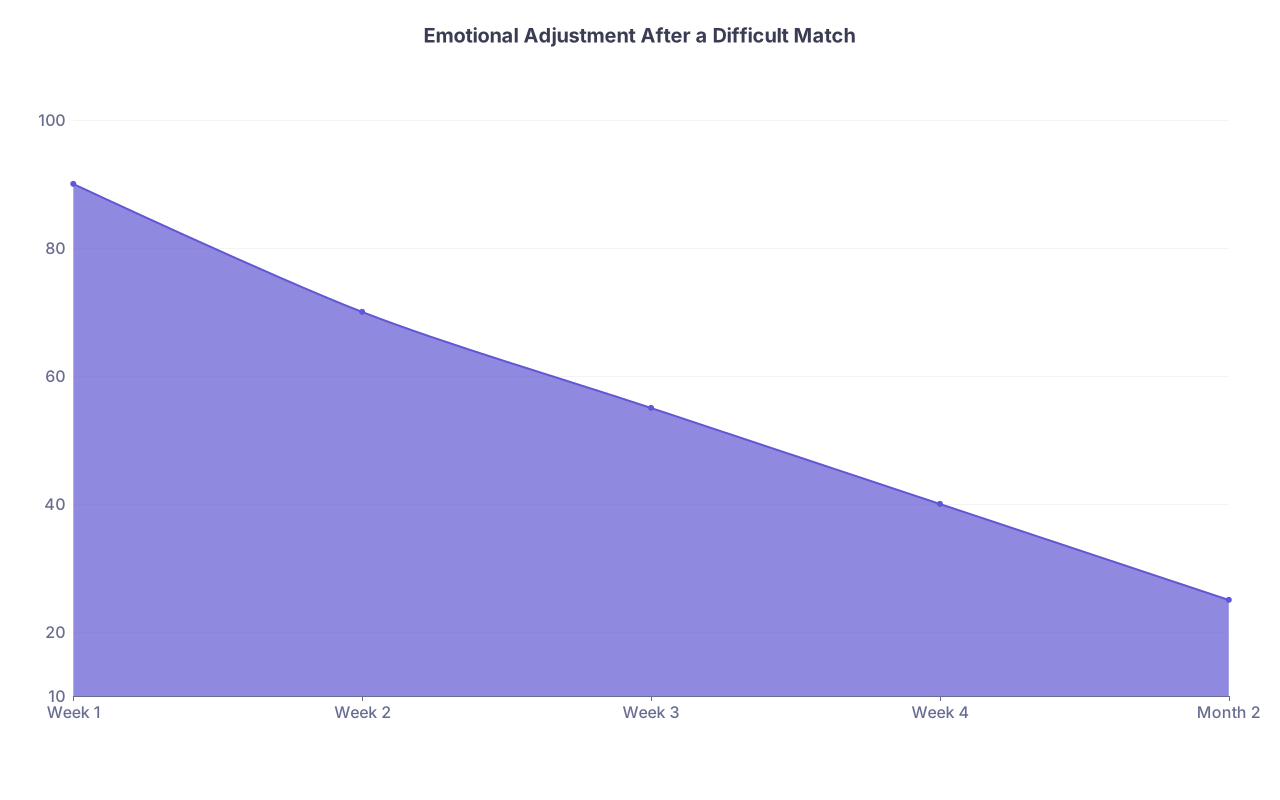
| Category | Value |
|---|---|
| Week 1 | 90 |
| Week 2 | 70 |
| Week 3 | 55 |
| Week 4 | 40 |
| Month 2 | 25 |
(This is roughly how your distress level tends to drop with active coping.)
Immediate steps:
Connect with queer folks in that region
- Use social media: “Queer residents/physicians in [city/state] – any advice/resources?”
- Join national groups: GLMA, OutCare, specialty-specific LGBTQ+ physician groups.
- Email the GME office and bluntly ask: “Do you have an LGBTQ+ affinity group or contact who can speak with me?”
Contact the program about logistics that affect safety
Without making it a crisis, you can ask:- “Is there support for residents who experience discrimination or harassment from patients or staff?”
- “Does the hospital have a nondiscrimination policy that includes sexual orientation and gender identity?”
- “Are there gender-neutral restrooms available to staff?”
Secure your housing with safety in mind
- Research neighborhoods where diversity is more visible.
- Ask current residents (off the record) which areas feel safer for queer folks.
- If you have a visibly queer presentation, prioritize areas with younger populations, campuses, or arts communities.
Mental health scaffolding
- Before you move, line up a therapist – ideally queer-competent and licensed in your Match state.
- Decide what your non-negotiable self-care blocks will be (e.g., one therapy session a month minimum, protected queer social time once a month).
Step 6: Being Out (Or Not) In A New Program
This part is messy. Anyone who tells you “just be yourself, it will all be fine” is not paying attention to the realities in certain states and institutions.
You’re allowed to calibrate.
Data points to watch during orientation and early months
- How do attendings respond to patients who say homophobic/transphobic things?
- Have you heard slurs or “jokes” in workrooms? Do others push back?
- How does leadership talk about DEI – as a checkbox, or as a real priority?
- Are there other visibly out people? How are they treated?
You’re running a quiet social experiment before you hand people your full story.
Strategies for navigating workplace identity
Start with “need-to-know” disclosure
You can be out to a few trusted co-residents before broadcasting it to the whole program.Use “signal” items selectively
- Small Pride pin on your lanyard.
- Subtle background image on Teams/Zoom.
- Mentioning a partner without gender, then with gender once you feel out the reaction.
Have scripts ready for bad moments
- Patient uses a slur: “We do not use that language here.”
- Colleague makes a “joke”: “Not funny to me.” Then silence. Let them feel it.
- Misgendering if you’re trans/nonbinary (choose your level):
- Minimal: “Actually, I use [they/them] pronouns.”
- Firmer: “I’ve corrected you before. I need you to respect my pronouns.”
Know your internal advocates
Identify at least one attending and one chief or senior who’s clearly safe. If something serious happens, you don’t want to figure out from scratch who will go to bat for you.
Step 7: If Things Go Badly – Your Escape and Protection Options
Sometimes it really is as bad as you fear. That’s not you being dramatic. That’s you being accurate.
Start documenting from the first serious incident
- Date, time, location
- Who was present
- Exact words/actions
- What you did
- Any follow-up
Keep it on a personal, secure device, not a work computer. Pattern matters if you ever need to escalate or, worst case, transfer programs.
Use hospital resources strategically
In rough order of escalation:
- Trusted chief or senior resident
- Program director / associate program director
- GME office / DIO (Designated Institutional Official)
- Hospital HR / compliance office
- Institutional ombudsperson or anonymous reporting systems
If your PD is the problem, do not start with them. Go around.
Transfer is hard, but it’s not impossible
Residents do transfer programs. Quietly. Often because of “fit” or “family reasons,” but sometimes because of discrimination or safety issues.
If things truly become untenable:
- Reach out discreetly to mentors at your med school or national specialty organizations.
- Ask your PD (if trustworthy) or another leader about “exploring transfer options due to serious personal concerns.”
- Do not threaten legal action and then ask for help transferring in the same breath. Separate those paths.
You’re not a failure if you leave a toxic program or location. You’re someone who refused to burn out to make others comfortable.
Step 8: If You’re Still Early – Building This Into Your Application Strategy Next Time
For MS2s/MS3s reading this early: good. You have more leverage.
Build location and safety into your original application plan:
- Apply more heavily to states/cities with protections if that’s possible for your specialty.
- During interviews, be deliberate about the questions in Step 3.
- Rank fewer true “red” programs. You’re allowed to let them go.
Here’s a simple flow that actually matches how most queer applicants think, even if no one says it out loud:

| Step | Description |
|---|---|
| Step 1 | Identify all interview offers |
| Step 2 | Assess state laws and city climate |
| Step 3 | Red tier - bottom or remove |
| Step 4 | Assess program culture and support |
| Step 5 | Green tier - rank higher |
| Step 6 | Yellow tier - middle ranks |
| Step 7 | Finalize rank list |
| Step 8 | Safe or workable? |
| Step 9 | Supportive? |
This is not idealism. It is survival planning.
FAQs
1. Should I ever rank a program highly in a state that’s actively passing anti-LGBTQ+ laws?
Sometimes yes, but only if three things are true:
- The city itself has strong protections and a visible queer community;
- The program has a proven track record of supporting LGBTQ+ residents (actual people you can talk to, not just website buzzwords); and
- Your personal situation (identity, medical needs, family) can realistically be managed safely there.
If those three are not solidly in place, that program shouldn’t be in your top tier no matter how prestigious it is.
2. How honest can I be in my personal statement or interviews about being LGBTQ+?
You can be fully honest if 1) you’re applying mostly to programs in safer areas, or 2) you’re prepared to let programs that don’t like it self-select out. If you’re applying broadly, including to hostile states, you may choose a “strategic honesty” approach: mention advocacy, DEI, or “working with sexual and gender minority patients” without foregrounding your own identity in every piece of written material. You get to decide who you come out to and when. That’s not dishonesty; that’s boundary-setting.
3. What if my partner refuses to move to certain states?
Then those states are effectively off your list, or at most belong at the very bottom as absolute last-resort options. Do not assume “we’ll figure it out later.” Talk early and explicitly about which states/cities are non-negotiable no-go zones for them. If that shrinks your list, it shrinks your list. You can still match with a realistic application strategy weighted toward acceptable locations.
4. Will being LGBTQ+ hurt my chances of matching if I’m open about it?
In some programs, yes. In others, it will help you because they’re actively looking for queer residents and value that perspective. Since you cannot fully control who is reading your file or what biases they bring, focus on aligning yourself with places that actually want you there. If a program is so biased that your identity would hurt your chances, that’s not a place you want to spend the next 3–7 years anyway.
You’re not just matching into a specialty. You’re matching into a life: a city, a legal environment, a hospital culture, a set of colleagues who will see you at your worst and at 3 a.m. on day 27 of nights.
If you’re LGBTQ+ and worried about your Match location’s climate, you’re doing exactly what you should be doing—thinking a few steps ahead. You’ve now got a playbook: how to research, how to rank, how to plan for the worst and build toward the best.
With that groundwork laid, you can walk into Match Day with less fear and more clarity. Whatever city shows up on that screen, you’ll already know what your next moves are. The rest—building community, shaping your program culture, and eventually mentoring the queer med students coming up behind you—that comes later.