
Long-Distance Relationship and Match Day: Navigating Tough Outcomes
What do you actually do when Match Day tells you and your partner, in the bluntest way possible, that you are not going to be in the same city next year?
I’m not asking how you feel. I know how you feel. Gutted. Numb. Angry at a system that does not care that you have a life outside medicine. You spent months gaming couples match lists, stalking program websites, color-coding spreadsheets. And now you’re staring at two emails, two cities, maybe two time zones apart.
So let’s skip the “this is hard” platitudes. You already know that. Let’s talk about: What now?
Step 1: The First 72 Hours After a Bad Couples Match
This is triage time. You’re not planning your whole life yet. You’re keeping yourself and your relationship from blowing up in the immediate aftermath.
1. Call each other. Video, not text.
Do not try to “process” this over text.
If you can’t be physically together, at least see each other’s faces. Plan one clear conversation as soon as you can both get 45–60 uninterrupted minutes.
In that first call, your goals are not to solve the problem. Your goals are:
- Acknowledge: “This sucks. For both of us.”
- Avoid blame: No “You ranked X too high” or “I told you this would happen.”
- Commit: “We are on the same team. The problem is the distance, not you vs me.”
- Contain: Decide you’re not making any huge decisions (breakup / engagement / moving) in the first 72 hours unless you absolutely must.
If either of you starts spiraling into “What if we never…” or “This will ruin…”, you gently pull it back to: “We don’t have enough data yet. Let’s get information first.”
2. Protect yourself from comparison
Half your class is posting couples-match “We did it!” pictures. Matching in the same city. Same hospital. Cutesy captions.
Mute people. Log off. You’re allowed.
Your situation is not less valid because it does not fit the Instagram version. I’ve seen plenty of “perfect” couples-match pairs break up intern year. I’ve seen long-distance couples in separate states make it and get married second or third year. What matters is what you two do next, not how it looks on Friday afternoon.
3. Decide what to tell people (and what not to)
Plan a 1–2 sentence script you can repeat for the next week when people ask:
- “We both matched, but in different cities. We’re figuring out a plan.”
- “We’re long distance next year. It’s not what we hoped for, but we’ll work with it.”
You don’t owe anyone a detailed breakdown of your couples rank list. You especially don’t owe it to that one classmate who treats everything like gossip.
Step 2: Map Out the Reality of Your Specific Situation
Once the emotional wildfire dies down a bit, you switch into assessment mode.
1. Lay out the hard facts together
Have one practical meeting (yes, treat it like a meeting) where you literally write this down:
- Your location and program
- Their location and program
- Start dates, orientation dates, and known vacation rules
- Distance between cities (driving vs flying, realistic travel time door-to-door)
- Time zones and typical shift patterns if you already know (surgery vs psych vs EM vs peds, etc.)
| Scenario | Distance | Travel Time Approx |
|---|---|---|
| Boston – New York | 215 miles | 4–5 hrs by train |
| Chicago – St. Louis | 300 miles | 1 hr flight |
| LA – San Francisco | 380 miles | 1.5 hr flight |
| NYC – Houston | 1600 miles | 3.5–4 hr flight |
| East Coast – West Coast | 2500+ miles | 5–6 hr flight |
This is not just “emotional long distance”; this is “what does it physically take for us to see each other.”
2. Understand your program’s flexibility window
A lot of people forget this: the first 6–9 months are when it’s hardest to change anything. Program directors are building schedules, filling gaps, scrambling to cover nights.
You need to:
- Read your contract and GME policies on leave, moonlighting, and outside employment (even if you’re not moonlighting).
- Ask senior residents: “How strict is scheduling? How often can people swap?”
- Quietly figure out: does your program ever allow off-cycle starts, transfers, or swaps? (You’re not asking for it yet. You’re gathering intel.)
Step 3: Decide Which Track You’re On This Year
You and your partner need to decide your working assumption for PGY-1:
- We are long distance for at least a full year.
- We are long distance for 6–12 months while we try to get into the same system/region.
- We are long distance indefinitely, and we’ll decide about one of us moving later.
- We are not continuing the relationship. (Yes, this is a valid, sometimes healthy, choice.)
Do not default into “We’ll just see what happens” for months. That limbo kills more relationships than distance itself.
You can change your decision later, but you need a working plan now. My bias, from watching this go both ways: if you both still want the relationship, assume you’re committing to at least a year of real effort before you re-evaluate.
Step 4: Build a Concrete Long-Distance Plan (Not Just “We’ll Talk a Lot”)
Long-distance during residency is a logistics problem. Feelings matter, but logistics kill or save you.
1. Set a weekly communication structure
No, this doesn’t make it robotic. It makes it survivable.
Example structure:
- One “anchor” video call each week (60–90 minutes, protected, no multitasking)
- 2–4 short check-in calls (10–20 minutes) on set days (e.g., post-call, mid-week, weekend pre-rounds)
- Ongoing texts/voice notes as energy allows, but neither of you treats response delays as personal attacks
If one of you is in a brutal program (think general surgery, ortho, EM with nights), that schedule might flex, but there should still be some predictable anchors.
Spell out expectations:
- Are you expecting good-morning/good-night texts?
- Is it OK to not respond for 6–8 hours on call days?
- When is it not OK to stay silent?
2. Plan visits like you plan rotations
Open your calendars. Look at:
- Orientation month
- ICU months
- Night float blocks
- Golden weekends (if they exist in your universe)
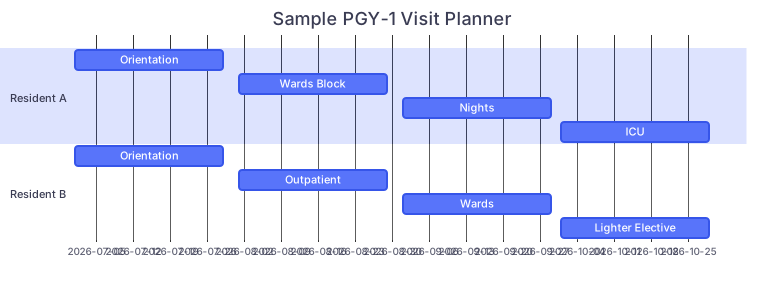
| Task | Details |
|---|---|
| Resident A: Orientation | a1, 2026-07, 4w |
| Resident A: Wards Block | a2, 2026-08, 4w |
| Resident A: Nights | a3, 2026-09, 4w |
| Resident A: ICU | a4, 2026-10, 4w |
| Resident B: Orientation | b1, 2026-07, 4w |
| Resident B: Outpatient | b2, 2026-08, 4w |
| Resident B: Wards | b3, 2026-09, 4w |
| Resident B: Lighter Elective | b4, 2026-10, 4w |
Now, you identify realistic visit windows:
- No visits during mutual orientation unless you live drivable distance.
- Avoid planning big travel in your worst rotations first quarter.
- Prioritize visits when one person has a light elective and the other is on a moderate rotation.
Be brutally honest:
- Can you afford monthly flights?
- Is one of you in a higher-paying specialty or lower cost-of-living city, and therefore better able to shoulder more travel costs?
- Does it make sense to alternate visits, or will one of you do 60–70% of the traveling due to schedule realities?
Write down the first 2–3 tentative visit windows and who is going where. Put them on your calendars even if they’re “likely, not guaranteed.”
Step 5: Deal With Resentment, Fairness, and “Who Sacrifices More”
This is where most long-distance resident couples blow up. Not the distance itself. The story each person starts telling themselves about fairness.
“He has weekends off and still barely visits.”
“She chose that super competitive program far away instead of ranking closer ones higher.”
“I’m the one always flying.”
“I’m stuck in this malignant program and still trying, and they act like they’re busier.”
You must talk about this directly. Early. Before it calcifies.
1. Decide on a working “division of sacrifice”
This will look different for each pair, and that’s fine as long as you both consciously agree.
Common patterns I’ve seen:
- Higher-demand specialty, malignant-ish program → less travel, more financial contribution
- Lower cost-of-living city → that partner does more visiting because it’s cheaper to fly out than in
- One person closer to family support → they travel less because they carry more day-to-day life tasks (bills, apartment logistics, etc.)
The wrong pattern is: you both secretly keep score but pretend you’re not.
Say it explicitly: “Realistically, I can do 1 trip every 6–8 weeks. You can probably do monthly. Are we OK with you doing more visits if I pick up more of the flight costs?”
Then revisit this agreement every 3–4 months.
2. Set rules around conflict while long-distance
You will fight. You’re both exhausted, sleep-deprived, and stressed by new systems.
Some rules that help:
- No “break up” threats mid-argument unless you genuinely mean it and are ready to follow through. You cannot weaponize leaving.
- If one of you is post-call, you’re not having a big relationship talk that day unless it’s an absolute emergency.
- If a fight starts over text and escalates, one of you calls. No dragging out multi-hour arguments over paragraphs on your phone.
Have a repair move: a phrase you can say that both of you agree means “I’m not your enemy; let’s reset.” Something like: “Same team. Let’s restart this.”
Step 6: Explore Realistic Options for Closing the Distance (Later, Not This Week)
Everyone’s first instinct after a bad couples match is: “Can we change it? Transfer? Scramble into the same program?”
You might have options, but they’re limited, and timing matters.
1. Short term (first 6–9 months): mostly off the table
Transfers or switches rarely happen early PGY-1 unless there’s:
- A catastrophic program issue (losing accreditation, serious toxicity, unsafe environment)
- A major life event (serious family illness, partner relocation for military orders, etc.)
What you can do in this phase:
- Excel where you are. Strong evaluations and a solid professional reputation are your best currency if you want to move later.
- Quietly learn how your program has handled transfers before: talk to a trusted chief or upper-level. “Have we ever had residents transfer to other programs or come in from other places?”
2. Medium term (PGY-2+): more realistic pathways
If you both still want to close the distance after a year and you still want each other (this matters), options include:
- Intra-specialty transfer to a program in your partner’s city/region.
- Switching to a related specialty with open spots near them (e.g., prelim -> categorical, IM → neurology in same hospital, etc.).
- Coordinating fellowship in the same city if you’re in specialties where that matters (cards, GI, heme/onc, etc.).
None of this is quick. All of this requires you to be someone programs actually want: reliable, competent, not the intern who constantly complains about your current program.
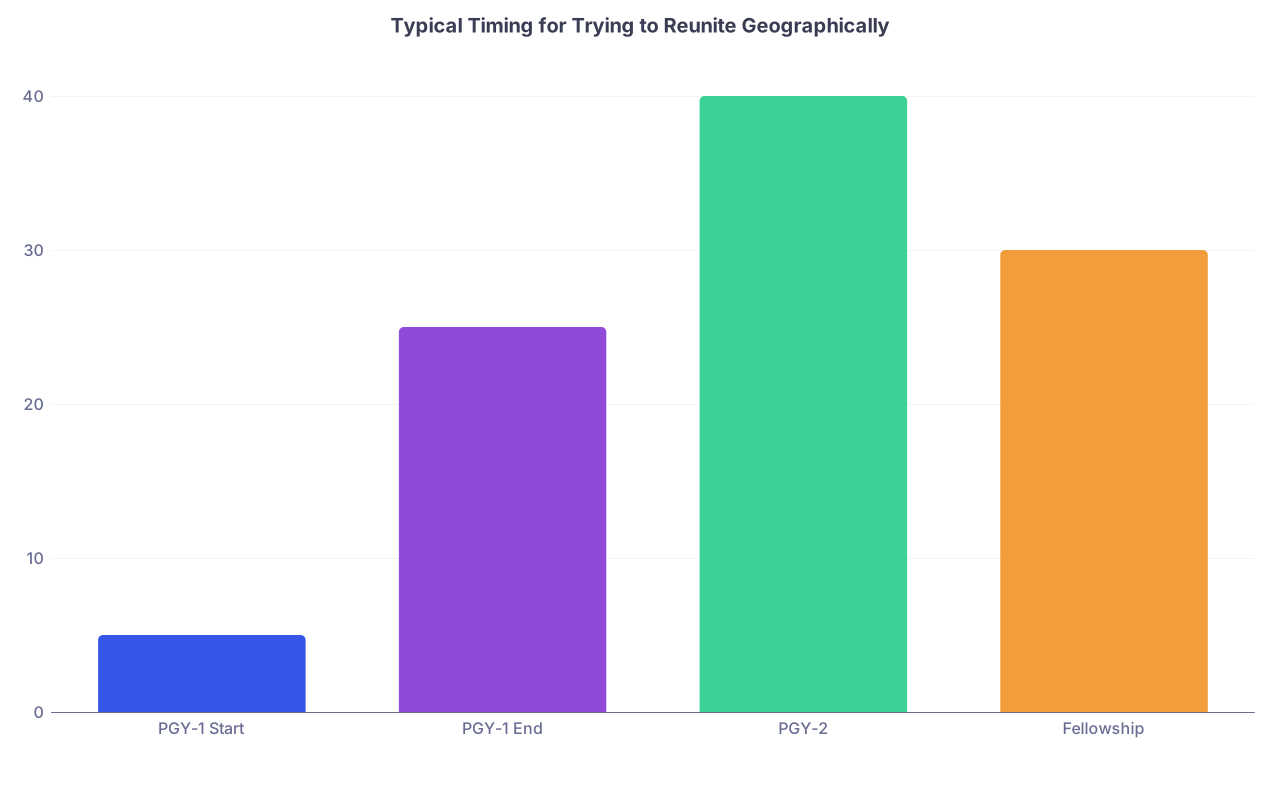
| Category | Value |
|---|---|
| PGY-1 Start | 5 |
| PGY-1 End | 25 |
| PGY-2 | 40 |
| Fellowship | 30 |
Interpretation: Rough, not scientific — I’ve simply seen far more successful moves at end of PGY-1 or during PGY-2 than during orientation.
Step 7: Protect Yourself Individually While Protecting the Relationship
You cannot pour from an empty tank. And residency loves to empty tanks.
1. Build a support system in your own city
Your partner cannot be your only emotional outlet. That’s the fastest route to suffocation.
You need, in your own location:
- 1–2 co-interns or residents you actually like and can vent with
- A non-med friend or group if possible (gym, church, hobby)
- At least one attending or senior who is decent and not a monster
Your partner does not need a play-by-play of every bad day. Some things should get processed locally so that your calls aren’t just misery dumps.
2. Decide how honest you’ll be about bad days
You have to strike a balance between “I tell you everything” and “I protect you from all my stress and end up emotionally distant.”
Talk about it:
- Do you want to hear about each other’s bad shifts in detail?
- Is it okay to say, “I had a terrible day, I don’t have energy to rehash it, can we just watch something together?”
- How do you both interpret emotional withdrawal: as rejection, or just exhaustion?
Act like adults here. You’re both in medicine. You know darkness is part of the deal. The question is how you share it without drowning each other.
Step 8: If You’re Considering Ending the Relationship
Let’s be blunt: sometimes the tough Match outcome is just the accelerant for a relationship that was already unstable. Or it reveals that long-term, your priorities don’t align.
If you’re considering ending things:
- Don’t do it in the immediate Match-Day emotional chaos unless there was already a clear, pre-existing dealbreaker.
- Don’t half-break-up. If you decide to end it, end it. Don’t hover in “let’s see but we’re basically not together.” That wrecks both of you.
- If you stay, stay on purpose. Not by inertia, not because “we’ve already been together so long,” not because you’re scared to be single in residency.
Sometimes the grown-up choice is: “We love each other, but our career goals and geography make this unsustainable, and we’re not willing to compromise enough to fix that.” Painful, but clear.
Quick Reality Check: What Actually Predicts Whether You’ll Make It?
From watching years of residents and med students do long distance, here’s what actually predicts survival better than “were you physically close on Match Day”:
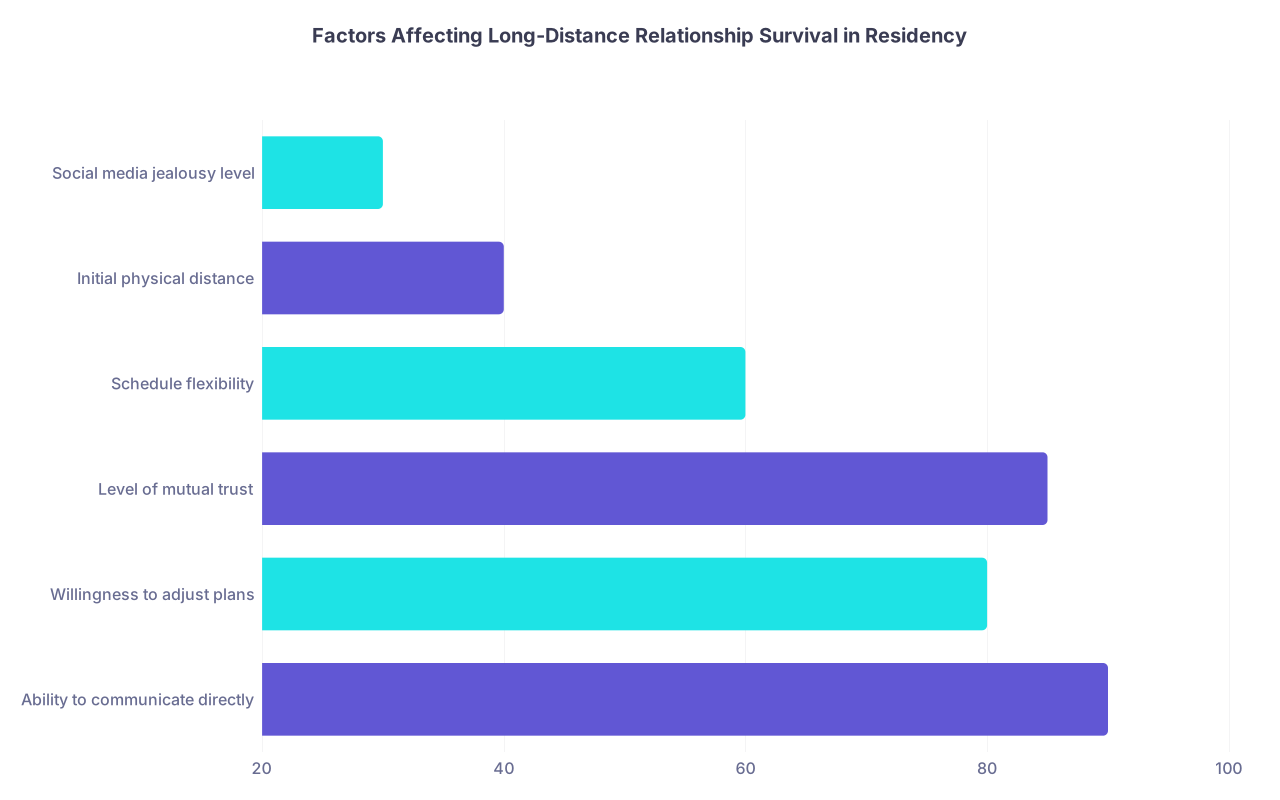
| Category | Value |
|---|---|
| Ability to communicate directly | 90 |
| Willingness to adjust plans | 80 |
| Level of mutual trust | 85 |
| Schedule flexibility | 60 |
| Initial physical distance | 40 |
| Social media jealousy level | 30 |
The big three that matter most:
- Can you both communicate directly, even when tired and angry?
- Are you both willing to adjust your career or lifestyle at least somewhat for the other?
- Do you fundamentally trust each other, or is this built on fear and insecurity?
If those three are strong, physical distance is survivable. If those three are weak, all the geographic closeness in the world will not rescue you.
FAQs
1. Should we have couples matched in the first place if we ended up apart?
Hindsight is always brutal. You can sit here and autopsy your rank list for the next year, or you can accept this: you made the best decision you could with the information you had. Couples matching is not a guarantee; it’s a way to influence the outcome.
Ask one useful question: “If we had ranked independently, would we be in a clearly better position now?” If the answer is no or unclear, let the self-blame go. If the answer is yes, learn from it for fellowship or future moves, but don’t keep stabbing yourself with it. It changes nothing today.
2. Is it realistic to try to transfer after PGY-1 just to be with my partner?
Yes, it’s realistic. It’s not guaranteed. Programs absolutely consider partner location as one factor, especially if you’re a strong resident, but they’re not going to create spots out of thin air. Your first responsibility is to be excellent where you are. Then, if you still want to pursue a transfer, talk candidly with a trusted chief or PD: “My partner is in X city. If a spot ever opened there or nearby, would you support me exploring that?”
If you sense strong resistance from your PD, you plan your moves more quietly and over a longer time frame (end of PGY-2, fellowship).
3. How often do long-distance resident couples actually see each other?
In practice, I’ve seen functional couples manage:
- Driving distance (3–6 hours): often twice a month or more, especially on lighter rotations.
- Short flights (1–2 hours): every 4–6 weeks, sometimes more if finances allow and schedules align.
- Long flights / cross-country: every 6–8 weeks in PGY-1, maybe every 4–6 weeks later if schedules improve.
More important than frequency is predictability. If you both know, “We’re seeing each other on X date,” it gives you a psychological anchor. Random, last-minute visits are nice surprises but not a stable strategy.
4. How do we keep intimacy alive when we’re exhausted and apart?
You’re not going to be movie-level romantic every week. Aim for something more human and sustainable:
- Use video or voice notes on days you’re too tired to talk live. A 30-second “here’s what I loved about you this week” message goes a long way.
- Have a shared activity once a week that’s not just debriefing your misery: watching a show together, reading the same book, playing an online game, cooking the same meal on FaceTime.
- Talk occasionally about the future beyond residency. Not every day, but enough that you both remember this isn’t just endless grind.
And yes, schedule sex when you’re together if you have to. You schedule literally everything else.
Open your calendar and your partner’s calendar right now. Pick the first month of residency and identify one likely weekend you both might be able to visit, even tentatively. Put it in both calendars. You can move it later—but give yourselves something concrete to move toward, not just something vague to hope for.