
The couples match can blow up even the strongest relationship if you walk into Match Day without a plan.
This isn’t about whether coupling is “worth it.” You already did it. Now you’re staring down the scenario no one likes to talk about: only one of you is happy with the outcome.
I’m going to assume three things:
- You care about each other.
- You both still care about your careers.
- You do not want to decide your future in a 5‑minute meltdown after opening that email.
Good. Let’s build scripts and concrete game plans for the most common ugly-but-real versions of “only one is happy.”
1. The Core Rule: Decide Your Rules Before Match Day
If you’re reading this before Match Day, you’re already ahead. If you’re reading it after? You’ll still use the scripts, but you’ll wish you had this talk earlier.
You need one core agreement:
Match Day is not the day you decide your relationship or your career.
It’s the day you learn the problem you’ll be solving together.
Say that out loud to each other at least once this week.
Here’s the 10‑minute pre‑Match script I recommend couples literally read to each other.
Pre‑Match Agreement Script
You:
“On Match Day, whatever happens, we are not making any big decisions about:
– Breaking up
– Getting married
– One of us quitting or switching specialties
– One of us declining a position
That stuff waits at least 7 days. Deal?”
Partner:
“Deal. On Match Day we’re just going to:
– Open the email together
– Acknowledge how each of us feels
– Avoid blaming each other or ourselves
– Take a pause before talking logistics”
You:
“If only one of us is happy, we both agree:
– The happy person is allowed to be happy
– The unhappy person is allowed to be upset
– Neither of us is the villain for what a computer algorithm did.
We’re going to treat this like a shared problem to solve, not a competition of who ‘sacrificed more.’ Agreed?”
Partner:
“Agreed. And we’ll schedule a real sit‑down conversation within the week to plan next steps.”
That one conversation won’t fix everything, but it will blunt the worst impulse: panicking and saying something you can’t unsay.
2. The Four Big Scenarios (And Immediate Scripts)
Let’s get specific. Here are the most common “only one is happy” couples match outcomes.
| Scenario | Short Description |
|---|---|
| A | One at top choice, other at low-ranked |
| B | One in dream specialty, other unmatched |
| C | One in desired city, other far away |
| D | One thrilled with program, other regretting specialty |
Scenario A: One Matched at Top Choice, Other at Bottom of List
This one is poison if you don’t manage it early. Happy partner feels guilty. Unhappy partner feels cheated and resentful.
Immediate script (first 24 hours):
Happy partner:
“I’m really excited about [Program]. I’ve wanted this for a long time. I also see that this didn’t go how you wanted, and I’m not going to pretend it did. I want you to know I am allowed to be happy about mine, and you are allowed to be upset about yours. Both can be true. We’ll figure out how to make your situation better, but not today. Today I just want to be on your team.”
Unhappy partner:
“I’m glad you got [Program]. I really am. I’m also pretty crushed about mine. I may not say everything perfectly while I’m upset, so if I sound short or withdrawn, it’s about me processing, not about you. I do not want you to hide your happiness, but I might need some space now and then while I deal with this.”
Boundary to agree on:
For the first 72 hours, no “I should’ve ranked differently” spirals. Nothing good comes from post‑hoc fantasy lists in the first week.
Practical “Day 2–7” steps for the unhappy partner:
- Quietly research your program:
- How often do people match out after PGY‑1?
- What fellowships do they place into?
- What’s the vibe on Reddit / AMA / alumni?
- Identify 1–2 realistic upsides you can hold onto:
- Strong procedural exposure
- Excellent mentoring reputation
- University name that travels well
You’re not gaslighting yourself into loving it. You’re giving your brain something other than “I lost.”
Scenario B: One Matches, the Other Does Not
This is the nightmare. I’ve watched this blow up couples because nobody prepared for the emotional whiplash.
Emotionally, unmatched partner often feels:
- Shame
- “Dead weight” in the relationship
- Urge to downplay or sabotage the other’s happiness
You cannot let shame drive the next 48 hours.
Immediate script (right after NRMP email):
Matched partner:
“I matched. I’m relieved. I also see that you didn’t, and that hurts. I’m not going anywhere, and this doesn’t change my opinion of you as a physician. For today, my priority is you. We can celebrate mine later. Right now I’m with you for SOAP and next steps.”
Unmatched partner:
“I’m devastated, and I’m going to need your help for SOAP and for the next few weeks. I’m also glad you matched and I want to celebrate that, just… not today. Right now I’m in survival mode.”
Now the practical part.

| Step | Description |
|---|---|
| Step 1 | Unmatched Email |
| Step 2 | Allow 1-2 hours emotion |
| Step 3 | Check eligibility for SOAP |
| Step 4 | Meet with dean or advisor |
| Step 5 | Identify realistic SOAP targets |
| Step 6 | Submit applications |
Your roles for SOAP week:
Matched partner:
- Block out specific SOAP blocks in your calendar (even if clerkships are “mandatory”)
- Run logistics: food, water, schedule, tech, spreadsheets
- Be the assertive one emailing advisors: “Can you hop on a quick call with us today about SOAP options?”
Unmatched partner:
- Own the final decisions, even if you’re leaning on your partner for data
- Stay attached to your own email and NRMP messages
- Let yourself be upset, but do not disappear during SAP/ SOAP windows
Important: The matched partner does NOT:
- Suggest prematurely: “Maybe you should pivot to a less competitive specialty”
- Turn this into a story about the relationship needing to “recalibrate” right away
- Say, “It’ll all work out” every 10 minutes. It’s annoying and hollow.
Scenario C: One Lands in the Ideal City, Other Ends Up Far Away
This is where the long‑distance reality hits. Maybe you couples‑matched but landed in different hospitals 90 minutes apart. Or worse, you failed to couple and ended up many states apart.
First, distinguish two situations:
- Commutable distance (under ~75–90 minutes)
- True long‑distance (different cities/states)
For commutable:
You sit down and build a literal weekly schedule.
| Day | Where You Sleep | Non-Negotiables |
|---|---|---|
| Mon | City A | Pre-rounding & sign-out |
| Tue | City A | Didactics |
| Wed | City B | Clinic day |
| Thu | City B | Night float |
| Fri | Alternating | Social / reset |
You will not “figure it out as you go.” That’s how resentment creeps in.
For true long‑distance (different cities/states):
Immediate 1‑week script:
You:
“We’re committed through at least intern year. We can revisit our relationship structure after we’ve both seen what our programs are like. I don’t want us trying to solve PGY‑4 logistics before we’ve even survived orientation.”
Partner:
“Agreed. Let’s set a six‑month check‑in where we talk honestly about how long‑distance is affecting us, what’s sustainable, and what’s not.”
Then you draft a basic structure:
- How often you’ll visit (realistically, with call schedules—not fantasy)
- Minimum communication standard:
- Example: one 10–15 minute check‑in call daily, even on call days
- One “protected” longer call weekly (no multitasking, no notes open)
Scenario D: One Is Thrilled With Specialty, Other Is Already Regretting Theirs
This one’s subtle but dangerous, because it can metastasize into, “You got everything you wanted, I settled.”
Here’s how it often sounds:
- Happy partner: “I can’t believe I get to be a dermatologist in [Top Program]!”
- Unhappy partner: “Yeah. I guess I’m just… going to be tired and miserable for three years.”
First 48‑hour rule:
No career‑change decisions. No “maybe I should do a prelim year then reapply.” Your judgment is garbage while your brain is grieving your fantasy future.
What you can do:
Unhappy partner:
- Journal or voice‑note what exactly feels wrong:
- The specialty itself?
- The program location?
- The program vibe?
- Comparing yourself to your partner?
- Describe it concretely: “I’m worried I will hate the lifestyle,” not “My life is over.”
Happy partner:
- Do not try to sell your partner on their match:
“You’ll grow to love it” is not comforting. - Instead:
“I hear that you’re scared this will make you miserable. I’m not going to minimize that. Let’s get you talking with 1–2 residents there before you decide how bad it really is.”
Within 2–4 weeks, the unhappy partner should:
- Schedule calls with:
- A current resident at their program
- A graduate who used that residency as a springboard to something else (fellowship, different practice style, etc.)
- Ask specifically:
- “What do people who are borderline about this specialty end up doing after?”
- “How feasible is it to pivot after PGY‑1 or after residency?”
You’re building a map, not committing to an exit.
3. How to Talk About It Without Destroying Each Other
You can get through asymmetry. What kills couples is the way they talk about it.
Here’s a structure you can steal for your first real debrief (ideally 2–7 days after Match).
Set the scene:
- Phones silent, face‑down
- No alcohol
- 45–60 minutes max
Use this 4‑step flow:
Each person takes 5 minutes to describe their internal state
“I feel…” not “You made me…”Each person gets 5 minutes to describe their fears
“I’m afraid that…” not “You will…”Together, list what’s actually in your control over the next 12 months:
- Program‑specific opportunities
- Where you live
- How often you see each other
- How much you apply for research, leadership, away rotations, etc.
Then pick 1–2 concrete decisions to make now, and explicitly defer the rest.
Example language:
You:
“Over the next year, here’s what I think we can decide now:
– Where we’ll live relative to our programs
– Our baseline visiting/call schedule
We’ll defer:
– Whether one of us tries to transfer programs
– Whether we stay together after intern year
until at least [specific date 6–12 months out].”
Partner:
“That works. I’m committing to not using ‘you got a better match’ as shorthand for every problem we have. If I feel resentment building I’ll say that directly instead of sniping.”
4. Practical Planning Moves When Only One Outcome Is “Good”
Feelings aside, you need logistics. Let’s talk strategy, not vibes.
Housing and Commutes
If one program is clearly stronger geographically (safety, affordability, support systems), that’s your anchor. Even if the other person’s program is “better” on paper.
General rule:
- Anchor where the more miserable/rigorous schedule is, not the happier person.
Why? Because the more overworked partner will not commute well. They’ll crash their car or your relationship.
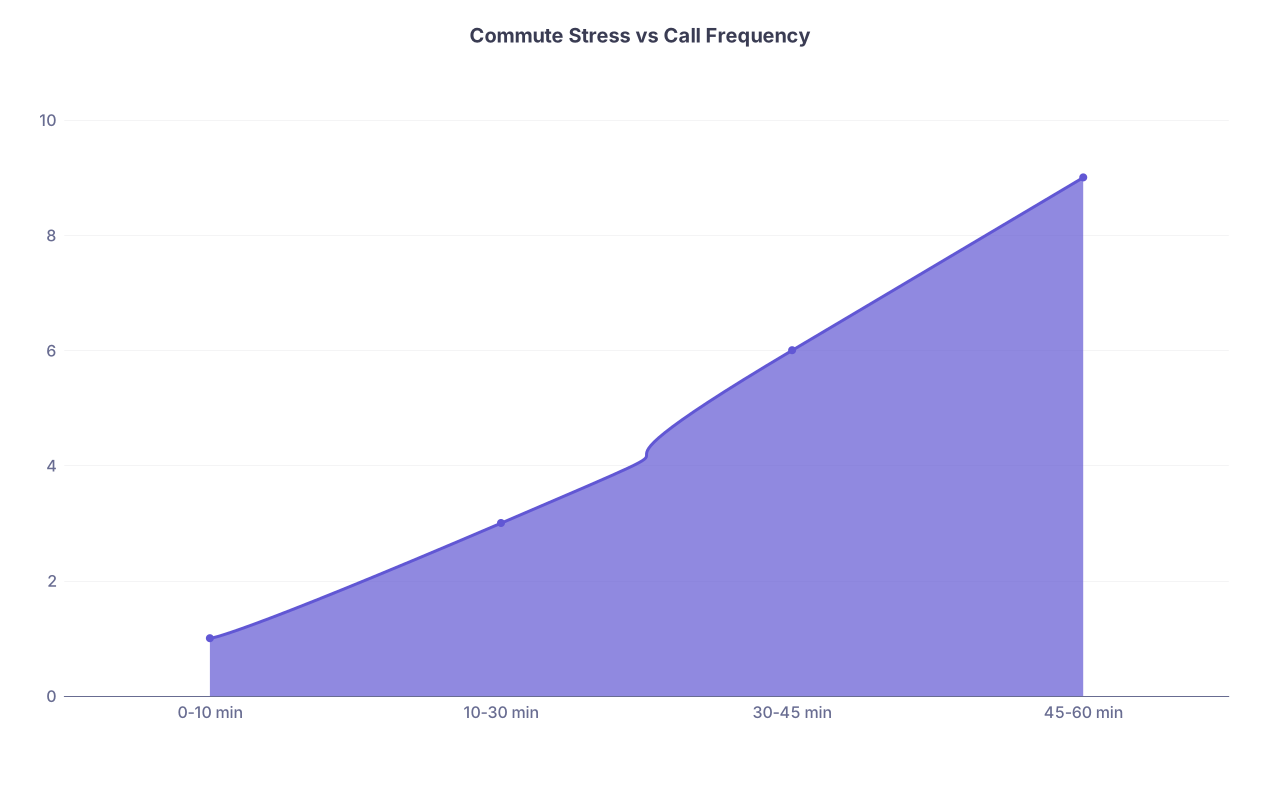
| Category | Value |
|---|---|
| 0-10 min | 1 |
| 10-30 min | 3 |
| 30-45 min | 6 |
| 45-60 min | 9 |
Think of “stress score” above as exponential. A 15‑minute commute is fine. A 60‑minute commute on Q4 call is misery.
So:
- If one of you is in surgery with 5am rounds, the other in psych with 8:30am clinic?
You live near the surgeon. - If one of you is thrilled in derm and the other is dreading IM nights?
You live near the IM hospital.
Career Damage Control for the Unhappy Partner
Let’s be blunt: one of you got the clear “win” in this match. The other needs a deliberate development plan so their career doesn’t just drift for three years while they’re resentful.
Within 2–3 months of starting residency, unhappy partner should:
- Identify 1–2 mentors (can be outside program, even virtual)
- Clarify a 3‑year “salvage” plan, for example:
- Use IM at a mid‑tier program to set up for cardiology fellowship
- Use a community gen surg spot to lateral into academic surg via research years
- Use a prelim year to strengthen application for a different specialty (if realistic)
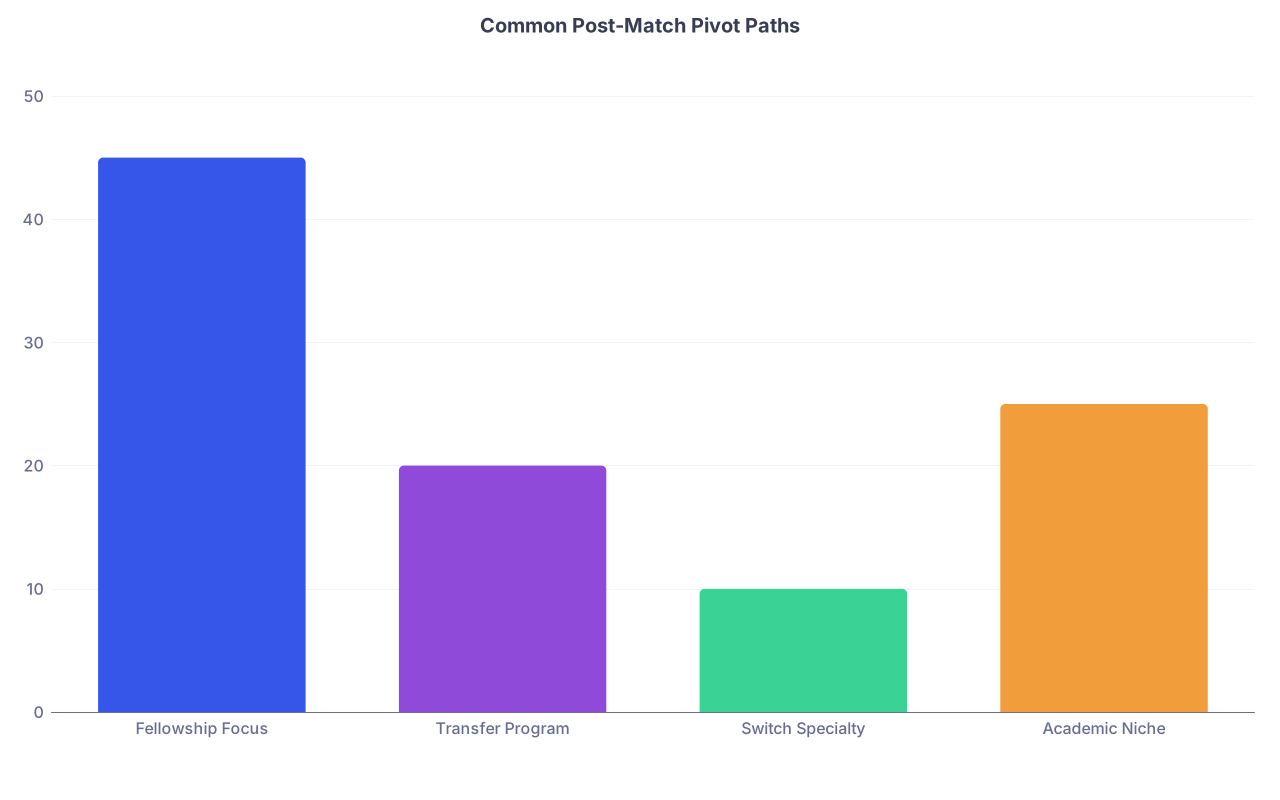
| Category | Value |
|---|---|
| Fellowship Focus | 45 |
| Transfer Program | 20 |
| Switch Specialty | 10 |
| Academic Niche | 25 |
Those numbers aren’t from NRMP—they’re representative of how I see people actually claw their way to satisfying careers after a “disappointing” match. Most don’t blow it all up. They pivot.
5. Protecting the Relationship While Careers Diverge
You can’t stop the fact that one career just got a boost. You can stop that difference from quietly rotting the relationship.
Here’s what usually goes wrong:
- The happy partner starts censoring themselves: “I won’t talk about how excited I am because I don’t want to hurt them.”
- The unhappy partner feels isolated and excluded anyway, and resents both the outcome and the silence.
Better pattern:
- Agree on a “career talk” window. Example: Sunday afternoons, 30 minutes.
- During that time:
- Happy partner is allowed to be excited: “I scrubbed on this incredible case…”
- Unhappy partner is allowed to be honest: “I’m glad for you. I also felt jealous today.”
Outside that window, either of you can say:
“I want to hear more, but right now I’m saturated on career talk. Can we bookmark this for Sunday?”
It sounds formal, but structure actually de‑pressurizes the day‑to‑day.
Also: stop keeping score.
Yes, you both sacrificed for each other—all the rank list drama, cancelled away rotations, interviews you skipped together. That’s already sunk cost. There is no prize for who “gave up more.” The prize is whether you both still respect each other 3–5 years from now.

6. If You’re Reading This After Match and It’s Already Messy
Maybe you already snapped at each other. Maybe someone said, “I wish we’d never couples‑matched.” Okay. Damage control mode.
Here’s the reset script you can use literally verbatim:
You:
“I don’t like how we’ve been talking about the match. I’ve said things in anger that weren’t fair. You probably have too. I don’t want our worst moments to be what we build on. I’d like us to call a truce on rehashing the rank list and instead focus on:
- How we support each other this year
- How we each make the best of the programs we got
- How we decide, at a specific time in the future, what our long‑term path is.
Can we agree to that and schedule a real talk sometime this week?”
If they say yes:
- You go back to the 4‑step debrief structure from earlier.
- You pick 1–2 decisions, not 10.
If they say no:
- That’s your data. You may have a relationship problem that goes deeper than the match.
- Don’t fix that on your own. Use:
- Couples counseling (lots of therapists do telehealth, evenings)
- Your school’s counseling service (for individual support)
- Mentors who’ve been through couples match dynamics
7. A Quick Reality Check
I’ve seen couples survive:
- One person matching ortho at their #1 and the other SOAPing into a prelim year
- One person across the country, the other stuck in a city they hate
- One ecstatic future dermatologist, one burned‑out preliminary surgery intern
The ones who make it do a few unglamorous but crucial things:
- They say the quiet parts out loud: “I’m jealous,” “I feel like I lost,” “I’m proud of you.”
- They treat the match as one chapter, not the whole story.
- They decide on timelines: “We’ll re‑evaluate X by Y date” instead of living in vague limbo.
The match algorithm is indifferent to your relationship. That’s brutal. But how you two respond? That’s not random at all.

FAQ: Couples Match When Only One Is Happy
1. Should the happier partner “downplay” their excitement to protect the other person?
No, not long term. In the first 24–48 hours, of course you modulate. If your partner is actively crying about SOAP, you don’t pop champagne in their face. But beyond that, pretending you are not happy breeds weirdness and distance. Better: explicitly acknowledge both realities. “I’m really excited. I also see that this hurts for you, and I’m not going to rub it in—but I don’t want to hide from you either.”
2. Is it ever reasonable for the unhappy partner to ask the happy one to try to transfer programs later?
Reasonable to ask, yes. But you don’t anchor the relationship on that expectation. The transfer market is brutal and unpredictable. The healthier framing: “In a year, if things are stable for both of us, let’s revisit whether a transfer would help our lives as a whole, not just even the score.” Never demand: “You owe me a transfer because I compromised for your rank list.”
3. We already regret our rank list. Do we keep analyzing what we ‘should have’ done?
No. Post‑match rank‑list autopsies are like scratching a mosquito bite until it bleeds. You get temporary satisfaction, then more pain. Limit rank‑list talk to a single, structured debrief where you extract lessons (for future big decisions together): how you listened to each other, how you handled conflict, how you weighed risk. After that: any time one of you starts “If only we had ranked…,” the other has full permission to say, “We agreed to retire that topic.”
4. When do we reconsider the relationship itself if our paths are clearly diverging?
Set a specific review point: usually 6–12 months into residency. Before that, you’re both overwhelmed and adjusting. Any “we’re doomed” conclusion is distorted by fatigue and fear. At that review, you ask: Are we both still growing? Is this relationship adding net support or net strain? Are we willing to keep choosing each other with these careers? That conversation should be calm, scheduled, and not during a post‑call haze.
5. How do we involve mentors or family without making things worse?
Pick 1–2 people each, max. Give them the facts and your actual feelings, not a curated story. Ask for specific help: “Can you help me map career options from this program?” or “Can you reality‑check our housing plan?” What you don’t do is turn mentors or family into referees for your relationship. Any sentence that starts with “See, even Dr. X thinks you got the better deal…” means you’re weaponizing other people. That always backfires.
Key takeaways:
- The match outcome is fixed; how you talk and plan around it is not.
- Name the asymmetry, protect space for both happiness and disappointment, and set clear timelines for re‑evaluating big decisions.
- Build concrete logistics and career plans—especially for the unhappy partner—so you’re solving problems, not just reliving the algorithm.