
You wake up on Match Day to a small foot in your face and dried applesauce on your scrubs. Your inbox has the Match email. Your kid wants breakfast, Paw Patrol, and that specific blue cup that’s somehow disappeared. You’re solo parenting. And the biggest professional email of your life is about to land.
Everyone else talks about champagne, group photos, and “the moment” they open the email together. You’re thinking: Who watches my kid? What if I don’t match? What if I cry? What if I’m ecstatic and my toddler chooses that exact moment for a meltdown?
This is not a “normal” Match Day. You do not have a built-in co-parent buffer. You have to engineer both childcare and emotional space on a day when your phone will not stop buzzing.
Let’s handle this like a real situation, not an Instagram fantasy.
Step 1: Decide Exactly How You Want Match Day to Look
Before we talk logistics, you need a picture in your head. Because “I’ll just see how I feel that morning” is how you end up crying in a bathroom stall with your kid banging on the door.
There are three basic Match Day modes for solo parents:
- Private and quiet
- Shared but controlled
- Big, public, ceremonial
You’re allowed to pick any of them. You’re also allowed to pick a different plan than your classmates.
Ask yourself these specific questions:
- Do I want my child with me at the exact moment I open the email?
- If I get bad news, who do I want physically present in the first 10 minutes?
- If I get good news, who do I want present?
- Will my kid’s needs (nap, food, sensory overload) make any of this impossible?
Now commit. Literally write it down:
“On Match Day at [time] I want to open my email while [location], with [people/no one] present, and [child status: with me / in another room / with sitter].”
If you can’t answer that sentence, you’re not ready to schedule childcare.
Step 2: Build a Childcare Plan That Assumes Things Go Wrong
You’re not just planning “who watches the kid.” You’re planning for:
- Delayed emails
- Tech issues
- Emotional fallout
- A clingy or sick child
- You being too overwhelmed to parent well for a few hours
Match Day is not the day to wing it.
Choose Your Match Day “Anchor Person”
You need one primary adult whose job is: keep the kid safe and occupied so you can have a real emotional moment.
This might be:
- A grandparent
- A sibling
- A close friend
- A trusted neighbor
- A paid sitter you’ve used before
Who it should not be:
Someone flaky, new, or emotionally volatile about your Match outcome.
Tell them, very directly:
“I need you on [date] from [time range]. Your job is to take care of [child] while I open my Match email and deal with the fallout. I may need 30–90 minutes where I am totally unavailable. Are you okay with that?”
Do not sugarcoat. If they hesitate, they’re not your anchor person.
Set Up Primary + Backup + Emergency
You’re a solo parent. You already know plans implode. On Match Day, you want layers:
| Layer | Who | Role |
|---|---|---|
| Primary | Anchor person | Main childcare |
| Backup | Second person | Steps in if primary cancels |
| Emergency | Last resort | Phone support / short coverage |
Text or call each one this week. Confirm times, addresses, and expectations. Put them in your phone as:
“Match Day – [Name] – Primary” “Match Day – [Name] – Backup”
Yes, literally rename the contact for that day if you need to.
Decide Where the Child Will Be
You have three main options:
Child out of the house (anchor takes them out / to their place)
- Best if your home is small and you’re easily overstimulated
- Gives you actual quiet to open the email and cry/scream/whatever
- Downside: logistics, car seats, drop-off
Child in another room
- Works if you trust your anchor to keep them fully engaged
- You’ll still hear them. Be honest about whether that will wreck your focus
Child with you when you open the email, then leaves
- Good if you want them “in the moment” but not for the full emotional fallout
- Requires a clear handoff plan: “We open the email at 11:00, then at 11:05 you take them to the playground for an hour.”
Pick one. Communicate it to your anchor person now, not the morning of.
Step 3: Engineer Emotional Space Like It’s a Procedure
You’re not just planning logistics. You’re planning your emotional operating room.
You need:
- Time block
- Physical space
- Communication rules
- A “bad outcome” protocol
- A “good outcome” protocol
Block Out a Protected Time Window
Check what time your Match email is expected. Then protect a larger window around it.
For most people, something like:
- 30 minutes before email time
- 60–90 minutes after email time
That’s your “do not parent, do not answer non-critical texts” zone if at all possible.
Tell your anchor:
“I need you fully in charge from [time 1] to [time 2]. I may turn my phone on Do Not Disturb. If there is not blood or fire, please don’t knock.”
You have to say it that bluntly. People underestimate how intense Match feelings are.
Pick Your Physical Space
Where exactly are you opening the email? List pros/cons.
Common spots:
- Your bedroom with door closed
- A friend’s apartment
- A quiet coffee shop (not my favorite for solo parents—too public)
- Your car in a quiet parking lot
- Hospital library room you reserved
I’ve seen solo parents do this well by:
- Dropping kid with anchor
- Driving literally 5 minutes away
- Parking somewhere quiet
- Opening the email in the car
- Calling 1–2 key people from there
- Coming back when they can somewhat function again
Not glamorous. Very effective.

| Step | Description |
|---|---|
| Step 1 | Childcare arranged |
| Step 2 | Drop off / handoff |
| Step 3 | Go to chosen location |
| Step 4 | Open Match email |
| Step 5 | Call 1-2 people |
| Step 6 | SOAP/Next steps |
| Step 7 | Rejoin child |
| Step 8 | Outcome |
Decide Your Communication Rules
Match Day can turn your phone into a grenade.
Set rules before:
- Who gets told first, second, third?
- Who gets a text only, no call?
- Who gets nothing today because they’re emotionally exhausting?
Make a short list in order:
- Person I call no matter what (1–2 max)
- People who get a short text template
- People I’ll respond to later or not at all today
Yes, you’re allowed to mute group chats. Yes, you’re allowed to not respond to “???” texts.
Step 4: Plan for Both Outcomes Like an Adult, Not an Optimist
You hope you match. Good. You also owe it to yourself and your kid to plan for “I did not match” while you’re still relatively calm.
If You Match
You still might:
- Hate the location
- Be shocked by the specialty
- Feel relief + grief + panic at once
So plan:
Initial reaction space
- Give yourself at least 10–15 minutes alone after opening, even if it’s good news
- Cry, swear, scream, sit in silence—whatever
Short script for your child
Your kid does not need a TED talk about NRMP.It can be:
- Toddler: “Mommy’s going to be a doctor in [City]! I’m happy and a little nervous.”
- Older child: “I matched at [Program] in [City]. That means we’ll be moving / staying here. I might be a little emotional today, but I’m okay.”
Short script for social media/classmates
Decide in advance whether you’re posting at all. If you are, write a short template so you’re not stress-editing while crying.Grounding plan
After the high, there’s a crash. That’s when parenting hits hard. Have something low-key planned with your kid later:- Park
- Movie night
- Takeout picnic on the floor
Your child is your anchor back to normal life. Use that.
If You Do Not Match
This is brutal. It feels like the oxygen just left the room. You’re also still a parent with a kid who wants snacks.
You need a specific plan you can follow on autopilot.
Before Match Day, set up:
- A “bad outcome” friend: The person you call who will not say, “Maybe it’s for the best.”
- A SOAP plan: Where to go, who to email, what the timeline is.
- A kid script: Something age-appropriate that does not dump your panic on them.
Sample script for your anchor person (send now):
“If I don’t match, I might need you to keep [child] longer than planned, maybe the rest of the afternoon. I may be very quiet or crying. I don’t need advice, just coverage and time.”
Sample script for yourself (write in your notes app):
“If I don’t match:
- Breathe for 2 minutes.
- Call [name].
- Pull up SOAP instructions email.
- Text [anchor] if I need longer childcare.
- Do not make any permanent decisions today.”
Your kid script, simple:
- Younger child: “My job is to find a doctor job. It did not work out today, so I am sad. I’m working on the next steps. I love you and I’m okay even if I’m crying.”
- Older child: “Today’s email was not what I hoped for. There’s another process I’ll be working on this week. I’ll be stressed, but it’s not your job to fix it. We’re still okay.”
If you’re in the “did not match” group, your emotional space is not a luxury. It’s part of your ability to function for SOAP. Fight for it.
Step 5: Normalize Your Kid’s Experience (and Yours)
Solo parents get hit with guilt on Match Day.
“I should include them.”
“It’s selfish to want to be alone.”
“I’m a bad parent if I can’t be fully present when the email comes.”
No. This is a medical emergency-level day for your career. Your kid needs:
- Safety
- Basic routines
- A parent who is not actively falling apart in front of them for hours
Having them with an anchor while you open the email is often the most protective thing you can do.
Age-Specific Tips
Under 3 years old
- They won’t remember specifics. You’re planning for your regulation, not their memory.
- Prioritize: naps, snacks, familiar caregiver.
- Avoid big loud Match ceremonies. Overstimulating for them, impossible for you.
3–7 years old
- They’ll pick up that it’s “a big day.”
- Keep explanations short, then back to normal routine.
- Matching or not, aim for something familiar in the afternoon: park, favorite show, same bedtime story.
8+ years old
They can understand basic success/disappointment.
They may want to be included more. You can still create boundaries:
“I’m going to open the email alone first. Then I’ll come tell you. I might cry even if it’s good news, because it is a lot of emotion. That’s okay.”
Remember: Your job is not to stage a Hallmark moment. It’s to protect both your mental health and theirs.
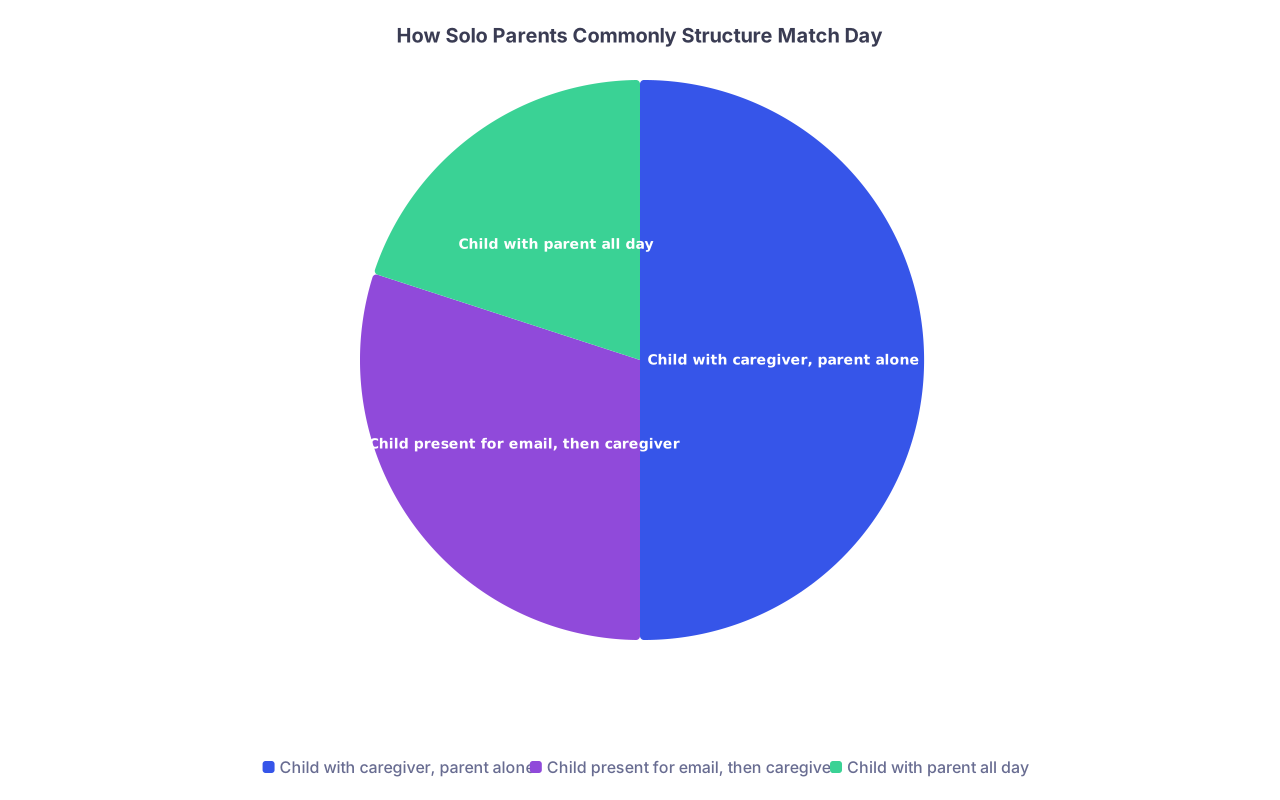
| Category | Value |
|---|---|
| Child with caregiver, parent alone | 50 |
| Child present for email, then caregiver | 30 |
| Child with parent all day | 20 |
Step 6: Coordinate With Your Program / School Realistically
If your school does a big envelope ceremony, you need to decide if that makes sense for you.
Questions to ask yourself:
- Can I safely bring my child there (stroller? noise? crowds?)
- Do I actually want 200 people watching my reaction?
- Who’s going to watch my kid if I end up in a corner sobbing?
A few realistic setups I’ve seen work well:
Solo parent skips big ceremony entirely. Opens email at home with anchor watching the kid. Joins classmates later for photos if they feel up to it.
Solo parent attends ceremony, but arranges for a friend/relative to be on “full kid duty” (even standing at the back with the stroller) so the parent can step forward, open envelope, and react without a toddler grabbing the paper.
Parent opens email early at home, processes emotions, then goes to ceremony just for the social aspect, already knowing the outcome.
None of these are wrong. What’s wrong is pretending you can juggle toddler, envelope, phone, and your nervous system like someone who doesn’t have childcare on their mind.
If you’re already in residency (e.g., SOAP or fellowship) and your current program expects you to work on Match Day, that’s another layer. You may need to:
- Ask for a 30-minute protected window
- Let your senior know now that you’re solo parenting and have specific timing needs
- Arrange childcare timing around your shift start/finish
You are allowed to say: “I’m the only caregiver for my child; I have a tight window on Match Day that I need protected.”
Step 7: Pre-Pack the Day Like It’s a Long Call Shift
Decision fatigue will be sky-high. So front-load it.
The night before Match Day:
- Lay out clothes (for you and your kid).
- Pack diaper bag / backpack.
- Prep kid snacks + easy meals.
- Charge your phone and laptop.
- Confirm childcare by text: “We’re still on for tomorrow from [time] to [time], right?”
- Write down your “bad outcome” steps and “good outcome” steps on a literal piece of paper.
If you’re leaving the house to open your email, pack a small “emotional go-bag”:
- Tissues
- Water
- Simple snack
- Phone charger
- Small notebook + pen (yes, sometimes writing is steadier than typing when you’re shaking)
You are not overpreparing. You are being a solo parent on the biggest day of your training path so far.

Step 8: Give Yourself Permission for a Weird Day
Match Day as a solo parent is almost guaranteed to feel…off.
You might:
- Feel strangely numb.
- Be over-the-top cheerful with your kid and then sob in the shower.
- Get angry at classmates posting “couldn’t have done it without my amazing spouse!!”
- Alternate between hugging your kid like a life raft and wishing you had 12 hours totally alone.
All of that is normal. You’re carrying two realities at once:
“I’m a parent who has to keep functioning.”
“I’m a trainee whose entire professional trajectory just shifted.”
You’re allowed to be messy. You just need containers for the mess so it doesn’t spill all over your child.
That’s what this entire plan is: containers.
FAQs
1. What if I have no local family or close friends to help with childcare?
Then you treat this like you would backup childcare for call or a night shift. Use a trusted paid sitter you’ve used before, or ask a classmate or resident who you already know is solid with kids. If that means paying extra for the day or swapping coverage later (you help them move, babysit their kid, cover future call), that’s worth it. The key is: not a brand-new sitter, and not someone you barely trust. If you truly have no one, your backup plan becomes: kid stays home, but you still plan a separate room or time where you can step away for 15–20 minutes while they’re safe with a screen / toys / baby gate.
2. Should I let my child be there when I open the email?
Only if you’re okay with them being part of an unfiltered reaction—good or bad. Very young kids won’t understand but may get freaked out by intense crying or screaming. Older kids might misinterpret disappointment as catastrophe. My bias: younger than 5, have them with a caregiver for the exact moment you open it. Older than 5, you can consider including them after you’ve opened and had at least a few minutes to regulate.
3. How do I handle social media as a solo parent on Match Day?
Decide in advance whether you’re posting at all. If you match and want to share, keep it short and honest; you don’t owe anyone a big family-like announcement. If you feel bitter seeing couple/family posts, mute or log out for the day. You’re not required to perform happiness (or vulnerability) publicly. And if you don’t match, it’s completely valid to say nothing online and only communicate with your inner circle.
4. What do I tell my child about moving for residency if they’re school-aged?
Keep it concrete and phased. First: “I matched at a hospital in [city]. That means we’ll be moving there in [month].” Then focus on what will stay the same (you as their parent, favorite toys, routines) and what will change (house, school, friends). You do not need to explain every detail on Match Day itself. Match Day is “the news”; the following weeks are for real planning conversations, school visits (even virtual), and letting them have their own feelings about it.
5. How do I handle Match Day if I’m also co-parenting with an ex?
Decide in writing who has physical custody on Match Day and what role, if any, the other parent will play. If your ex is supportive and you can tolerate being around them, they can be an anchor person. If not, keep boundaries tight: they have the child or you do, but they’re not your emotional support. Do not rely on an unstable or combative ex for Match Day childcare; that’s a setup for drama on a day you can’t afford it. If needed, use your legal custody schedule, ask for a swap, and confirm it formally ahead of time.
Take one concrete next step today: open your calendar, block a 2-hour window around your Match email time, and text one person to be your Match Day anchor for childcare. The rest of the plan gets a lot easier once that piece is locked in.