
You are standing in a noisy auditorium on Match Day. People all around you are hugging, crying, FaceTiming parents. Your phone buzzes nonstop. Group chats are blowing up:
“Did you match at your #1??” “Bro, you ranked us #2 right??” “Tell me you ranked us high, we told the PD we planned to rank each other.”
You hesitate before answering, because a month ago you did the thing that felt harmless. You showed your “trusted” classmates your rank list. Swapped screenshots. Talked about where you put your partner, your best friend, that “safety” program you secretly hate.
Now you are realizing just how exposed you are. And there is no undo button.
This is the mistake I want you to avoid: over-sharing your rank list. With friends. With partners. With mentors. With anyone who is not NRMP, you, and maybe one or two truly trusted advisors who know how to keep their mouth shut.
Let me walk through how this goes wrong. Not in theory. In practice. On Match Day and for years after.
The Core Problem: Your Rank List Is a Loaded Weapon
Your rank list is not just a list of preferences. It is a high-resolution image of:
- Your insecurities (programs you listed low because you felt “not good enough”)
- Your ego (programs you ranked above your realistic competitiveness)
- Your loyalties (friends, partners, home institution)
- Your true priorities (prestige vs happiness vs geography vs lifestyle)
Once you share it, you lose control of that information. And humans do what humans always do with sensitive information: gossip with it, judge with it, weaponize it when relationships sour.
The biggest misconception I see:
“Everyone is sharing their list. It is just part of the process.”
No. It is not. It is part of the culture of anxious people trying to regulate their fear by dragging others into their decision-making. Do not confuse that with something wise or necessary.
Mistake #1: Turning Your Rank List into Group Project Drama
You sit down at a coffee shop with two classmates. Someone says, “Ok, let’s just show each other our lists so we can sanity check.” It feels collaborative. Adult. Transparent.
In reality, you just opened the door to three problems at once.
1. You let other people’s anxiety rewrite your list
I have watched students go into these conversations with a clear set of priorities:
- Wants to be near partner
- Prefers mid-sized city
- Loved mid-tier Program B, liked fancy Program A less
Then they share. The moment someone says:
- “You ranked B over A? That is insane. A is top 10.”
- “If you do not put your home program #1, they will be pissed.”
- “You know C only took people with 250+ last year, right?”
Your brain does what human brains do: it starts optimizing for other people’s judgment instead of your own happiness.
That is how you end up rearranging your list at 11:45 p.m. on deadline night. Not based on fit. Based on peer pressure, prestige anxiety, and fear of being the odd one out.
I have seen people cry on Match Day because they matched at the program their friends thought they should rank higher, instead of the place they originally wanted. You do not want that flavor of regret.
2. You create a fragile pact that will not survive Match Day
Groups that “agree” to rank each other’s programs highly are setting themselves up for one of two outcomes:
- Everyone miraculously matches together (rare)
- Someone does not, and feels betrayed
You rank your friend’s program #3. They rank your program #8. But only one of you gets in. Now what?
I have watched group chats silently die on Match Day because:
- One person matched at a “prestige” program they “swore” they were not ranking high
- Another ended up at their friend’s low-ranked program and found out months later
- Someone’s partner matched close to home after “definitely not ranking” a local program high
Over-sharing is not just a breach of privacy. It is a setup for relationship damage when reality does not match the promises people made under stress.
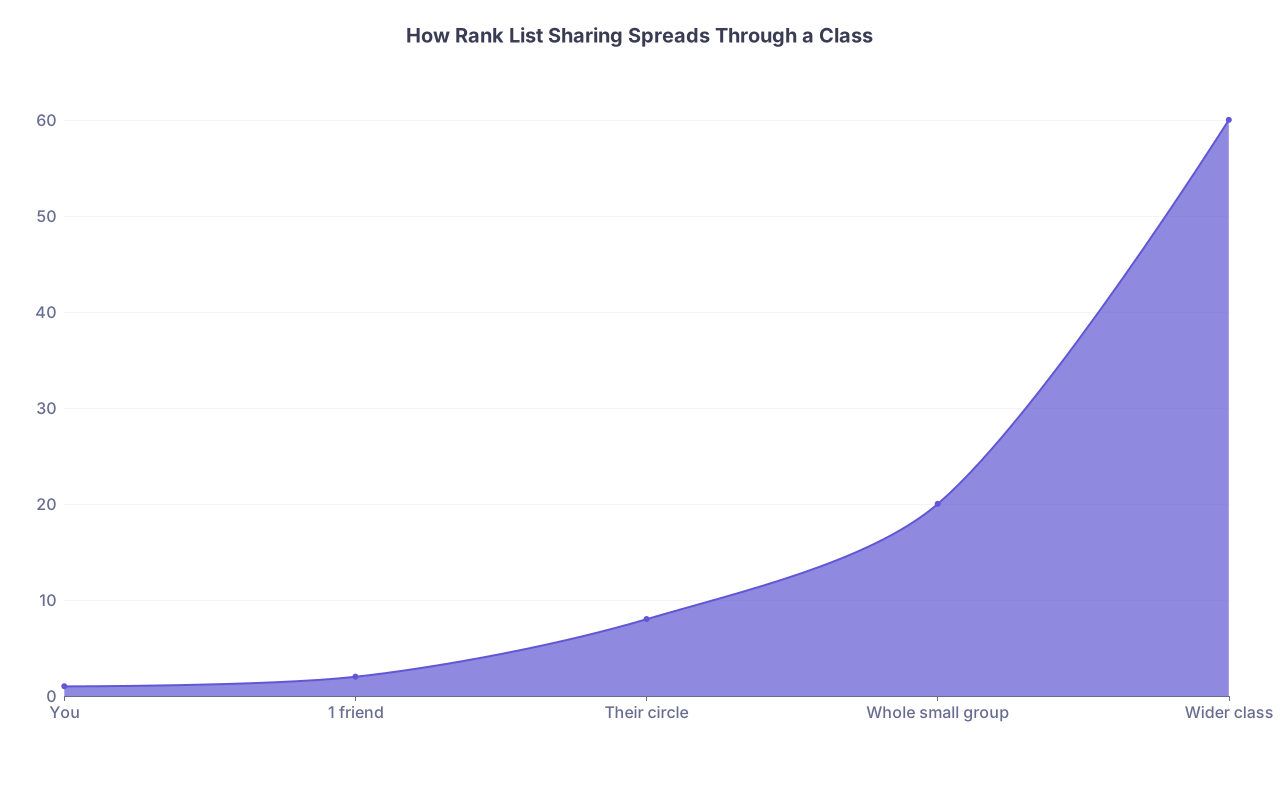
Mistake #2: Underestimating How Fast Your Rank List Will Travel
You tell one person. You emphasize, “Please do not share this.” They say “Of course.” They probably mean it.
Then this happens:
- They are talking with another close friend who is spiraling about their own rank list
- They say, “Well, [your name] ranked X #1 and Y #2, and they are kind of similar to you”
- That person mentions it to their roommate
- The roommate is dating someone in another specialty who is applying to the same city…
By March, half your class has a vague but fairly accurate sense of where you placed major programs.
| Category | Value |
|---|---|
| You | 1 |
| 1 friend | 2 |
| Their circle | 8 |
| Whole small group | 20 |
| Wider class | 60 |
You, meanwhile, are the last to know that people are talking about:
- How “ambitious” your list is
- How “safe” your list is
- How “desperate” you must be to rank that one program high
It is not that people are evil. They are stressed and bored and rank lists are social currency in February. Give them that currency, and it will be spent.
Mistake #3: Damaging Program Relationships Without Realizing It
This one is more subtle, and it can actually hurt you after you match.
Here is how it goes wrong.
Scenario 1: Your home program finds out they were not #1
Faculty are humans. Residents are humans. Many have fragile egos about where their program “ranks.”
If a resident hears from a student:
“You were my #1,”
and later hears from your friend,
“Well, actually they had X above you but were worried about not matching,”
that can sour how you are perceived. Even if subconsciously.
Worse: if you match at your home program after telling people they were low on your list, it can get awkward. I have heard interns joke bitterly:
“Yeah, I was their backup, but here I am.”
You do not want to start residency with that narrative floating around.
Scenario 2: Cross-talk between programs
Programs sometimes talk. Residents talk at conferences. Chiefs who trained together catch up. A loose comment like:
“We were surprised [your name] did not rank us higher – they told our residents they loved us.”
If someone in your applicant group has been broadcasting everyone’s rough rank order, pieces can line up. People might not be able to see your official list, but they can see patterns:
- Who told whom what
- Who seemed “genuine” vs strategic
- Who was playing both sides with multiple programs
Residency is built on reputation and trust. Starting with even a faint whiff of being two-faced is not worth a momentary ego boost of telling program X, “You’re my #1.”
Mistake #4: Hurting Your Future Self When Circumstances Change
You are creating a permanent record of your preferences at a very specific and emotionally overloaded moment in time.
Then life happens.
- You break up with the partner you ranked around
- You have a kid and suddenly care about schools and call schedule
- Your “dream” institution turns out to be malignant when you rotate as a fellow
But your friends, your partner, your family still remember:
“You told us Program A was the absolute best. You said you would never leave that city.”
That memory will resurface when:
- You want to transfer programs
- You are choosing a fellowship location
- You are job-hunting after residency
I have watched people stay in toxic environments longer than they should because they were haunted by their own public narrative from Match year. They did not want to admit they were wrong about the place they bragged about ranking #1.
You protect your future flexibility by keeping this phase quieter. Less performative. Less branded.
Mistake #5: Letting Partners or Family Co‑Own Your Rank List
This one is sensitive. I understand the stakes when couples are matching, or when you are trying to stay near aging parents or a spouse’s job.
But here is the line you must not cross: letting someone else dictate rank order based on their fear rather than your career.
The common patterns:
- Partner demands to see and edit the list
- Family pressures you to rank local programs higher “or else”
- You promise specific ranks to keep the peace
Then, if you match in a way that is not ideal for them, they can weaponize what you shared:
- “You said you would put [city] #1 – you lied.”
- “You must not care about us; you chose prestige over family.”
- “If you really wanted to be here, you would have ranked differently.”
This can destroy relationships. I have seen engagements break over this. I have seen parents refuse to visit a child out of state because they were “betrayed” by the rank list.
The safest approach:
You discuss priorities. You discuss ranges. You discuss city tiers. But you do not negotiate exact ranks like you are haggling over a car.
You own the final order. You do not outsource your professional fate.
Mistake #6: Forgetting That You Are Guessing Half the Time
Another reason to stop broadcasting your list: your certainty is mostly fake.
You:
- Spent 8 hours total at each place
- Met a curated group of “happy” residents
- Saw the hospital hallways once, on a tour with cookies
- Based 30 years of training and career on 2–3 conversations per program
Whenever I see students arguing passionately about whether Program X is “better” than Program Y, I know they are overfitting to limited data.
Once you realize how shaky everyone’s judgments are, it becomes absurd to publicly defend or debate your exact rank order.
You are guessing. So is everyone else. No need to put your guesses on a big public billboard where they can be quoted back to you later.
Where It Really Hurts: Match Day Psychology
On Match Day, two groups have a much harder time emotionally:
- The people whose public “story” does not match where they matched
- The people who know exactly how low they ranked the program they matched at
And those two groups strongly overlap with people who over-shared.
The public story mismatch
If you loudly told everyone:
- “I am only ranking West Coast programs.”
- “If I do not get into a top‑tier program, I’ll be devastated.”
- “I refuse to live in [City X].”
Then you match at an East Coast mid-tier program in [City X]. Now you are not just processing your own feelings. You are preparing answers for everyone who remembers your speeches.
You are fielding:
- “Wait, did you not match at your top places?”
- “I thought you said you hated that city?”
- “What happened?”
All of that piles onto what is already a high‑stress day.
The “low-ranked program” sting
If 10 people know that you put Program Z #12, and you match there, it feels like public failure even when it is not. They may not be judging you. But you are imagining their judgment, because you armed them with your private hierarchy.
Whereas if nobody knows your internal rank, matching at Program Z is just: “I matched. I am a doctor. This is where I am going.” Full stop.
You can adjust in private, reframe, and move forward without extra humiliation layered on top.
How to Share Wisely Without Over‑Sharing
I am not telling you to make your rank list in total isolation. That is another mistake.
The trick is controlled input with clear boundaries.
Here is a simple framework.
| Person Type | What You Share | What You Avoid Sharing |
|---|---|---|
| Trusted advisor | Draft list, reasoning | Final exact order screenshot |
| Close friend | Top 3–5, general tiers | Full list with rank numbers |
| Partner/family | Cities, constraints, tiers | Exact rank of every program |
| Classmates broadly | Vibes, impressions | Specific rank positions |
What is reasonable to share
You can safely talk about:
- Programs you are strongly considering vs probably not ranking
- General tiers (“These are my top 3, these are solid backups”)
- Concerns you have about specific programs
- Your non‑negotiables (no 24‑hour call, must be near X city, etc.)
Those conversations help you clarify your thinking without turning your list into gossip fodder.
What you should keep to yourself
Avoid:
- Sending screenshots of your ERAS rank order
- Giving an exact numbered list to anyone who is not a formal advisor
- Promising any program “You are my #1”
- Making public declarations about where you “refuse” to go
This is the line between smart collaboration and self‑sabotage.
Practical Scripts to Protect Yourself
You will be pressured to share. Plan your answers now, not when cornered in the student lounge.
When a classmate says, “Send me your list, I’ll send you mine,” you can say:
- “I’m keeping the exact order private, but my top group is A, B, C.”
- “I found I was getting too influenced by other people’s opinions, so I’m keeping the final list to myself.”
- “I’m happy to talk about impressions, but not exact ranks.”
When a program presses you:
- “Where are we on your list?”
Say:
- “I am ranking programs based on fit. I had a fantastic experience here and you’ll be very competitive on my list.”
- “I do not share exact rank positions, but you are in my top group.”
When a partner or family member pushes for rank control:
- “I want us to decide the geography and program types together. But I need to own the final order so I can live with it as a physician.”
- “Let’s agree on acceptable cities and distances, then I’ll handle the exact ranking based on training quality.”
You are not being secretive. You are being professionally responsible.
A Quick Reality Check: What Actually Matters in Matching
There is a misconception that strategic micro‑tweaks to your rank list will “game” the Match. They will not.
The single biggest rule:
Rank programs in your true order of preference. That is it.
| Category | Value |
|---|---|
| Impress classmates | 40 |
| Appease home program | 25 |
| Match with friends | 20 |
| Actual fit and training | 15 |
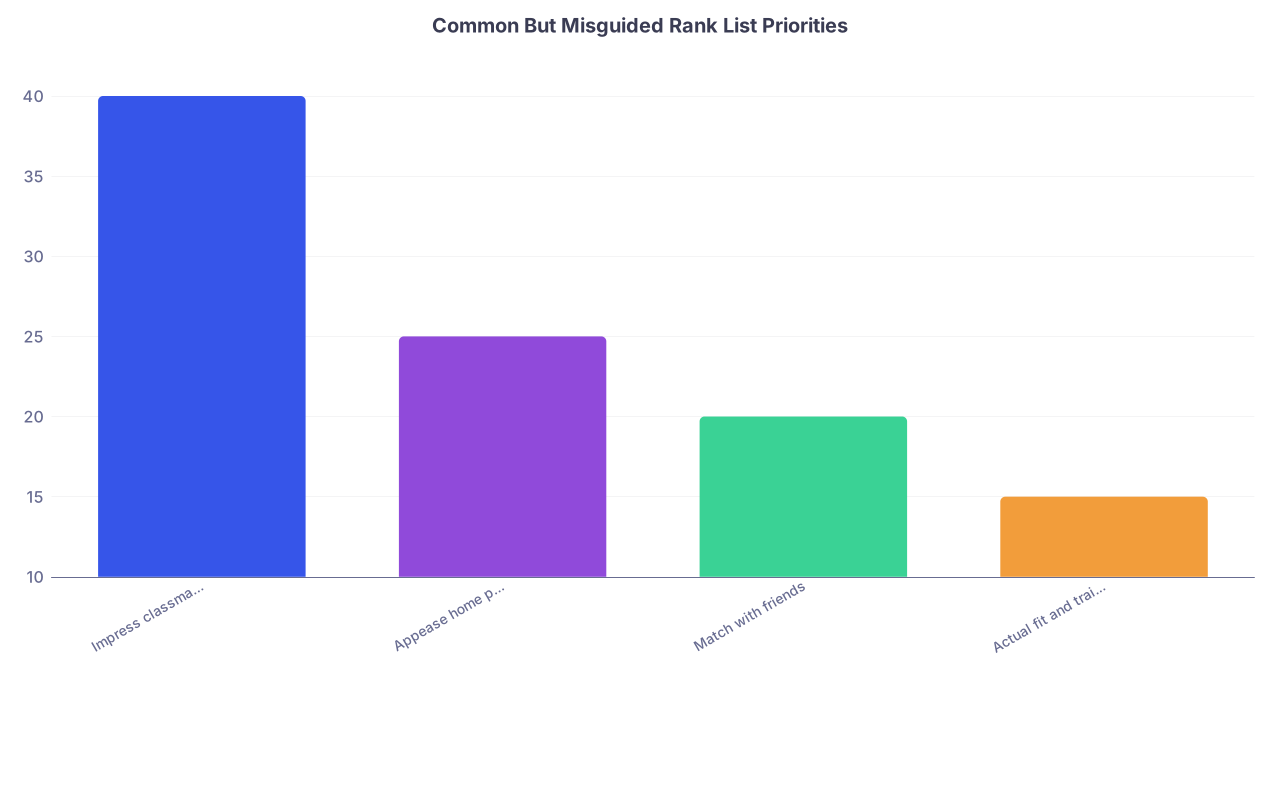
Too many people are optimizing the first three bars in that chart. The only bar that should matter is the last one: actual fit and training.
You will not care that your classmates thought Program A was “more elite” when you are on hour 20 of a brutal call night in a toxic culture.
You will care that:
- Your co‑residents are decent humans
- Your PD has your back
- You are supported to learn and grow
None of that improves when you turn your personal rank list into social performance art.
What To Do Instead – A Saner Process
If you want to avoid the oversharing trap, structure your decision process deliberately.

| Step | Description |
|---|---|
| Step 1 | Interview Season Ends |
| Step 2 | Reflect Alone |
| Step 3 | Draft Rank Tiers |
| Step 4 | Discuss With 1-2 Advisors |
| Step 5 | Optional Talk With Partner |
| Step 6 | Refine List Privately |
| Step 7 | Submit Rank List |
| Step 8 | Share Only General Info |
Key moves:
- Reflect alone first. Write down impressions before talking to anyone.
- Create tiers (Top / Solid / Backup) instead of obsessing over exact positions.
- Show the conceptual list to advisors for feedback. Not the screenshot.
- Submit your final list without a committee vote from your entire class.
- After submission, resist the urge to keep tinkering or re‑debating.
This keeps control where it belongs: with you, anchored in your values, not other people’s expectations.
FAQ: Rank Lists and Over‑Sharing
1. My close friend showed me their entire list. Am I being a bad friend if I refuse to share mine?
No. You are being a responsible adult. Friendship does not require symmetric disclosure of everything. You can respond with gratitude and a boundary: “Thanks for trusting me with yours. I’ve realized I make better decisions when I keep my final order private, but I’m happy to talk about the top few and why I liked them.” If that harms the friendship, the friendship was fragile to begin with.
2. Is it ever okay to promise a program they are #1 on my list?
You are playing with fire when you do this. Unless you are 100% certain that program is first, and you have already decided you will not change your mind no matter what, avoid explicit promises. Programs remember when applicants break these assurances, and medicine is a small world. Better language: “You are one of my top choices and a very strong fit for me.”
3. What if my partner insists on seeing the full list and having veto power?
Take that as a sign to slow down and have a serious conversation. You can say, “We absolutely need to align on geography and lifestyle. But if you try to control the exact order, I will end up resenting the outcome if things are hard in residency.” If they cannot accept that boundary, the issue is bigger than the rank list. You are deciding whether this person respects your professional autonomy.
4. I already shared my full list with several people. Is there anything I can still do to limit damage?
Yes. Stop the leak now. Do not send it to anyone else. Ask the people you already shared with to keep it to themselves, and do not keep discussing exact ranks in group settings. You can also “soft reset” the narrative by talking more in general terms (“My top group is A/B/C”) instead of repeating your specific order. And, most importantly, give yourself permission to change your list based on your own reflection, even if that means contradicting what you told others last week.
Open the Notes app on your phone right now and write one sentence:
“I will not share my exact rank order with classmates, programs, or social media.”
That one line, followed consistently, will save you more stress and drama on Match Day than any last‑minute “rearranging” ever will.