
Match Day does not just decide where you train. It quietly decides who you train with and what your day-to-day life will feel like for an entire year.
Most students obsess about the name on the badge and the location. Attendings, chiefs, and program directors? We spend March and April talking about something else:
“What kind of class did we just get?”
You think we look at your name on a spreadsheet, shrug, and welcome everyone the same. That is not how this works. The way your class comes together on Match Day—where your co-interns come from, the mix of “near misses” vs “top choices,” couples matches, prelims, and categorical spots—creates a social ecosystem that will either make PGY-1 feel like a war buddy experience or a quiet, cold slog.
Let me walk you through what really happens behind the scenes, how programs think about “the class,” and how Match Day outcomes ripple into your first-year team dynamics.
What Programs Really Mean By “Fit” (And How It Shapes Your Class)
When faculty say they “care about fit,” students roll their eyes and hear: “We liked whoever we liked and we’re not going to explain it.”
Here’s the truth: most programs are not just ranking individuals; they’re building a class profile.
I’ve sat in meetings in December where we literally have conversations like:
“We already have three very quiet applicants high on the list. We need at least a couple of social glue people.”
“We’re heavy on home students. We should probably bump some strong external applicants so we do not end up with a cliquey class.”
We do not just want twelve smart people. We want a group that can 1) survive the year without constant drama, and 2) keep the culture we’re trying to protect.
So the rank list ends up reflecting some unspoken balancing acts:
- At least one or two natural leaders who will become the de facto “class mom/dad”
- A mix of “grinders” (highly reliable, maybe quieter) and “spark plugs” (high-energy, social, often involved in everything)
- Not all from one med school or region
- Not all hyper-competitive gunners, but not all hyper-chill either
We never admit this on the website. But yes, there is intentional class engineering. And Match Day is where we discover whether the algorithm cooperated.
The Three Types of Match Day Classes (And How They Behave Intern Year)
Most interns don’t realize they’re walking into a pre-built social structure that started forming the minute the rank list was certified. Over the years, I’ve seen the same three archetypes appear again and again.
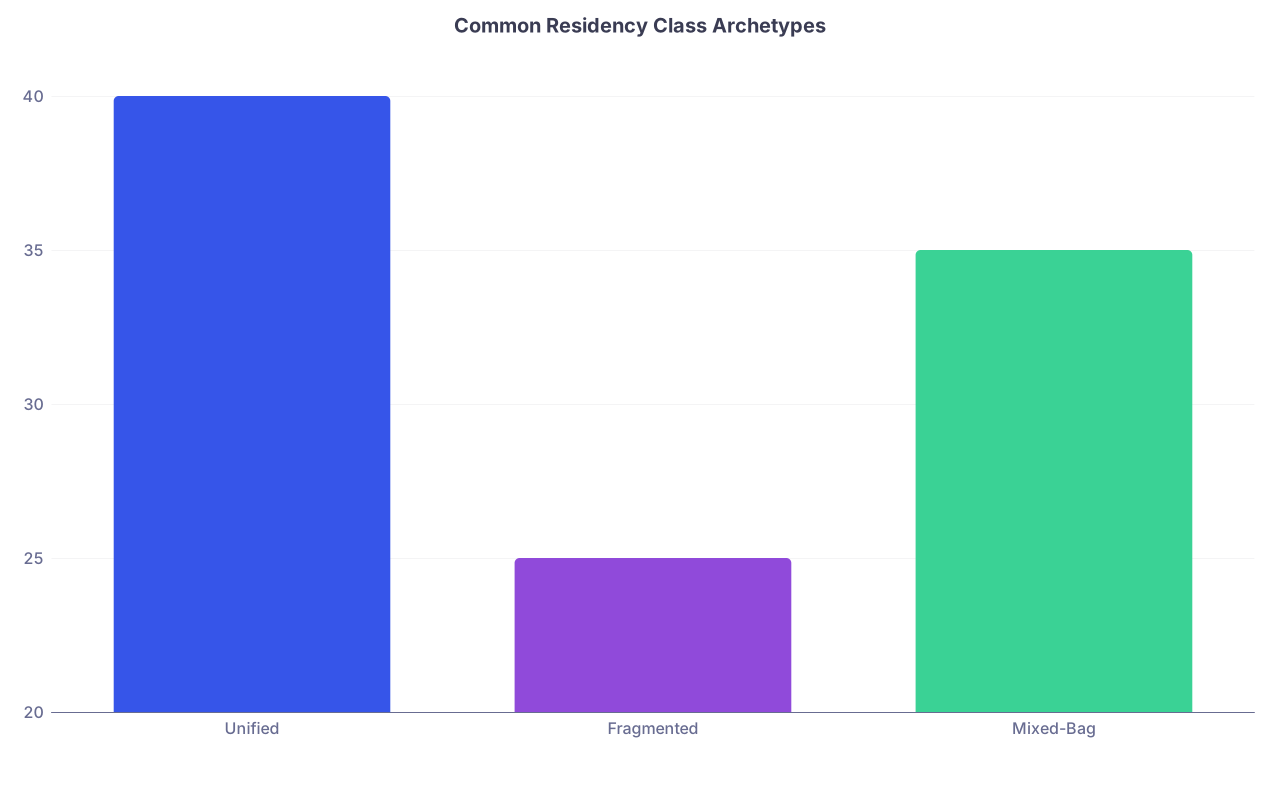
| Category | Value |
|---|---|
| Unified | 40 |
| Fragmented | 25 |
| Mixed-Bag | 35 |
1. The “Unified Class” – The Gold Standard
This is the class that PDs brag about for years.
Traits you see by October:
- Group chats that are actually helpful, not passive-aggressive
- Intern dinners that people actually go to, even post-call
- Natural sharing of difficult patients, bad outcomes, and personal stressors
Where does this start? Match Day.
These are the classes where:
- A decent proportion matched in their top 3 choices
- There are a few people who already knew the program well (aways, home students) and feel genuinely happy to be there
- The “near miss” folks (who wanted something slightly different) are at least content and not resentful
The vibe when they arrive in June is: “We’re all in this together, we chose this, let’s make it good.” And that matters more than people realize.
Unified classes:
- Cover for each other without keeping score
- Self-organize study groups for boards and in-service exams
- Share unwritten rules about which senior is reasonable, which attending you should be over-prepared for, which nurse you never piss off
That kind of cohesion reduces burnout. You feel like you’re struggling with people, not next to them.
2. The “Fragmented Class” – Silos and Silent Resentments
The fragmented class usually looks fine on paper. Strong scores, strong schools. Then you watch them for two months and realize: this is going to be a long year.
Match Day seeds this in a few predictable ways:
- Too many home students who already have tight friend groups
- Several couples-match pairs who are focused on each other, not the class
- A cluster of people who openly wanted something “more competitive” and see this as their consolation prize
What you feel as an intern:
- Group chat is quiet or only half the class participates
- The same four people always swap shifts and help each other; the rest fend for themselves
- People show up, do the work, go home. No one builds any deeper trust.
When a fragmented class hits a crisis—bad patient outcome, abusive attending, schedule disaster—they fragment more. Individuals go to leadership alone instead of as a united front. Feedback from chiefs becomes: “This class just feels…disconnected.”
Nobody will say it to your face, but I’ve heard this exact hallway remark from a PD:
“Individually they’re fine. As a class? Weak culture. I worry about their second years.”
3. The “Mixed-Bag Class” – The Wildcard
Most classes land here. Half the class is thrilled; a quarter is “fine, whatever”; a quarter is quietly disappointed.
These are the classes where Match Day stories are all over the place:
- One or two clearly matched “up” and know it
- One or two clearly matched “down” from what they were aiming for
- A couple of SOAP survivors or late adds who feel like outsiders for a while
These classes can swing either way depending on whether a few key people lean in or out. That’s where you come in, by the way. But we’ll get to that.
How “Match Satisfaction” Predicts Class Behavior
I’m going to say something blunt: how happy your class is with where they matched shapes how hard they’ll work for each other, not just for their CVs.
We do not survey this officially. But we can read Match Day faces, and we absolutely pay attention to the post-Match e-mails that trickle in:
- “This was my dream program for years”
- “I never thought I would be able to match here”
- Versus: the ominous silence from the people we know ranked us 8th
There’s a pattern:
- Classes where at least 60–70% of interns had us in their top 3 usually develop a healthier, more collaborative dynamic.
- Classes that feel collectively “settling” for the program show more absenteeism from social things, less peer support, and more low-level complaining.
Let me show you how this plays out emotionally over the year.
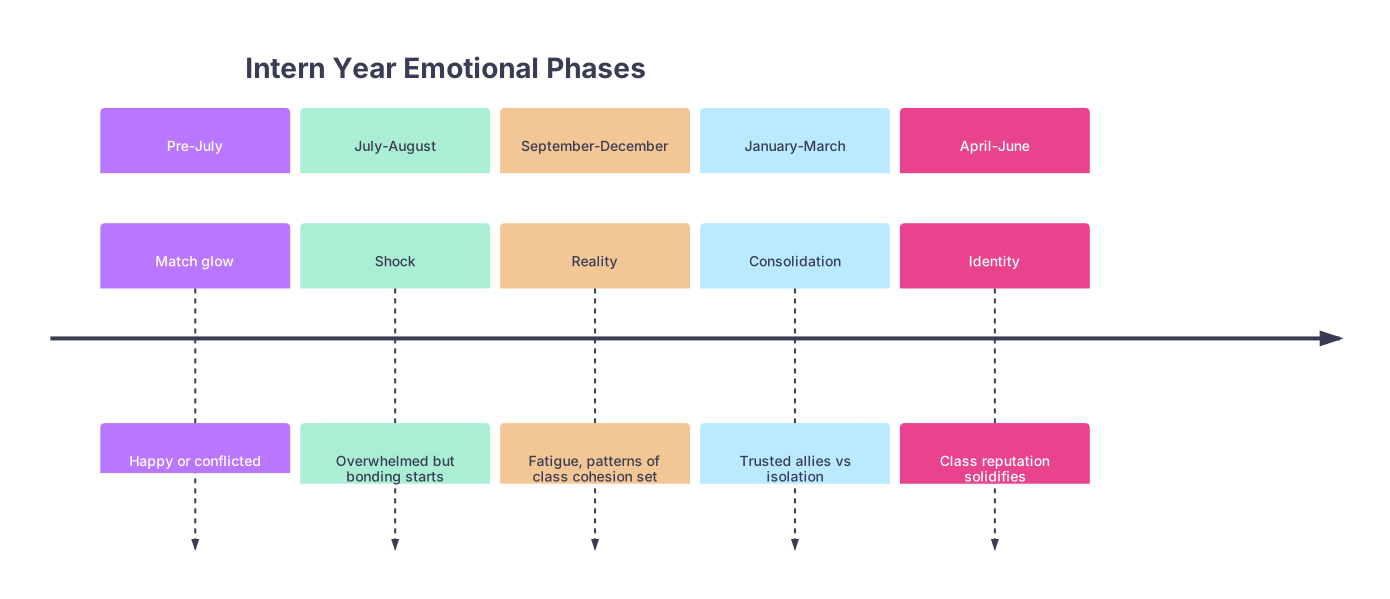
| Period | Event |
|---|---|
| Pre-July - Match glow | Happy or conflicted |
| July-August - Shock | Overwhelmed but bonding starts |
| September-December - Reality | Fatigue, patterns of class cohesion set |
| January-March - Consolidation | Trusted allies vs isolation |
| April-June - Identity | Class reputation solidifies |
If your class walks in with mostly “I can live with this” energy, you’re already behind the classes who walk in thinking “I can’t believe I get to be here.”
The difference is not in knowledge or skill; it’s in generosity. People more content with their match give more—to co-interns, to patients, to the program.
Who You Matched With Matters More Than You Think
Students focus obsessively on the name of the institution. Insiders focus on: “Who’s in their class?”
A few under-discussed class composition factors:
1. The Home-School Ratio
When a class is >50% home students, the danger is automatic cliques. They already know the cafeteria hacks, the secret call rooms, the attendings’ reputations.
If those home students are emotionally intelligent, they’ll take the role of guides. They’ll drag you into the fold, tell you where to park, which radiologist to call directly, where to live.
If they’re immature, they’ll form a protected circle and let the outsiders sink or swim.
Healthy dynamic: home students say “come with me” a lot. Unhealthy dynamic: they say “we’re doing X” in a group you’re not in.
2. Couples-Match Gravity
Couples-matching is great for the individuals. For class cohesion? Double-edged sword.
Two-couple dynamics I’ve seen repeatedly:
- The couple operates as its own social unit, rarely at class events, always calculating time together vs time with co-interns
- When one partner hates their program and the other loves theirs, the emotional spillover is constant—and the class feels it
If your class has multiple couples, you’ll notice: their gravitational pull is strong. They either help host gatherings and anchor the social calendar, or disappear into their own orbit.
3. Prelim vs Categorical Tension
Specialties that rely on prelim years (IM, surgery, TYs feeding into radiology, anesthesia, derm) know this one well.
Prelims show up thinking: “This is temporary.” Categorical interns think: “This is my home.”
When Match Day loads a class with many prelims, a subtle split can happen:
- Prelims may be less invested in long-term program projects or QI work
- Categoricals may feel like they’re carrying more of the “legacy” responsibility
Good leadership can bridge this. Weak leadership ignores it, and you end up with half your class emotionally checked out by February.
How Match Day Stories Shape Power and Status Within Your Class
Nobody says this out loud, but I’ve watched it happen every year. Your Match Day narrative follows you in subtle ways.
- The person who “matched up” to a very competitive program or coast tends to have some unspoken prestige, even if everyone pretends they don’t care.
- The SOAP survivor or “late add” may feel like they have to over-prove themselves. Sometimes they become the hardest working, most reliable intern in the class. Sometimes they stay on the outside and emotionally tap out.
Inside the class, people keep mental tallies:
- Who was here by choice vs by compromise
- Who had other interviews that sounded “impressive”
- Who talked all year about wanting to do a competitive fellowship versus someone who “just wants a job”
As an attending, I can almost always tell by November who has internal status inside the class. It’s not always the smartest or the most clinically talented. It’s often:
- The intern who quietly helps everyone with notes, orders, handoffs
- The person who organizes the first “we survived July” dinner
- The one everybody tags in the group chat when they’re stuck on an admission
Your Match Day story might have set the tone, but your behavior resets the hierarchy quickly. The bitter “I should have matched higher” intern loses social capital fast once the work starts.
What You Can Actually Do Before Match Day To Improve Your Future Class Life
You do not control how programs engineer their rank lists. You do not control who else matches with you. You do have more influence than you think on the class you’re about to walk into.
Before Match:
Be honest with yourself on your rank list.
Not the fantasy version of you that wants a shiny name at any cost. The real you who’s going to wake up at 4:30 a.m. on a Sunday to pre-round. If you know you’ll resent Program X if you land there, don’t rank it “just to see.”Pay attention to resident culture on interview day.
Not the slideshow. Watch residents between sessions. Do they actually enjoy each other? Do they show up for each other’s talks? Does the PGY-3 seem to know the intern’s life outside the hospital?Listen to off-hand comments.
The intern who says, “Our class is pretty close, we hang out all the time” is giving you real data. The intern who says, “Well, everyone’s busy, we’re all doing our own thing” is also giving you real data.
After Match, before July:
- Find your co-interns early. Join (or start) the group chat.
- Be the person who sends: “Hey, where’s everyone living?” or “Anyone else moving in June 25–27 and want extra hands?”
- If you’re a home student, explicitly include the away folks. “We’re grabbing drinks after orientation, please come.” That one sentence can change someone’s entire first month.
You are not just matching into a program. You are matching into a social microculture that you can either passively accept or actively shape.
Hidden Ways PDs and Chiefs React to a New Class After Match
You probably imagine that after Match Day, leadership just shrugs and waits for July. Not remotely true.
Here’s what actually happens:
- The PD prints the final list, stares at the names, and mentally catalogs: home vs away, couples, prelims, “project” interns, and future chief candidates.
- Chiefs start texting current residents: “Anyone know this person from away rotations?” They’re doing social reconnaissance. How teachable, how intense, how likable.
Many programs quietly adjust how they’ll manage your year based on the class’s composition.
| Class Profile | Leadership Reaction |
|---|---|
| Heavy on home students | Extra focus on integrating externs |
| Many couples-matches | Watch for burnout, schedule sensitivities |
| Many prelim positions | Lower expectations for long-term projects |
| Very competitive CV group | Watch for ego clashes, emphasize teamwork |
| Many SOAP/late matches | Extra mentorship, closer early supervision |
I’ve heard PDs say:
- “This class looks very academically strong, but I worry they might be a little intense. We need to emphasize wellness early.”
- “We’ve got several who feel like we’re their dream program. Good, we can lean on them to help anchor the culture.”
You walking in thinking “I just matched, now I see what happens.” Meanwhile the hospital is already adjusting around what they think you will be like collectively.
How to Survive and Thrive No Matter What Kind of Class You Get
You cannot pick your co-interns. But you can decide which role you’re going to play in the class ecosystem.
If you land in a unified, high-energy class:
Don’t coast. These are fertile environments to grow fast. Find the senior who everyone respects and attach yourself. Offer to help with the boring stuff (protocols, sign-out templates) and you’ll become a quiet leader quickly.
If you land in a fragmented class:
This is where you separate adults from children. You can either join the silos or bridge them.
Practical moves:
- Create a small “core” with 2–3 interns across cliques. Have lunch together consistently.
- Share high-yield tips broadly, not just with your favorites. “Hey everyone, Dr. X loves when you present labs this way” belongs in the group chat, not in a private DM.
- On rough rotations, send the simple text: “Anyone drowning on wards this week and need a hand with notes?” You’ll be remembered for that.
If you’re the one who’s disappointed with where you matched:
You are dangerous—to yourself and to your class—if you let that fester. I’ve watched two almost identical interns diverge purely on how they processed Match disappointment.
- One sulked for six months, compared every patient case to what they would have seen at their dream program, and left a residue of bitterness everywhere.
- The other decided, “Fine, I’ll become impossible to ignore from here,” worked hard, built strong relationships, and ended up landing the fellowship everyone said required a “better” residency.
No one wants to hear this in March, but it’s true: your attitude after a disappointing match will matter more to your future than the name of the place on your badge.
FAQs
1. How much do programs actually care whether you ranked them #1?
Less than you think—but they do care whether you act like you want to be there. We do not see your rank list. We infer it from your energy, your engagement, and sometimes what your dean quietly hints. Once you’re here, if you lean in and commit, nobody cares if we were #2 vs #5.
2. Does being a home student help or hurt my social standing in the class?
It can do either. If you use your home status to welcome and orient others, you become a trusted anchor. If you only hang out with your old med school friends, you become part of the problem. People are watching that more than you think.
3. I couples-matched. How do I avoid being “that couple” that’s never around?
Show up a little more than is comfortable at first. Go to the first few class events even if you’re exhausted. Signal with your actions that you’re part of this group too, not just operating in your own two-person bubble. Your relationship does not need you at 100% of your off-hours; your residency class actually does.
4. I ended up in a class that feels really cliquey. Is it even worth trying to change that?
Yes, but you’re not going to “fix” everyone. Aim smaller. Find 2–4 people who are open and build a micro-community that functions well. Often that little cluster becomes the culture seed for the next year’s interns—chiefs notice who creates sanity in a dysfunctional class.
5. I matched through SOAP. Will my co-interns or attendings treat me differently?
Some will judge quietly; many will not care. What you control is data they see daily: your reliability, your preparation, your growth curve. I’ve seen SOAP interns become chiefs and outcompete “straight match” colleagues for top fellowships. Your entrance route is a sentence in your story; your performance is the whole chapter.
Key takeaways?
Match Day doesn’t just assign you a hospital; it assigns you a social ecosystem. The distribution of who’s thrilled, who’s fine, and who’s bitter shapes your intern year more than the curriculum PDF ever will. And while you do not control who matches with you, you absolutely control whether you become dead weight, neutral mass, or the person who quietly pulls the class in a healthier direction.