

The Match does not just break careers. It breaks expectations. And mismatched expectations between partners after an unmatch can quietly wreck a relationship if you handle it badly.
You have two jobs now:
- Stabilize your partner’s world.
- Stabilize the relationship’s plan.
Let me walk you through how to do both without losing your mind, your future, or each other.
Step 1: Drop the Fantasy Script You Were Both Running
You probably had a mental movie playing:
- Same city.
- Reasonable rent.
- Maybe you even knew which coffee shop would be “yours.”
- You matched. They would too. Of course.
Then it did not happen.
Your first instinct will be to cling to the old script:
- “It’s fine, SOAP will fix it.”
- “You will just take a gap year, and we will figure it out.”
- “We can still do long distance. It will not change that much.”
That urge to immediately smooth everything over is dangerous. It makes you say things you cannot guarantee and sets you both up for more disappointment later.
Here is what you do instead.
Immediate protocol for Match Day when one partner does not match:
Pause problem-solving for a few hours.
Not days. Just hours. Let the shock land.- Turn off your phone notifications if you can.
- Cancel nonessential social plans. You do not need to go to the class “celebration” if your partner is shattered.
Name what actually happened in simple terms.
Out loud. No sugar-coating.- “You did not match. We are going to figure out next steps, but right now this just hurts.”
- Avoid nonsense like, “The system is broken, you’re amazing, it’s their loss.” That might be emotionally true, but it does not help them process the reality.
Create a 24-hour bubble.
The rule: no big, permanent decisions in the first 24 hours.- No “Maybe I should change specialty forever.”
- No “Maybe we should break up if this is too hard.”
- No “I will just give up on medicine.”
You are not ignoring the problem. You are preventing panicked, irreversible choices while both of you are emotionally concussed.
Step 2: Separate Three Different Problems
Right now everything feels like one disaster. It is not. You have three distinct issues:
Emotional crash
Shame, humiliation, grief, jealousy (especially if you did match).Career logistics
SOAP, prelim spots, research year, reapplying strategy.Relationship logistics
City, distance, finances, timing, future kids, visas if you are international, etc.
If you mix all three together, every conversation becomes a fight. You will start arguing about:
- Whether they should switch specialties…
- While you are actually angry they might not move with you…
- While they are actually terrified of being “the failure” in the relationship.
So you handle them one at a time. Intentionally.
Make three buckets:
- “Feelings”
- “Career”
- “Us”
Say it explicitly:
“Right now we are just doing ‘feelings.’ Later we will do ‘career.’ We will only get to ‘us’ when we are a little calmer.”
That labeling alone lowers the temperature.
Step 3: Handle the Emotional Fallout Like an Adult, Not a Hero
Your job is not to fix their feelings. Your job is to:
- Not minimize them.
- Not make it about you.
- Not disappear into guilt or resentment.
Here is the script I have seen actually work in couples where one matched and one did not.
If you matched and your partner did not
You are walking a tightrope between survivor’s guilt and their shame.
Do this:
Say clearly:
“I am happy I matched AND I am devastated that you did not. Both are true. I will not pretend I am not excited about my match, but I will be very careful how and when I talk about it. We are on the same team.”Ask what they want from you specifically in the first week:
- “Do you want me in the room for SOAP calls?”
- “Do you want me to filter texts from people asking what happened?”
- “Do you want distraction tonight or quiet?”
Protect them from social nonsense.
- If people ask, “So where did they match?” say, “It is been a rough week, they are working out next steps” and stop. No details unless they consent.
Do NOT:
- Brag-match on social media with a long paragraph while your partner is still crying in the bedroom.
- Force them to go to Match parties.
- Say, “At least one of us matched, that is something.” That sounds like you are telling them to get over it.
If you did not match and your partner did
You feel like the “drag” in the relationship. You are not.
What you must avoid is weaponizing your pain:
- “You do not get it, you are fine, you matched.”
- “Easy for you to say, you have a plan.”
- “I am just the loser now.”
That will destroy intimacy faster than the unmatch.
Instead, try:
- “I am genuinely happy you matched. I am also really hurting and I might be quiet or short for a while, but it is not about you as a person. It is about what happened to me.”
- “Please keep telling me about your plans. Just check with me first on timing. Sometimes I might say, ‘Can we talk about it later?’”
Give your partner something they can actually do:
- “Can you handle family questions for a while?”
- “Can you sit with me while I email programs, even if you are just on your laptop next to me?”
That lets them support you without guessing.
Step 4: Triage the Career Side Without Burning Bridges
Now the practical, unglamorous part. You must help your partner make smart moves fast.
There are four common pathways after not matching:
| Path | Timeline | Main Goal |
|---|---|---|
| SOAP | Same week | Secure any PGY-1 spot |
| Prelim/Transitional | 1 year | Reapply with US training |
| Research Year | 1–2 years | Strengthen CV, reapply |
| Career Pivot | Variable | New specialty/trajectory |
1. SOAP week (if relevant)
If you are in SOAP territory, time is tight. You support by structure, not by micromanaging.
Your role:
Help with:
- Spreadsheet tracking of programs.
- Scheduling calls.
- Double-checking ERAS materials for errors.
Do not:
- Push them into any program or specialty “just to get something.”
- Demand instant decisions when they already feel desperate.
Set a rule:
“No accepting an offer that feels unsafe, unethical, or completely misaligned with long-term goals just because we are scared.”
A less prestigious but solid prelim in medicine beats a toxic categorical spot in a field they hate.
2. If SOAP fails: move to a 12–18 month strategy
Now things get uncomfortable. This is where mismatched expectations blow up couples.
You need a small, ruthless planning meeting.
Step 5: Run a Real Planning Meeting (Not a Vague “We’ll Figure It Out” Talk)
Treat this like a high-stakes case conference. Put it on the calendar. 60–90 minutes.
Agenda:
Clarify the partner’s actual career objective.
Not “I want to be a doctor.” That is too vague.Pull it down to something like:
- “I want to be an internal medicine attending in 8–10 years.”
- “I want to reapply to psychiatry for next cycle, but I am open to prelims/transitional years.”
If they are suddenly unsure about specialty, that becomes part of the year plan.
Lay out all realistic options on the table.
No judgment yet. Just list.Common ones:
- Research year in the same city as your residency.
- Research or master’s year in a different city (closer to programs they want).
- Prelim medicine/surgery year anywhere that will take them.
- Non-clinical work (industry, consulting, scribe, etc.) while reapplying.
- Specialty pivot (e.g., unsuccessful ortho applicant considering IM).
Overlay your match details onto each option.
Questions to answer:
- Where will you physically be for residency?
- What is the call schedule like? (Surgery vs derm is not the same.)
- Income difference between you and them?
- Immigration/visa issues if applicable?
Score each option on four axes:
- Career viability for them (low / medium / high)
- Relationship stability (low / medium / high)
- Financial sustainability (low / medium / high)
- Emotional tolerability (low / medium / high)
You will notice patterns. Some options might be great for one axis and terrible for another.
Pick a “primary plan” and a “backup plan.”
For example:- Plan A: They do a 1-year research position in your city + strategic reapplication.
- Plan B: If that fails by Month 6, they broaden to prelim positions for the next cycle in any region within X flight time.
The point is not perfection. It is mutual clarity: “Here is what we are actually trying for this year.”
Step 6: Face the “Us” Logistics With Brutal Honesty
Now the hardest part: how this affects your relationship track.
Two major friction points show up again and again:
- Location
- Timeline for major life decisions (marriage, kids, buying a house, visas)
Let’s go through both.
Location: together vs long-distance
I have seen couples implode not because of distance, but because they lied to themselves about what they were signing up for.
Ask, and answer, without performing:
- Are we actually willing to do long distance for 1–3 years?
- What are non-negotiables? (e.g., “We need to see each other at least every X weeks.”)
- Is one of us willing to forgo the “ideal” career move to stay in the same city?
Here is a simple location decision flow:

| Step | Description |
|---|---|
| Step 1 | One partner matched |
| Step 2 | Prioritize same city options first |
| Step 3 | Each pursues strongest career option |
| Step 4 | Reassess relationship priorities and timelines |
| Step 5 | Can unmatched partner find viable role in same city |
| Step 6 | Is long distance acceptable 1 to 3 years |
Concrete questions:
- Is there any research, MPH, or hospital job near your residency?
- Can you afford two separate rents if they stay elsewhere?
- How much vacation time will you realistically have to travel?
Say the ugly truths out loud:
- “If we do long distance for more than 3 years, I will resent it.”
- “I am willing to live in a less ideal city if it means we can share one apartment and support each other.”
There is no right answer. There is only the lie you will regret later if you avoid this conversation now.
Timelines: marriage, kids, visas, and everything else
The unmatched year (or two) often collides with:
- Planned wedding dates.
- Fertility timelines.
- Family expectations.
- Visa deadlines for international grads.
You must put those on the table alongside the career plan, not pretend they are separate.
Do a timeline sketch:
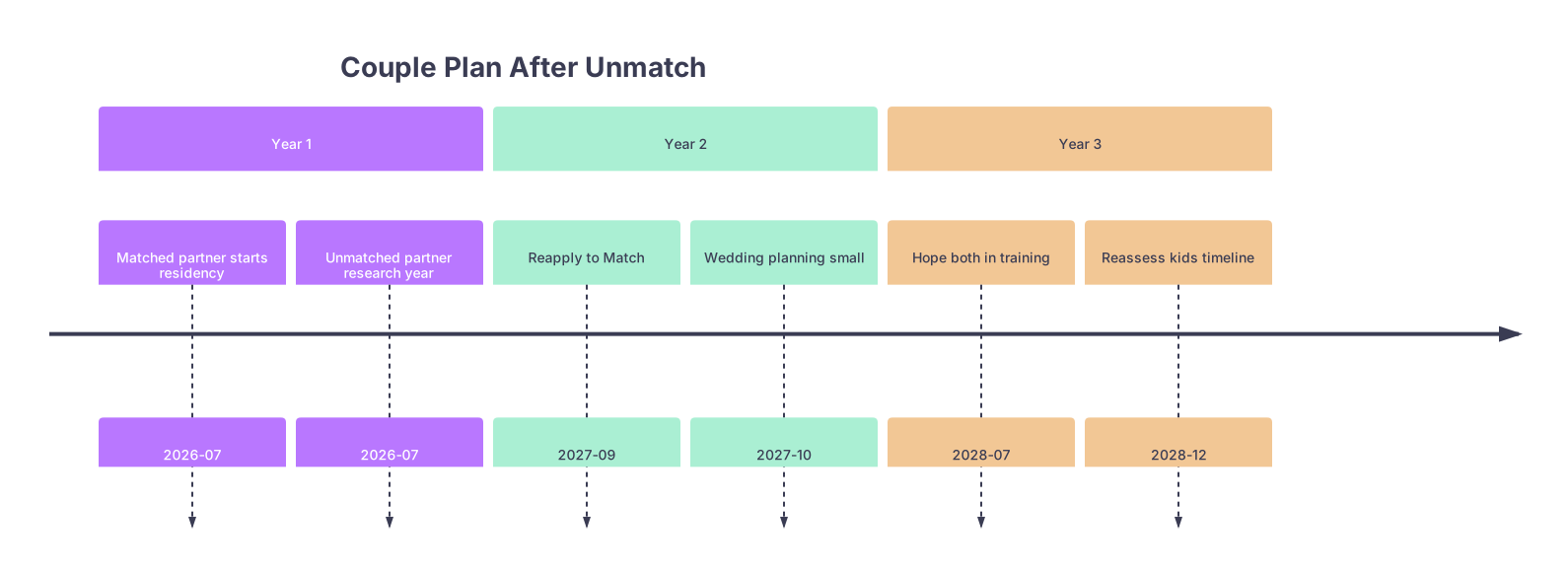
| Period | Event |
|---|---|
| Year 1 - Matched partner starts residency | 2026-07 |
| Year 1 - Unmatched partner research year | 2026-07 |
| Year 2 - Reapply to Match | 2027-09 |
| Year 2 - Wedding planning small | 2027-10 |
| Year 3 - Hope both in training | 2028-07 |
| Year 3 - Reassess kids timeline | 2028-12 |
You do not need exact months. You do need rough sequencing. Because:
- If having kids before 35 is critical for one partner, a 2-year delay may change plans.
- If immigration status depends on matching by a certain year, that limits reapplication cycles.
- If parents already paid deposits on a huge wedding, you may need to scale that down to avoid debt while one partner is unemployed.
None of this is romantic. It is adult. You are choosing an actual shared life, not Instagram aesthetics.
Step 7: Protect the Relationship From Two Specific Poisons
The two things that destroy couples in this situation are not distance and not money. It is:
- Unspoken resentment.
- Identity imbalance.
You can actually attack both systematically.
Poison #1: Unspoken resentment
Resentment sounds like:
- “You got everything you wanted and I got nothing.”
- “I sacrificed my career options for you and you do not even notice.”
- “I am carrying us financially and you complain about being bored.”
If you wait until it explodes, it will be ugly.
Set a recurring “check-in” ritual. Short. Structured. Predictable.
For example, 30 minutes every 2 weeks on a lighter day:
5 minutes: quick personal update each (how am I doing mentally).
10 minutes: logistics (schedule, money, upcoming stresses).
10–15 minutes: one prompt question:
- “Is there anything you are biting your tongue about?”
- “Has anything felt unfair lately?”
- “What is one thing I can do this month that would help you feel supported?”
You will not fix every resentment in one talk. The goal is to make it normal to bring them up before they calcify.
Poison #2: Identity imbalance
The matched partner becomes “the doctor.” The unmatched partner becomes “the one who failed.”
If you let that identity calcify, the power dynamic in the relationship gets twisted. I have seen this turn into subtle contempt on one side and chronic defensiveness on the other.
Your job, both of you, is to build parallel identities during this year:
The unmatched partner must have a real, meaningful role:
- Research lead on a project.
- Core teaching role for med students.
- Key contributor at an NGO or health system.
- Serious exam prep and structured CV-building work, not just “waiting to reapply.”
The matched partner must not become the sole authority on “real medicine.”
- Do not talk down. Do not use your white coat as leverage in arguments.
- Do not “teach” constantly unless they explicitly ask.
You are not the “winner” and the “loser.” You are two clinicians on different parts of the same staircase.
Step 8: Set Hard Boundaries With Outside People
Families, classmates, attendings, and random acquaintances can make this situation unbearable if you let them.
You and your partner should explicitly agree on:
- What you will and will not share about their unmatch.
- What the “public story” is.
- How you will handle pushy or nosy people.
Create a single, boring, repeatable line, for both of you, like:
- “It was a tough cycle, they are taking a structured year to strengthen their application and will reapply.”
- “They are doing a research year in [city] and targeting [specialty] again.”
That is it. No step scores. No “ranked too few programs.” No drama.
And when family pushes:
- “So what went wrong?”
- “Why did they not just pick an easier specialty?”
- “Are you sure this is a good relationship to stay in if they could not match?”
Your answer should be firm and final:
- “We are not going into details. We both know the plan and we are comfortable with it.”
- “Comments about breaking up or about their career are not on the table. Please respect that.”
You are protecting your partner’s dignity and your own sanity.
Step 9: Build a Daily/Weekly Structure That Actually Works
Abstract plans are useless if day-to-day life is chaos.
You need:
- A realistic schedule for the unmatched partner.
- A realistic connection plan between you.
Schedule for the unmatched partner
Unmatched + unstructured time = depression and burnout. Every time.
At minimum, most days should include:
1–3 hours of professional work:
- Applications, networking, ERAS updates, research tasks, studying, etc.
1–2 hours of physical/mental health:
- Exercise, therapy, support groups, or at least walks and decent meals.
1 small “progress marker” per day:
- Sent 3 emails.
- Completed 20 Anki cards.
- Registered for a conference.
- Drafted 1 personal statement paragraph.
You, as the partner, encourage structure without micromanaging:
- “Do you want me to be an accountability partner or stay out of it?”
- “Do you want to share daily goals with me, or just wins at the end of the week?”
Connection plan between you
Especially if you are in different cities and you are drowning in residency.
Define:
Minimum touchpoints:
- Daily text check-ins?
- 2 video calls per week?
- One longer call on your lighter day?
“Protected time”:
- E.g., Sunday mornings or Tuesday nights are no-hospital-talk zones. Just life stuff.
Use something as simple as:
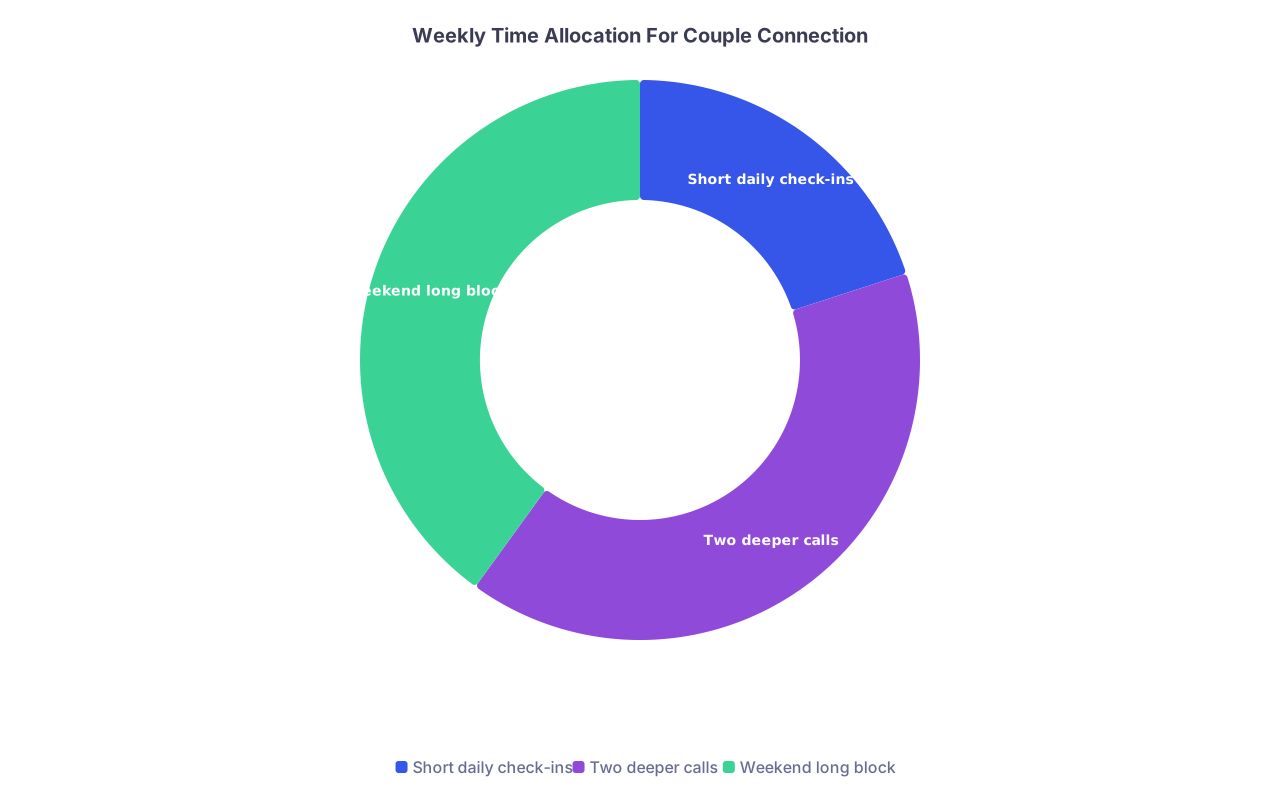
| Category | Value |
|---|---|
| Short daily check-ins | 20 |
| Two deeper calls | 40 |
| Weekend long block | 40 |
Not because the exact numbers matter, but because you both commit: “Even in chaos, this relationship still gets intentional time.”
Step 10: Decide What You Will Not Sacrifice
Last piece. You must decide the lines you refuse to cross, both individually and as a couple.
Examples:
- “We will not stay with a program that is emotionally or physically abusive just because we are scared of not matching again.”
- “We will not lie on applications or misrepresent scores.”
- “We will not stay together out of obligation if one of us genuinely wants a different life and is just afraid to say it.”
The hardest conversations are often:
- “If we end up in separate cities long term with no realistic convergence, are we staying together no matter what? Or is there a point where we admit our careers are incompatible?”
- “If reapplying fails two cycles in a row, what are your real Plan B and C careers, and am I on board with that life?”
It sounds brutal. But pretending these questions do not exist while silently spiraling is worse.
One More Thing: You Are Not a Rescue Mission
You are not responsible for “fixing” your partner’s career. You are responsible for:
- Being honest.
- Being kind.
- Being a stable teammate.
They must own their application, their strategy, their work. If you start taking on their responsibilities out of guilt (“I matched and they didn’t, so I owe them everything”), you will end up resentful and they will end up feeling infantilized.
The healthiest couples I have seen come out of this stronger do this:
- Both partners keep their own therapist, mentor, or advisor.
- Both partners keep some personal hobbies or friendships that are not about medicine.
- Both partners are allowed to have good days and celebrate small wins, even if the other is struggling.
You do not put your life on hold. You expand it to make space for a rough chapter together.
Final Takeaways
- Stop pretending it is one big mess. Treat emotional fallout, career strategy, and relationship logistics as three separate problems and tackle each deliberately.
- Build an explicit, time-bound plan: where they will be, what they will do, how you will stay connected, and what you both are and are not willing to sacrifice.
- Protect the relationship from resentment and identity imbalance by scheduling honest check-ins, building real roles for both partners, and setting hard boundaries with everyone outside the relationship.
Do that, and an unmatch becomes a brutal detour, not the end of either career or the relationship.


