

The residency Match does not “just work out.” When the outcome blindsides you—no match, low-ranked program, wrong location—that is not fate. It is a data point. And data can be worked with.
You are not done. You are in a transition zone that most people never prepare for and most schools barely address. So I will: here is a concrete, 4‑phase framework to help you reflect, repair, and reposition yourself after an unexpected Match result.
Use this like a protocol. Phase by phase. Step by step.
Phase 1: Stabilize and Contain the Damage (Days 0–7)
The first mistake people make after a bad Match outcome is flailing: firing off emails, rewriting their entire life plan in an afternoon, or disappearing into shame for weeks. All three are bad strategies.
First week goal: stabilize emotionally and logistically so you have the bandwidth to think clearly.
Step 1: Control the immediate narrative
Silence creates rumors and mental noise. You need a short, neutral script you can reuse.
Create one sentence for each scenario:
- If you did not match at all:
- “I did not match this cycle. I am working with my dean and mentors on a reapplication plan and exploring options for the coming year.”
- If you partially matched / SOAPed into something unexpected:
- “I matched through SOAP to a [specialty] position in [location]. I am taking some time to reassess long‑term plans and will share more once things are settled.”
- If you matched very low on your list (but did match):
- “I matched at [Program] in [City]. It was lower on my list, but I am committed to making the most of the opportunity and focusing on my training.”
Use this script with:
- Family
- Classmates
- Attendings who casually ask, “So where did you match?”
It buys you space and signals you are not spiraling.
Step 2: Do a rapid emotional triage
You are probably not thinking clearly right now. Assume that.
Do this within 24–48 hours:
- Sleep at least 7–8 hours for 2 nights in a row.
- Eat something that is not coffee and sugar.
- Move your body—30 minutes of walking, running, or any exercise.
Then, set a time‑boxed vent session:
- 30–60 minutes with a trusted person (friend, partner, therapist, or mentor).
- No “solutions,” no future planning. Only:
- What happened.
- How it feels.
- What you are afraid of.
After that, set a rule for yourself:
- Ruminating is allowed only in scheduled windows (e.g., 15 minutes in the evening). The rest of the day is for execution.
Is this rigid? Yes. That is the point. Drift is your enemy in this phase.
Step 3: Notify the minimum required people
Within the first week, you need a minimal “operations update” to people who can actually help you:
- Dean’s office / student affairs
- Subject line: “Requesting Post-Match Advising Meeting”
- Content: factual: did not match, SOAP outcome (if any), desired specialty, Step scores, broad idea of Plan A vs Plan B.
- Key mentors in your specialty of interest
- The people who wrote your letters, supervised your research, or ran your sub‑I.
- Personal support network
- Anyone whose finances, living plans, or emotional life are affected (partner, close family, roommates).
Keep everything factual, short, and forward‑leaning. No long apologies. No self‑flagellation.
Step 4: Lock in immediate logistics
If you SOAPed or matched somewhere surprising:
- Confirm:
- Contract details and deadlines.
- Start dates.
- Visa issues (if applicable).
- Licensing / onboarding tasks and deadlines.
If you did not match:
- Clarify:
- Graduation date requirements and any conditions.
- Health insurance coverage after graduation.
- Housing timeline (when you need to move out).
- Any remaining degree requirements (electives, paperwork).
You are building yourself a stable floor to stand on. No one makes good strategic decisions while panicking over where they will live in 60 days.
Phase 2: Conduct a Brutally Honest Post‑Match Audit (Weeks 1–2)
Your emotions will tell you a story: “Programs were biased,” “I was unlucky,” “My school is weak,” or “I am just not good enough.” Some of that might be partially true. None of it is a plan.
Now we switch to analysis.
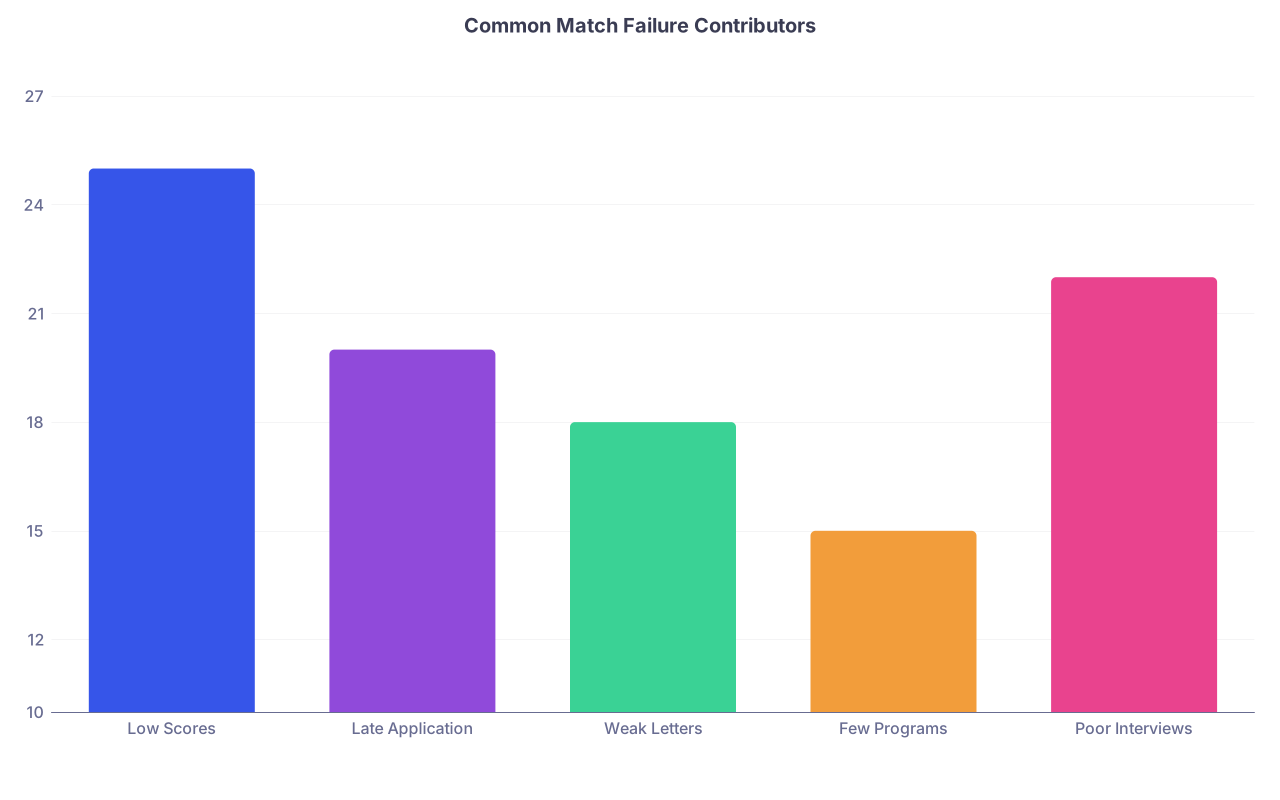
| Category | Value |
|---|---|
| Low Scores | 25 |
| Late Application | 20 |
| Weak Letters | 18 |
| Few Programs | 15 |
| Poor Interviews | 22 |
Roughly speaking, most failed or disappointing outcomes can be traced to five buckets:
- Academic metrics
- Application strategy
- Letters and reputation
- Interview performance
- Fit and realism of target list
You are going to quantify each.
Step 1: Collect your raw data
Gather:
- Step 1 / COMLEX 1 (even if pass/fail, note the actual score if you know it).
- Step 2 CK / COMLEX 2.
- Clinical grades (especially core clerkships and any honors).
- Number of programs applied to per specialty.
- Number of:
- Interview invites received
- Interviews attended
- Programs ranked
- Your full ERAS application:
- Personal statement
- CV
- Experience descriptions
- List of letter writers and which programs got which letters.
Put it all in one place. Spreadsheet is ideal.
Step 2: Benchmark yourself honestly
Stop guessing if your scores or application volume were “okay.” Compare against real numbers.
Use an approximate internal rubric:
| Factor | Lower Risk | Moderate Risk | High Risk |
|---|---|---|---|
| Step 2 CK | ≥ 245 | 230–244 | < 230 or failed attempt |
| Applications (IM, FM) | 40–60 | 25–39 | < 25 |
| Applications (competitive) | 60–80 | 40–59 | < 40 |
| Interviews | ≥ 12 | 8–11 | ≤ 7 |
| Letters | Known advocates, strong detail | Mixed, generic language | Weak, generic, red flag language |
| Research (competitive) | Multiple pubs, presentations | Some research exposure | Minimal or none for hyper‑competitive fields |
If your metrics fall mostly in the “high risk” column, your unexpected Match outcome was not random. It was predictable. That is good news: predictable problems can be fixed.
Step 3: Get outside audits from people who tell the truth
You are too close to your own story. You need 2–4 brutally honest reviewers:
- A specialty advisor in your target field.
- Someone in a “less competitive but adjacent” field (e.g., IM if you aimed for Derm).
- If possible, a program director or APD who knows you, even slightly.
- One person who will not sugarcoat (you know exactly who that is).
Ask them for specific feedback on:
- Were my scores / grades fatal, marginal, or totally fine?
- Did my personal statement help me, do nothing, or hurt me?
- Did my application tell a coherent story?
- Do you think my letter set was strong or average?
- Based on my interviews with you or others, how would you rate my interview performance on a 1–10 scale?
Send them:
- Your ERAS PDF.
- A short, factual summary of your cycle: “Applied to 52 [specialty] programs, 6 interviews, ranked all, did not match.”
Then ask for written or verbal comments. Not vague reassurance.
Step 4: Create your “Match Post‑Mortem” document
One document. One page front‑loaded with the core issues.
Divide into four sections:
- Strengths this cycle
- Good scores, unique experiences, strong research, strong letters, resilience, etc.
- Primary failure contributors
- Example: “Applied too narrowly (25 programs) with a borderline Step 2 (228) to a competitive specialty. No backup specialty. Weak interview performance.”
- Secondary contributors
- Example: “Personal statement generic; late application (submitted in October); letters not from well‑known faculty.”
- Non‑negotiable constraints
- Coupled with partner, visa needs, geography limits, financial responsibilities.
If you cannot state your failure contributors in 3–5 clear bullets, you have not looked hard enough yet.
Phase 3: Rebuild and Reposition (Weeks 2–8)
This is the real work. The goal is not “try again and hope.” The goal is to change the underlying inputs so your next outcome is structurally different.
Your path splits here depending on your actual result.

| Step | Description |
|---|---|
| Step 1 | Unexpected Match Outcome |
| Step 2 | Plan new specialty with advisor |
| Step 3 | Strengthen same specialty app |
| Step 4 | Gather data and seek transfer |
| Step 5 | Commit 1 year and reassess |
| Step 6 | Network and apply for transfer |
| Step 7 | Research, gap year, prelim/TY |
| Step 8 | Maximize training, build CV |
| Step 9 | Reapply strategically |
| Step 10 | Matched anywhere? |
| Step 11 | Willing to switch specialty? |
| Step 12 | Program toxic or unsafe? |
Scenario A: You did not match at all
Your priorities:
- Secure something for the coming year
- Repair your application weaknesses
- Clarify specialty strategy (same vs switch vs dual apply)
Step 1: Decide on same specialty vs pivot
Ask yourself three blunt questions:
- Do I still genuinely want this specialty enough to tolerate another year (or more) of uncertainty?
- Does at least one experienced advisor in that specialty believe I have a realistic chance next cycle if I fix X, Y, and Z?
- Are there adjacent specialties that actually fit my skills and goals better than my original “dream” field?
If:
- Scores are low AND specialty is hyper‑competitive (Derm, Ortho, Plastics, ENT, Neurosurg, Rad Onc)
→ A full pivot or dual‑apply strategy is usually smarter than blind persistence. - Scores are reasonable and you just misplayed the cycle (too few programs, no backup, late Step 2, weak interviews)
→ Reapplying in the same field with a structured plan is reasonable.
Document your decision:
- Plan A: Specialty X.
- Plan B: Specialty Y or “broad‑based non‑categorical year + reapply.”
Step 2: Choose a structured “bridge year” option
You need a year that:
- Pays you (ideally).
- Lets you fix application gaps.
- Puts you in front of potential letter writers and program directors.
Realistic options:
- Transitional year (TY) or prelim year (IM, surgery, etc.)
- Pros: Real resident salary, hands‑on clinical experience, new letters, potential internal match.
- Cons: Hard to secure last‑minute; may be heavy workload with little protected time for research.
- Research year / post‑doc
- Pros: Especially strong for competitive specialties; can generate publications; close contact with faculty.
- Cons: Often low pay; can be variable quality; risk of being used as “cheap labor” without mentorship.
- Non‑ACGME clinical positions (hospitalist extender, “junior attending” roles in some countries, etc.)
- Highly variable; get detailed info and mentor input.
- Fifth clinical year / extra sub‑Is (if your school allows)
- Sometimes possible for unmatched seniors to extend enrollment. Good for letters and more time.
Non‑negotiable rule:
Do not waste the year in a role that does not produce concrete, CV‑visible outcomes.
You should be aiming for:
- 2–4 strong new letters.
- 1–3 publications / abstracts / posters (field‑dependent).
- Clear demonstration of clinical reliability and professionalism.
Step 3: Fix obvious weak points
Based on your audit:
If scores are the issue:
- Plan for:
- Step 2 CK retake (if very low and allowed) or
- Step 3 (for some fields, a strong Step 3 helps show “I can pass boards”).
- Use a structured schedule, not “whenever I have time.”
- Plan for:
If letters were weak or generic:
- Identify 2–3 new attendings who can see you in action for at least 2–3 months.
- Tell them your situation and explicitly ask: “If I work hard and perform well, would you be open to writing a strong residency recommendation letter next cycle?”
If interviews went badly:
- Get frank feedback from at least 2 people who have seen you interview.
- Do recorded mock interviews and watch them. Yes, it is painful. Do it anyway.
- Fix specific issues: rambling, poor eye contact, weak “Tell me about yourself,” inability to explain red flags.
If your application story was incoherent:
- Work on a tighter narrative: who you are, why this specialty, what you bring, and what you want long‑term.
- Align your research, activities, and statement around that.
Scenario B: You matched to a program or specialty you do not want
This is more common than people admit. The reaction is usually panic or denial. Neither helps.
You have three broad options:
- Commit to making the most of it and potentially grow into contentment.
- Complete a year, then seek transfer or reapplication.
- In rare cases: do not start, or leave early, and fully pivot.
Step 1: Distinguish “not what I wanted” from “objectively unsafe/toxic”
Red flags that a program might be worth leaving:
- Systematic duty hour violations with no remediation.
- Bullying, harassment, or clear discrimination.
- Chronic failure to graduate residents or constant resignations.
- No operative or clinical volume to achieve competence.
Annoyances that are painful but survivable:
- Not your ideal city.
- Not your preferred tier of academic prestige.
- Personality clash with one attending.
- Less “sexy” patient population.
Do not confuse disappointment with danger.
Step 2: Do a 90‑day “deep observation” period
If you matched:
- Commit to 3 months of full engagement:
- Show up early, work hard, be teachable.
- Take notes: structure, culture, strengths, and real weaknesses of the program.
- During those 90 days:
- Do not threaten to leave.
- Do not tell your co‑interns you hate it and plan to jump ship.
- Do not send desperate emails asking other programs to “take you.”
After 90 days, reassess with a mentor outside your program:
- Is this something I can realistically tolerate for 3–5 years?
- Is there a compelling career reason to change (e.g., you matched FM but still feel strongly aligned with Psychiatry and advisors agree)?
If you still genuinely believe a transfer or reapplication is needed, you begin a controlled, professional search, not a chaotic flee.
Step 3: If considering transfer
Transfers are rare, but they happen. The process generally involves:
- Quietly discussing with:
- A trusted attending or PD at your program.
- Mentors in the target specialty.
- Updating your CV with residency‑level performance.
- Applying for open PGY‑2 (or sometimes PGY‑1) spots when they are posted.
Key principles:
- Never blindside your PD if things become serious. Programs talk to each other.
- Do not tank your performance at your current program. Your behavior now is your reputation forever.
In parallel, build the same assets as any reapplicant:
- New letters from residency faculty.
- Strong evaluations.
- Specialty‑aligned experiences if you are switching fields.
Phase 4: Build a Concrete Reapplication / Career Plan (Months 2–6)
By now you should know:
- What went wrong.
- What you are doing this year.
- Whether you are staying with your original specialty, dual‑applying, or pivoting.
Now you turn that into a calendar and checklist. Vague intention is how you end up in the same mess next March.
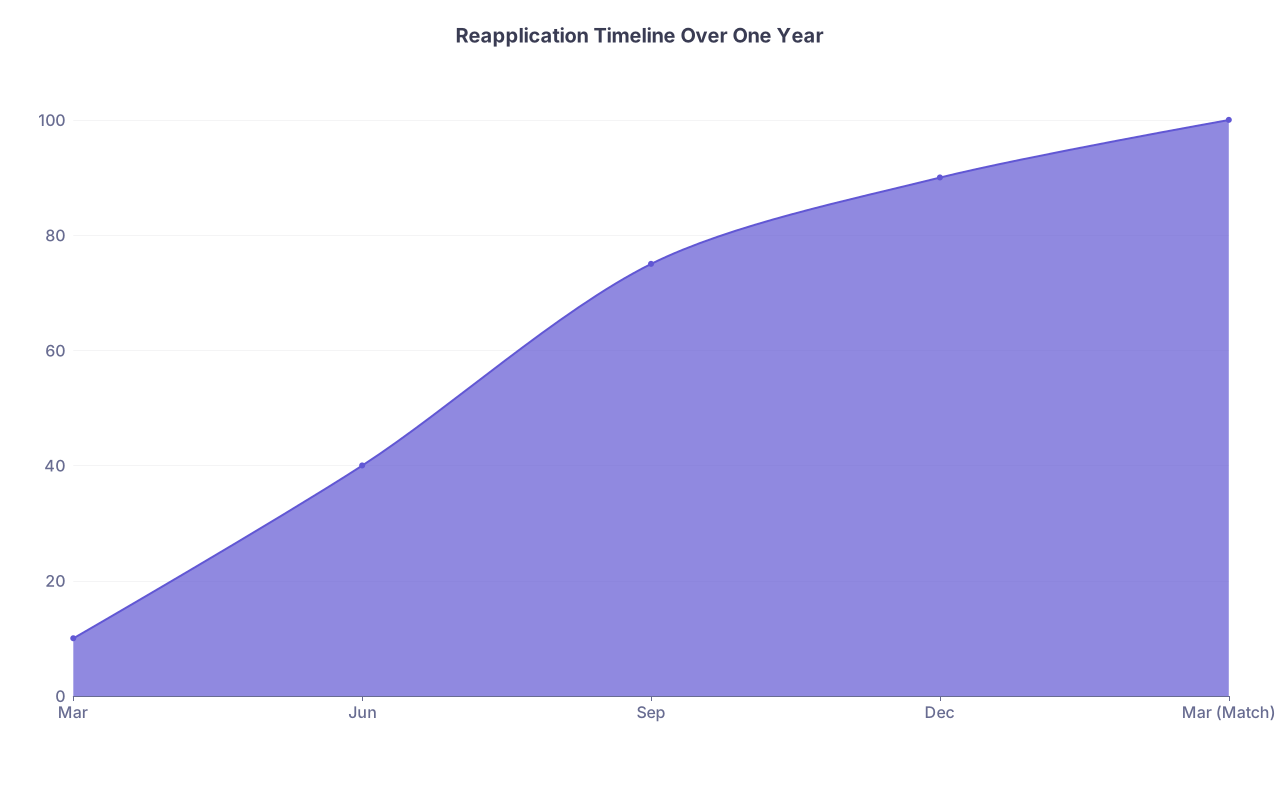
| Category | Value |
|---|---|
| Mar | 10 |
| Jun | 40 |
| Sep | 75 |
| Dec | 90 |
| Mar (Match) | 100 |
Think of “percent readiness” rising across the year. The area under the curve is your actual effort.
Step 1: Build a month‑by‑month timeline
Here is a sample for a student who did not match and plans to reapply:
March–April
- Stabilize and complete Match audit.
- Confirm bridge‑year position (research, prelim, TY).
- Outline reapplication strategy and target list ranges.
May–June
- Start bridge‑year role.
- Schedule Step 3 (if appropriate) and begin structured study.
- Draft new personal statement and update CV.
- Identify and meet future letter writers.
July–August
- Take Step 3 (if planned).
- Polish ERAS (experiences, descriptions, PS).
- Obtain at least one new, updated letter.
- Finalize program list with “reach / realistic / safety” balance.
September
- Submit ERAS early (first week it opens).
- Confirm all letters received.
- Begin interview prep with mock sessions.
October–January
- Attend interviews.
- Keep performing strongly in your bridge‑year role.
- Send targeted, specific update letters when appropriate.
February–March
- Finalize rank list.
- Continue accumulating performance data and CV entries.
- Plan for both Match and no‑Match contingencies (again, with less panic this time).
Customize this for your reality, but do not skip the timeline step.
Step 2: Redesign your program list intelligently
This is where many people sabotage themselves.
Strategy rules:
- Use real data (NRMP Charting Outcomes, specialty‑specific match guides).
- Sort programs into:
- Reach (you are below their usual metrics)
- Realistic (you fit well)
- Safety (your metrics are above their usual)
- Avoid over‑concentration in one category.
Example for Internal Medicine reapplicant:
- Total programs: 70
- Reach: 15
- Realistic: 35
- Safety / community: 20
For competitive specialties:
- If you reapply in the same field, strongly consider dual applying to a more available field (e.g., Pathology, IM, FM, Psych, PM&R depending on your interests).
Step 3: Upgrade your application materials, not just recycle
Personal Statement
- Do not simply tweak last year’s version.
- Address your growth without writing a “trauma essay” about not matching.
- One line or short paragraph is enough:
“After an unsuccessful Match cycle, I spent the past year in a [TY / research / clinical] role, where I [concrete outcomes]. This period strengthened my commitment to [specialty] and sharpened my skills in [specific ways].”
Experiences Section
- Add clear bullet descriptions that show:
- Leadership
- Responsibility
- Clinical skills
- Outcomes (numbers if possible: “Authored 2 manuscripts,” “Presented 3 posters,” “Led QI project decreasing X by Y%”).
- Add clear bullet descriptions that show:
Letters
- Aim for at least:
- 2–3 letters from the specialty you are applying into.
- 1 from your current bridge‑year supervisor.
- Politely retire any letter that you suspect is lukewarm.
- Aim for at least:
Step 4: Systematize your interview prep
You are not “bad at interviews.” You are untrained.
Do the following:
- Record yourself answering:
- “Tell me about yourself.”
- “Why this specialty?”
- “Tell me about a challenge or failure.”
- “Why did you not match previously?” (if applicable)
- Watch it. Note:
- Rambling.
- Filler words.
- Defensiveness or oversharing around red flags.
- Fix with:
- Shorter, structured answers (30–90 seconds).
- Clear narratives with beginning, middle, and end.
- Calm, factual explanations of prior failure:
- “I applied too narrowly to programs above my competitiveness and did not have a backup specialty. Since then, I have [concrete steps], and my mentors and I now believe my application is much stronger and better targeted.”
Run at least 3–5 full mock interviews:
- 1 with a peer.
- 1 with a faculty member.
- 1 with someone who intimidates you slightly (this is good stress inoculation).
Phase 5: Protect Your Identity and Long‑Term Career
One more layer. The part people neglect: what this does to how you see yourself.
You invested years in the story: “I am on track. I do things right. I get the outcome I planned for.” A bad Match shatters that. Not just logistically, but existentially.
If you ignore this, you will carry bitterness and shame into your next cycle, your residency, and your patients. That is not acceptable.
Separate your worth from your Match card
You know this logically. You will not feel it automatically. So you create structures.
- Talk to at least one person who:
- Matched on reapplication.
- Pivoted into a different specialty and is now satisfied.
- Took a non‑linear path (research years, prelim, etc.) and is doing fine.
They exist everywhere. I have seen:
- An unmatched Derm applicant become a thriving IM hospitalist.
- A SOAPed prelim who later matched Anesthesiology and loves it.
- An IMG who failed Step 1 once, did research, and is now at a respected academic IM program.
Your path is not a referendum on your value. It is just your path.
Put structure around comparison and social media
For at least 1–2 months:
- Mute:
- Instagram / LinkedIn feeds full of Match posts.
- Group chats that endlessly dissect who matched where.
- Replace with:
- One or two curated channels: a mentor chat, one supportive friend.
You are not obligated to watch everyone else’s highlight reel while you are rebuilding.
Reconnect your “why”
Residency is a vehicle, not the mission. The mission is:
- Taking care of patients.
- Solving clinical problems.
- Contributing to your community or field.
Spend time in environments that remind you of that:
- Volunteer clinic.
- Shadowing (if appropriate).
- Even just reading real patient stories instead of Reddit doomscrolling.
You are not clinging to a dream because of ego. You are building a life that matches who you actually are.
Your Next Step Today
Do not try to “fix your future” in one sitting. Do this instead, right now:
- Open a blank document titled: “Match Post‑Mortem – [Your Name]”
- Write four headings:
- Strengths this cycle
- Primary failure contributors
- Secondary contributors
- Non‑negotiable constraints
- Under each, force yourself to write at least two bullet points, even if they are rough.
- Then send an email to one mentor or dean with that document attached and a subject line:
“Requesting help planning my next steps after an unexpected Match outcome.”
Once that email is sent, you are no longer stuck in “I failed.” You are in Phase 1 of a deliberate recovery plan.


