

The worst thing about matching your safety program is not the program. It is the story you start telling yourself about what that match means.
I am going to be blunt: if you stay in that story, you will poison your PGY‑1 year, sabotage your growth, and make every on‑call night heavier than it has to be. The match is done. What happens in the next seven days decides whether this is a chip on your shoulder that makes you better, or a weight on your back that drags you down.
Here is a structured, 7‑day plan to turn “I only matched my safety” into “I am going to extract every ounce of value from this place.”
The Real Problem (And It Is Not The Program)
You are not just disappointed. You are grieving a version of your future you have been rehearsing in your head for months. The “big‑name” badge. The city you wanted. The co‑residents you imagined. Maybe the research machine that would have made fellowship “easy.”
You are dealing with three things at once:
- Ego injury – “If I matched my safety, what does that say about me?”
- Fear – “Did I just close doors for fellowship / career / life?”
- Identity confusion – “I thought I was top tier; how does this fit?”
Ignore those, and you will:
- Arrive resentful.
- Withdraw from your new co‑residents.
- Miss early opportunities that matter more than the name on your badge.
Face them head‑on with a plan, and you can:
- Rebuild confidence based on performance, not brand.
- Reverse‑engineer your fellowship or career goals from where you are.
- Start PGY‑1 with a sharper strategy than many who matched “higher.”
So that is what the next seven days are for.
Overview: Your 7‑Day Reset Plan
Here is what we are going to do. One focused theme per day, not therapy homework, not toxic positivity.
| Day | Focus Area |
|---|---|
| 1 | Decompress and Contain |
| 2 | Reality Check and Data |
| 3 | Redefine Your Targets |
| 4 | Map This Program to Your Goals |
| 5 | Build Your Early‑Wins Strategy |
| 6 | Network and Reputation Plan |
| 7 | Commitments and Contingencies |
You can compress this into 3–4 days if you are short on time before graduation, but do not skip steps.
Day 1: Decompress and Contain The Damage
First goal: stop the emotional bleeding so it does not contaminate your relationships and opportunities.
Step 1: Control the narrative (externally)
You do not owe anyone a full debrief of your disappointment. Decide in advance what you will say when people ask, “Where did you match?” or “Are you happy?”
Script something that is honest but contained:
- “I matched at [Program]. It was on my list, and I am going to make the most of it.”
- If they push: “It was not my top choice, but I am grateful to have matched and I am already thinking about how to hit the ground running there.”
That is it. No detailed rank list. No “I only matched my safety.” You do not need to invite pity.
Step 2: Identify 1–2 people for unfiltered feelings
Your attending who wrote your best letter does not need a 30‑minute rant. Your future PD definitely does not. Your co‑residents next year? Absolutely not.
Pick:
- One friend (ideally outside your specialty).
- One mentor or senior who has judgment you trust.
Tell them explicitly: “I am going to vent for 10 minutes. I do not need fixing right now, I need to get this out.” Set a time limit. Then stop.
Step 3: Give your brain a deadline for rumination
You are not going to “just get over it” by willpower. You can, however, put a box around it.
Pick a length of time:
- 48–72 hours is usually enough. Tell yourself: “For the next 2–3 days, I am allowed to feel miserable and replay this. After that, I am switching into strategy mode.”
This is not magical thinking. It is psychological triage. Without a boundary, the disappointment will spread into everything.
Step 4: Keep your hands off social media (mostly)
Scrolling through everyone’s ecstatic posts from “dream programs” is gasoline on the fire. Check in enough to be polite and congratulate close friends. Then log out.
If you must post, keep it short and neutral:
- “Matched into [specialty] at [Institution]. Grateful for the support along the way.”
You are not auditioning for fellowship on Instagram.
Day 2: Reality Check With Actual Data (Not Feelings)
Now that the initial emotional shock is contained, you need facts. Disappointment is loud and rarely accurate.
Step 1: Assess where this program actually stands
Look for:
- ACGME case logs and board pass rates.
- Recent graduates’ fellowship placements.
- Hospital type: tertiary center, community, hybrid.
- Service vs education balance.

If you can, pull numbers from FREIDA, program websites, old PowerPoints from virtual open houses, or ask senior residents you know.
Record hard data:
- Board pass rate last 5 years.
- Number of residents per year.
- Number of faculty in your subspecialty of interest.
- Any research infrastructure: clinical trials office, statisticians, database access.
You may be surprised. I have seen “safety” community programs whose residents match competitive fellowships consistently because they get high operative volume, strong letters, and one or two power‑house mentors.
Step 2: Clarify how many doors are actually closed (fewer than you think)
Ask yourself:
- Do residents from this program get into:
- The fellowships I care about?
- The jobs I could see myself in? If yes, the “door closed” narrative is false. The door is there. The path is just narrower and requires more deliberate work.
If no:
- Are those fellowships hyper‑elite (e.g., top 3 brand names in the country)? If so, that is a vanity problem, not a career problem.
- Or is there a pattern of weak placements across the board? That is a real issue, but still not fatal if you plan early.
Step 3: Benchmark yourself against what matters next
The match is done. Future gatekeepers (fellowship PDs, hiring groups) will care about:
- Where you trained (yes, but less than you think).
- Performance during residency: evaluations, letters, responsibilities you were trusted with.
- Board scores.
- Scholarship output, especially in your target field.
- Reputation from word‑of‑mouth (“This resident works hard, learns quickly, does not cause drama.”)
So your job is to maximize those. This program is now the environment, not the verdict.
Day 3: Redefine Your Targets (Career, Not Ego)
You probably built your rank list partly around prestige. That is normal. The problem is staying there once the match card is printed.
Now you set targets around outcomes you control.
Step 1: Write down your medium‑term goal in concrete form
Not “be successful.” Instead:
- “Match GI fellowship at a solid academic center.”
- “Become a well‑trained general internist in a mid‑sized city with protected teaching time.”
- “Get into a competitive surgical oncology fellowship.”
- “Join a private EM group in a coastal city with good schedule flexibility.”
Be specific: role, setting, and any non‑negotiables.
Step 2: Backward plan from that goal
For your specific aim, list what people in that position usually have:
Example – GI fellowship at academic center:
- Strong IM residency evaluations.
- Excellent letters from 2–3 GI faculty.
- Minimum 2–3 GI‑related projects with at least 1 publication or major abstract.
- Possibly chief resident experience or leadership roles.
- Solid board scores.
Example – competitive surgical subspecialty fellowship:
- High case volume and technical comfort.
- Letters from known surgeons with real fellowship connections.
- Research in their field.
- A reputation as “top of the class” within residency.
Now ask: which of these are:
- Program‑dependent?
- Within my control regardless of program?
You cannot change how famous the chair is. You can absolutely control how reliable, prepared, and productive you are.
Day 4: Map This Specific Program To Your Goals
You are done comparing it to the fantasy program. Compare it to your actual targets.
Step 1: Identify program strengths that align with your goals
Examples I have seen at so‑called “safety” programs:
- Community program with extremely high procedural volume.
- Smaller residency where you get chief resident responsibilities earlier.
- Faculty who are not “famous” nationally but are deeply invested in teaching.
- Less competition among residents for projects, so motivated people dominate research output.
Make a 3‑column list:
- Column 1: My goal (e.g., critical care fellowship).
- Column 2: Program assets that help (e.g., strong ICU, attendings involved in SCCM, high‑acuity cases).
- Column 3: Gaps.
Step 2: Identify the actual gaps
Common ones:
- Limited formal research infrastructure.
- Fewer subspecialty faculty.
- Less brand‑name recognition.
- Less structured mentorship.
You fix gaps. You do not whine about them.
Step 3: Generate concrete workarounds
Here is where you separate yourself from the “I settled” crowd.
Workarounds for common gaps:
Weak research environment
- Partner with faculty at nearby academic centers.
- Use multi‑center database projects (registries, QI collaboratives).
- Learn basic stats and simple study designs so you can drive projects, not wait on others.
- Do case reports and small series early, then build to bigger projects once you prove you finish things.
Few subspecialty faculty
- Identify 1–2 people even tangentially related to your area of interest and ask about expanding their work.
- Cold email faculty at other institutions with a specific project idea and ask about collaboration.
- Join national societies as a resident member; work on committees.
Modest “name recognition”
- Present at national conferences early and repeatedly.
- Network there: meet fellowship PDs, ask good questions after talks, follow up once by email.
- Make sure your PD and key faculty can speak confidently about you to their contacts.
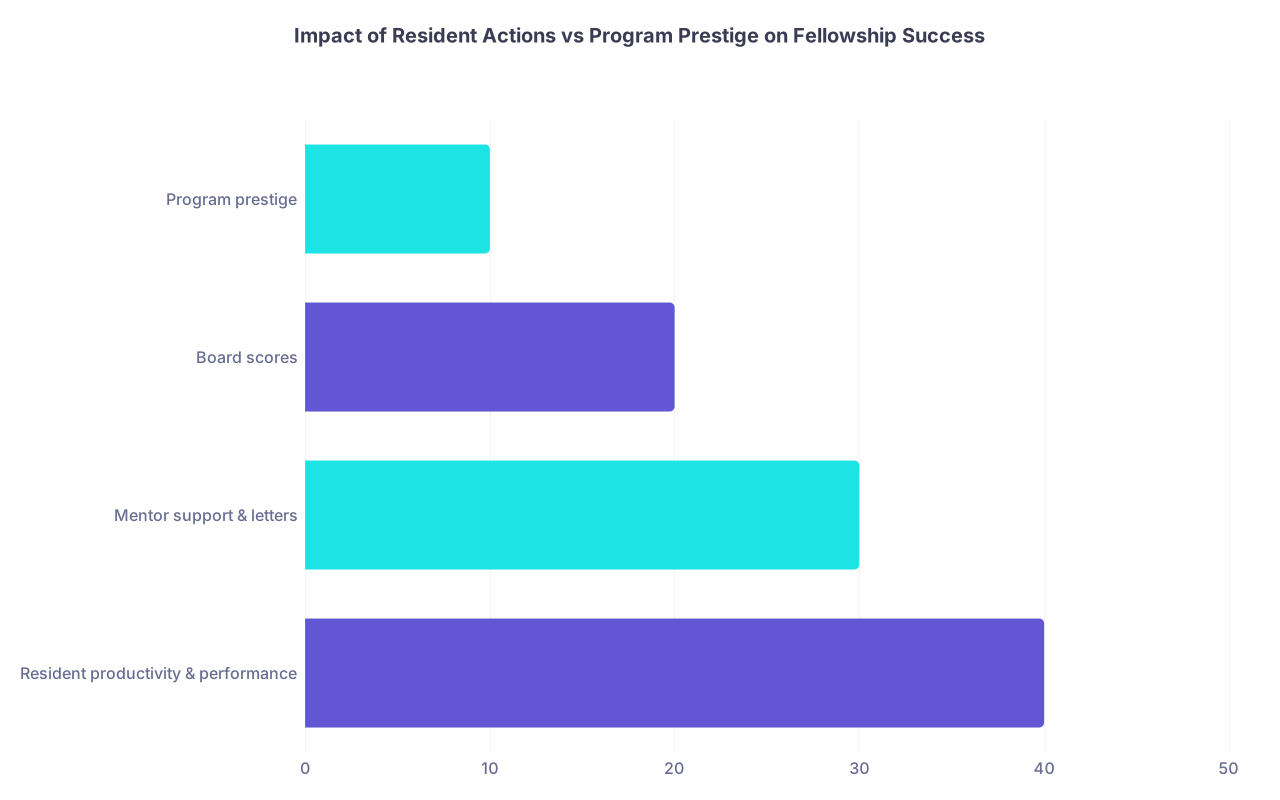
| Category | Value |
|---|---|
| Resident productivity & performance | 40 |
| Mentor support & letters | 30 |
| Board scores | 20 |
| Program prestige | 10 |
The point is simple: your actions and mentors will weigh more than the logo on your badge.
Day 5: Build Your Early‑Wins Strategy For PGY‑1
Next, you design how you are going to show up in July so you are not “the resident who never wanted to be here.”
You want to be the one who:
- Learns fast.
- Is reliable.
- Is coachable.
- Shows potential.
Step 1: Decide your first‑month behaviors
Non‑negotiables:
- Show up early. Not by five minutes. By 20–30, so you can pre‑chart, get oriented, and never start behind.
- Know the EMR cold within two weeks. Ask co‑residents for high‑yield tips.
- Carry a small notebook. Write down every recurring question, process, and teaching point.
- Close your loops. If you say you will follow up on a lab, consult, or imaging, you do it and report back.
I have seen residents from “no‑name” programs get top fellowships for one reason: faculty could trust them on call. That trust starts in month one.
Step 2: Identify 2–3 potential mentors early
Criteria:
- Actually present and engaged with residents. Not just “famous.”
- In or adjacent to your area of interest.
- Reputation among current residents as fair and supportive.
Your script:
- After a good interaction: “I really appreciated your teaching on rounds this week. I am interested in [field]. Would you be open to my reaching out later about career advice or possible projects?”
You do not ask for a letter. You ask for a relationship.
Step 3: Grab low‑hanging opportunities
Early things that signal initiative:
- Volunteer for small QI projects on your first rotation.
- Offer to present a brief article or topic at noon conference.
- Ask your senior: “What is one thing that annoys attendings here that I should avoid?” Then avoid it.

| Step | Description |
|---|---|
| Step 1 | Start PGY1 |
| Step 2 | Arrive 20-30 min early |
| Step 3 | Master EMR basics |
| Step 4 | Identify 2-3 mentors |
| Step 5 | Take on small QI or teaching tasks |
| Step 6 | Ask for feedback |
| Step 7 | Adjust behavior and improve |
You are building a reputation. That is more valuable than the spot you held on last year’s rank list.
Day 6: Network and Reputation, On Purpose
This is where you claw back what you think you lost by not matching a “bigger” name.
Step 1: Build your internal reputation
Within 6–12 months, you want:
- Nurses to like working with you.
- Seniors to request you on their teams.
- Attendings to trust you with progressively more responsibility.
You get there by:
- Being kind and direct with nursing and ancillary staff.
- Owning your mistakes and fixing them.
- Asking for feedback at specific times: “Any one thing I could do differently next call to be more helpful?”
People talk. “This resident is solid” closes as many doors as any branding.
Step 2: Build your external network
You are not stuck inside your building.
Action items:
- Join your specialty’s main society as a resident member (ACP, ACR, ACEP, etc.).
- Sign up for relevant listservs, SIGs (special interest groups), and committees.
- Aim to attend at least one national conference per year starting PGY‑1 or PGY‑2.
At conferences:
- Go to the early‑morning or evening trainee events.
- Introduce yourself: “I am [Name], intern at [Program]. Interested in [field]. Really enjoyed your talk on [topic].”
- Ask one good question, not ten. Quality over volume.
Then follow up once by email with a concrete line:
- “I am interested in [topic]. If you ever have multi‑center projects needing a motivated resident, I would be glad to help with data collection or chart review.”
Step 3: Use your PD strategically
Assuming your PD is not toxic, they can be a force multiplier.
Schedule a brief meeting in the first few months:
- Be prepared: “My long‑term goal is [goal]. I would like your advice on how to best position myself from this program.”
Ask:
- Which rotations are highest yield for exposure and reputation?
- Which faculty write the strongest, most honest letters?
- Are there alumni in [target fellowship/job region] you can connect with?
PDs hate entitlement. They respect clarity and initiative.
Day 7: Commitments and Contingency Plans
Last piece of this: you need to decide what you are committing to, and what you will do if you are genuinely miserable despite trying.
Step 1: Write down 3–5 concrete commitments
Examples:
- “I will show up to this program as if it had been my first choice, for at least the first 12 months.”
- “I will secure at least one ongoing project by the end of PGY‑1 in my area of interest.”
- “I will meet with my mentor(s) at least twice a year to review progress and adjust.”
- “I will take Step 3 / boards as seriously as the original Step exams and aim to outperform my prior scores.”
- “I will not publicly disparage my program, inside or outside, even when I am frustrated.”
You are not promising to love everything. You are promising to act in line with your long‑term interests.
Step 2: Define your red lines and backup options
Sometimes the safety program is not just less prestigious. Sometimes it is dysfunctional: unsafe staffing, chronic violations, abusive culture.
You do not decide that on Twitter. You decide it based on:
- Pattern of ACGME citations.
- Clear, ongoing safety issues ignored by leadership.
- Widespread, consistent reports from multiple residents (not just one disgruntled PGY‑2).
If, after 6–12 months of genuine effort:
- The program is unsafe or destructive to your mental health. Then you can:
- Quietly explore transfer options with your PD or trusted mentors.
- Look into switching specialties only if your interests truly changed, not as an escape from disappointment.
- Document issues carefully if they relate to safety or compliance.
But you must give it an honest attempt first. If you walk in angry and detached, you will not be able to tell whether the program is actually bad or you are just bitter.
A Brief Word On Comparison And Shame
You matched your safety. Someone in your class did not match at all. Someone else SOAPed into a specialty they never wanted. Someone before you matched no program and changed careers entirely.
Comparison is a rigged game:
- Upward comparison: you feel inferior.
- Downward comparison: you feel guilty.
Drop it. Measure yourself by:
- Your growth curve.
- Your consistency.
- Whether you did what you could with what you had.
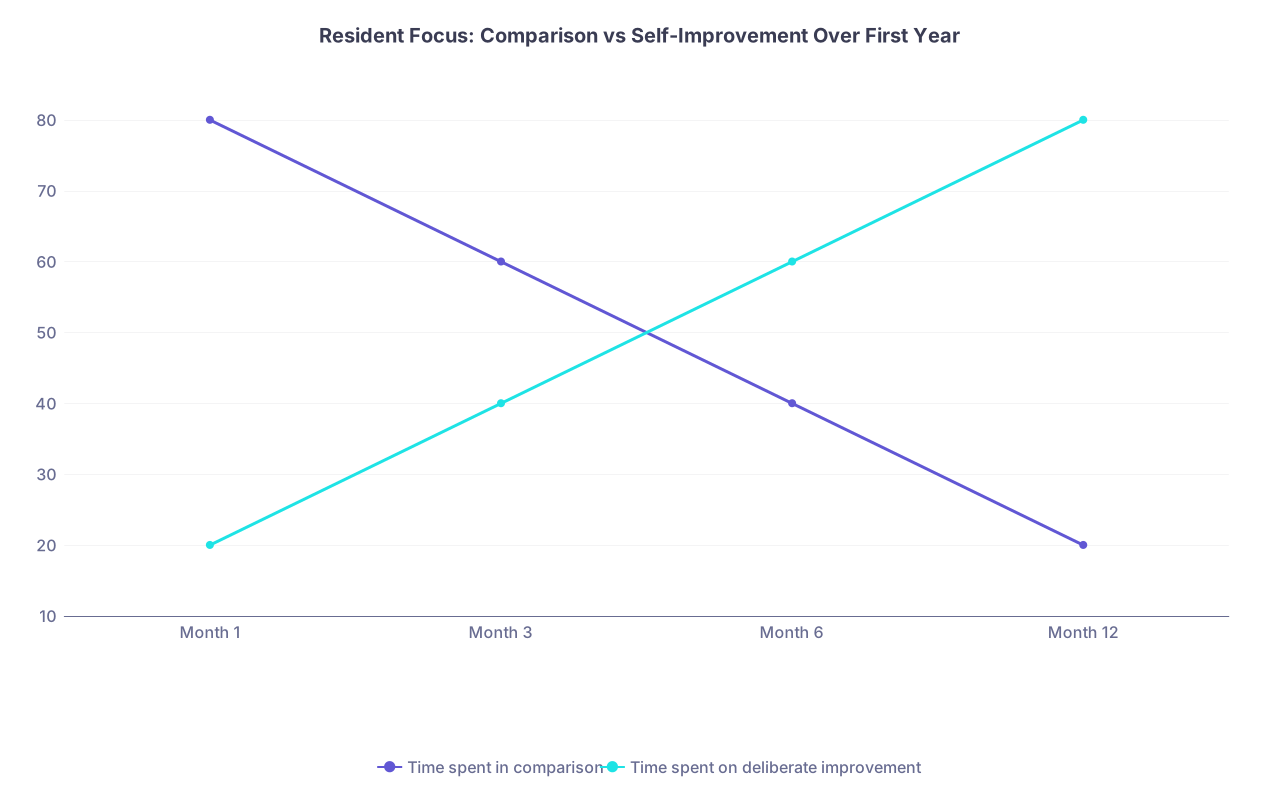
| Category | Time spent in comparison | Time spent on deliberate improvement |
|---|---|---|
| Month 1 | 80 | 20 |
| Month 3 | 60 | 40 |
| Month 6 | 40 | 60 |
| Month 12 | 20 | 80 |
The residents who thrive from “safety” programs are not the ones who convince themselves they never cared. They are the ones who say: “I cared. I am disappointed. And now I am going to out‑work and out‑plan what this program’s reputation predicts.”
Final Check: How To Know You Have Turned The Corner
In a few months, you will see signs you did this right:
- You talk about your program with clear eyes, not constant apology.
- You have at least one faculty member who believes in you and knows your goals.
- You have one ongoing scholarly, QI, or leadership project.
- You are known on the wards as reliable, teachable, and not dramatic.
At that point, your “safety” label is irrelevant. You are no longer defined by where you matched. You are defined by how you train.
Key Takeaways
- Your safety match is a story, not a sentence. Change the story by focusing on data, deliberate planning, and performance.
- Use the first 7 days after Match Day to reset: contain emotions, reassess goals, map your program’s assets and gaps, and design your PGY‑1 strategy.
- Over the next year, your reputation, mentors, and output will matter far more than the line on your Match letter. Act accordingly.


