

The biggest lie about Match Day is that you must feel ecstatic the moment you open that email.
You do not. And many residents do not—especially when the city on that screen is one you never wanted.
I am going to walk you through a stepwise plan for exactly that scenario: you matched, but you hate the city (or think you do). This is not about toxic positivity or pretending everything is great. It is about control. You have more of it than you think.
Step 1: Stabilize the First 72 Hours
You are not reacting to a city. You are reacting to shock, loss of control, and the death of the fantasy you built around Match Day.
Treat the first 72 hours like an acute event. Because it is.
1. Lock down what you say publicly
Do this before you start texting or posting.
Do not:
- Trash the city on social media.
- Say things like “I am devastated” in group chats with classmates, faculty, or program people.
- Ask “Can I get out of this?” in any semi-public forum.
Do:
- Use a neutral script you can copy-paste:
- “Matched to [Program Name] in [City]. Grateful to have matched and processing the news.”
- “Happy to have a spot, definitely surprised by the location. Taking a few days to regroup.”
- Use a neutral script you can copy-paste:
Residency is small. Screenshots live forever. You do not want your future chiefs or PD seeing a rant about how their city is “garbage.”
2. Give yourself a contained meltdown
You need an emotional pressure valve, but with boundaries.
Set up:
- One trusted person (or two) who know you well.
- A defined time box: “I am going to vent for 30 minutes.”
- A hard stop: after that, you switch to planning, not spiraling.
What this looks like in practice:
- You say all the ugly stuff: “I hate cold,” “That city is dangerous,” “It is a cultural wasteland,” “I worked too hard for this.”
- Your friend’s job: listen, validate, and not problem-solve yet.
Then you stop. Stand up. Drink water. Walk around the block. You have discharged some of the emotional voltage. Good. Now we can think.
3. Delay any big “meaning” decisions
Your brain will try to assign meaning immediately:
- “This means I am a failure.”
- “This means I will be miserable for 3–7 years.”
- “This means I chose the wrong specialty.”
Treat those thoughts as symptoms, not facts.
Make one simple rule:
- For 7 days, you do not make any major conclusions about:
- Your career.
- Your self-worth.
- Your long-term happiness.
For a week, your job is data collection and triage, not philosophy.
Step 2: Separate Program Quality from City Preference
Residents regularly confuse two different questions:
- Is this a good program for my training?
- Do I like this city?
You can hate the second and still massively win on the first.
1. Do a quick, cold review of the program itself
Print or open a document. Write these headings:
- Training quality (case volume, acuity, autonomy)
- Fellowship placement / job outcomes
- Reputation in your specialty
- Support culture (wellness, mentorship, responsiveness)
- Resident schedule and call structure
Now, for each category, rate from 1–5 based on your interview impressions and what you know:
- 1 = major concern
- 3 = average
- 5 = strong positive
You may find:
- You matched to a program you ranked high for training but low for city.
- Or you ranked it high just to have “enough” programs, and barely thought about it.
Either way, right now you need clarity:
Is this a strong place to become a competent, employable physician?
That question matters more than whether the nearest Trader Joe’s is 20 or 40 minutes away.
2. Use outside data to sanity-check
Do not rely only on your memory of Interview Day marketing.
Scan:
- Program website for:
- Case numbers.
- Fellowship match lists.
- Patient population diversity.
- FREIDA / specialty-specific forums (with caution) to:
- Confirm general reputation.
- See if any major red flags are repeated by multiple independent people.
Rule of thumb:
If training quality is strong or excellent, and the primary problem is “wrong city,” the situation is fixable. If the program is genuinely toxic and the city is bad, we plan differently. For most, it is the first scenario.
Step 3: Do a Hard Reality Check on the City Itself
Many residents walk in with a cartoon version of a city based on headlines, stereotypes, or one terrible weekend trip.
We are going to run a basic “city due diligence” protocol.
1. Define your actual deal-breakers
Not “I prefer warm weather.” That is not a deal-breaker. I am talking about concrete non-negotiables.
Common categories:
- Safety: specific crime rates in the neighborhoods residents actually live in.
- Partner/family constraints:
- Spouse employment options.
- Kids’ school needs.
- Elder care proximity.
- Health constraints:
- Severe seasonal affective disorder in dark winters.
- Severe allergies/asthma in certain climates.
- Immigration / visa realities.
Make a short list: 3–5 actual constraints. Not 15 preferences.
2. Compare perception vs actual data
Use basic city data, but look at it by neighborhood, not the whole metro:
- Crime heatmaps.
- Cost of living calculators.
- Commute times from safer / more residential areas.
- Housing options that other residents actually choose.
Then ask bluntly:
- Is this “I hate this city” or “I hate a specific imagined version of this city”?
- Are my fears based on:
- Old reputation?
- One bad news story?
- My classmates’ snobby comments?
Cities change. Fast. I have seen people write off “gritty” cities that turned out to be the best training and best financial move of their lives.
Step 4: Build a 30-Day Reframe Plan
You cannot force yourself to love a place. But you can engineer familiarity and control, which is what your brain is really screaming for.
Think of the first 30 days after Match as a structured exposure / adaptation protocol.
1. Week 1: Information and connection
Your tasks:
Join the resident ecosystem
- Ask the program coordinator for:
- Current resident contact list.
- Any unofficial WhatsApp/GroupMe/Discord channels.
- Post a short, humble intro:
- “Hi all, I am [Name], incoming PGY-1 in [Specialty]. Coming from [Current City/School]. Would love any advice on neighborhoods, housing, and what you wish you knew before moving to [City].”
- Ask the program coordinator for:
Schedule 2–3 resident calls
- Target:
- One intern.
- One senior.
- If possible, someone who also moved from far away or from a similar background.
- Ask specific questions:
- “What were your biggest worries before moving here, and were they accurate?”
- “Where do most residents live and why?”
- “What makes this city livable during intern year?”
- “What do people complain about that is actually true?”
- Target:
You will get a much more realistic city picture in 3 conversations than 30 Reddit threads.
2. Week 2: Concrete logistics = less anxiety
Anxiety feeds on vagueness. Kill vagueness.
Create a simple document with these sections:
- Housing options (3–5 realistic options, not 20 tabs)
- Transportation plan (car vs no car, parking, public transit)
- Initial budget for Year 1
- Daily living basics: groceries, gym, primary care, pharmacies
| Item | Decision / Status |
|---|---|
| Neighborhood | Shortlist of 2–3 areas |
| Housing | Target rent range set |
| Transportation | Car vs transit chosen |
| Budget | Year 1 draft completed |
| Move-in Timeline | Target dates identified |
Your goal by the end of Week 2:
You can answer, without hand-waving, “Where will I probably live? How will I get to work? Roughly what will my life cost?”
3. Week 3–4: Structured exposure (virtual or in-person)
If you can afford a visit, do it. If not, you can still do a solid virtual exposure.
If you can visit:
- Walk the neighborhoods where residents actually live.
- Do a commute test during roughly the hours you will commute.
- Sit in a local coffee shop for 30–60 minutes and just watch.
Who lives here? Does it feel tense, relaxed, mixed?
While visiting, force yourself to find:
- 1 place you would happily eat once a week.
- 1 grocery store where you could reasonably shop.
- 1 park / outdoor space you could use.
- 1 gym or physical activity option.
Write those down. They are anchors. On hard days as an intern, those 4 things matter more than any brochure.
If you cannot visit:
Use a structured virtual method:
- Google Street View walks in likely neighborhoods.
- YouTube “walkthrough” videos of the city.
- Ask residents to send:
- Photos of their neighborhoods.
- Screenshots of rent listings.
- Description of their weekly routines.
Your brain does not need perfection. It needs to replace blank unknowns with concrete “good enough” images.
Step 5: Design a Life Outside the Hospital (On Purpose)
Residents underestimate how much their micro-life radius shapes their perception of a city.
If your only exposure is:
- Apartment → hospital → hospital cafeteria → back home → collapse, you could be in Paris or Peoria and still hate it.
You need a deliberate “90-minute life”—things you can reasonably do within 90 minutes of free time that do not involve medicine.
1. Identify 3–5 “identity anchors”
These are small, recurring activities that protect the parts of you that are not “Dr. [Last Name].”
Examples:
- Weekly or biweekly:
- Rec soccer league, climbing gym, yoga class.
- Church/mosque/temple community.
- Language class, book club, music group.
- Solo but meaningful:
- Nature trail walks.
- Photography, drawing, or writing routines.
Make a short list:
- 2 things you already do and want to keep.
- 1–2 things you want to try in this new place.
Then map them to the actual city:
- Search: “[City] adult soccer league,” “[City] choir,” “[City] hiking groups,” etc.
- Ask residents: “What do people actually do here when they are not in the hospital?”
2. Set a “minimum engagement” rule
You do not need to become the city’s biggest fan. But you will not adjust if you never leave your apartment.
Set a realistic rule for your first 3 months:
- At least 2 non-work activities per month that engage with the city:
- One social (with co-residents or locals).
- One solo or small-group thing that is just for you.
Intern year is exhausting. Fine. But two activities a month is survivable and can be scheduled ahead, especially on golden weekends.
Step 6: Reframe the Narrative (Without Lying to Yourself)
You are not trying to gaslight yourself into “loving” a place you do not love yet. You are rewriting the story so it is usable.
Right now, the default script in your head might be:
- “I got stuck in a city I hate.”
- “Everyone else got better matches.”
- “I am trapped here for 3–7 years.”
We will replace that with a more accurate and more functional script.
1. Use this 3-part reframe template
Write (literally write) 3–5 sentences that cover:
What happened (neutral, factual):
- “I matched into [Specialty] at [Program] in [City]. I did not initially want to live there.”
Why it still matters (training / career focus):
- “This program will train me to be a competent [specialty] with strong opportunities for [fellowship / job type].”
What I am going to do about it (agency):
- “For at least the first year, I am going to fully commit to the training, deliberately build a small but solid life outside the hospital, and then reassess with real experience instead of assumptions.”
That is not rose-colored. That is strategic.
Stick this somewhere you will see it:
- Phone notes.
- Printed on your wall.
- Inside your white coat.
2. Preempt the comparison trap
Someone in your class matched to your dream city. Someone matched to a top-5 program. Someone matched near family. You are going to see their Instagram.
Decide now how you will handle it:
- Mute or unfollow temporarily if you must.
- When you catch yourself comparing, force the thought:
- “Different constraints, different luck, different game. My job is to maximize the hand I got, not replay the deal.”
Sounds harsh, but it works.
Step 7: Create an Exit Option (So You Feel Less Trapped)
Feeling trapped magnifies misery. Even if you never use the exit, just knowing it exists reduces panic.
No, you cannot just “re-match” next week because you do not like the skyline. But you can build credible future options.
1. The 12–18 month reassessment plan
Give yourself a clear checkpoint:
- “At the end of PGY-1 (or PGY-2 for longer programs), I will reassess: training, city, mental health, and career goals.”
At that point, your options might include:
- Staying and finishing because:
- Training is strong.
- City is tolerable or even surprisingly decent.
- Looking at:
- Transfer opportunities (rare but not impossible).
- Fellowship in a different city.
- Job search post-residency in your preferred region.
| Category | Value |
|---|---|
| Month 1 | 30 |
| Month 6 | 55 |
| Month 12 | 65 |
| Month 18 | 70 |
| Graduation | 80 |
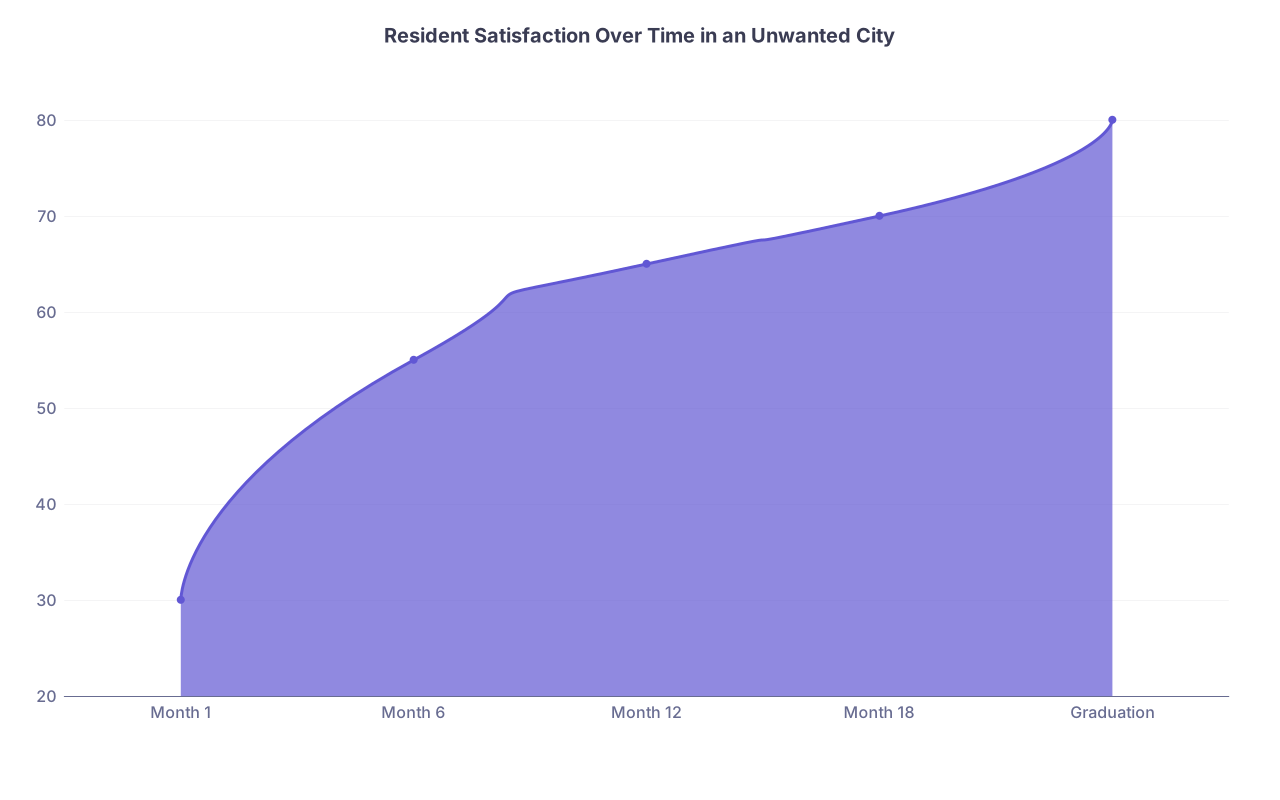
I have seen many residents go from “I hate this place” at Month 1 to “I would not have traded this training for anything” by graduation. They still leave afterward. That is fine. The key is they suffered less because they knew leaving later was an option.
2. Concrete exit prep you can start early
Small things now make you highly mobile later:
- Maintain connections in your preferred region:
- Periodic emails to mentors.
- Present at a conference in that region if possible.
- Build a solid CV:
- QI projects.
- Research.
- Strong evaluations.
- Avoid burning bridges:
- No explosive conflicts.
- No public trashing of the city or hospital.
You are positioning yourself so that, when residency ends, you have choices. That knowledge alone lightens the load.
Step 8: Mental Health and Coping: When to Escalate
Sometimes “I hate this city” is code for:
- “I am depressed.”
- “I have untreated anxiety.”
- “My support system just got ripped away and I am not okay.”
You cannot mindset-hack your way out of major depression.
1. Red flags that this is more than adjustment
Get serious help if you notice:
- Persistent hopelessness beyond 2–4 weeks.
- Sleep completely wrecked (barely any, or sleeping all day).
- Loss of interest in everything, not just the city.
- Thoughts that people would be better off without you.
- Increasing use of alcohol or substances to tolerate being there.
At that point, priority shifts from “reframe the city” to “protect your life.”
2. Build a mental health support plan before you move
Minimum setup:
- Identify local therapists or psychiatrists now (do not wait until crisis).
- Ask incoming co-residents or chief residents:
- “Do you know any providers who see residents?”
- Use:
- Your school’s mental health services for bridge support.
- National hotlines if you are in immediate crisis.

| Step | Description |
|---|---|
| Step 1 | Feel overwhelmed |
| Step 2 | Use peer support and coping plan |
| Step 3 | Schedule therapy visit |
| Step 4 | Continue outpatient care |
| Step 5 | Contact crisis services or ER |
| Step 6 | Lasting more than 2 weeks |
| Step 7 | Suicidal thoughts |
Using mental health care is not a sign you “cannot hack residency.” It is a sign you are not willing to let an address destroy you.
Step 9: Turn the City Into Training Leverage
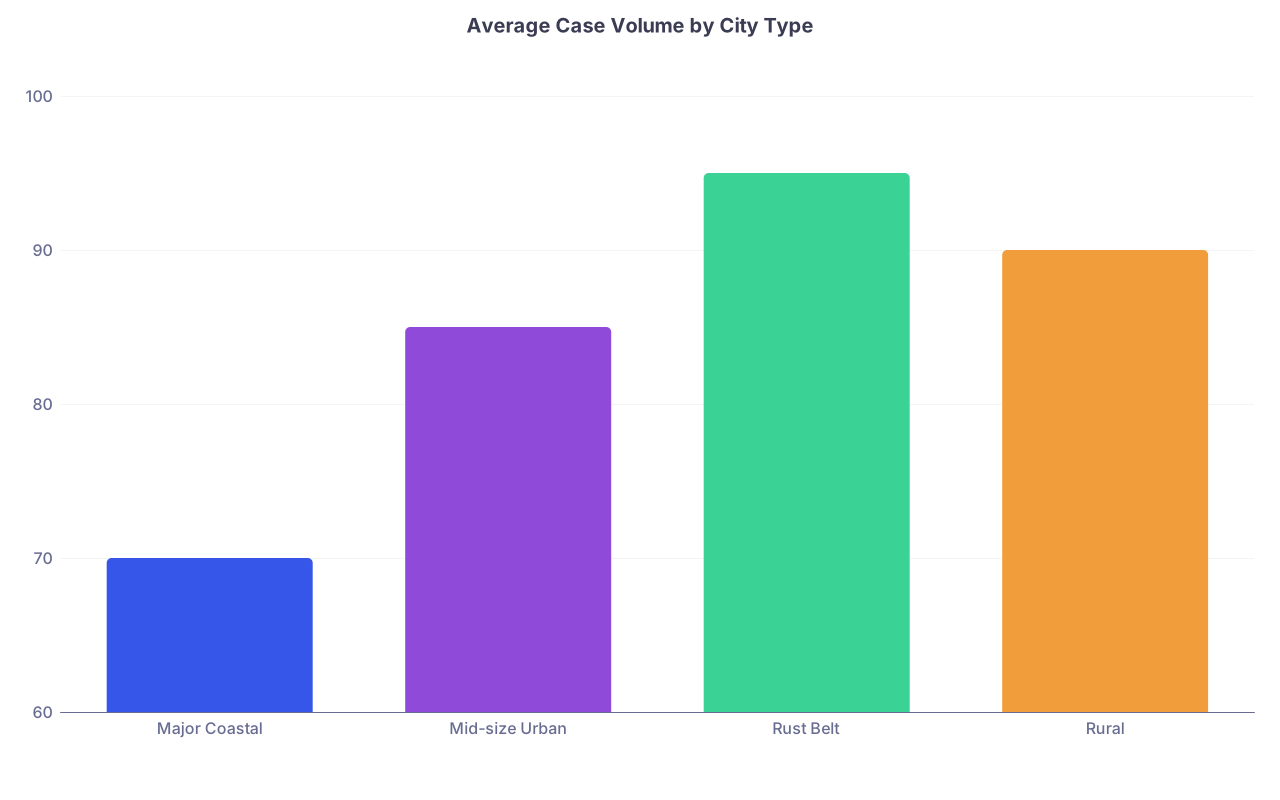
There is one more angle almost nobody talks about: “undesirable” cities often offer superior clinical training.
Because:
- Higher acuity.
- Less competition from other trainees.
- Underserved populations with complex pathology.
- Fewer “tourist distractions,” more focus on work and skill-building.
| Category | Value |
|---|---|
| Major Coastal | 70 |
| Mid-size Urban | 85 |
| Rust Belt | 95 |
| Rural | 90 |
You can choose to frame it as:
- “I am exiled.” or:
- “I am doing a high-yield training tour in a place that will make me very, very competent.”
A few ways to operationalize that:
- Seek out:
- Extra procedures (with supervision).
- Complex patient follow-up experiences.
- Build skills that travel well:
- Managing resource-limited settings.
- Working with diverse, underserved populations.
- Leading teams under pressure.
When you later interview for fellowship or jobs in your dream city, you will be the applicant who can say, “I trained in a high-acuity, resource-challenged environment and can handle anything.” That is not fluff. Employers know which programs produce these people.
Step 10: Script for Conversations You Are Dreading
You are going to have to explain this match outcome to people. Let us make that easy.
1. To proud but confused family
They might say, “Why there? That city is dangerous / ugly / far.”
Use a calm, firm script:
- “The Match is a national algorithm. You cannot pick just one place. I matched to a strong program that will train me well. The city was not my first choice, but I am committed to making it work for these years. After that, I can choose where to live.”
Repeat as necessary. You are not inviting a debate about the ranking list you already submitted months ago.
2. To classmates subtly flexing their coastal matches
You can be honest without self-sabotage:
- “I had a few places higher on my list for location, but I am ending up at a program with really solid training. I am focusing on that and building a life there for a few years.”
If someone pushes: “But do you like the city?”
Option:
- “It was not at the top of my location list, to be honest. I am giving it a real shot for at least a year before I judge it.”
You do not owe anyone your emotional diary.

Putting It All Together: A Quick Stepwise Summary
If you remember nothing else, follow this sequence:
First 72 hours
- Control what you say publicly.
- Vent in a controlled way.
- Ban big life conclusions for a week.
Week 1–2
- Separate program quality from city preference.
- Talk to current residents.
- Build a basic logistics plan (housing, transit, budget).
Week 3–4
- Do physical or virtual exposure to the city.
- Identify at least 4 “anchors” (food, grocery, park, activity).
First 3 months
- Maintain 2 non-work activities per month.
- Use your written reframe script.
- Start quiet groundwork for future options (fellowship, jobs, networking).
By 12–18 months
- Reassess with real experience.
- Decide: stay and finish, or actively plan post-residency move / fellowship elsewhere.

FAQ (Exactly 4 Questions)
1. Can I try to transfer to another residency just because I dislike the city?
You can try, but transfers are rare and usually driven by significant reasons: family emergencies, major program issues, dual-career constraints, or severe health concerns. “I do not like the city” alone is a very weak justification, and most programs will not open a slot for that. Your better strategy is:
- Fully commit to your current program for at least the first year.
- Build a strong performance record.
- Quietly monitor for genuine transfer openings through mentors and specialty networks. Always assume you will likely complete training where you matched, and then choose your ideal location for fellowship or practice.
2. What if my partner absolutely refuses to move to this city?
That is not a logistics problem; it is a relationship problem. You both need to confront the reality of medical training: sometimes the algorithm separates couples geographically. Options to discuss honestly:
- Long-distance for a defined period with clear check-ins.
- Partner reassessing their flexibility or job mobility.
- You both reassessing priorities and whether this relationship can survive the constraints of your career path. What does not work: pretending you can please the Match, your program, your partner, and your own preferences all at once without sacrifice. You will have to choose which tradeoffs you can live with.
3. How long should I expect it to take before I feel “okay” in a city I did not want?
Most residents I have seen who made a real effort hit a rough pattern:
- First 1–2 months: disorientation, grief for what might have been, lots of comparison.
- Months 3–6: familiarity grows, a few local favorites appear, social ties start to form.
- By 12 months: the city feels at least navigable, and the main stressors are residency itself, not the address. If you still feel actively miserable about the city specifically after 6–12 months despite making real efforts to engage and build a life, that is when you revisit mental health support and longer-term exit planning.
4. What if I genuinely never end up liking the city?
Then you treat it as a finite deployment, not a life sentence. Many physicians spend 3–7 years in cities they would never choose long term. They:
- Focus on maximizing clinical skill and CV building.
- Protect their non-work identity with hobbies, travel on vacations, and virtual connections to loved ones.
- Use the time to pay down debt, save money, and set themselves up for a future move. You are allowed to say, years later, “That city was not my favorite.” The goal is that it becomes “a tough but valuable chapter” rather than “the time I let geography crush me.”
Open your Match email again and read the program name, not the city. Then write a 3-sentence reframe using the template above and save it to your phone. That is your starting point—do it today, before your brain writes a worse story for you.


