

The worst time to process your Match result is five minutes before you have to see your next patient. But that is exactly when medicine likes to schedule your feelings.
You checked your email. You saw the program name. Your brain exploded for about 4.7 seconds. Then reality slapped you: “You’re still on shift.”
So the question is not “How should I feel?” The question is “How do I keep functioning safely and professionally when my entire future just got decided, and I still have orders to write?”
Here is the playbook.
1. First 5 Minutes: Stabilize, Do Not “Push Through”
This is the critical window. What you do in the first 5 minutes after seeing your Match result determines whether the rest of your shift is controlled or chaotic.
Step 1: Physically step away
If you can, do this immediately:
Tell someone you trust on the team (resident, attending, charge nurse):
“Match email just came in. I need 5 minutes in the restroom/locker room to look and reset. I’ll be right back.”If you are literally about to walk into a room, delay by 2 minutes:
“Let me wash my hands and grab something, then I’ll come in.”
Then step into a bathroom or empty room.
Do not open your Match email in the middle of a hallway. Or in front of a patient. Or at the nurses’ station with ten people watching. You are handing away control of your reaction.
Step 2: One clear statement about reality
Once you see the result, name it in one sentence. Out loud if possible.
- “I matched at my top choice.”
- “I matched somewhere I did not want.”
- “I matched but not at home.”
- “I matched and I have mixed feelings.”
Why? Because your mind will start spinning in 12 directions. One clear sentence locks reality in. It gives your brain something solid to hold.
Step 3: 90-second decompression protocol
You have 90 seconds. Use it.
**Set a timer** on your phone for 90 seconds. Commit to go back when it ends.
Box breathing (simple, reliable):
- Inhale through nose 4 seconds
- Hold 4 seconds
- Exhale through mouth 4 seconds
- Hold 4 seconds
- Repeat 4 cycles
Name three things you can control for the next 4 hours:
- “I can control how I talk to patients.”
- “I can control my documentation quality.”
- “I can control when I respond to my family.”
You are not trying to “feel better.” You are trying to stabilize enough to be safe and professional.
2. Script Your Communication (So You Don’t Have To Think Later)
In the middle of a shift, the worst drain on your brain is decision fatigue. So remove as many decisions as possible. Especially communication.
Decide three things now:
- Who gets told during the shift
- Who gets told after the shift
- What you will say when asked
A. Decide your “inner circle” for during-shift
This list should be short. People who affect your workflow and your emotional safety.
Examples:
- Your senior resident or attending
- One co-student or co-intern on shift
- Maybe one close friend or partner if you can text them quickly
Everyone else can wait.
B. Use canned scripts for text
You do not have the emotional bandwidth to write heartfelt messages right now. Pre-script it.
- For happy result:
“Matched! Still on shift, will call you after. Love you.” - For neutral/mixed result:
“I matched. I am on shift and still processing. I will call you after I get off.” - For disappointing result:
“I matched, but it is not what I hoped for. I am on shift and not ready to talk yet. I will reach out later today.”
Copy-paste that. Do not improvise.
C. Script for in-person questions
People on shift will ask. Sometimes in the worst possible moment.
Have one sentence ready:
- Joyful: “Yes, I matched at [Program]. I am excited. I will celebrate after shift, but for now I need to stay focused.”
- Mixed: “Yes, I matched. Still processing it. I want to stay focused on patients right now, but we can talk later.”
- Disappointed: “Yes, I matched, but it was not what I hoped. I am okay to work, but I would rather not talk details during shift.”
Short. Clear. Boundary-setting.
Say it the same way every time. Saves you from re-living the story 20 times while you still have orders to place.
3. Shift Triage: Protect Patient Safety and Your Brain
Here is the part no one says out loud: after Match results, your cognitive load is shot. You are more distractible. Your risk of making a mistake goes up.
You fix that by simplifying the shift.
A. Tell your supervising physician the truth
You do not need a therapy session. You do need acknowledgment.
Example script:
“I just saw my Match result. I am okay to work, but I am more emotionally loaded than usual. If I seem slower or need double-checks, that is why.”
Nine out of ten attendings will support you. The tenth is a red flag, not your problem.
What this does:
- Gives them context if you seem off.
- Makes it easier for you to ask for help later without feeling weak.
B. Reduce multitasking aggressively
On a day like this, your rule is:
One task. One patient. One screen. At a time.
Concrete adjustments:
- Stop juggling three charts at once.
- Finish orders on one patient before jumping to the next.
- Use physical notes to track to-dos if your mind feels scattered.
Example mini-checklist you can keep in your pocket:
- New consults seen?
- STAT labs ordered?
- Critical results addressed?
- Discharge orders placed?
- Notes completed for seen patients?
You are shrinking your cognitive workspace so you do not drop something important.
C. Use micro-pauses before critical actions
Before:
- Writing orders
- Entering prescriptions
- Dictating/typing final diagnoses
- Signing notes
Do a 5-second micro-check:
- Confirm patient name + room.
- Say out loud (softly): “This is [patient name]. I am ordering [thing]. This is correct.”
- Then click.
Feels silly. Works incredibly well when your mind wants to drift back to your Match email instead of the med list.
4. Emotional Containment: How to Park Feelings Without Numbing Out
You cannot process the whole thing right now. You also cannot pretend it did not happen. The middle path is “emotional containment.”
A. Set a specific time to “open the box”
Your brain needs a promise, or it will keep intruding mid-shift.
Tell yourself:
- “I will sit down at 8:30 pm after my shift, phone on airplane mode, for 30 minutes to fully feel this and process.”
- Add it as an actual calendar event if that helps.
This tells your mind, “Not now, but yes, it will be addressed.” Shockingly effective.
B. Write a 30-second note to your future self
Open Notes on your phone. Type:
- “Current feeling: ___”
- “What I want to remember later: ___”
- “What I am afraid of right now: ___”
Example for a disappointing result:
- “Current feeling: Sick to my stomach, embarrassed to tell people.”
- “Remember later: I still matched. I will still become a doctor.”
- “Afraid of: Being unhappy for 3+ years, being judged by my classmates.”
Then close it. You have captured the emotional state. You do not need to stay inside it for the whole shift.
C. Limit emotional triggers during the shift
This means:
- Do not scroll social media.
- Do not open group chats blowing up with “I MATCHED!!!”
- Mute or hide notifications from your class GroupMe, WhatsApp, whatever.
You are not avoiding joy or pain forever. You are preserving bandwidth for the next few hours.
5. Handling Different Match Outcomes While Still Working
The emotional tone matters. Joy, shock, disappointment—all hit differently. The strategy shifts slightly.
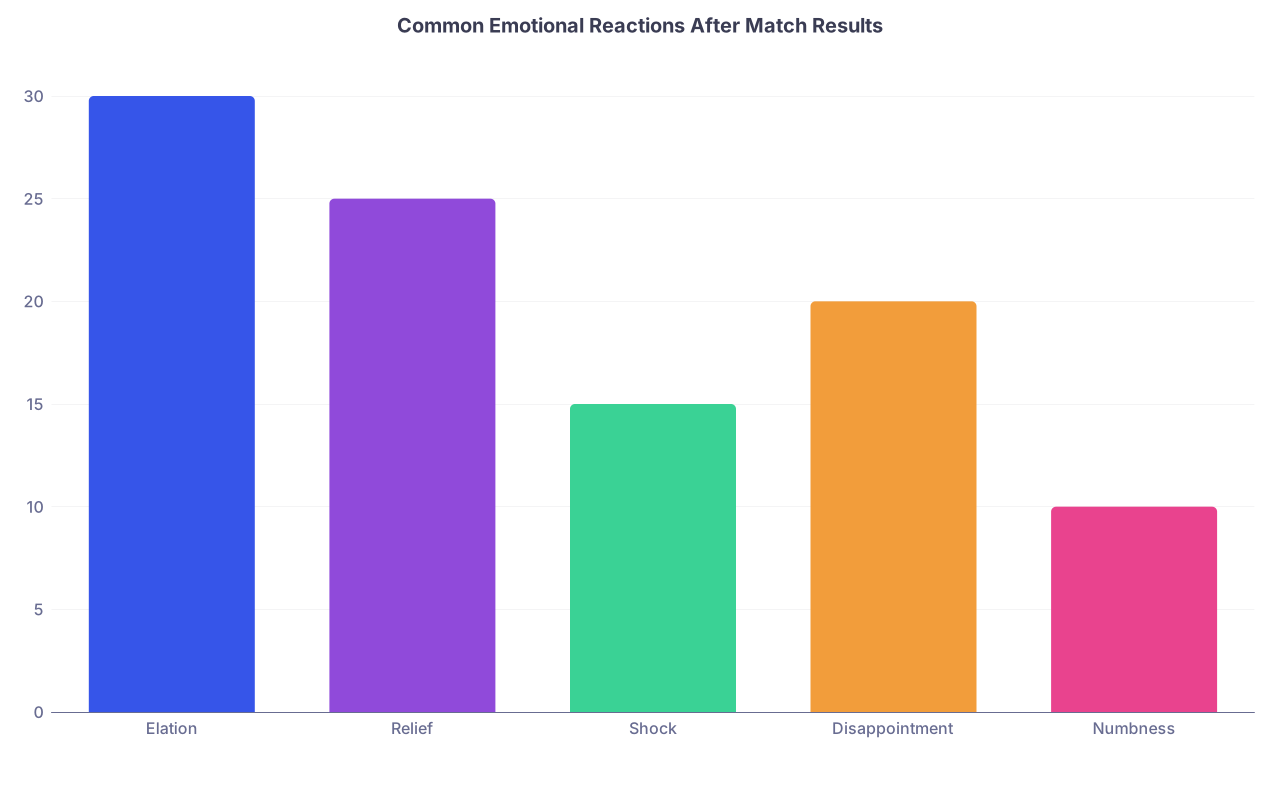
| Category | Value |
|---|---|
| Elation | 30 |
| Relief | 25 |
| Shock | 15 |
| Disappointment | 20 |
| Numbness | 10 |
A. If you matched at your top choice or better
Problem: You are euphoric and distractible.
Protocol:
- Ask yourself: “On a 0–10 scale, how activated am I?” If you are above 7, take a 3–5 minute walk or bathroom break to let the adrenaline settle.
- Tell your supervising resident/attending:
“I matched at my top choice. I am thrilled and want to keep my head in the game. I might be more chatty than usual; feel free to rein me in.” - Celebrate micro, not macro:
- A quick high-five in the workroom
- A 10-second “Thank you” to the nurse who says congrats
- Then back to the chart
Avoid:
- Long story-telling about your rank list and interview trail mid-shift
- Checking your phone every 2 minutes to watch congratulations roll in
You will enjoy it more later when you are not split in twelve directions.
B. If you matched but not where you wanted
This is the most dangerous emotionally. You are not in crisis enough for people to obviously intervene, but you are hurting enough to be mentally offline.
Protocol:
- Acknowledge the grief:
“I am allowed to be disappointed. I still have to be safe.” - Name the worst thought explicitly (to reduce its power):
“I am afraid this means my career is ruined / I will be miserable.”
Then, one counter-fact: “Objectively, I will still be a board-certified physician.” - Tell one person you trust on shift:
“I matched, but not where I hoped. I am functioning, just pretty down. I might be quiet today.”
Protect yourself from:
- Detailed program comparisons with other students today
- “At least you matched” speeches from people who mean well but do not get it
You can unpack the career implications later with a mentor. Right now the goal is “good enough functioning,” not “complete emotional resolution.”
C. If you are genuinely devastated or on the edge of losing it
I have seen students try to “tough it out” and then cry in the hallway between rooms. That helps nobody.
Signs you need more than this article:
- You feel like you might burst into tears at any interaction.
- You keep rereading the Match email and cannot focus on what patients are saying.
- You are having thoughts like “What is the point anymore?”
At that point, you have two responsibilities:
- Patient safety
- Your own safety
You are allowed to say:
“I saw my Match result and I am not okay right now. I do not think I can safely care for patients for the rest of this shift. What options do we have for coverage or reducing my load?”
Is calling out ideal? No. Is unsafe care worse? Yes.
If there is truly no coverage and you must stay:
- Ask for your role to be narrowed (no new admissions, focus on follow-up tasks).
- Ask for closer supervision on orders.
- Keep your tasks mechanical: vitals, labs, basic notes. No heroic diagnostic puzzles today.
6. Protecting Relationships While You Are Emotionally Volatile
Your phone will try to hijack your nervous system: parents, partner, faculty, classmates.
You need clear boundaries, or you will end the shift resentful and exhausted.
A. Decide your communication tiers
Think of it in levels:
- Tier 1 (Immediate): People whose anxiety will spike without a quick answer.
Usually: parents, partner, maybe one best friend. - Tier 2 (End-of-day): Close friends, mentors, home program PD.
- Tier 3 (Later): Distant relatives, college friends, social media, group chats.
During the shift:
- Respond only to Tier 1 with one-line canned texts.
- Silence/mute everything else.
B. Use “containment” language with family
Example for parents who are chronic over-texters:
- “I matched at [Program]. I am on shift. I cannot talk now, but I will call at [time range]. Please do not call repeatedly; my phone needs to stay quiet.”
If you matched somewhere you are unhappy with and know they will guilt-trip or panic:
- “I matched. It is not what I hoped for, and I am still processing. I am on shift and cannot talk it through now. I will call later when I have had time to think.”
You are not being cold. You are protecting both your patients and your relationship from saying something in the heat of the moment that you will regret.
C. Handle colleagues who get inappropriate
There is always someone who decides your disappointment is their entertainment.
If someone presses you for details or makes comments you do not want:
- “I am keeping details for later; I want to focus on patients right now.”
- “I am not up for joking about it today.”
- If they keep going: a flat, “Not appropriate right now,” followed by turning back to your workstation.
Short, firm, no performance.
7. After-Shift: Structured Decompression So It Does Not Linger
If you do not decompress properly after this kind of day, it leaks into tomorrow. And the next rotation. And your relationships.
Here is a simple, structured way to land the plane.
A. First 10–15 minutes after leaving
Before calling anyone. Before social media.
Change locations
Do not sit in your car in the parking garage scrolling Reddit. At least start driving or walk 5–10 minutes outside.Body reset
- Long exhale breathing: inhale 4 seconds, exhale 6–8 seconds, repeat for 2–3 minutes.
- Shoulder roll, neck stretch, shake out hands. You have been holding tension all day.
Name the day honestly
“Today was Match day. I worked while my future was decided. I did [good, mediocre, survivable]. That is enough.”
You are closing the “clinical self” for the day.
B. 30-minute processing block
Remember that calendar “open the box” time? This is it.
You can structure it like this:
Write for 5–10 minutes
Answers to:- “What did I feel when I saw the email?”
- “What am I afraid will happen because of this?”
- “What do I actually know versus what I am imagining?”
Talk to one safe person
Not ten people. One or two max at first.- For joy: someone who can celebrate without making it all about them.
- For disappointment: someone who listens without immediately “reframing it positive.”
One concrete next-step for residency prep
This part matters. It gives your brain a sense of direction.Examples:
- Look up housing info for your new city for 5 minutes.
- Bookmark your residency’s schedule or curriculum page.
- Email your mentor: “Matched at [Program]. Would love to debrief and plan next steps later this week.”
You are signaling to yourself: “The story continues. Today is not the end point.”
C. Delayed social media strategy
Do not feel obligated to blast your Match result within hours.
Options:
- Post next day after you have slept.
- Keep it simple: program name, specialty, gratitude if you genuinely feel it.
- If your result is painful and you do not want to post, you are not obligated. A quiet message to people who matter and no public announcement is perfectly legitimate.
8. What To Do Differently Next Time You Have Big News On Shift
You will have other high-stakes days during training: board scores, fellowship match, family emergencies. Use this as a template.

| Step | Description |
|---|---|
| Step 1 | Receive Big News |
| Step 2 | Process fully now |
| Step 3 | Step away 5 min |
| Step 4 | Name reality in 1 sentence |
| Step 5 | 90 sec breathing |
| Step 6 | Notify supervisor briefly |
| Step 7 | Set time to process later |
| Step 8 | Return to simplified tasks |
| Step 9 | End of shift decompression |
| Step 10 | On shift? |
Patterns to adopt for the rest of your career:
- Never open life-changing emails in a patient area.
- Always give yourself a 5-minute buffer, even on a slammed shift.
- Script short responses ahead of time for predictable questions.
- Protect your future self’s mental health by setting boundaries in real time.
You are not weak for needing this structure. You are professional for using it.
9. Quick Reference Playbook (Print or Save)
Here is the condensed field guide you can screenshot or jot down.
| Moment | Action |
|---|---|
| Immediately after email | Step away 5 min, name result in 1 sentence, 90-sec box breathing |
| Before returning to work | Text Tier 1 contacts a canned line, set time to process later |
| Back on the floor | Tell supervising physician, simplify tasks, one-patient-at-a-time focus |
| When asked about result | Use pre-scripted 1-sentence response, avoid long discussions |
| If emotions spike mid-shift | 2-min bathroom break, slow exhale breathing, quick reality check |
| After shift | 10–15 min alone, 30-min processing block, one concrete next-step for residency |
Stop reading here and do one small thing:
Decide now what exact sentence you will say when someone on your shift asks, “So, where did you match?”
Say it out loud once. Lock it in. That one line will buy you more mental space than anything else you do today.


