The worst time to realize your call schedule is unsafe is after you have already agreed to it.
Let me walk you through how an actual resident who wants to survive residency looks at a call schedule on day one at their matched program—line by line, not vibes and hope.
Step 1: Get the Right Documents in Front of You
You cannot analyze what you do not have. You want three things, not one.
- Official rotation schedule (block schedule) for PGY-1
- Call schedule for at least the first 2–3 blocks
- Program policies on duty hours and call (usually in the resident handbook or GME policies)
On day one (or even before orientation if they send it out), you should have a block schedule that looks something like:
- Block 1: Inpatient Medicine A
- Block 2: Night Float
- Block 3: ICU
- Block 4: Ambulatory
- Block 5: Inpatient Medicine B
- …and so on
Then you will have a call schedule—often a messy grid with dates, names, and “Call / NF / Off” written or abbreviated.
Before you start judging anything, sit down and align these two: what rotation are you on and what type of call is attached to that rotation? That determines your life.
| Document Type | What You’re Looking For |
|---|---|
| Block schedule | Rotation type and sequence |
| Call schedule | Nights, weekends, call type, off days |
| GME duty hour policy | Hard limits to compare against schedule |
Step 2: Decode the Language of the Call Schedule
Programs love cryptic abbreviations. Decode them or you will miss key problems.
Common labels you will see:
- “24+4”, “q4 call”, “q3 call” – traditional in-house overnight call
- “NF” – night float (usually blocks of nights, no 24s)
- “Home call” – pager at home, must come in for admissions/consults
- “Short call” – late stay but not overnight (e.g., until 9–11 pm)
- “Long call” – you are the admitting team until late or overnight
- “Jeopardy / Backup” – you are the person they call to cover others
On day one, take a pen and annotate your printed schedule (print it; do not try to do this in your head on a phone screen). Circle your name and actually mark:
- N = confirmed night in the hospital
- H = home call
- J = jeopardy / backup
- O = off day
- C = 24-hour (or “24+4”) in-house call
You want to visually see the pattern: runs of nights, frequency of 24s, and where your days off fall.
Step 3: Anchor Everything to Duty Hour Rules
Here is where you stop trusting that “they must have checked this already.” They often have not. Or they checked at a time when the coverage looked different.
The key ACGME duty hour rules (for most specialties) you should actively apply:
- Max 80 hours per week, averaged over 4 weeks
- One day off (24 consecutive hours) in 7, averaged over 4 weeks
- In-house call no more frequent than every 3rd night (q3)
- In-house call: no more than 24 hours of continuous scheduled clinical duties, plus up to 4 additional hours for transitions/education
- At least 8 hours (and ideally 10) between scheduled duty periods for in-house call
Now, this is not theoretical. You apply it directly to your schedule.
Take a 4-week block and go date by date. Estimate hours. You do not need perfection; you need ballpark.
Example for a typical inpatient ward month:
- Day shift: ~12–13 hours (e.g., 6:30–18:30)
- Call day: ~24–28 hours (e.g., 6:30–next day 11:00)
- Post-call: usually off by late morning, sometimes “post-call half-day”
Now simulate your week.
Let’s say your schedule for Week 1 (on wards) shows:
- Mon: Day
- Tue: Day
- Wed: Call (C)
- Thu: Post-call
- Fri: Day
- Sat: Call
- Sun: Post-call
Rough hour estimate:
- Mon: 12–13
- Tue: 12–13
- Wed: 24–26
- Thu: 6–8
- Fri: 12–13
- Sat: 24–26
- Sun: 6–8
You are already pushing close to 90 hours. If that repeats, the “80 hours averaged over 4 weeks” is dead.
Your job on day one is not to start a crusade. It is to see whether:
- The numbers are actually impossible to reconcile with 80 hours, or
- They are aggressive but technically defensible (and you may need to track them carefully), or
- The pattern is fine on paper, but you suspect culture will quietly inflate hours (e.g., mandatory “pre-rounding” that starts at 4:30 am off the clock)
You want to know which category you are in. That changes how you interact with chiefs and co-interns.
Step 4: Identify Your True “Off Days” vs Fake Off Days
A “post-call” day is not automatically a true day off. Many schedules pretend it is.
On your call schedule, find:
- Every day specifically marked “Off”
- Every “post-call” day
- Any “Golden Weekend” (two consecutive days off; often once a month on heavy rotations)
Count each separately.
Reality check:
- Genuine 24-hour off days: no rounding, no clinic, no mandatory didactics. This is the only thing that meets the ACGME “one day off in seven” rule.
- Post-call days that keep you in the hospital until 1–2 pm are not true days off. You got a partial day, not 24 consecutive hours.
Now trace your longest stretch without a real day off.
Example:
You are on inpatient wards, and your schedule shows:
- Sun: Off
- Mon: Day
- Tue: Day
- Wed: Call
- Thu: Post-call
- Fri: Day
- Sat: Day
- Sun: Call
- Mon: Post-call
- Tue: Day
- Wed: Day
- Thu: Call
- Fri: Post-call
- Sat: Day
- Sun: Off
From that first Sunday off to the following Sunday off, how many actual 24-hour periods without work did you have? Only those two Sundays. You basically worked 12 of 14 days with no 24-hour gap in the middle. That is flirting with or outright violating the spirit of the “one day off in seven, averaged over four weeks.”
On day one, I want you to mark with a highlighter your legitimate 24-hour off periods. You may be surprised how thin they are.
Step 5: Count Call Frequency and Patterns
Now you focus on the call days themselves.
Look at one 4-week block and count:
- Total number of 24+ hour calls
- Longest run of days between call days
- Any q2 or q3 patterns that persist for more than a week
- Whether call falls disproportionately on weekends
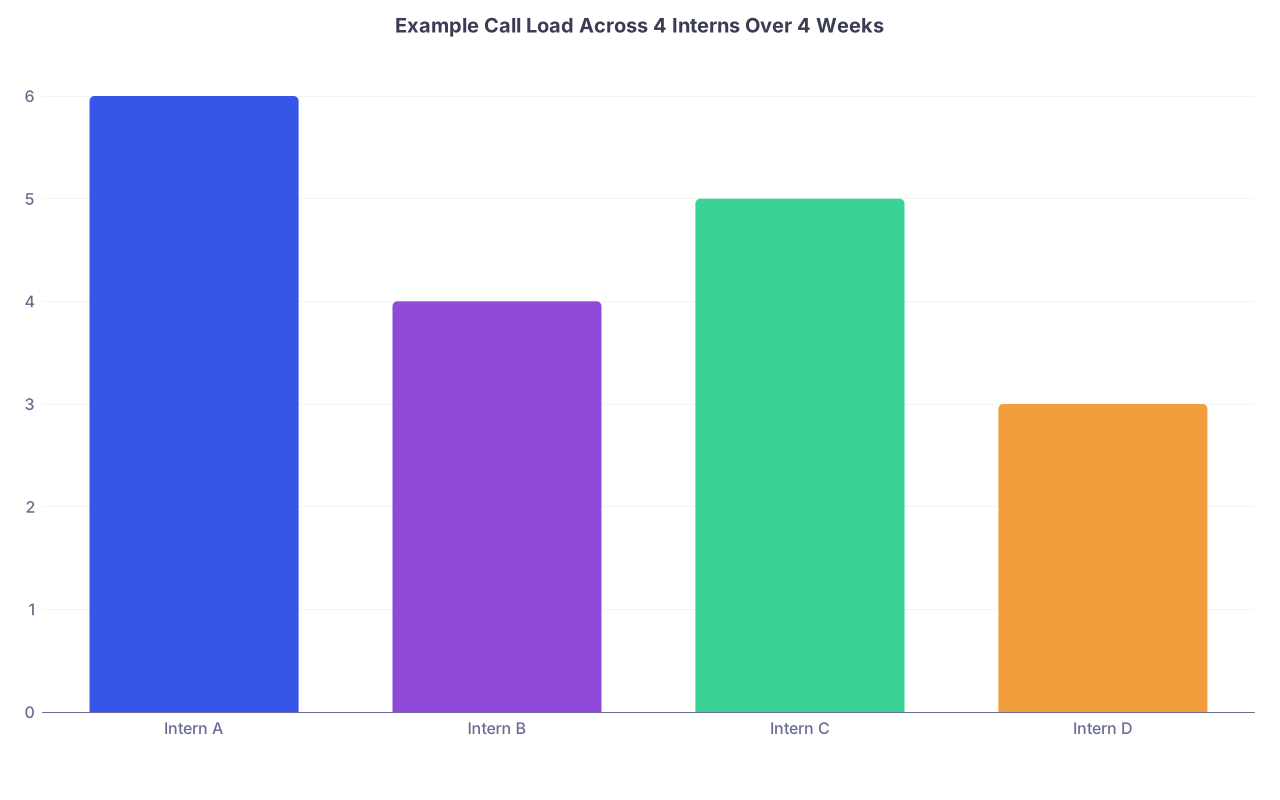
Then compare to your co-interns on the same rotation. Are you the “heavy” intern?
You will usually see one of four patterns on a heavy month:
- q4 call (classic: every 4th night; still intense but survivable)
- Night float with 6 nights on / 1 off pattern
- Hybrid: early nights, then day float, then a few 24s
- Hidden call: home call that behaves like in-house because you get constant pages and are expected to physically come in
Depending on your program and specialty, some of these are aggressive but standard. Others are red flags.
Which are the red flags?
- Repeated q3 call for the same person, unless you are in a legacy surgical program and even then it should be closely scrutinized.
- Multiple 24-hour calls with only a single day between them (e.g., call Mon, day Tue, call Wed).
- “Staggered call” where you get tagged as the backup or “Jeopardy” intern an unreasonable number of times compared to peers.
Now you add pattern recognition: Are you getting more holiday weekends? Are you loaded with more Friday/Saturday calls than others? This is where people silently get burned and do not notice until they are exhausted and resentful.
| Category | Value |
|---|---|
| Intern A | 6 |
| Intern B | 4 |
| Intern C | 5 |
| Intern D | 3 |
If you are Intern A in that example, you should at least know it and confirm that this rotates fairly over the year.
Step 6: Map Call Against Rotation Intensity
Not all calls are created equal. A 24 on a sleepy community medicine service is not the same as a 24 in a tertiary ICU in July with three new interns.
Your question on day one: Where does the heavy call fall in relation to your hardest rotations?
Take your block schedule and mentally classify rotations:
- High-intensity: ICU, trauma surgery, busy inpatient medicine, night float, ED on certain services
- Moderate: step-down units, subspecialty consults, some surgical subspecialty services
- Lower intensity: elective, research, ambulatory clinic, lighter consult services
Now look at:
- Are your heaviest call patterns (q3–q4, busy night float, frequent weekends) attached to those high-intensity rotations?
- Do any of your “lighter” blocks still have surprising night or weekend call attached?
I have seen interns discover on day one that their “research month” has built-in jeopardy coverage for three other residents and effectively becomes an unscheduled call block.
You want to identify early:
(Related: Creating a residency budget framework)
- Which 2–3 months of PGY-1 will be structurally the hardest
- Where you must aggressively protect your sleep, childcare, or life logistics
- Where you can realistically schedule dentist appointments, family visits, or a move
The call schedule tells you this far more honestly than any glossy program brochure.
Step 7: Walk Through a Single “Month in the Life” in Detail
This is the step almost no one does. You should.
Pick one particularly intense-looking month. Let us say your July rotation is ICU with q4 call.
Take a blank calendar and write, for each day:
- D = Day
- C = 24+ call
- PC = post-call
- OFF = entire day off
Then annotate what your day actually looks like. For example:
Day on ICU (non-call):
- 05:15 – Wake up
- 06:00 – Sign in, chart review, pre-round
- 07:00 – Rounds
- 18:30–19:30 – Sign out, orders, notes
- 20:00 – Home (if lucky)
24+ call on ICU:
- 05:15 – Wake up
- 06:00 – Start day
- 07:00 – Regular rounds
- 17:00 – Evening admissions and cross-coverage
- 00:00–06:00 – Overnight calls, codes, cross-coverage
- 07:00 – Morning sign out
- 09:00–11:00 – Finish tasks, update families, tie loose ends
- 11:00–12:00 – Go home
Post-call:
- 11:30 – Get home, crash
- Realistically: that day is mostly gone
Now trace 4 weeks of that. See whether you actually have:
- Any weekend that is truly free
- Any stretch of 3+ days in a row where you feel you can do something non-medical
- Reasonable spacing between overnight calls
You are not doing this to scare yourself. You are doing it so that when you get to week 3 and feel like you are breaking down, you understand that the schedule is rough, not that you are “weak” or “bad at residency.”
Step 8: Compare to Co-Interns and Check for Equity
Day one is when everyone is still politely pretending it will all be fine. Use that to your advantage.
Sit down with your co-interns with your schedules side by side.
Look for:
- Total number of 24s each of you has in a given 4-week block
- Total weekend days off each person gets
- Who has the majority of holidays or “desirable” weekends off
- Who is pegged as backup/jeopardy disproportionately
If you clearly have the heaviest schedule—more calls, fewer free weekends—do two things:
- Confirm this is part of a rotating pattern. For example, you have more calls on Block 1, but fewer on Block 3. Equity over the year is acceptable.
- If it is not rotating and you are just loaded down, flag it early with your chief residents in a calm, non-accusatory way: “When we compared, it looked like I have 7 calls this month and most others have 4–5. Is that intentional for some reason or a misalignment?”
Reasonable chiefs will fix obvious asymmetries if caught early. What they hate is someone coming in at the end of the block furious about something that could have been corrected on day one.
Step 9: Cross-Check Against GME and Program Call Policies
Now you go to the rulebook.
You should be able to find:
- Program-specific duty hour policy (often in a PDF or handbook)
- Institutional GME policies on call, night float, time off, and moonlighting
Typical useful details in these documents:
- Maximum consecutive days on service before a required day off
- Whether night float is supposed to be 6 + 1, 5 + 2, or some other pattern
- Expectations for at-home call (what constitutes “in-house” from a duty hour perspective)
- Rules about handoff times, mandatory rest periods, and transitions
Here is the key trick: check whether the written policy actually matches your schedule.
| Policy Item | Policy States | Your Schedule Shows |
|---|---|---|
| Max in-house call frequency | No more frequent than q3 | You have q2 for one week |
| Required day off frequency | 1 in 7, averaged | Only 2 true days off in 4 weeks |
| Night float pattern | 6 nights on, 1 off | 12 nights straight |
| Home call counting as duty hours | Yes, all time counts | Untracked late-night pages |
If the schedule seems to break stated policy, you have leverage to ask for clarification or correction—without sounding like you are “complaining.” You are pointing out a discrepancy between the written standard and the assigned schedule.
Step 10: Recognize Cultural Red Flags Hidden in the Schedule
A call schedule tells you a lot about program culture if you know what to look for.
Some warning signs when you read between the lines:
- No explicit “off” days listed; residents are expected to “work it out among yourselves.” Translation: chaos and inequality.
- Frequent “Jeopardy” shifts with unclear frequency or boundaries. These often become extra unpaid, unprotected work.
- Home call listed almost every night on certain rotations with no written guidance on what is expected. That usually means constant availability is assumed.
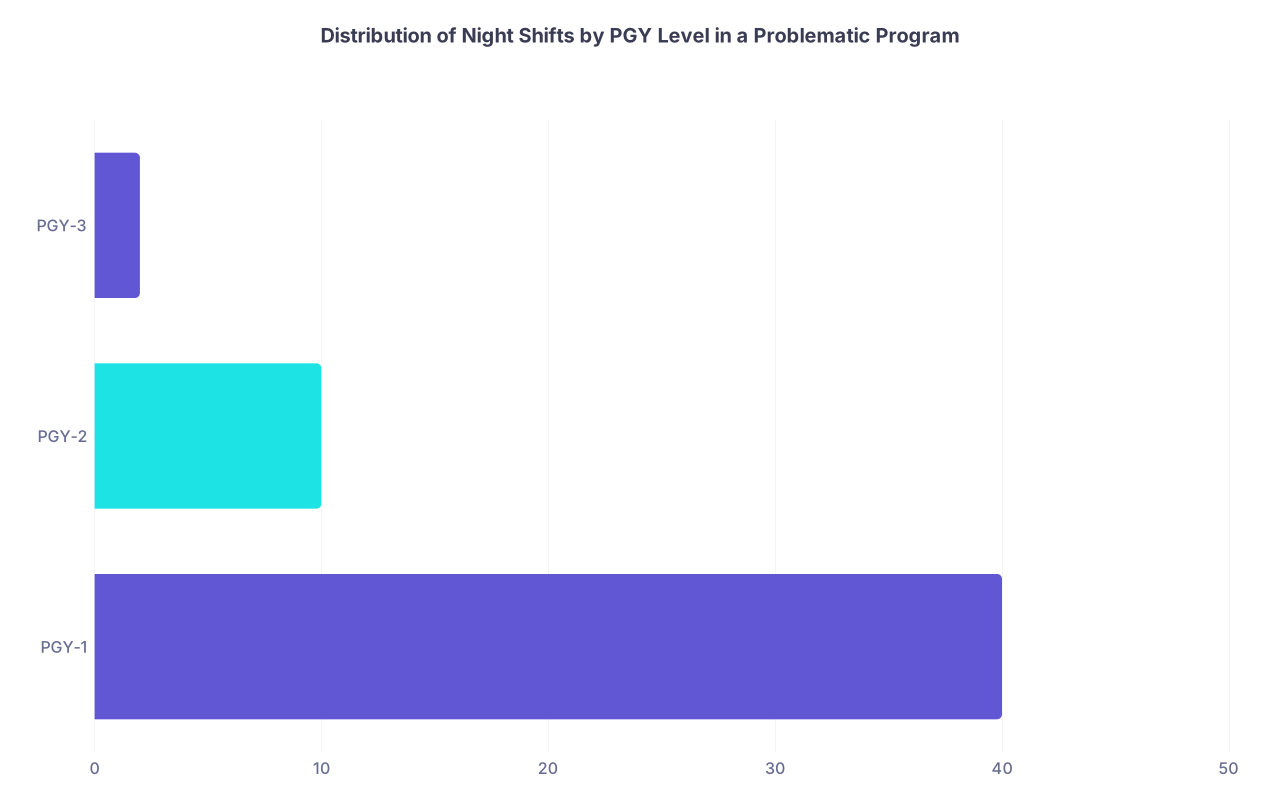
- Interns carrying almost all the nights while seniors stay mostly on days. Some distribution difference is normal; extreme imbalance is not.
You want to separate: “This will be hard, but fair” from “This looks structurally exploitative.”
Hard but fair schedule:
- Long hours on ICU and wards, but clear days off
- Rotating call burdens across interns over the year
- Night float that follows a predictable 6 + 1 or 5 + 2 pattern
- Explicit attention to post-call protection
Exploitative or dysfunctional schedule:
- Habitual q3 call or closer without clear rotation or workload balancing
- Inconsistent or missing days off
- “Optional” pre-rounding that in practice starts 1–2 hours before scheduled start time and is expected
- Post-call days where you are regularly scheduled for clinic or didactics until late afternoon
| Category | Value |
|---|---|
| PGY-1 | 40 |
| PGY-2 | 10 |
| PGY-3 | 2 |
If your program looks like that graph across the entire year, that is not a residency. That is cheap labor disguised as training.
Step 11: Build Your Personal Survival Plan Around the Call Schedule
Now you know what your schedule actually looks like. Time to do something with it.
You are going to sketch three things for each heavy rotation:
- Sleep strategy
- Logistics / life tasks
- Academic / exam prep expectations
Sleep:
- Identify which nights before call you must protect.
- Plan realistic post-call sleep blocks (e.g., 12:00–18:00) and lock them in.
- Decide which social events you will preemptively say no to during a brutal block so you are not constantly canceling last minute.
(See also: Preparing a residency relocation binder for a checklist.)
Logistics:
- Mark your rare true off days and plan high-need tasks (grocery stock-up, banking, car maintenance, mandatory appointments).
- Arrange backup childcare or pet care for your call days, especially those that can run long.
- If you are moving cities, make sure your move, furniture delivery, and any major setup do not collide with your earliest 24s or night float.
Academic:
- During ICU with q4 call, you are not doing a full board review curriculum. Be honest. Commit to something realistic like 10–20 focused questions on non-call days.
- Use your lighter months (electives, ambulatory) for serious exam prep or research productivity. The call schedule will tell you when those windows are.
This is where a simple visual can help:

You match your expectations to reality. That prevents the chronic guilt that destroys a lot of residents—feeling like you are failing at work, at studying, and at life simultaneously because you built your plans on fantasy, not on the call schedule.
Step 12: Decide What to Raise and How to Raise It
You are not going to storm the program director’s office on day one about every concern. That is a good way to get labeled “difficult” before you have any credibility.
But you also should not silently accept a clearly unsafe or inequitable schedule.
Bring up immediately (within the first week) if:
- You see an obvious duty hour violation on paper (e.g., scheduled back-to-back 24s, no listed days off for 2–3 weeks).
- Your calls are dramatically heavier than co-interns on the same rotation without any explanation.
- The schedule contradicts clear written GME policy.
Who to talk to first:
Start with the chief resident responsible for scheduling. Keep it factual, non-emotional.
Example script:
“I was going through my schedule carefully, and I noticed I have 7 calls this block, while the other interns seem to have 4–5. Could we review this together to see if there was a mis-assignment or if it evens out later in the year?”
You are not whining. You are auditing. That distinction matters.
Hold for later discussion, once you understand culture:
- The general workload intensity (“this feels like too much”)
- Subtle pressure to pre-round off the clock
- Chronic overrun of post-call days into the afternoon
These may be real issues, but you need allies, context, and some time before going after them.
Step 13: Use the Schedule as Your Reality-Based Expectations Tool
The final point: your matched program’s call schedule is not just a list of shifts. It is a brutally honest snapshot of what your residency actually values.
- A schedule that protects days off, rotates call fairly, and adheres to policies tells you the program takes resident well-being and accreditation seriously.
- A chaotic, opaque, or clearly overloaded schedule tells you that you will need strong personal boundaries and active monitoring from day one.
You cannot change the entire system as an intern. But you can do three very practical things from day one:
- Understand the true pattern of your work and rest—no illusions.
- Plan your life, sleep, and study around that pattern with ruthless realism.
- Flag genuine structural problems early, calmly, and with documentation.
That is how you use your call schedule, instead of letting it use you.
Key Takeaways
- Do not trust the call schedule blindly. Decode abbreviations, map hours, and actively compare against ACGME and GME rules.
- Count real off days, overnight calls, and weekend coverage, then compare with co-interns to assess fairness and safety.
- Build your sleep, life logistics, and study plans directly from the schedule, and raise clear discrepancies with chiefs early—factually, not emotionally.