
You are already behind if you wait until July 1st to figure out your residency budget.
Let me be blunt. The moment you know your Match city—literally that week—you should be building a concrete, numbers-driven budget framework. Not vibes. Not “I think I can afford this.” A real framework that tells you, in hard numbers, what kind of rent, car, and lifestyle your PGY-1 salary can survive.
You do not need your exact program contract in hand to start. You need a city, a ballpark PGY-1 salary, and a method. I am going to give you that method.
Step 1: Lock Down the Three Numbers That Will Control Your Life
The second you know where you are going, you anchor your budget around three numbers:
- Expected PGY-1 salary in that city
- Local tax hit (federal + state + city)
- Realistic rent band based on that salary
You do not guess these. You pull them.
1. Find your PGY-1 salary for that city
Go to:
- Program website (GME / “House Staff Benefits”)
- Institutional GME office page (they usually list all PGY salaries)
- If that fails, search:
"[your program] resident salary PGY-1"
Use the current year’s PGY-1 salary and subtract 2–3% if you want to be conservative about next year’s cost creep, or just use it as-is.
Most academic hospitals fall in a predictable band:
| Region | PGY-1 Salary (Typical Range) |
|---|---|
| Northeast (NYC/BOS) | $65,000 – $78,000 |
| West Coast (SF/LA) | $68,000 – $80,000 |
| Midwest | $58,000 – $68,000 |
| South | $55,000 – $65,000 |
You now have your gross. Next, you figure out what actually lands in your checking account.
2. Estimate your after-tax income in that city
This is where residents get burned. “My salary is $70k, I’m fine” becomes “…why is only ~$3,800 showing up per month?”
Use any decent online paycheck calculator (SmartAsset, ADP paycheck, etc.), plug in:
- Salary: your PGY-1 amount
- Filing: single, standard deduction (unless you are married and know your situation)
- State and city: your Match city
- Retirement: assume 0% to start. You can add this back later if you contribute.
You are aiming to pull one number: net monthly pay.
If you do not want to fuss with calculators yet, use a quick mental rule:
- No/low-tax state (TX, FL, WA): take-home is roughly 70–75% of gross
- Moderate tax state: 65–70%
- High tax (CA, NY, MA): 60–65%
So with a $70,000 salary:
- High-tax: $70k × 0.62 ≈ $43,400 per year → ~$3,615 per month
- Low-tax: $70k × 0.72 ≈ $50,400 per year → ~$4,200 per month
Already you see the trap. Same “salary”, very different disposable lives.
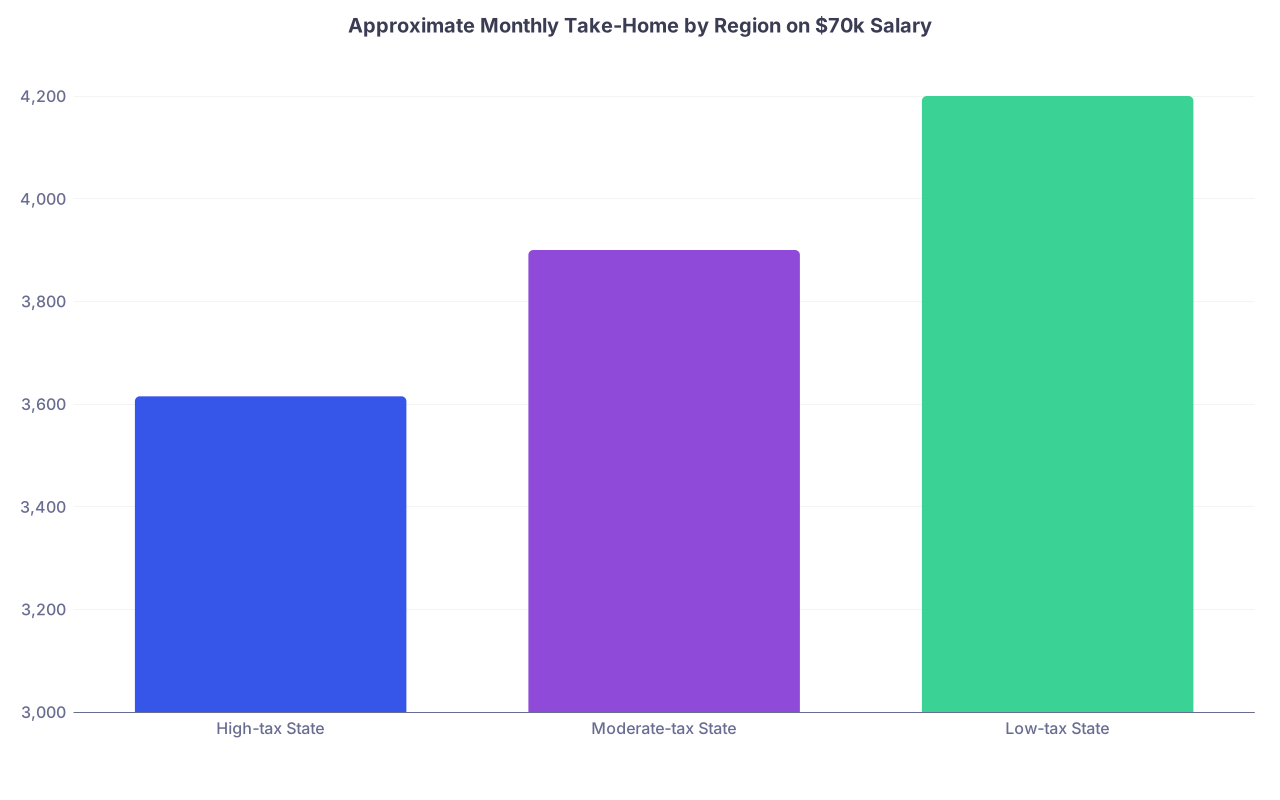
| Category | Value |
|---|---|
| High-tax State | 3615 |
| Moderate-tax State | 3900 |
| Low-tax State | 4200 |
3. Snap a rent ceiling off your take-home—immediately
Do this before you even open Zillow or Apartments.com.
Ignore the generic “30% of income” line everyone parrots. For residents who:
- Have loans,
- Might need a car, and
- Want any chance of saving or not drowning in credit card debt,
I recommend:
Target rent (base + mandatory building fees) = 25–30% of net take-home. Hard cap 35% max if you are in a brutal housing market.
So if net monthly is ~$3,800:
- Ideal: 0.25–0.30 × 3,800 = $950–$1,140
- Absolute max: 0.35 × 3,800 ≈ $1,330
That number is not “just rent.” It is total predictable monthly housing payment before utilities:
- Base rent
- Mandatory building fees (amenities, trash, etc., often $50–$150)
- Required parking if you must have a spot to survive (garage under the same lease)
If that cap sounds impossible in your city (e.g., SF, Manhattan), that is not a sign to stretch. That is a sign you must:
- Get a roommate
- Live slightly farther out and commute
- Or sacrifice car / parking
You now have the skeleton of your framework: gross salary → net income → rent band. The rest of the budget hangs off this.
Step 2: Map Your City’s “Non-Negotiable” Cost Structure in 48 Hours
The day you match, you should treat your city like a patient you are pre-rounding on. You get the key vitals:
- Housing reality
- Transport reality
- Food reality
Then you make a plan.
A. Housing: you are not choosing neighborhoods, you are choosing a commute pattern plus a budget
Pull up a map. Put a pin on:
- Your main hospital
- Any off-site clinics/affiliates where you will rotate often (often listed on program website)
Now you think concretely: “From where I live to where I need to be at 5:30 a.m., using the way I will actually travel, is this reasonable?”
Do a fast scan:
- Apartments.com, Zillow, HotPads
- Filter by: studio/1BR if solo, 2BR+ if planning roommates
- Price filter: set your rent cap from Step 1, not what you “hope” is there
Look at 3 radii:
- Within 15–20 minutes of the main hospital
- 20–35 minutes away (driving or transit)
- Outskirts where rent suddenly drops
You are answering one question:
What rent ranges exist that are compatible with a sane commute?
If your rent cap is $1,100 and the closest you can find is $1,700 everywhere within 30 minutes…that is your early warning that you need a roommate, or that you must accept 35–40% of take-home going to rent and compensate elsewhere.
B. Transport: car vs no car is a budget-defining decision
Residents constantly underestimate transportation costs. “It’s just gas and insurance” turns into $800+/mo easily if you are not disciplined.
In each city, you decide:
- Can you realistically go car-free?
- If not, what is the true monthly cost of a car in this specific city?
Car-free is viable if:
- Hospital is close to a reliable transit line, and
- Neighborhoods in your rent band exist along that line, and
- Late-night / early-morning transit is actually running and safe enough
Car-required is likely if:
- You have multiple suburban sites
- Weak or nonexistent public transit
- Midwest/Southern cities built for cars
Now quantify.
Approximate resident car cost structure per month
Not theoretical. Realistically:
- Car payment (if financed): $250–$450+
- Insurance: $80–$200 (varies a lot by city and your record)
- Gas: $80–$200 depending on commute pattern
- Parking: $0–$250 (hospital garage + home parking)
- Maintenance / registration averaged: $50–$100
You can see where this is going.
| Scenario | Est. Monthly Cost |
|---|---|
| Paid-off car, free parking | $200–$300 |
| Financed car, low-cost city | $400–$550 |
| Financed car, major city parking | $550–$800 |
Do this based on the city you actually matched in. Chicago vs Birmingham vs San Diego are three different worlds.
If you are even thinking about getting a new car before residency, this is when you set a hard monthly ceiling before the dealer talks you into anything. You do not reverse engineer your budget around a $600/month SUV payment.
C. Food and basic living in that city: use real numbers, not national averages
Everyone throws out “$300–$400/month groceries.” That is fantasy in some cities and laughably high in others. Use a grocery delivery app as a crude index:
- Instacart, Walmart, local chains—set the store to your future ZIP code
- Add:
- 2 lb chicken
- Dozen eggs
- 1 gallon milk
- Bread
- Rice
- Basic produce (bananas, apples, spinach)
You will quickly see: is this city 20–30% pricier than where you are now? Or similar?
Then assume:
- Groceries: $300–$450/month for a solo resident who cooks most dinners and packs some lunches
- Eating out / grab-and-go: highly variable, but for sanity, start with $150–$200/month and adjust
Now you have the non-negotiable skeleton for this city:
- Rent band reality
- Transport mode + rough cost
- Food baseline
Those three are 60–70% of your PGY-1 life.
Step 3: Build a First-Pass Budget Framework in One Sitting
Now you stop scrolling apartments and social media and you grab a piece of paper or a basic spreadsheet.
You are going to build a residency budget framework that you can plug real numbers into as you move closer to July. The key difference: this is city-specific, not generic.
The structure I recommend is simple but strict:
- Income line: net monthly pay (after taxes)
- Fixed essentials
- Variable essentials
- Financial obligations (loans, minimums)
- Discretionary / lifestyle
- Savings / buffer
Let me walk through each.
1. Income line
One number:
- Net monthly pay from Step 1 (estimate now, update once you see your first stub)
Write that at the top. That is your entire pie.
2. Fixed essentials (these do not care how tired you are)
These are bills that hit no matter what.
- Rent + mandatory fees + base parking (if tied to lease)
- Utilities (averaged):
- Electricity: often $40–$80
- Gas: $20–$50 if separate
- Water/sewer/trash: sometimes bundled, sometimes $20–$60
- Phone bill: $40–$90
- Internet: $40–$80
- Car insurance: your real quote for that ZIP code
- Car payment (if any)
- Health insurance premiums if not fully covered (many GME plans are highly subsidized, check program info)
- Required professional fees spread across months (see below)
You will not know all of these the day you match. That is fine. You put placeholders based on typical ranges, and you flag them to update.
Do not forget residency-specific fixed costs
These get ignored until they slap your card.
- Licensing/permit fees (training license / limited license)
- USMLE Step 3 (if you plan to take PGY-1 or PGY-2)
- Board prep / question banks
- Specialty association dues (some are covered, some not)
- Disability insurance if you choose to buy it early (many should, but that is a separate discussion)
If you know, for example, you will need $1,000 total for all that in PGY-1, spread it:
- $1,000 / 12 ≈ $85 per month allocated in your budget
That is a “fixed future obligation,” and it belongs in the framework.
3. Variable essentials
These are needs, but with some flexibility.
- Groceries
- Gas (if you drive) or transit pass
- Basic personal care (toiletries, laundry, etc.)
- Work meals when you cannot bring food (night float, trauma, etc.)
Set realistic but not heroic numbers. If you tell yourself $150 for groceries “to be frugal,” you will blow it by the second week of wards.
4. Financial obligations: student loans and debt
With current student loan chaos, you may not know your exact payment at Match. So you budget in scenarios.
Let us say:
- You owe $250,000 federal loans
- You expect income-driven repayment (IDR) starting sometime in PGY-1
- Your net monthly is ~$3,800
An IDR payment might land around $250–$350/month depending on program and adjusted gross income. You do not wait for servicer emails to adjust your budget. You pick a number (say $300/month), put it here, and protect it.
If loans will be in grace or forbearance early PGY-1, still budget something—even $100–$150/month into a “loan sinking fund” savings bucket. That way, when payments restart, you are not scrambling.
Same for credit cards: minimums must be in this section. You can always pay more if there is leftover.
5. Discretionary / lifestyle
Here is where residents lie to themselves the most.
Include:
- Eating out / coffee shops beyond your “essential work food”
- Entertainment (streaming, going out, hobbies)
- Travel (even just going home twice a year)
- Gifts, holidays, random life events
You do not cut this to zero. That is how you burn out faster. But you assign it a hard number based on how much is left after essentials.
6. Savings / buffer
Residents who survive unexpected costs do one thing right: they carve out a small buffer even when it seems impossible.
Aim for:
- $100–$200/month minimum going into:
- Emergency fund (car repairs, flights for family emergencies)
- Irregular professional costs bucket (licensing, exams, etc.)
If there is nothing left to allocate here after your first-pass budget, that is not a moral failing. It is a sign your rent and/or car choices are too aggressive for your salary. Better to see this in March than in October.
Step 4: Run “What If” Scenarios Before You Sign Anything
This is where that “moment you see your city” framework actually earns its keep. You use it to test choices before they lock in.
You are basically asking:
“If I choose X housing + Y car situation in this city, do I end up negative, stable, or with a buffer?”
Case Study 1: Same city, different rent choices
Assumptions:
- PGY-1 salary: $70,000 in a moderate-tax state
- Net monthly: ≈ $3,900
- No car (solid transit, downtown hospital)
- Loan payment (IDR estimate): $300
Now test two rent options.
Scenario A: Fancy solo studio near hospital, $1,800 all-in
Scenario B: Older 2BR with roommate, your share $1,050 all-in
Let us sketch Scenario A.
Income:
- $3,900
Fixed essentials:
- Rent: $1,800
- Utilities + internet + phone: $200
- Transit pass: $90
- Insurance premiums, professional fees: $100
Total fixed ≈ $2,190
Remaining: $1,710
Variable essentials:
- Groceries: $350
- Work meals / misc: $150
Essentials subtotal ≈ $500
Remaining: $1,210
Financial obligations:
- Loans: $300
Remaining: $910
Discretionary + savings:
- This looks fine on paper. Until reality. You will not actually save $500–$600. You will fill that space with Ubers, takeout on trauma, and last-minute flights. You are not in danger of catastrophe, but there is not huge margin.
Now Scenario B.
Same income: $3,900
Fixed essentials:
- Rent: $1,050
- Utilities + internet + phone: $200
- Transit: $90
- Insurance/professional: $100
Total fixed ≈ $1,440
Remaining: $2,460
Variable essentials:
- Groceries: $350
- Work meals: $150
Remaining: $1,960
Loans: $300 → Remaining: $1,660
Now you can actually:
- Put $300–$400/month into emergency savings
- Not flinch when your program tells you you must buy another review resource
- Travel once or twice a year without debt
Same city. Same salary. Choice of housing swung the entire financial trajectory.
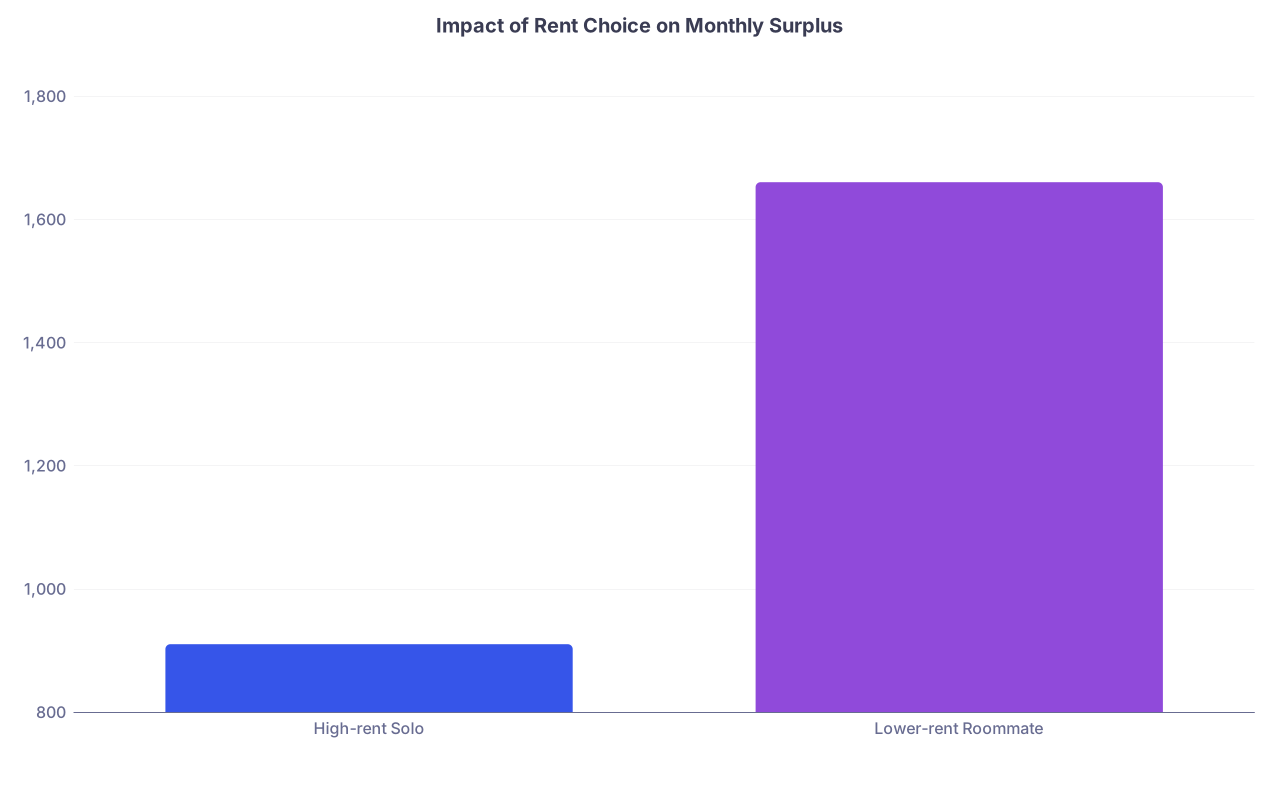
| Category | Value |
|---|---|
| High-rent Solo | 910 |
| Lower-rent Roommate | 1660 |
Case Study 2: Car vs no car in a car-biased city
Assumptions:
- PGY-1 salary: $62,000 in a low-tax Southern city
- Net monthly: ≈ $3,900 (yes, taxes lower)
- Hospital with suburban clinic sites, weak transit
Option 1: Live walking distance to main hospital, still need car for clinics
Option 2: Live cheaper farther out, daily driving everywhere
You run true car cost for each. Hospital might offer subsidized parking, your apartment may not. The combination matters more than the rent sticker.
If Option 1 is:
- Rent: $1,400
- Car (paid-off, insurance, gas, parking): $300
→ Housing + car ≈ $1,700
Option 2 is:
- Rent: $1,050
- Car (more gas, paid parking at hospital and home): $450
→ Housing + car ≈ $1,500
On paper, Option 2 saves $200/month. But if that also means a 35-minute commute with post-call driving when you are barely awake, you have to decide whether that trade for $2,400/year is worth it. That is a safety and sanity calculation layered on top of the budget. But at least you are seeing the numbers clearly.
Step 5: Translate the Framework into a Simple, Living Tool
You do not need an elaborate app. Residents do not need more friction. You need something you will actually open twice a month.
You have three main options:
- A basic spreadsheet (Google Sheets, Excel)
- A zero-based budgeting app (YNAB, EveryDollar)
- A manual envelope system or bank “buckets”
I prefer a simple spreadsheet plus automatic transfers, especially early on.
Minimum viable spreadsheet layout
Columns:
- Category
- Budgeted amount
- Actual (Month 1)
- Actual (Month 2)
- Notes
Rows grouped as we structured:
- Income
- Housing
- Utilities
- Transport
- Groceries
- Work meals
- Insurance
- Loans
- Professional costs
- Discretionary
- Savings
You set all budgeted amounts now based on your city research and PGY-1 estimates. Then, once you actually start residency, you track:
- Month 1: reality shock
- Month 2–3: adjust budget to match your real patterns

| Step | Description |
|---|---|
| Step 1 | Match City Known |
| Step 2 | Estimate Salary and Net Pay |
| Step 3 | Research City Costs |
| Step 4 | Build Budget Framework |
| Step 5 | Set Target Rent and Car Plan |
| Step 6 | Create Spreadsheet or App |
| Step 7 | Start Residency |
| Step 8 | Track 1st 2 Months |
| Step 9 | Adjust Categories |
| Step 10 | Automate Transfers and Bills |
The point is not to be perfect in March. The point is to hit July with a framework that is 70% accurate and easy to tune.
Step 6: Think Ahead to the Hidden One-Time Costs Before Day One
Residents get ambushed not by monthly rent, but by the onboarding cluster of May–August expenses. These are tied to your city and your program and they hit fast.
When you see your Match city, assume you will need cash for:
- Security deposit + first month’s rent + possibly last month’s rent
- Application fees for multiple apartments ($40–$75 each)
- Moving costs: truck, shipping, gas, storage if there’s a gap
- Furniture basics (bed, mattress, desk, chair, minimal kitchen setup)
- Professional wardrobe refresh if you are going from scrubs-only to clinic-heavy
- Travel/lodging for in-person orientation if you are coming from far away
This is where your city matters. Moving 20 miles within the same city ≠ moving cross-country to a high-cost coastal area.
You should sketch a rough onboarding budget tailored to where you matched:
| Move Type | Est. Total Range |
|---|---|
| Local move, same city | $800–$1,500 |
| Regional drive (same region) | $1,200–$2,500 |
| Cross-country apartment setup | $2,500–$5,000+ |
Seeing those numbers now, in March, may directly affect:
- Whether you take extra shifts as an MS4
- Whether you aggressively cut discretionary spending now
- Whether you avoid big purchases (car, trips) before Match
Your residency city is not just where you live. It is the cost structure of your onboarding.
Step 7: Make City-Specific Tradeoffs Consciously, Not Accidentally
Here is where I stop sugarcoating. Residents who ignore city realities end up with:
- Maxed credit cards by October
- No savings
- Panic when car or health issues hit
Residents who use their city to shape decisions early on are the ones who quietly say, “Yeah, I am tired, but at least my money is under control.”
So, once you have your framework, you ask a few hard questions based on your specific city:
- Is this a “roommate city” for me at PGY-1, regardless of pride?
- Are there hospital-subsidized housing or parking options I am not using because of convenience bias?
- Does this city make car-free living both safe and logistically sound enough to trade away a car payment?
- Is my specialty’s lifestyle in this city (e.g., a malignant surgical prelim in NYC) going to drive me to spend more on convenience, and am I budgeting for that or ignoring it?
In Manhattan or San Francisco, for example, insisting on a solo one-bedroom walking distance to a major academic hospital on a PGY-1 salary is, in most cases, financially irresponsible. You can do it, but the tradeoff is:
- No real savings
- Constant money stress
- Every unexpected expense goes on plastic
In Cleveland or Indianapolis, the equation is different. You may realistically afford a modest solo place plus a paid-off used car and still save.
Your city is not just background. It is an active variable in your residency budget framework, and you treat it that way from Day One.
Final Thoughts
Three big points and then I am done.
- The instant you know your city, you can and should translate it into numbers: net income, rent cap, transport mode, and basic living cost.
- Build a simple, city-specific budget framework before you sign any lease or car note; then run “what if” scenarios and force yourself to see the tradeoffs.
- Protect a small buffer and savings line from the start, even if it feels tight—because residency does not break people only with hours. It breaks people with unplanned financial crises they could have seen coming.