
The wrong way to approach Match is to treat onboarding like an afterthought. The programs that will train you for years expect you to act like an adult colleague months before you ever put on their badge.
Here is how to use the final three months before Match Day so residency onboarding feels controlled instead of chaotic.
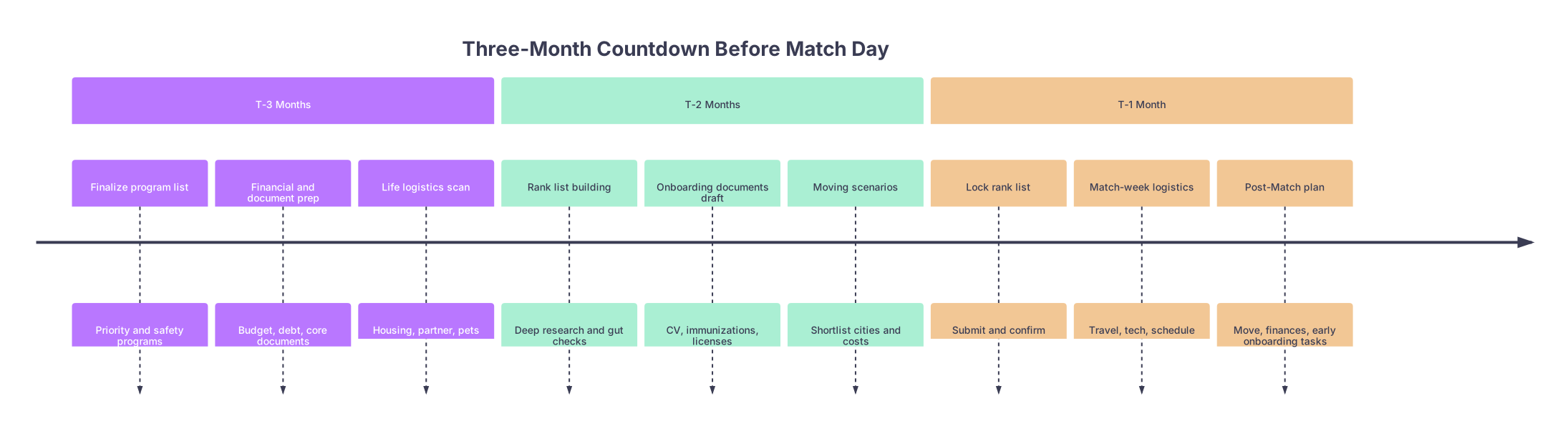
Big Picture: Your 3‑Month Countdown
First, orient yourself. I am assuming:
- Match Day is “Month 0”.
- You are starting this plan at T‑3 months (roughly mid‑December for a March Match).
| Period | Event |
|---|---|
| T-3 Months - Finalize program list | Priority and safety programs |
| T-3 Months - Financial and document prep | Budget, debt, core documents |
| T-3 Months - Life logistics scan | Housing, partner, pets |
| T-2 Months - Rank list building | Deep research and gut checks |
| T-2 Months - Onboarding documents draft | CV, immunizations, licenses |
| T-2 Months - Moving scenarios | Shortlist cities and costs |
| T-1 Month - Lock rank list | Submit and confirm |
| T-1 Month - Match-week logistics | Travel, tech, schedule |
| T-1 Month - Post-Match plan | Move, finances, early onboarding tasks |
You will touch four domains repeatedly:
- Professional (CV, licenses, onboarding forms)
- Administrative (IDs, documents, background checks)
- Financial (budgeting, loans, moving costs)
- Personal (housing, relationships, mental bandwidth)
Get used to that structure. Programs think that way. You should too.
T‑3 Months: Lay the Foundation (Weeks 12–9 Before Match)
At this point you should stop pretending “I’ll deal with that after I match.” You will not have the time or the brain space then.
Week 12: Core Documents and Identity Kit
Build a digital residency “packet” now. This will save you days later.
Create a single, organized folder (local + cloud backup) with:
- Current CV (1–2 pages, clean, updated through MS4)
- Passport or state ID (front and back scans)
- Social Security card scan
- Medical school ID scan
- Prior immunization records
- BLS/ACLS cards
- USMLE/COMLEX score reports
- Name‑change documents if applicable (marriage, court order)
Name files in a way that looks professional:
Lastname_Firstname_CV_2026.pdfLastname_Firstname_USMLETranscript.pdf
At this point you should:
Confirm your name exactly as it appears on:
- NBME/NBOME records
- Medical school transcript and diploma
- Government ID
Any mismatch (hyphen, middle initial, accent) becomes a licensing delay. I have seen onboarding stuck for 6 weeks because a middle name was on a diploma but not on the state license application.
Request anything missing:
- New SS card? Request now.
- Replacement vaccine records from student health? Request now.
- Passport expiring within a year? Renew now.
Week 11: Financial Reality Check
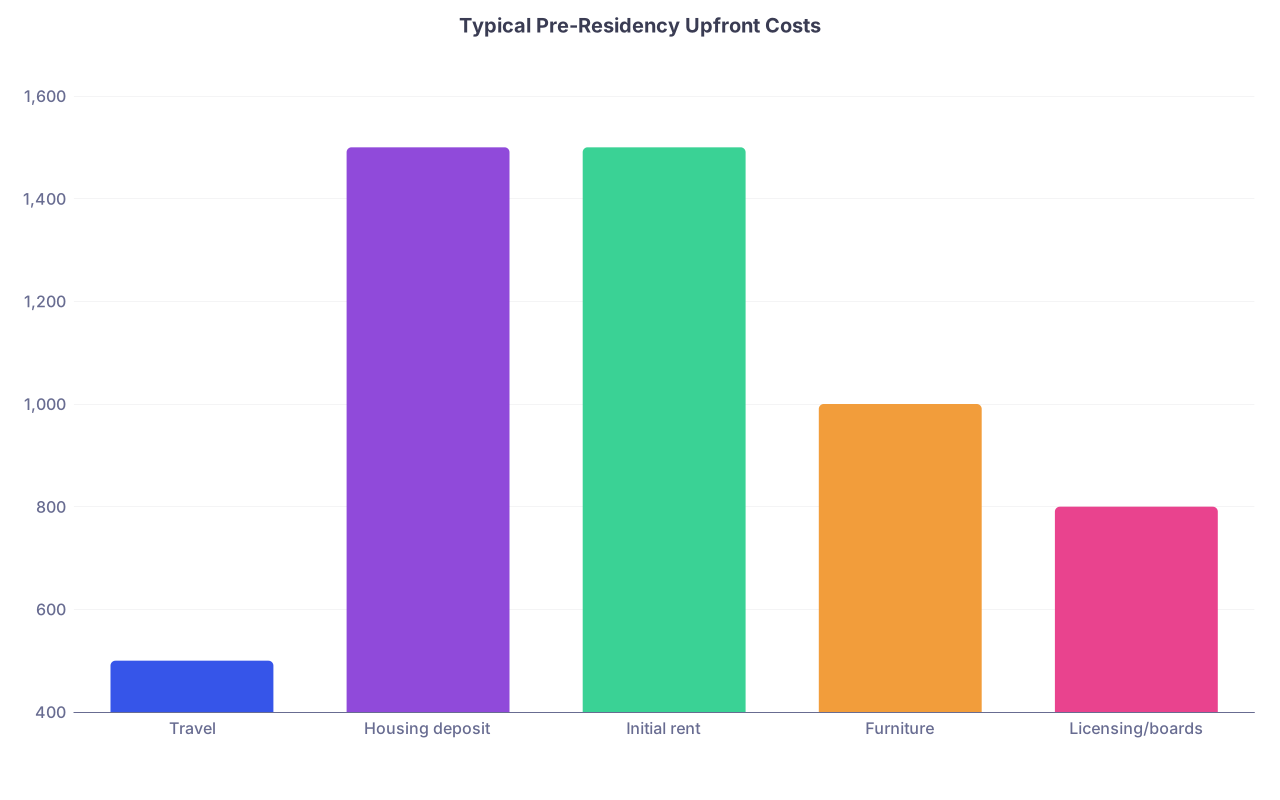
You will likely move, pay deposits, and float expenses before you get your first paycheck. That gap hurts if you pretend it does not exist.
At this point you should:
Estimate moving + setup costs:
- Travel to program city (flight / gas)
- Temporary housing / hotel if needed
- Security deposit + first month rent
- Basic furniture, scrubs, parking pass
Check available:
- Emergency savings
- Credit card limits (do not increase unless you must)
- Family support, if that is on the table
| Category | Value |
|---|---|
| Travel | 500 |
| Housing deposit | 1500 |
| Initial rent | 1500 |
| Furniture | 1000 |
| Licensing/boards | 800 |
Then:
- Call your loan servicer:
- Ask when payments resume after graduation.
- Ask about residency forbearance or income-driven options.
- Make a bare-bones pre-residency budget:
- Minimum cash you want on hand by Match: e.g., $4,000–$6,000
- If you are short, decide now:
- Extra shifts
- Reduced discretionary spending
- Short, targeted “bridge” loan (if absolutely necessary)
Week 10: Life Logistics Scan
At this point you should take a hard look at non‑medical constraints. Programs will not manage this for you.
Make a quick grid for your realistic match regions (e.g., “Northeast large city,” “Midwest academic center town,” “West Coast high‑COL city”):
| Region Type | Est. Rent (1BR) | Car Needed | Partner Job Market | Proximity to Family |
|---|---|---|---|---|
| Big coastal city | $2200–$3000 | No | Strong | Far |
| Mid-size academic city | $1300–$1800 | Yes | Moderate | Moderate |
| Small town community | $800–$1200 | Yes | Weak | Variable |
You do not need decisions yet. You do need scenarios.
If you have:
- A partner
- Kids
- Pets
- Dependent parents
At this point you should schedule explicit conversations about:
- Who is moving when
- Job search timeline for partner
- Childcare possibilities
- Pet‑friendly housing limits
Do this now, not two weeks before your lease needs signing.
T‑2 Months: Rank List + Onboarding Prep (Weeks 8–5 Before Match)
This is the most cognitively loaded stretch. Interviews, rank list, and early onboarding prep all collide.
Week 8: Post‑Interview Reality Check
At this point you should step back from the glow of “they were so nice!” and sort interviews into tiers.
Make a spreadsheet. Columns:
- Program name
- City
- Program type (university, community, hybrid)
- Call schedule
- Fellowships available
- Gut ranking (1–10)
- Deal‑breakers (yes/no, with notes)
Rewatch or reread anything the program sent:
- Conference schedule
- Vacation policy
- Moonlighting options
- Maternity/paternity leave
You are not finalizing your rank list yet. You are building ranking data so later you are not swayed only by who had the best free lunch.
Week 7: Rank List Draft 1 + Early Onboarding Documents
Now you start acting like someone who will actually be asked for paperwork.
At this point you should:
Draft Rank List v1
- Sort by “Where will I become the physician I want to be?”
- Not “Who loved me the most?” Not “Where did my classmates match?”
Build your Onboarding Packet 2.0:
- Update CV with any new publications, abstracts, teaching.
- Prepare a basic personal statement‑style paragraph about yourself. Programs sometimes ask for a blurb for websites or hospital credentialing.
- Get a professional headshot:
- Plain background, decent lighting, scrubs or business‑casual.
- You will reuse this for badges, email profiles, websites.
- Start a list of references (with correct email/phone).
Many hospitals will ask for:
- Immunization titers:
- Hep B surface antibody
- MMR, Varicella
- TB/Quantiferon or recent PPD
- COVID vaccination proof
At this point you should book lab draws or titers through student health if anything is incomplete or old. Do not wait for your program to tell you you are missing a Hep B antibody two weeks before orientation.

Week 6: Licensing Prerequisites + Background Check Readiness
You cannot start state licenses fully until you know where you matched, but you can eliminate delays.
At this point you should:
- Make a list of likely states based on your interview locations.
- For each state, quickly check:
- Do they require FBI fingerprints? (Most do.)
- Do they require notarized documents?
- Do they require official medical school transcripts mailed directly?
Then:
- Get your notary situation sorted:
- Know where you can find a notary (bank, school, UPS store).
- Confirm your background history details:
- Exact addresses (last 7–10 years)
- Exact dates of past employment/education
- Any old citations or misdemeanors: know dates and dispositions
If you have anything in your legal history, at this point you should:
- Request documentation (court records, letters of explanation).
- Draft a factual, concise explanation:
- What happened
- That it was resolved
- That there has been no recurrence
Hospitals do not like surprises. Licensing boards really hate them.
T‑1 Month: Lock the Rank List, Pre-Plan Match Week (Weeks 4–1 Before Match)
This month is about two things: deciding where you want to train, and making it logistically easy to start moving the second you know.
Week 4: Rank List Finalization
At this point you should be brutally honest with yourself.
You are choosing programs, not cities. Not prestige logos. Programs.
Go back to your spreadsheet and ask for each ranked program:
- If this is where I end up, without matching higher,
can I live with that for 3+ years?
If the answer is “no,” that program does not belong on your list. I have watched residents drag through 4 years in a city they loved, at a program they never respected.
Before Rank List Certification Day:
- Run your list by:
- One trusted attending who knows your specialty.
- One honest friend who knows your life constraints.
- Listen to feedback, then own the final decision.
When you are satisfied:
- Submit the list early. Do not flirt with the deadline.
- Screenshot or print your NRMP/Match confirmation page.
- Double check:
- No swapped program codes
- No missing prelim vs categorical choices
| Category | Value |
|---|---|
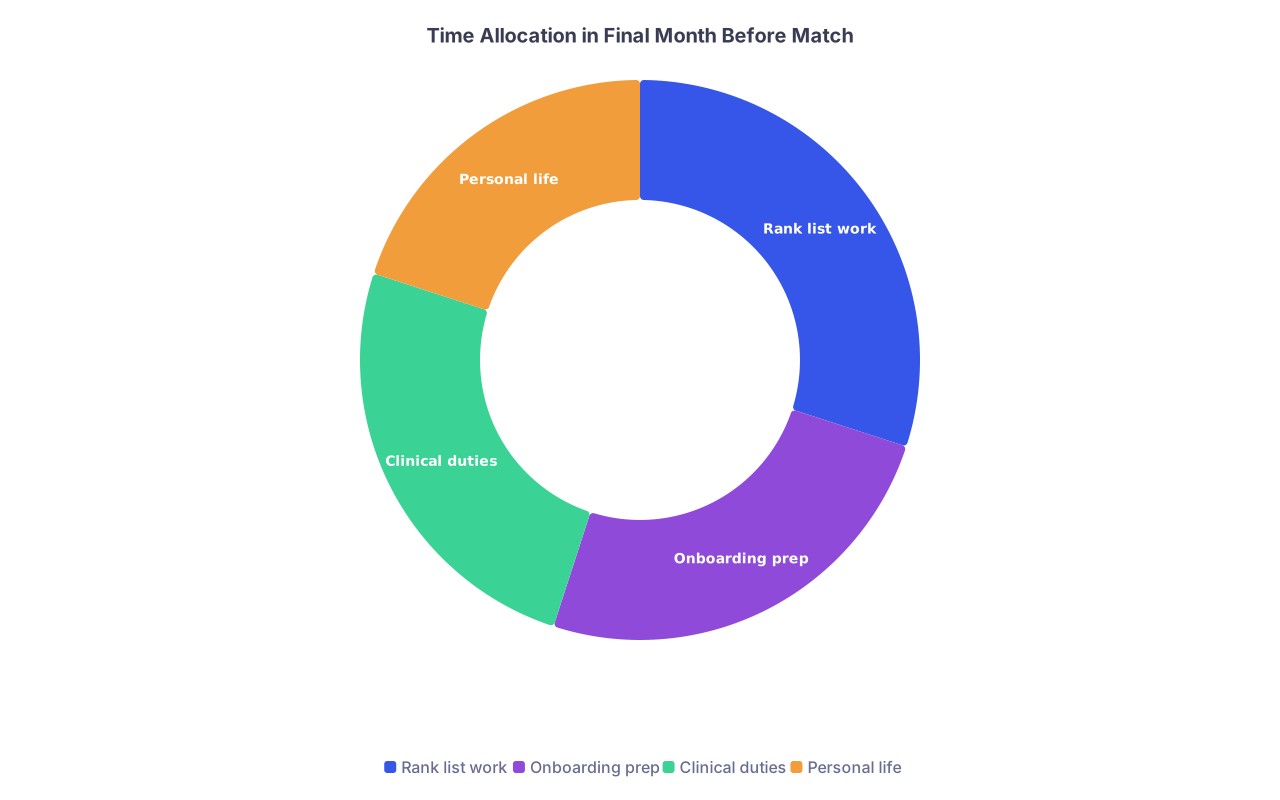
| Rank list work | 30 |
| Onboarding prep | 25 |
| Clinical duties | 25 |
| Personal life | 20 |
Week 3: Match-Week Logistics + Tech Setup
At this point you should assume things will go wrong and plan so they do not matter.
For Match Week (especially Monday “Did I match?” and Friday Match Day):
- Confirm:
- Reliable internet where you will be.
- Devices:
- Phone charged
- Laptop updates installed in advance
- Access to:
- NRMP
- ERAS application
- Email account used for applications
Decide:
- Where you will be for:
- Monday email (alone? with partner?)
- Friday reveal (school event? private?)
Block uninterrupted time on Monday morning in case:
- You learn you did not match and must begin SOAP.
- You did match but want to process/read instructions.
Set up a dedicated email label/folder:
- “Residency Onboarding”
- Create rules to auto‑label or highlight:
- Any email from @hospital.org
- Any subject containing “onboarding,” “credentialing,” “GME”
You will be buried in emails during that first post‑Match week. The people who do not miss deadlines are the ones who built a filter system first.
Week 2: Post-Match Housing + Moving Scenarios (Before You Know Where)
You still do not know where you are going. You can still streamline 80 percent of your move prep now.
At this point you should:
- Sketch two or three move templates:
- Template A: Big city, no car needed
- Focus: close to hospital, small apartment, public transit.
- Template B: Mid-size city, must drive
- Focus: parking, safe commute route, maybe roommate to cut costs.
- Template C: Small town
- Focus: Larger space for less, but limited rental stock; start earlier.
- Template A: Big city, no car needed
For each, list:
- Target rent range
- Neighborhood types you would consider
- Whether you want roommates
Create a moving checklist you will copy‑paste the minute you match:
- Notify current landlord
- Begin apartment search (primary websites, resident Facebook groups)
- Decide move date window
- Book movers / rental truck / flights
Identify must‑keep vs sell/donate belongings now:
- Bulky furniture you do not actually want following you for the next decade? Let it go.
- Old textbooks? Scan what you need, donate the rest.
You will thank yourself when you are staring at a Match letter in a different time zone and have 30 days to uproot your life.

Week 1: Emotional Prep + Contingency Planning
This last pre‑Match week, anxiety spikes. Productivity crashes if you do not structure it.
At this point you should:
- Keep clinical rotations light if possible (electives, research, lighter call)
- Schedule one or two non‑negotiable breaks:
- Dinner with friends
- Gym sessions
- Whatever keeps you feeling human
Run a SOAP contingency drill (even if your application is stellar):
- Save links to:
- SOAP list access
- ERAS editing
- NRMP instructions for unmatched applicants
- Draft a quick updated personal statement paragraph you could plug into a SOAP application.
- Identify two faculty who would:
- Answer their phone
- Push a last‑minute letter for SOAP if needed
You hope you never use this. But the people who have prepared for SOAP do better in everything: their stress is lower, and they respond faster if needed.
Match Week and Immediately After: Executing the Plan
Match Monday: “Did I Match?”
When the email arrives, you have three possible paths. At this point you should follow the one that applies to you without flailing.
You Matched
- Breathe.
- Do nothing drastic for 24 hours.
- Do not sign leases or post dramatic announcements until you know where.
You Did Not Match (SOAP route)
- Switch to SOAP protocol immediately. All your prep above (documents, references, short statement) goes into action.
- This article is about onboarding, so I will not outline SOAP in detail, but understand: your earlier document prep is now the difference between same‑day SOAP applications and chaotic scrambling.
Match Friday: “Where Did I Match?”
Now the real onboarding timeline starts.
The same day, or within 48 hours, you should:
- Read every line of the official communication from your program:
- Onboarding portal link
- Paperwork deadlines
- Contact for GME office
- Start date
- Start your Program Folder (digital + physical):
- “Residency – ProgramName”
- Subfolders:
- “Onboarding Forms”
- “Licensing”
- “Housing”
- “Payroll & Benefits”
- “Schedules & Orientation”
Then:
- Add all key dates to your calendar:
- Orientation
- White coat / welcome events
- Drug screening / employee health appointments
- License application deadlines
This is the point where your last three months of prep suddenly pay dividends. You already have:
- CV updated
- ID scans
- Immunization records
- Notary location
- Move templates
You are not starting from zero while overwhelmed.

Two Weeks After Match: Early Onboarding and Moving Execution
Most programs will start sending onboarding tasks quickly. At this point you should:
- Knock out any task that takes under 15 minutes immediately:
- Acknowledge offer / welcome letter
- Initial demographic forms
- Uniform/scrub size forms
- Simple surveys
Do not let 20 tiny tasks snowball into something unmanageable.
For the bigger items:
Licensing / Training License
- Use your pre‑researched state info.
- Submit:
- Application
- Fees
- Photo
- Any notarized documents
- Request:
- Official transcripts from your med school
- Dean’s letter if required
- Put the license confirmation number and contact info in your Licensing folder.
Hospital Credentialing
- Complete any online credentialing packet early.
- Provide exact work and training history (use the document you prepared at T‑2 months).
- Attach explanations for any gap or legal issue you prepared earlier.
Housing and Move
- Based on your match city, pick one of your pre‑made moving templates.
- Start:
- Apartment hunting with clear budget and commute parameters.
- Booking moving support for dates 1–2 weeks before your start date, if possible.
Key Takeaways
Onboarding starts long before Match Day. The students who glide into residency are the ones who built their document, financial, and life logistics systems 3 months early.
Decisions must be scheduled. Rank list, moving scenarios, and Match Week logistics all have specific windows. Treat them as deadlines, not vague intentions.
Future-you is either your ally or your enemy. Every titer drawn, ID scanned, and template built in the months before Match is one less crisis in the chaotic weeks after you find out where you will train.