

A suspected PE page overnight is almost never what junior residents think it is. It is rarely a neat diagnostic puzzle where you collect clues, order a CT, and wait for the answer like this is a board question. It is a risk-management problem under bad lighting, with incomplete information, a tired nurse, a scanner that may or may not be available, and a patient who may be quietly getting worse while everyone talks about “just ruling out PE.”
Let me tell you what really happens. Attendings and program directors are not sitting there waiting to see whether you guessed the diagnosis with heroic flair. They care about three things. Did you recognize instability? Did you do the immediate, boring, lifesaving things first? Did you escalate early enough that no one had to discover a crashing patient three hours after a CT order was placed? That’s the game. Not drama. Judgment.
And overnight, judgment is what protects you. Protects the patient first, obviously. But also protects your note, your handoff, and your reputation. I’ve seen residents get praised for a negative PE workup because they managed the situation cleanly. I’ve also seen residents get shredded over a patient who “was waiting for CT” while their oxygen requirement doubled and no one rechecked them. Same differential. Very different night.
This is about surviving the night safely, thinking like an attending before the attending arrives, and documenting why you did what you did.
Step 1: Triage the Page Like an Attending Would
The first job is simple and unforgiving: separate sick from not-sick. Immediately.
If the page says “concern for PE,” don’t get hypnotized by the label. Ask what changed. Right now. Is the patient hypoxic? Hypotensive? Syncopal? Newly tachycardic to the 140s? Having chest pain, hemoptysis, air hunger, or an oxygen requirement that keeps creeping upward? Are they post-op day one after a big case, or a cancer patient who suddenly looks awful? Those details matter far more than whether someone already said the letters P-E out loud.
Here’s the insider rule nobody prints in the orientation packet: if there’s instability, you go to the bedside before you go to the computer. Every time. Programs expect this. Attendings expect this. A resident who says, “I ordered the CT angiogram,” but hasn’t laid eyes on a patient with worsening hypoxia is not being efficient. They’re missing the point.
Start by forcing the situation into two buckets. Unstable or potentially unstable: bedside now, senior involved now, attending soon if not immediately. Stable but concerning: review vitals, oxygen trend, symptom onset, chart risk factors, then see the patient promptly. Not eventually. Promptly.
You also need to clarify what triggered the concern, because overnight pages are often sloppy summaries of a more specific problem. Sometimes it’s pleuritic chest pain with a normal sat. Sometimes it’s “new 2 liters” in a patient who has actually been drifting upward for six hours. Sometimes it’s unilateral leg swelling that no one mentioned during signout. Ask directly about the classic risk factors because they change the pretest probability in a real way: recent surgery, active cancer, prior DVT or PE, pregnancy, estrogen use, immobility, trauma, long travel, central lines. A postpartum patient with sudden dyspnea is a different animal from an anxious twenty-five-year-old with reproducible chest wall pain.
And don’t ignore “tachycardia out of proportion.” That’s one of the overnight traps. People dismiss it because the blood pressure looks okay and the patient is talking. Then two hours later the story is uglier. Persistent unexplained tachycardia deserves respect.
What to Do Before CT Becomes Available
This is where residents either look solid or look lost.
Before CT is available, your job is not to pace around waiting for radiology to save you. Your job is to stabilize, risk-stratify, and keep reassessing. Put the patient on oxygen if they need it. Put them on a monitor if they’re not already. Make sure they have functioning IV access. Repeat vitals yourself or have them repeated if the numbers are stale. If the patient looks sick, call your senior while you’re at the bedside, not after you’ve “finished gathering data.” That delay is how bad nights get worse.
Then order the basics that actually matter. An ECG is useful because the differential overnight is broad and ugly: ACS, arrhythmia, right heart strain, demand ischemia, pericarditis, sometimes nothing at all. Troponin can matter if you’re concerned about right heart strain or if the chest pain story is muddy. CBC, CMP, coagulation studies. Lactate if unstable. Pregnancy test when relevant because it changes imaging choices and anticoagulation conversations. If your shop uses bedside ultrasound and you know what you’re doing, that can help. RV dilation, septal bowing, a big IVC, a DVT on compression exam in the right context. None of that replaces CT in a stable patient, but overnight it can sharpen your thinking fast.
Now the part faculty actually notice: anticoagulation judgment.
Residents love to ask, “Can I just start heparin?” The real answer is: sometimes, and you’d better think before you click. If the patient has high clinical suspicion for PE and CT is meaningfully delayed, empiric anticoagulation may be appropriate, especially if the patient is not stable enough to sit around waiting and the bleeding risk is acceptable. But this is not a reflex. This is not a checkbox. This is where your maturity shows.
Ask yourself the hard questions. Did they just have surgery? Are they actively bleeding? Is the platelet count awful? Is there a known intracranial lesion or recent hemorrhagic stroke? Is severe renal dysfunction going to complicate the anticoagulation choice? Is this a pregnant patient where both imaging and treatment pathways may differ? Is this actually hemodynamic collapse, where the conversation may need to shift rapidly toward ICU-level care, bedside echo, PERT if your institution has it, and a very different escalation pathway?
This is the quiet truth: nobody gets impressed because you were aggressive for the sake of looking decisive. They get impressed when your decision is defensible. “High suspicion, increasing oxygen requirement, CT delayed, no major bleeding contraindications, discussed with senior and attending, started anticoagulation” is a grown-up sentence. So is “Concern for PE exists, but immediate post-op status with fresh surgical bleeding risk makes empiric anticoagulation unsafe pending further discussion and imaging.” That’s judgment. That’s medicine. Not theater.
And while you’re waiting, reassess. Reassess again. This is the part weak residents skip because they think the order itself equals action. It doesn’t. A CT order is not patient care. I’ve seen overnight residents place the imaging order, write “will follow,” and vanish into admissions while the patient’s oxygen goes from 2 liters to 6 liters. That’s how you end up with a very unpleasant morning review.
If the patient worsens while waiting, your plan changes. More oxygen. Repeat exam. Escalate level of care if needed. Recontact your senior or attending with the change, not just the original concern. If transport is delayed because the patient is unstable, that itself is a clue that the bedside problem is bigger than the imaging problem.
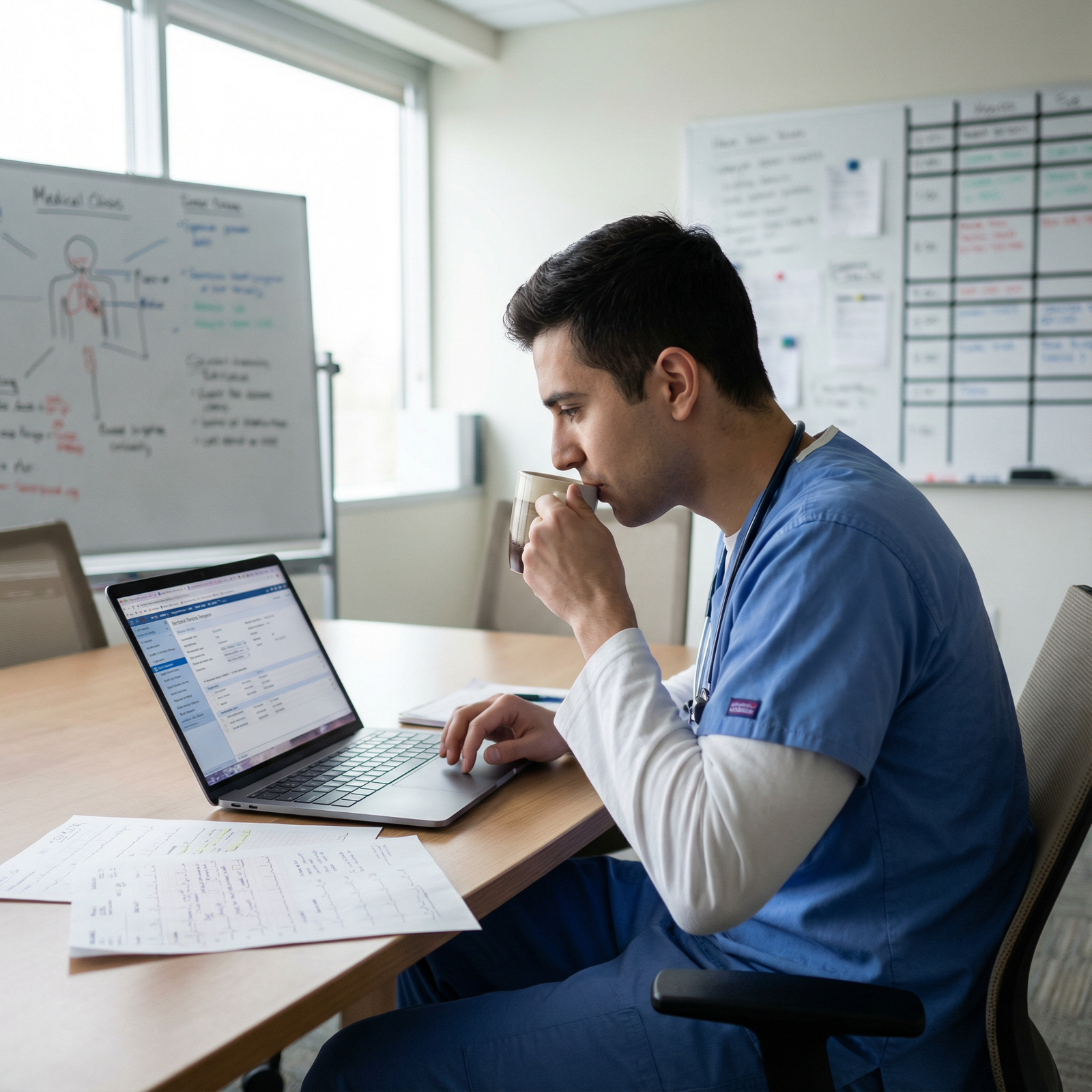
A few practical realities. If the creatinine is bad, don’t discover that after you’ve promised everyone a quick CTA. If contrast allergy exists, know whether premedication, alternate imaging, or a risk-benefit discussion is needed. If the patient can’t lie flat, can’t travel safely, or needs escalating support, that changes timing and the sequence of calls. Radiology doesn’t operate on your anxiety. They operate on logistics, safety, and protocols.
And one more thing. PE is not the only dangerous diagnosis in the room. Severe pneumonia, pneumothorax, ACS, tamponade, arrhythmia, aortic catastrophe. Don’t anchor because the page came with a diagnosis already attached. Overnight, anchoring is one of the dumbest and most common errors.
How to Talk to Your Senior, Attending, and Radiology
The fastest way to sound junior is to call in a panic and narrate your fear. The fastest way to sound trustworthy is to present an assessment and a plan.
Use an SBAR structure whether you formally name it or not. “I’m calling about Mr. Jones in 8B. New oxygen requirement and pleuritic chest pain in a post-op cancer patient. He’s now on 4 liters, sat 91 to 93%, heart rate 128, blood pressure stable, no hemoptysis, no active bleeding. I’ve seen him, put him on continuous monitoring, ordered ECG, CBC/CMP/coags, troponin, and CTA if renal function allows. I’m concerned for PE and want your input on empiric anticoagulation while CT is pending.”
That works. It’s concise, specific, and useful.
If unstable, say so immediately. “She’s hypotensive and worsening despite oxygen. I’m at bedside now and need you here.” Clean. No fluff. No dramatic storytelling. Just the facts and the need.
Radiology calls need the same discipline. Don’t just ask, “Can we get a CT?” Tell them what affects timing: oxygen requirement, hemodynamics, IV access, renal function, pregnancy status if relevant, contrast concerns, whether the patient can travel safely. The radiology reality overnight is brutal and predictable: limited staffing, transport bottlenecks, protocol questions, and competing emergencies. If the study is deferred or modified, document why and update your team.
The insider phrase that matters in all these calls is this: present your assessment and plan. Not your panic narrative. Attendings trust residents who say, “I’m concerned about PE because of X, I’ve done Y, and I need Z.” That’s how you build credibility at 2:17 a.m.
Documentation, Follow-Up, and What Not to Miss Overnight
Your note is not decorative. Overnight, it is evidence of your thinking.
Document the timeline. When were you paged? What changed? What were the vital signs when concern was raised, and what were they when you saw the patient? What symptoms did the patient report? What did the exam show? What are the risk factors? Who did you call, and when? Was CT delayed because of renal function, scanner availability, transport, instability, or contrast issues? Did you reassess after oxygen, fluids if appropriate, or other interventions? Put it in the note.
Most important, document your reasoning. If you observed rather than anticoagulated, say why. If you started empiric anticoagulation, say why and mention bleeding-risk review. If you escalated to ICU, say what changed. A short note with clear judgment beats a bloated note with no thinking in it.
The overnight misses are painfully consistent. Anchoring on anxiety in a tachycardic patient because they’re young. Dismissing persistent sinus tachycardia because “the pressure is okay.” Forgetting to look at oxygen trends over several hours. Failing to recheck the patient after the initial bedside visit. Assuming the CTA order means someone else is now handling it. That last one is poison.
And don’t botch the handoff. By morning, the day team should know exactly who still needs imaging, who is already anticoagulated, who had a discussion with attending, who needs repeat reassessment, and who got worse overnight even if they stabilized. A vague signout like “possible PE, CT pending” is lazy and dangerous. Give the real status: “High suspicion, new 4-liter oxygen need, heparin not started due to fresh post-op bleeding risk, CTA delayed for creatinine and radiology review, needs reevaluation first thing.” That’s a handoff someone can work with.
Closing Encouragement: The Goal Is Safe, Steady, and Defensible
You do not need to be perfect on a suspected PE page overnight. You need to be calm, structured, and impossible to surprise. That’s the real target.
Trust the sequence. Is the patient stable? What changed? What have you done at the bedside? Who have you called? What is the bleeding risk? What happens if CT is delayed? That framework will carry you through far more safely than trying to look brilliant.
The best overnight resident isn’t the one who dramatically “diagnoses PE” from across the hospital. It’s the one who recognizes danger early, reassesses while everyone else is waiting on the scanner, escalates before the patient crashes, and leaves behind a clean, defensible story. Before the CT exists. That’s what good looks like.


