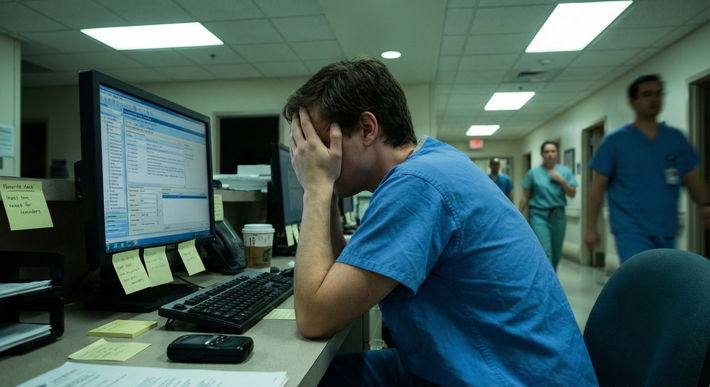
You know the feeling. You're covering Medicine, getting pinged by Surgery, the ICU wants an update, and your phone won't stop vibrating. One patient is hypotensive, another has a "stable" sodium that is absolutely not stable, and somewhere in that mess your brain starts whispering something dangerous: I've got this.
That's the lie.
When you're a floater resident on multiple teams, your brain is not a trustworthy narrator. Not because you're lazy. Not because you're weak. Because fatigue, interruptions, and constant context switching turn smart people into overconfident guessers. I've seen excellent residents make dumb, preventable mistakes after saying the same sentence: "It's probably fine."
Probably fine is where bad nights begin.
The Illusion of Control: Why Your Brain Lies When You're Exhausted
Sleep debt doesn't just make you tired. It degrades cognition in a very specific, very dangerous way. Attention narrows. Working memory gets sloppy. Your brain stops doing careful analysis and starts reaching for shortcuts. That matters in residency because medicine punishes shortcuts when the details are the diagnosis.
Chronic exhaustion plus rotational stress creates a nasty illusion: you still feel functional long after your reasoning has degraded. That's the trap. People assume they'll notice when they're no longer thinking clearly. Usually they don't. The decline is gradual, and confidence often outlasts competence.
Now add "multiple teams." That's not multitasking. Don't flatter it with that word. It's context switching, and context switching shreds attentional stability.
You're carrying different rules, different attendings, different workflows, different thresholds for concern:
- Surgery wants one kind of update.
- Medicine wants another.
- ICU wants precision now, not in ten minutes.
- Each team uses slightly different language for urgency.
- Each patient has a different story, different meds, different risk profile.
Your brain hates this. It starts compressing details just to survive. And when it compresses, it blends. That's where errors breed.
Red Flag #1: the "it feels familiar" trap. This is one of the most dangerous phrases in medicine because familiarity is seductive and often wrong. A patient "looks like" the CHF exacerbation you saw yesterday, so you mentally slot them into that category before you've earned it. Or the post-op tachycardia feels like pain or anxiety because that's what it was on the last call shift. Meanwhile, this patient is bleeding.
Exhausted brains lean harder on pattern recognition and weaker on analysis. That's prefrontal cortex fatigue in plain English. You stop asking, "What else could this be?" and start saying, "I've seen this before." Those are not the same thing.
Common signs your brain is lying to you:
- You're reassured because the story sounds familiar.
- You stop revisiting the differential after the first plausible answer.
- You confuse recognition with verification.
- You feel oddly confident without being able to explain why.
- You catch yourself saying, "It's probably just..."
That last phrase should scare you a little. Good. It should.
The fix isn't to distrust every instinct. The fix is to stop treating instinct as proof. Under fatigue, your brain defaults to heuristics. Sometimes useful. Often efficient. Never enough on their own.
Context Collapse: The Fatal Cost of Switching Teams Mid-Shift
The worst errors I've seen from float residents weren't dramatic acts of incompetence. They were quiet acts of carryover. A thought from Team A sneaks into Team B. A protocol from one service gets mentally pasted onto the wrong patient. A half-remembered handoff becomes the working truth.
That's context collapse.
Here's how it happens in real life. You're called by Surgery about low urine output, then immediately paged by Medicine about chest pain, then the ICU fellow asks whether a rising lactate was addressed. Your brain doesn't reset between those conversations. It drags assumptions forward. You think you're switching tasks. You're actually dragging residue.
That residue is dangerous.
A floater moving between Surgery, Medicine, and ICU is not just juggling information. You're toggling between different clinical priorities:
- Surgery may focus on post-op complications, drain output, pain control, fluid status.
- Medicine may center chronic disease interactions, medication reconciliation, broader differential diagnosis.
- ICU demands minute-to-minute physiology, trend interpretation, escalation thresholds.
Mistake alert: assuming a protocol from Team A applies to Team B's patient presentation.
Classic examples:
- Treating tachycardia in a post-op patient as expected pain response when the real issue is sepsis.
- Assuming "watch and wait" is acceptable because it was for a stable Medicine patient, then applying that same passivity to an ICU patient with narrowing reserve.
- Carrying over anticoagulation assumptions from one service's routine to another patient with a totally different bleeding risk.
Small mismatch. Big consequences.
There's also a known operational danger here: the more handoffs and micro-handoffs a patient experiences, the more likely critical information gets lost. Missed lab values, delayed response to abnormal vitals, unclear contingency plans. You don't need a perfect statistic to know this is true; anyone who's worked nights has watched it happen. The potassium of 2.8 "was in the chart." The hemoglobin drift "was noted in signout." The blood culture "was pending." Notes do not rescue patients by themselves.
That's why I'm a hardliner about soft handoffs.
A soft handoff means you do not rely solely on the written note or the passive signout line. You force a brief verbal confirmation when the issue matters.
Use a script:
- What is the active problem right now?
- What are you most worried about in the next 6 hours?
- What result or change should trigger a call?
- What did you consider and rule out already?
- What are you assuming is true?
That last question is gold. It exposes hidden fragility in the plan.
Here's the rule: if a patient is unstable, newly admitted, behaviorally complex, post-op, or has a lab/vital trend that could turn bad overnight, you need spoken confirmation. Not because you're paranoid. Because notes are snapshots, and cross-cover medicine is a moving target.
Don't miss the deeper point: context switching doesn't just slow you down. It changes what you notice. And what you fail to notice.
Confirmation Bias in the Emergency Department
Exhaustion pours gasoline on anchor bias. You grab the first diagnosis that fits, and once your mind settles there, contradictory evidence starts feeling annoying instead of important.
That's how "just another migraine" becomes giant cell arteritis in the patient you almost discharged because you wanted to go home.
I've seen versions of this. End-of-shift headache. Busy board. Normal-ish initial vibe. The resident hears "headache, nausea, photophobia" and mentally closes the chart before the work is done. But then there's jaw pain. Scalp tenderness. Age over 50. Maybe some visual change that was mentioned once and not revisited. Those aren't side notes. Those are the case.
The urge to be done is powerful. Don't trust it.
Then there's the sunk cost mistake. You've already spent an hour building a workup around diagnosis A, so changing course feels expensive, embarrassing, inefficient. That's dumb thinking. The time is already spent. The only real question is whether you're wrong now.
If new data doesn't fit, you must reopen the case.
Your protection here is simple and brutal: the Devil's Advocate rule.
For every leading diagnosis, force yourself to answer:
- What single fact most strongly argues against my current theory?
- What diagnosis would I regret missing?
- What finding am I minimizing because it's inconvenient?
That last one catches people. We don't just miss data because we don't see it. We miss it because it messes up the tidy story we want.
Longer shifts don't just feel worse. They produce worse thinking. Act accordingly.
Hierarchical Fear vs. Intuition: Knowing Which Voice to Silence
Residents get this wrong all the time. They think the knot in their stomach is intuition. Sometimes it is. Often it's fear. Different problem. Different fix.
Here's the dangerous version: you notice something doesn't fit, but the attending sounds confident, the senior sounds relaxed, and you decide your discomfort must be inexperience. So you stay quiet.
Bad move.
The mistake isn't being uncertain. The mistake is mistaking hierarchy for correctness.
Ask yourself:
- Am I worried because the clinical picture is off?
- Or am I worried because I'm scared of sounding stupid?
If it's the second, say something anyway. Fear-driven silence is a patient safety issue, not a personality quirk.
And don't lead with vague vibes. Lead with objective data.
Better:
- "The O2 sat dropped from 96% to 88% in the last 20 minutes."
- "Her blood pressure is down and urine output has fallen."
- "The pain is new, unilateral, and not responding to the current plan."
Worse:
- "He looks bad."
- "I just have a weird feeling."
- "I don't know, something seems off."
You may feel something is off, but data gives your concern teeth.

Use the hierarchy when it helps patients. Ignore it when it pressures you into silence.
The Exit Strategy: Protocols for Safe Decision-Making
If you're floating across teams, you need systems strong enough to catch you when your brain inevitably slips. Not if. When.
Start with the Triple Check before placing or finalizing orders during a team switch:
Vitals
- What changed?
- Are the trends worse than the single snapshot?
- Is there a new instability hidden by an old signout?
Labs
- What is new since the last review?
- What is pending that could change the plan?
- Are you reacting to yesterday's story instead of today's data?
Meds
- What was recently started, held, doubled, or missed?
- Are you carrying over the wrong medication assumptions from another patient?
- Does this team's plan conflict with the active MAR reality?
Then use the Power of the Pause. Thirty seconds. Silent. Before a consequential action, especially after an interruption.
That pause is not wasted time. It's error prevention.
In those 30 seconds, ask:
- Who is this patient?
- What team am I in right now?
- What is the problem I am solving?
- What data would make this plan wrong?
That tiny reset can save you from placing the right order on the wrong patient, applying the wrong protocol, or missing the obvious because your brain is still in the previous room.
Also: write your differential down. Yes, physically or in a structured note. I don't care if you think you'll remember. You won't. Not after three pages, two callbacks, and a rapid response overhead.
Documentation is not clerical busywork here. It's cognitive scaffolding.
Write:
- Leading diagnosis
- Dangerous alternatives
- What data supports your impression
- What data doesn't fit
- What should trigger escalation
That externalized reasoning protects you from interruption-amnesia, which is real and ugly.
Finally, know when to disengage. This is the part residents resist because ego always sneaks in wearing a professionalism costume.
You are not helping by pushing through obvious cognitive failure.
Warning signs you need backup or handoff:
- You've reread the same chart three times and still can't synthesize it.
- You're mixing up patients mentally.
- You can't explain your plan clearly out loud.
- You're making decisions mainly to reduce your own workload.
- You feel irritable, rushed, and weirdly certain at the same time.
That last combination is poison.
If you're at that point, escalate. Hand off. Ask another resident to sanity-check you. Call the senior. Wake the attending if the clinical situation warrants it. Pride is cheap. Patient harm is not.
What to Do Tonight, Not Someday
If you remember nothing else, remember this: your tired brain is a compromised instrument. Stop worshipping intuition when you're cross-covering three worlds at once.
Do these five things on your next float shift:
- Pause before every major order after switching teams.
- Use a verbal soft handoff for unstable or high-risk patients.
- Write your differential and your "can't-miss" diagnosis down.
- Challenge your leading diagnosis with one disconfirming fact.
- Speak up using objective data, not apologetic vibes.
And one more. The hard one.
- When your brain is slipping, admit it early. That is not weakness. That is grown-up medicine.
You do not need to be perfect. You do need to be honest about when you are cognitively unsafe. Residents get hurt by the fantasy that endurance equals competence. It doesn't. It just makes the mistake take longer to show itself.
Protect the patient from your fatigue. Protect yourself from your confidence. Build systems your worst night can survive.